
2026/2027 J.League Season: Matchday #1 Musings
A new summer start. A review of seven J1 and three J2 games!

It’s a new season! The first one in the new fall-spring calendar. This won’t be a review of every single match in matchday one because even I couldn’t crunch through all that in the three~four-ish days since the weekend. Here are my thoughts on a smattering of J1 and J2 games!
Let’s get started!
J1
Yokohama F. Marinos vs. Kashima Antlers
This game was the big one of the opening weekend with the two “Original 10” J.League clubs1 playing at the National Stadium. The big news that built up a lot of hype for this match were the starts handed out by both teams to their young starlets, the 16 year old Shin Miidera for Marinos and Minato Yoshida for Antlers.
Shin Miidera did quite well as he was involved in every single one of Marinos’ goals in some shape or form. The highlight was his flick over Naomichi Ueda in the lead up to the second goal. He went off injured in the 2nd Half but Steve Corica mentioned in the post-match presser that it was only a cramp. Hopefully we’ll see more of him in the months to come. Given he is only 16, J.League fans will be able to see him here for at least another two years before he turns 18!
(NOTE: the video below of Shin Miidera’s highlights might be geo-blocked... sorry!)
It was a humbling experience for Naomichi Ueda and Ikuma Sekigawa who both had a surprisingly poor day at the back. Usually quite strong, they both let their opponents dribble past or settle the ball far too easily in the build up to Marinos’ goals.
Kashima have attempted to evolve, transform a lot since their title win in the 2025 season. They were trying to build-up from the back more throughout the 100 Year Vision League half-season and they’ve continued those attempts here. The defense shifted into a Back 3 while Ryoya Ogawa advanced further forward to keep the width as a Left Winger while Yan Matheus was on the Right (in tactics terms, using maximum width). This meant that Bueno would approach the defenders to receive the ball quite often and there was also a lot of support from Yoshida, Yuma Suzuki, and Leo Ceara in showing for the ball and creating quick passing combinations to get the ball to the flanks. The return of Yan Matheus in particular, ironically against his former club, was quite exciting. The Brazilian had some good moments on the dribble and nearly scored with a sumptuous effort in the 36th minute.
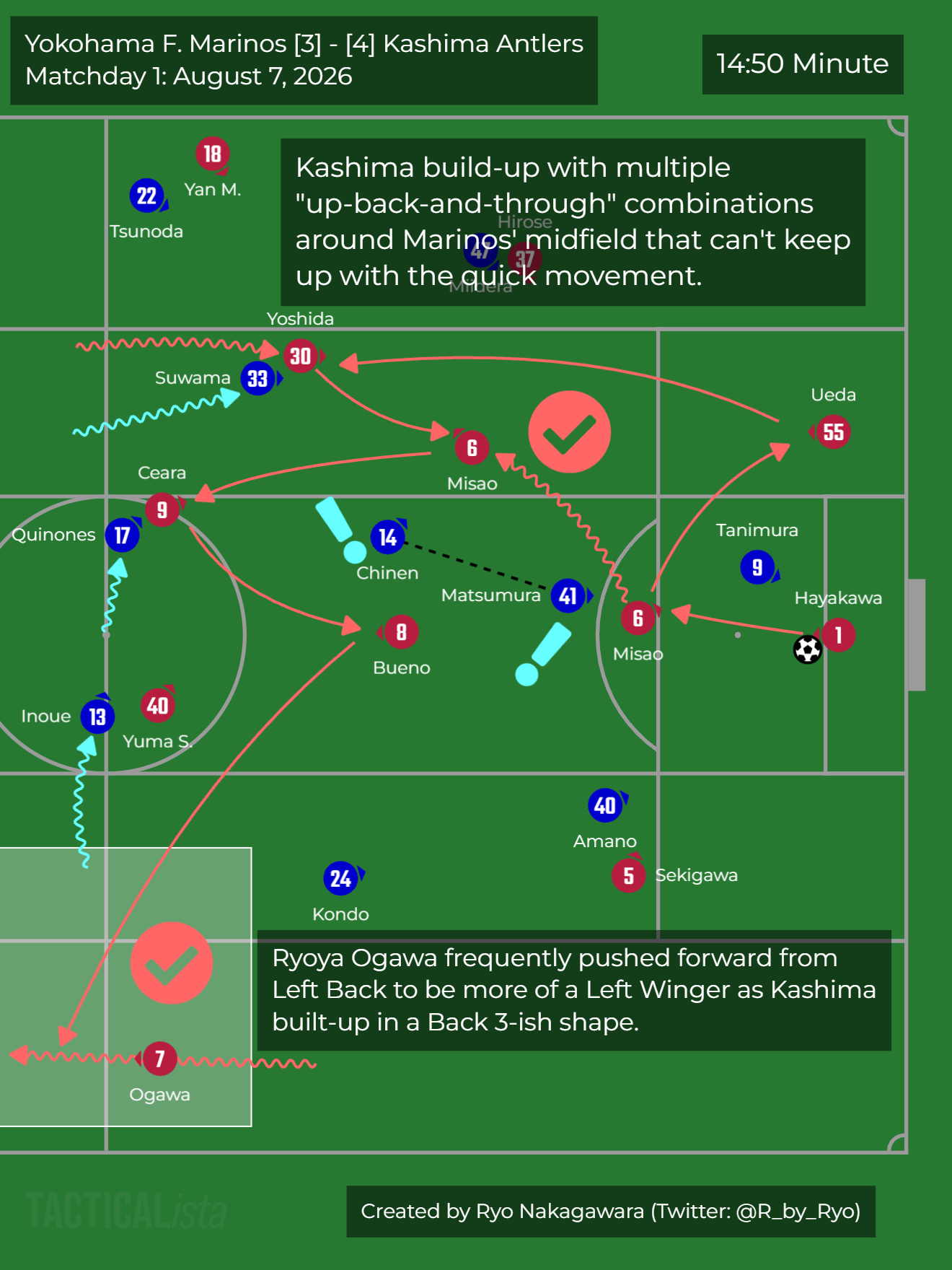
When viewing the match live I thought that Kashima’s possession was a bit stale despite their interesting positional rotations but on my re-watch it became clear how much of an impact it had on Marinos as they were completely exhausted by the hour mark. At least three Marinos players went down with cramps by the end of the game.
While Minato Yoshida was hooked at half time, I don’t think he played bad. Sure, he wasn’t great but I still think he showed a number of good moments. Yoshida linked well with the attackers and kept the ball flowing with really good touches in tight spaces. Given something clearly needed to change from Antlers and looking at the members in the starting XI, it made sense that Yoshida was the one to be hooked unfortunately.
In the end, it was a masterstroke from Oniki as Yuta Matsumura came on and completely changed the game. The winger was involved in every single one of Kashima’s 2nd half goals and gave a great example of an “impact sub”. I’ve always found him a bit of a one-trick pony (run/dribble very very fast) but hey, he is an extremely effective one-trick pony. His speed and directness on the dribble caused absolute havoc to a tiring Marinos defense. Matsumura finished the game on zero assists but his contributions were clear, it’s also a damning indictment of how using assists to judge attackers isn’t representative of their impact.
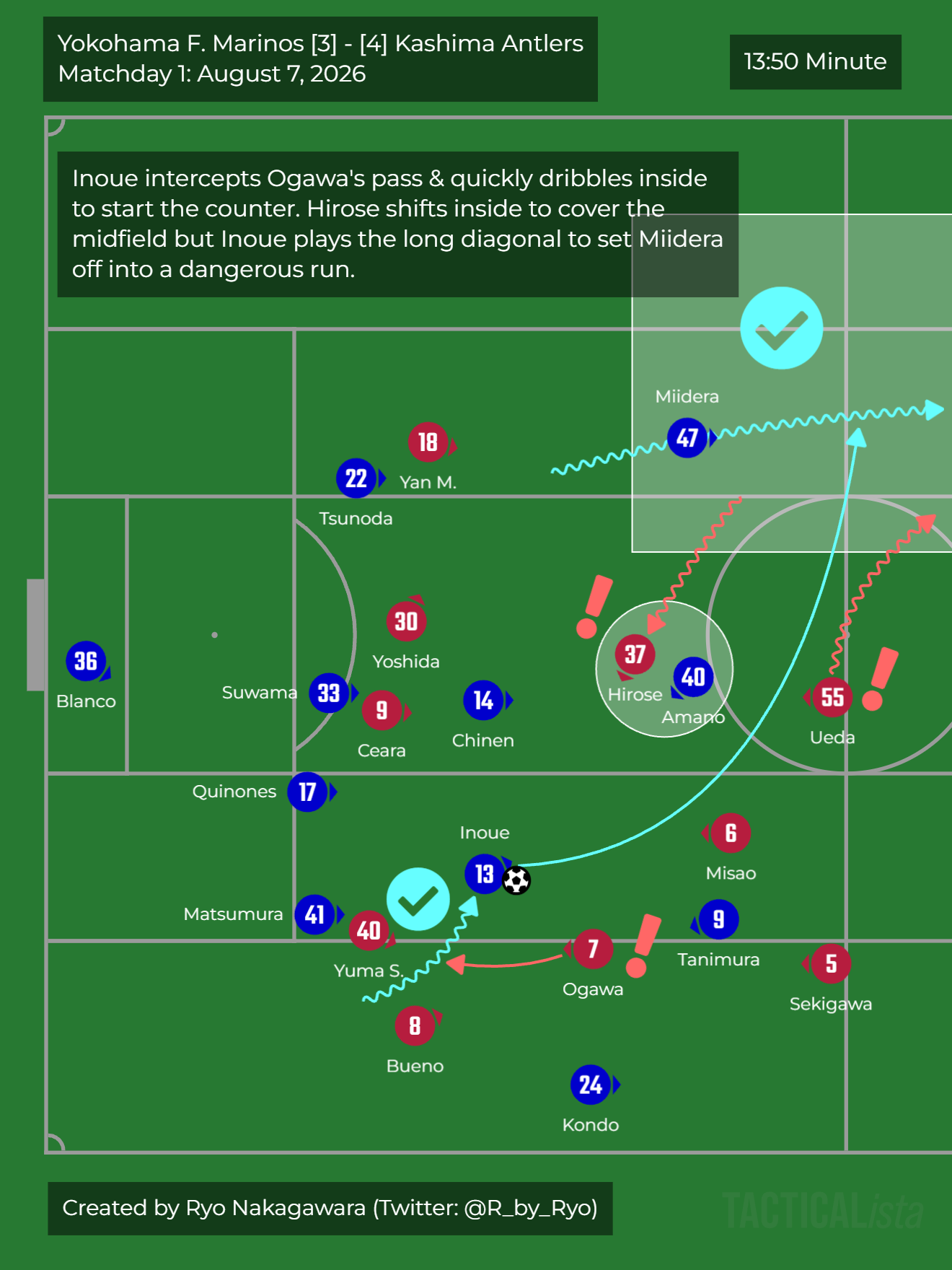
Aside from Miidera on the Marinos side of things, I thought Jun Amano had an excellent game. At the age of 35 I still think he’s very good and he worked together well with Miidera to create Marinos’ goals for Kaina Tanimura. At the Back I did like Taisei Inoue, his range of passing stood out to me when he was at Sagan Tosu and he showed that in this game as well with some good long diagonals to send attackers on their way to threaten Kashima’s defense.
With a prime-time Friday night public TV channel viewing and a J.League record crowd of almost 64,000, this game was a perfect start to the 2026/2027 season!
Gamba Osaka vs. Urawa Reds
This was the other game on Friday that was slightly overlooked given what was going on at the National Stadium. Even still, this game also had plenty of curve balls and goals galore!
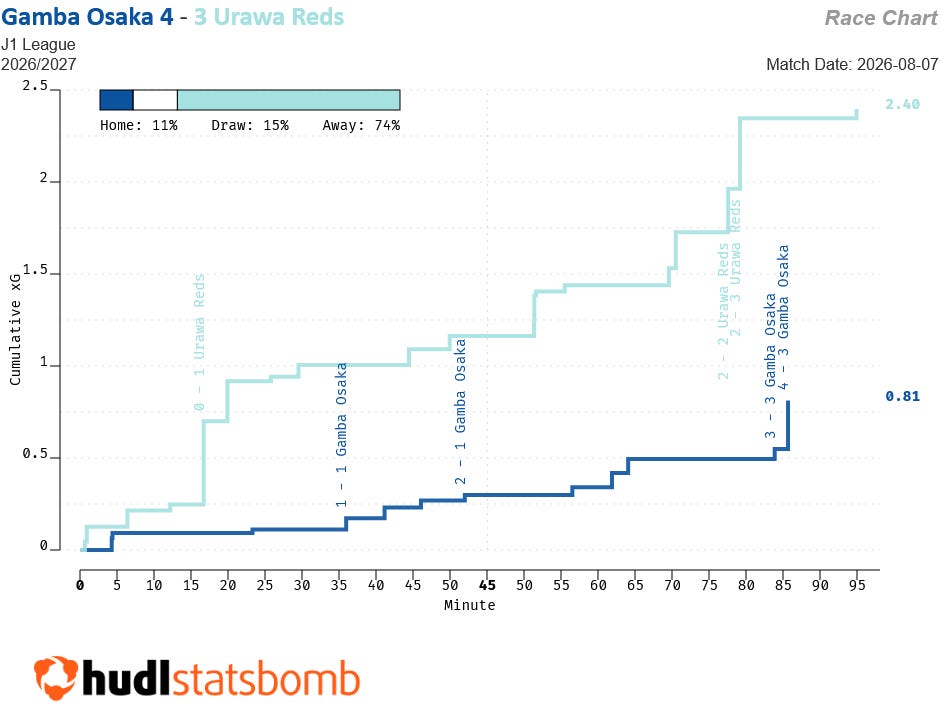
Hiiro Komori opened the score for Urawa with a good header, sneaking behind Ginjiro Ikegaya but disaster struck a few minutes later when Matheus Savio got himself sent off with a second yellow card... Shuto Abe made a meal of their little spat but being already on a yellow, the Brazilian should’ve known better...
Anyway, Gamba who hadn’t done much up until that point did well to score twice before half time to throw a wrench in any potential planning that Urawa had for the big half-time talk. However, Gamba managed the game poorly in the 2nd Half and let the Reds back into it. Despite having 10 men Urawa looked to possess and attack with a certain vigor that wasn’t matched by Gamba with their man advantage.
Ginjiro Ikegaya was quite poor in this game and a big reason why Urawa were able to score as many as they did. The University of Tsukuba graduate played a number of times during the 100 Year Vision League but mainly at Full Back. In this game, his inexperience showed quite a bit in the center of defense. As mentioned previously, he let Komori sneak by him to score Urawa’s first and then for their equalizer in the 78th minute, he made some bad decisions which left him in no man’s land for the cross into Takuro Kaneko.
In the end, it didn’t matter as Tomokazu Myojin made some inspired subs in the 2nd Half as both Asahi Uenaka and Welton scored off of some pretty poor defending from Urawa Reds themselves. If you’ve read my J.League season reviews in years past you would know I’m a huge Cho Kwi-jae skeptic. This combination of Cho Kwi-jae style and Urawa Reds has me even more suspicious. Urawa fans will have to hope that Hiiro Komori has an excellent season in front of goal like Rafael Elias did for Kyoto to cover up for a lot of Cho Kwi-jae ball’s deficiencies... On a more positive note, Ryoma Watanabe played really well despite being forced to play at least three different positions throughout the match and Harumi Minamino got his first goal, then celebrated wildly against his former club!
As for Gamba, I’m still not entirely convinced by Tomokazu Myojin at the helm, even more so after a rather tired performance against Gangwon FC a few days ago. He has been able to course-correct with some good substitutions but a lot of it is down to the fairly good squad that he has at his disposal. Issam Jebali will be key for them this season with his hold-up play and linking ability.
Sanfrecce Hiroshima vs. JEF United
This was an absolute paddlin’. Yeah, it wasn’t very close at all.
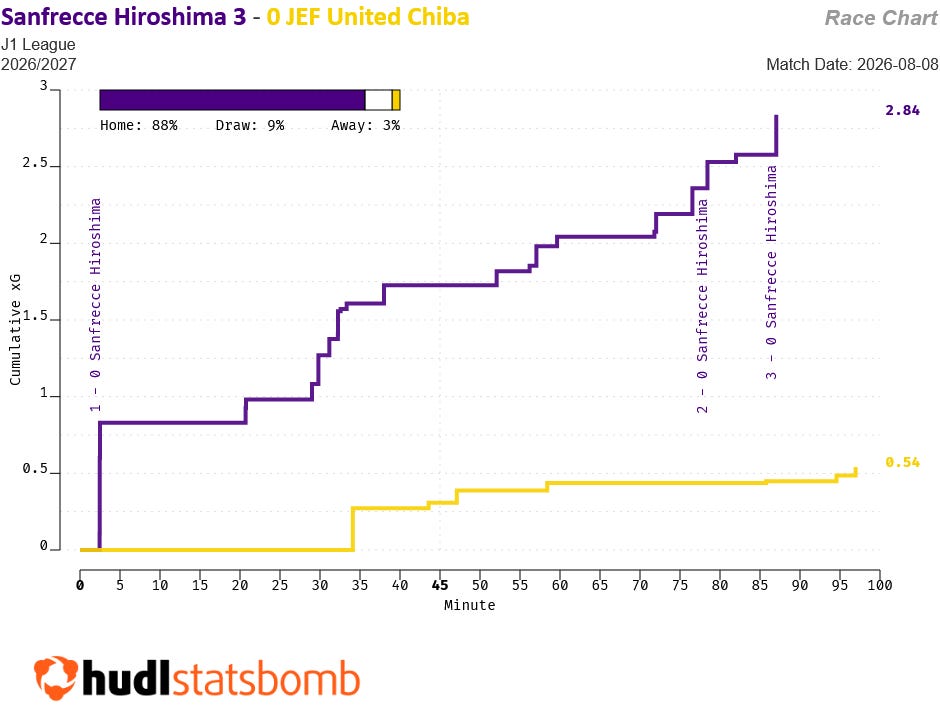
JEF United finished bottom of the East region in the 100 Year Vision League a few months ago. The Chiba team did make a big splash to get Erison from Kawasaki Frontale but my very quick take from just one game is that I’m still not convinced they avoid the drop. Of course, JEF still had a number of interesting “moments” in the build-up during the game but they couldn’t turn that into actual chance creation. Their continued lack of J1 quality players all over the pitch was quite telling.2 There’s going to be a lot of “lob it long for Erison and pray” for any chance of goals...
Sanfrecce Hiroshima meanwhile looked good, regardless of the quality of their opposition before them. This team is stacked with lots of talent especially being able to lure back ex-players from Europe in the form of Takuma Asano and Takumu Kawamura, neither of whom even started on the day! We also need to talk about the “elephant” in the room, Sebastian Haller. I thought he had an excellent debut. He busied himself with his back-to-goal and laid the ball off to the midfielders quite well. We’ll have to see if he’s got the legs to do a full 90 or consecutive full 90s but nice signs from the first match!
Even without considering Haller, Akito Suzuki continues to be a focal point in attack. The striker took a whopping 7 (seven!) shots but only scored one goal, albeit it all amounted to 0.83 xG so it was understandable in that sense. Aside from shots, he did all his usual link-up play when dropping deep and shifted to more of a inside-forward/#10 role that he is also comfortable with when Haller came on. I think Akito Suzuki will have a very good season given all the quality support around him and he probably gets close to 15 league goals. Maybe it’ll finally convince somebody in Europe to sign him!
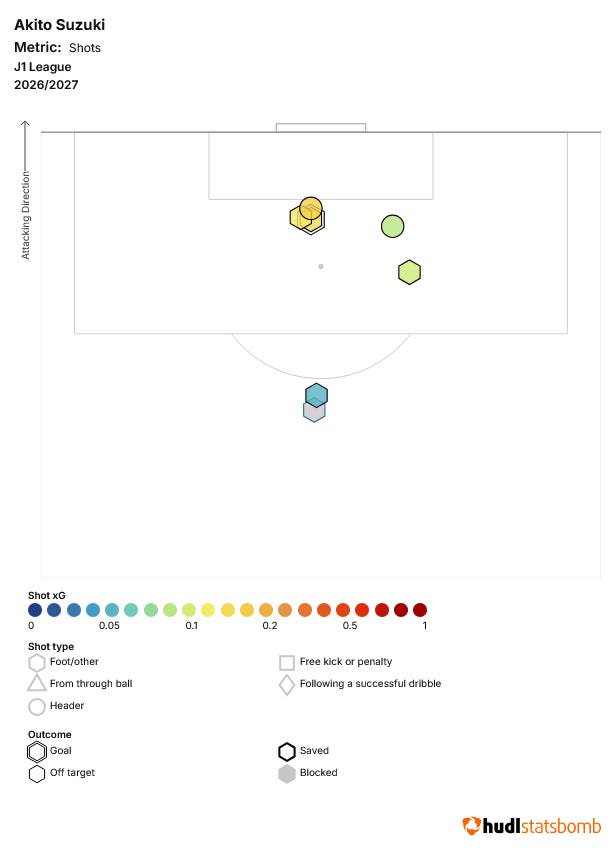
My favorite Sanfrecce Hiroshima player in the past few years has been Yotaro Nakajima. I wrote a deep dive on him last year:

I tweeted during the 100 Year Vision League how I thought Nakajima had improved a lot in defense and he showed that again in this game. Alongside his good defensive pressures (which was always fine from the beginning), he won quite a number of tackles and duels throughout the match. He was only on the pitch for a bit over an hour though which highlights how careful the team are being with his fitness. Injuries have been a problem over the past year but I hope he can keep fit as he’s clearly a very good player with a big future ahead of him.
It was another clean sheet for Sanfrecce’s famous, well-oiled, and drilled Back 5 that have consistently played with each other for many years. These guys are just really good defenders individually and as a unit. I’ve been flabbergasted at how Shuto Nakano hasn’t been called up for the National Team even once given how versatile he is as a Center Back and Wing Back. Shunki Higashi is a player that I was going to highlight in a StatsBomb article a few months back due to his wand of a left foot in open-play and set-pieces. I tweeted the entire text of the draft, here.
Of course, Issei Ouchi will face much harder tests in the coming months. There’s still a lot of question marks about Keisuke Osako’s future (he was left on the bench for this match) which will have an impact on Ouchi and whether Sanfrecce will move for another goalkeeper. Stay tuned on this front...
FC Tokyo vs. Machida Zelvia
So I had the misfortune to be at this match, live at the stadium...
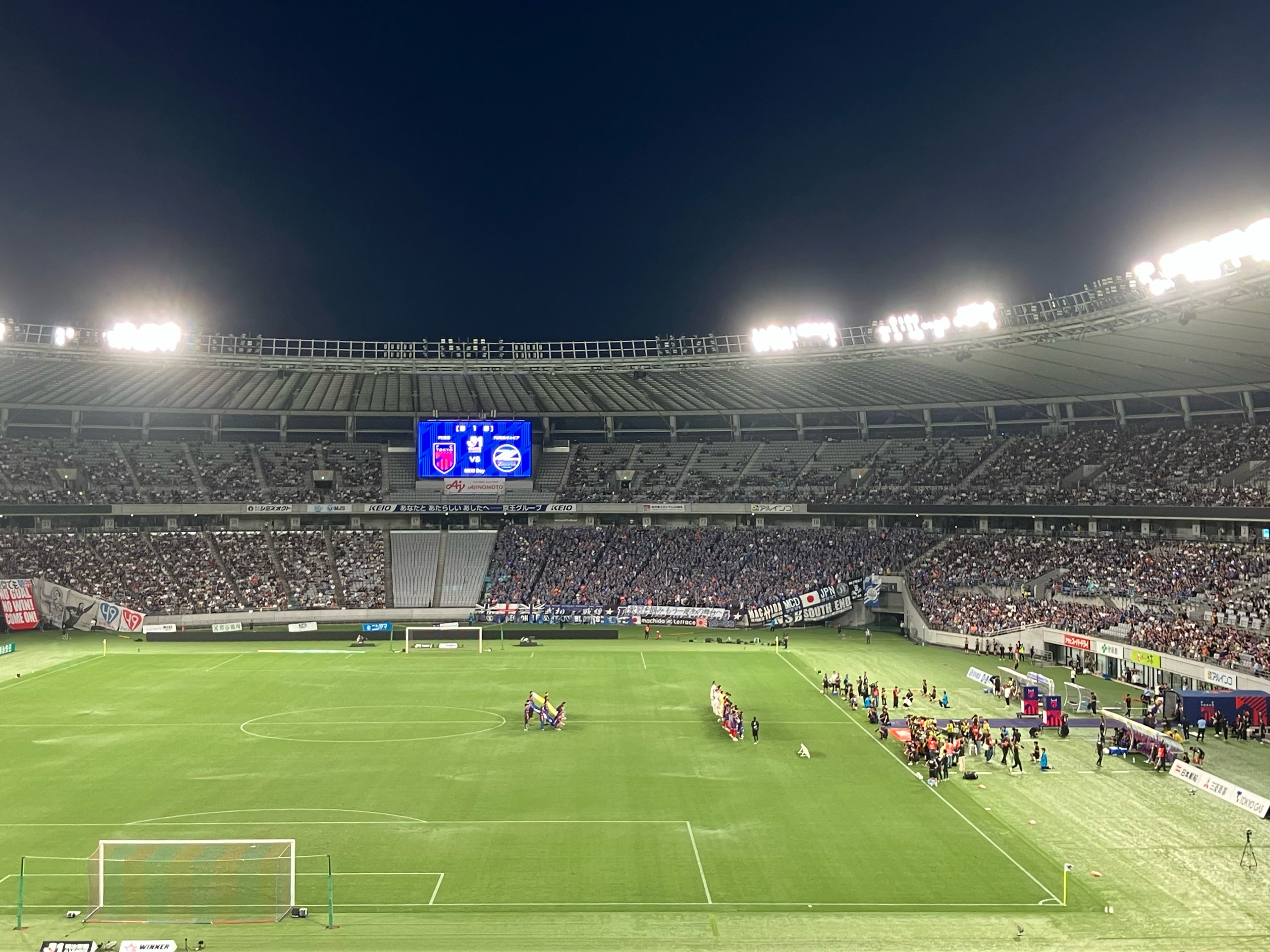
Of course, it all started off with a big announcement from the big man himself. Yuto Nagatomo told the crowd that he will spend another year at the club. He proudly proclaimed that FC Tokyo will win the league this year! A glorious jinx if I ever saw one...
The game itself actually started off quite well in FC Tokyo’s favor. The team used long balls quite well to evade Machida’s pressing. There were lots of switches of play to the Full Backs Sei Muroya or Kento Hashimoto to then accelerate the attacks. As we’ve seen over the past year, the strike partnership of Marcelo Ryan and Motoki Nagakura really play well off of each other. One dropping, the other hitting the space behind. Dragging opponent Center Backs around. Creating space for the Wingers and Full Backs to exploit.
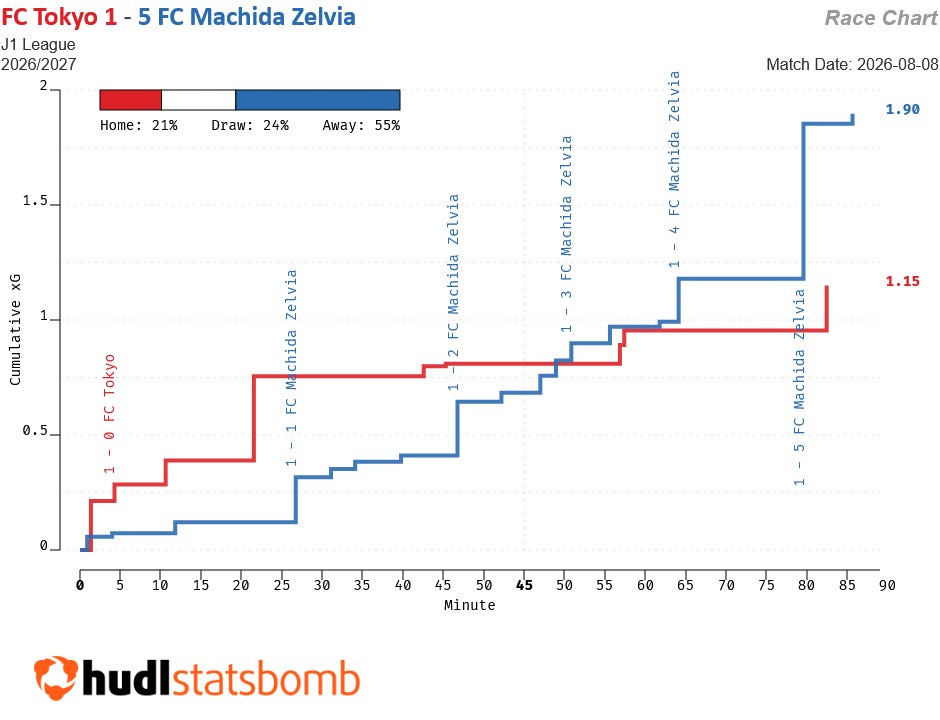
FC Tokyo took the lead in the 4th minute through exactly these kind of movements with Ryan holding off Gen Shoji, then playing a 1-2 with Kein Sato, to enter the box and slot it in from a tight angle. Unfortunately, despite an absolutely fantastic piece of build-up play in the 21st minute didn’t end up in another goal to take the score to 2-0... things started to fall apart as Machida got to grips with the game.
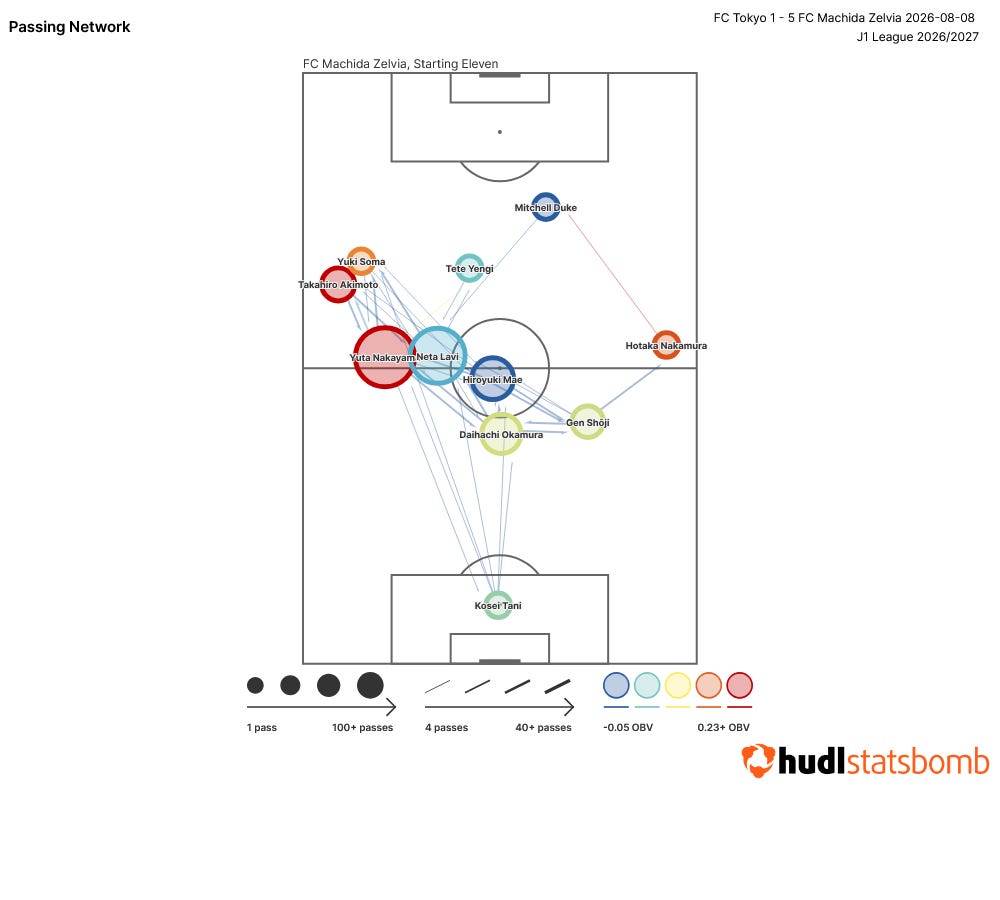
Over the summer, Machida sold Kotaro Hayashi to Urawa Reds and brought in former Urawa Reds Winger/Full Back Takahiro Akimoto from a brief spell in Belgium. He formed the left sided unit with Yuta Nakayama (Left Center Back) and Yuki Soma (Left Attacker). The trio rotated around the left side a lot and caused problems for FC Tokyo’s right side of Sei Muroya and Kein Sato. Sato especially was sucked way too deep by the tandem movements of Soma and Akimoto, which left a lot of space for Yuta Nakayama to carry the ball from defense deep into Tokyo’s defensive third.
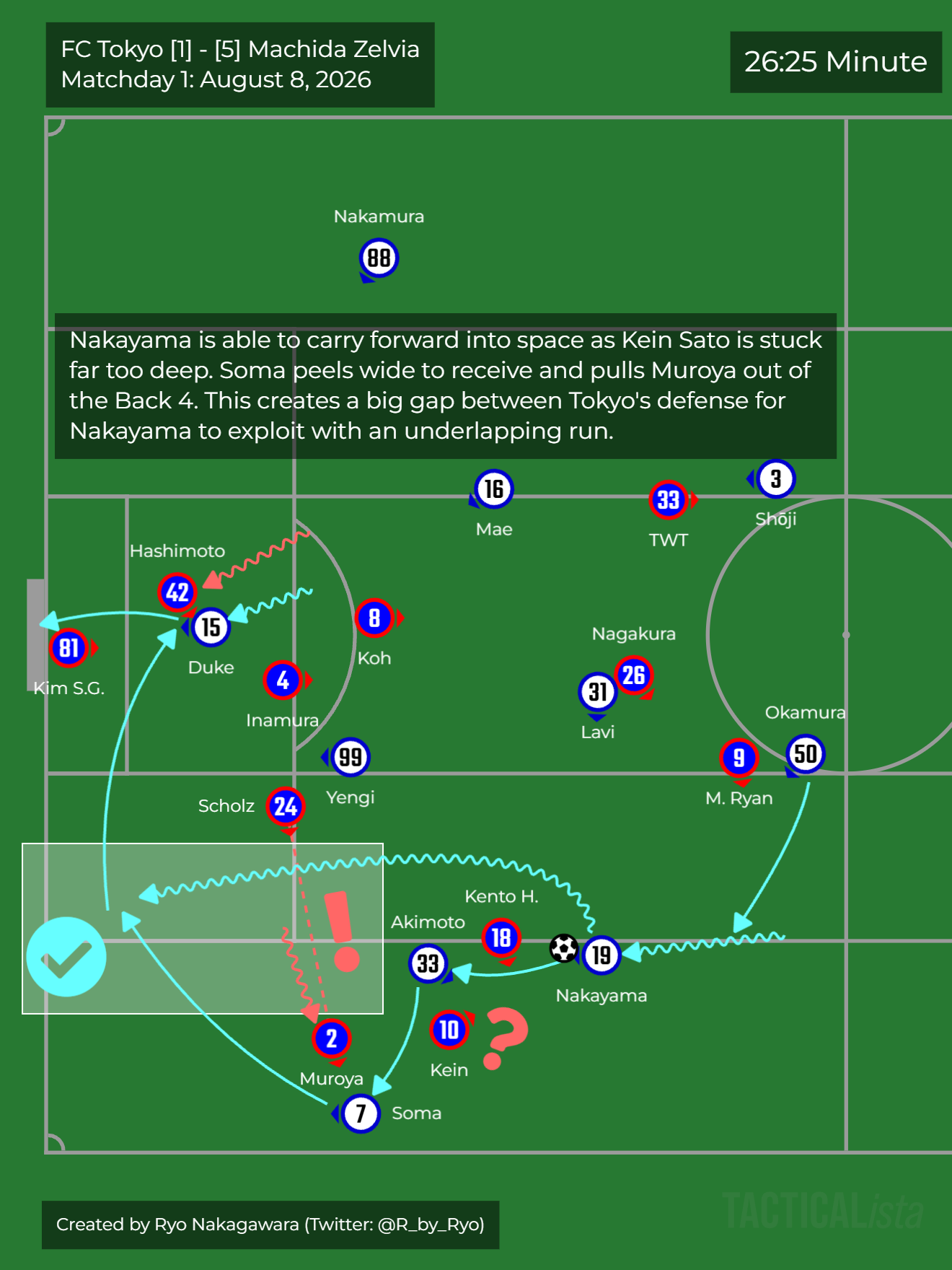
You can see in the below passing network just how much on-ball value Machida’s left side were able to create!
Then in the 36th minute Kento Hashimoto (Left Back) slid for the ball, missed, and hit Hotaka Nakamura’s shin. The ex-FC Tokyo man made a meal of it but a red card was probably the right call... That pretty much ended the contest as FC Tokyo continued to defend poorly against Machida and gave up another goal right before half time to make it 2-1 for the away side. The thing about getting a red card in the 1st Half is that you want to be able to hold out until Half Time for morale purposes and so the coaching staff can reset the team during the interval. Despite FC Tokyo’s defense being pretty good throughout the 100 Year Vision League, it completely fell apart here despite it being the same personnel they had for the entirety of 2026.
I don’t think I need to talk about the 2nd Half, it was a complete wipe-out. To compound the loss for the capital club, a few days later it was announced that Nicolai Vallys, FC Tokyo’s sparkly new marquee signing, suffered an ACL injury. When it rains, it pours!
Kashiwa Reysol vs. Mito HollyHock
Kashiwa Reysol are BACK. After a terrible 100 Year Vision League where they finished 8th in the East region (15th overall) as they were juggling a lot of major injury issues, things looked much better for them this past weekend. A big returnee to the starting XI was Koki Kumasaka who did make a small 11 minute cameo back in late May after a huge knee injury in June 2025. I’m a huge fan of him and was pretty excited to see him paired up with Nobuteru Nakagawa, who was the midfielder that replaced Kumasaka’s minutes last year. Having both in midfield along with Yoshio Koizumi in support meant that Reysol’s possession progressed far smoother. The lovely triangles out wide, the third-man-run under/overlaps to get into the half-space pockets all came back to life again. Also, have I ever mentioned how much I love Wataru Harada?
Tojiro Kubo was brilliant in this match, he completed 4 dribbles out of 5 and ran Hayata Yamamoto ragged down the wing. One long carry into the box ended with an cut-back assist for Yuki Kakita’s opening goal.
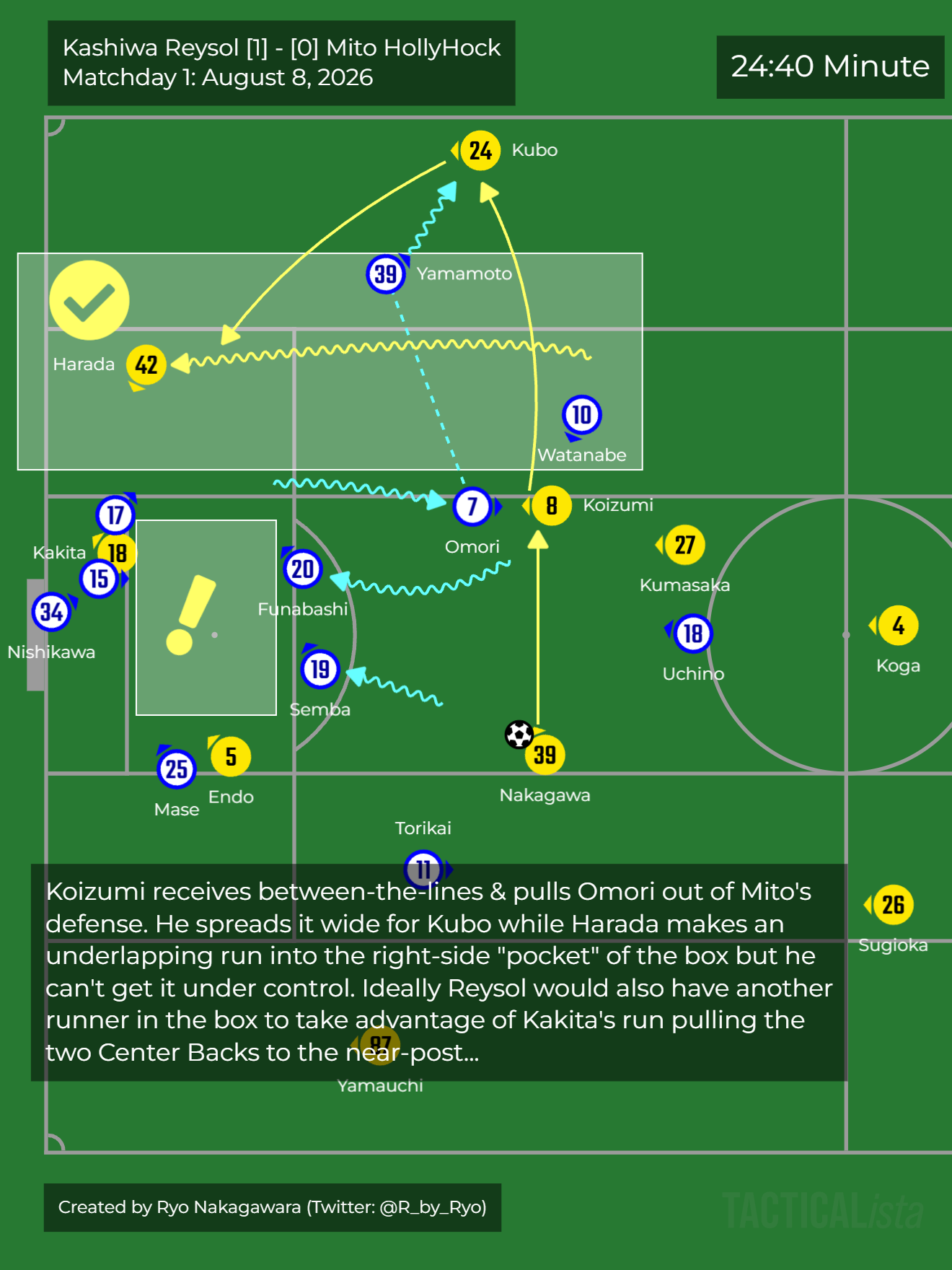
Mito HollyHock switched from their usual 4-4-2 to a 3-4-2-1 to mirror Reysol’s shape but they were consistently beaten by the sheer quality difference between the respective players all over the pitch. One somewhat bright note was Kotaro Uchino. This was his chance to shine after a poor start to his Brøndby career where he didn’t play and then also didn’t appear much on loan at Kobe during the 100 Year Vision League. He wasn’t superb by any means but given how much Mito struggled, I think he did fairly well off the scraps available. Uchino made lots of runs and had a few headed shots before stroking home a penalty to bring the game close.
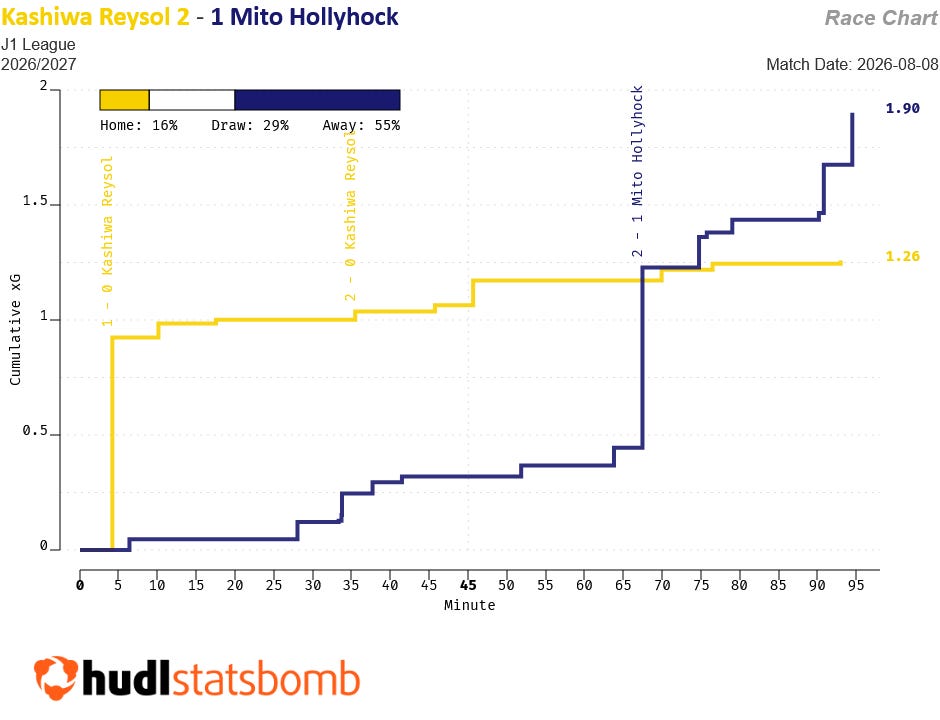
Overall, Reysol seem to have their mojo back even if it was against a fairly weak Mito team. Mito have a huge mountain to climb if they want to stay up. Similar to when they were promoted from J2, they put in a lot of effort, have some nice combination play out wide, and have clear ideas on how to orchestrate counterattacks but they just don’t have enough quality in either box.
Nagoya Grampus vs. Shimizu S-Pulse
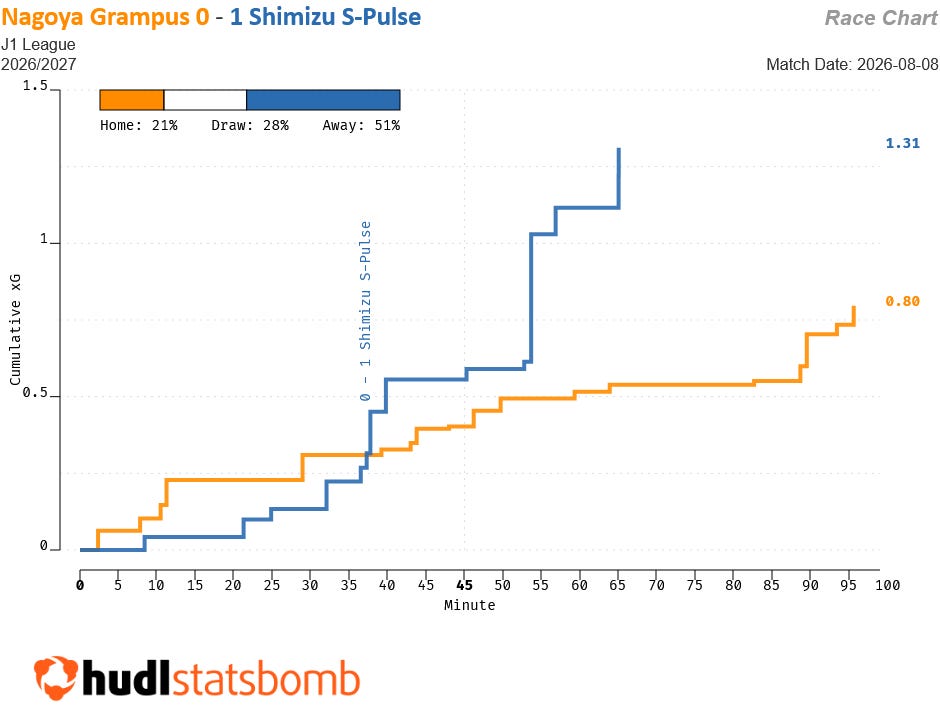
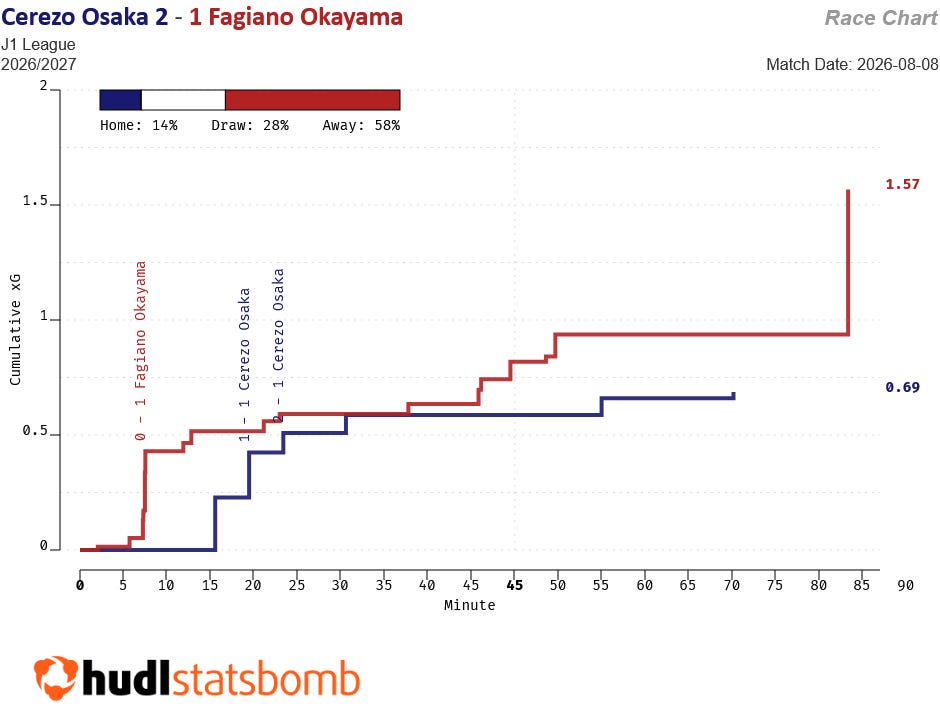
Both teams here got new managers at the start of 2026 and spent the 100 Year Vision League term as a practice run to bed in new tactics. This was unfortunately another game that was marred by a red card. A very silly and avoidable one with Oh Se-Hun clapping at the referee immediately after receiving a yellow card for a foul (more like Oh No Se-Hun...). You should be able to guess around when this moment of madness happened by looking at the xG race chart below...
I think this was Yudai Shimamoto’s best game of his S-Pulse career so far. Compared to the 100 Year Vision League where he was mostly playing behind the striker, he was set up in the double pivot from the first minute next to new signing Dieguinho (who looks like a pretty decent, “water carrier” type midfielder). What really stood out for me in this game was how he drove forward with the ball, especially in a 64th minute counterattack that ended with a shot on goal. His defensive contributions were significant, covering for the Full Backs for runs in behind and box defense after going a man down. On the other hand, Shimamoto didn’t create a whole lot of danger from his set pieces in this game. He is a big contender to be my next Shogun Soccer Scouting article...!
Nagoya Grampus on the other hand looked alright before the red card. They had some of the nice Mischa-style build-up moves with the Front 5 pinning the opponent very high and the Center Backs spread out. Unfortunately for them, a lot of their attacks died out when they got to the final 3rd. Mateus Castro finally returned from injury but he looked understandably rusty and was taken off after 70 minutes. I thought Yudai Kimura was the only consistent threat, receiving between-the-lines in the left half-space to accelerate attacks. However he took some poor shots and even that avenue of attack dried up once S-Pulse decided to lock things down and limit space.
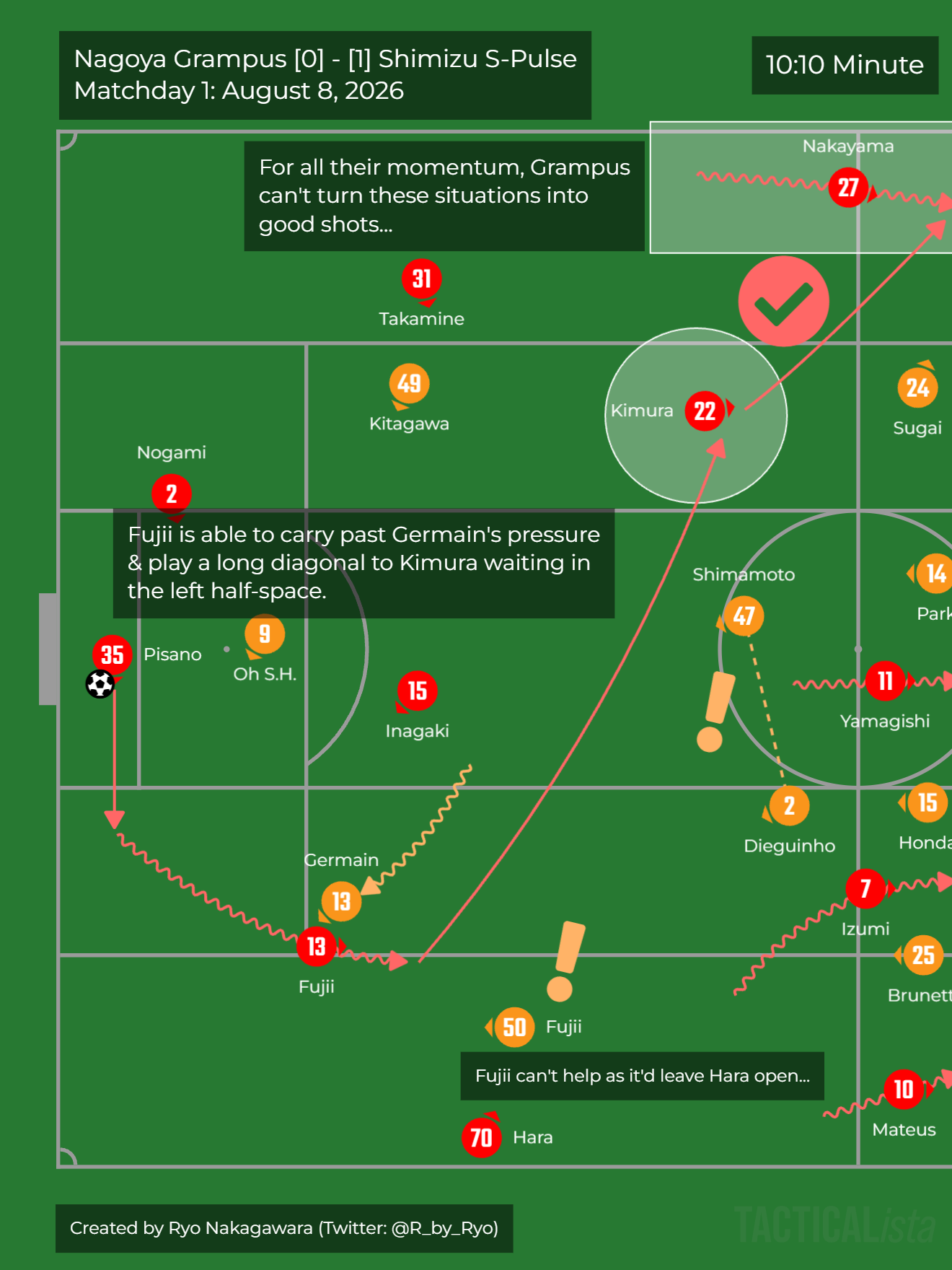
Alex Pisano in goal for Grampus was fine. He’d earned himself a start again because Daniel Schmidt keeps getting himself injured in pre-season. It was a decent performance and his build-up play wasn’t bad either but it all got ruined because of one bad pass that led to S-Pulse’s solitary goal...
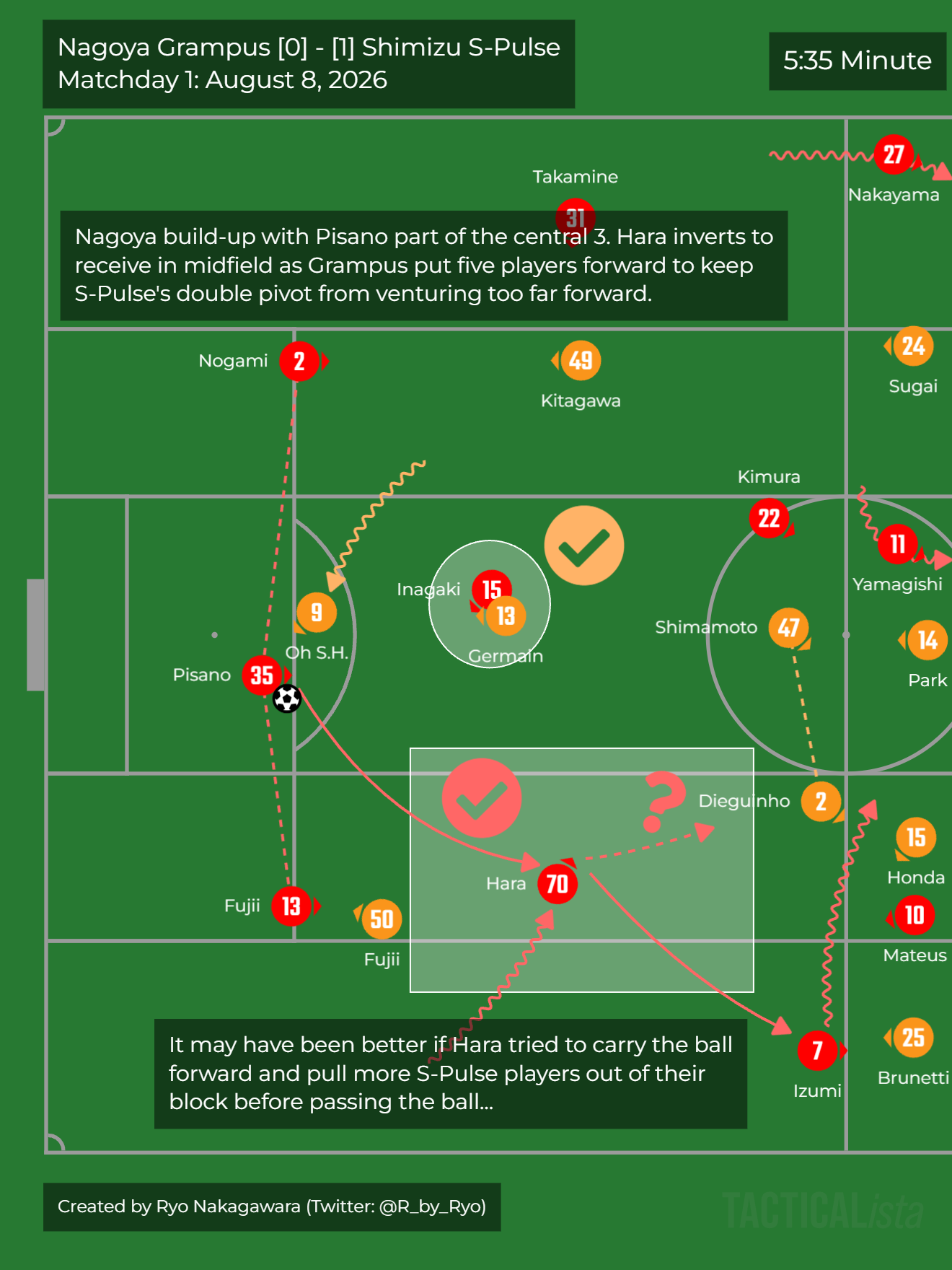
Long time readers of Shogun Soccer (and my old blog) know I’m a huge Mischa-skeptic but even I was surprised at how they actually got worse after the red card... On the other hand, I thought Takayuki Yoshida played his cards quite well for S-Pulse. After the sending off he made good substitutions and only changed the team’s shape during the hydration break in the 2nd Half. He’s kind of trying to re-create his Kobe team with much fewer resources at his disposal along with some new updates/tweaks to the formula and I can see the vision.
I see both teams as lower mid-table. They might get a few unlucky results and get stuck in the relegation battle for some periods but their squads are too good to be there for long.
Cerezo Osaka vs. Fagiano Okayama
Unfortunately, this was a dud of a game, well the last third of the game at least. All three of the goals happened within the first 25 minutes of the match, then both teams proceeded to do a whole lot of nothing. Okayama’s xG looks somewhat OK only because of a late Kota Kawano chance in the 84th minute which was their first shot in over 30 minutes...
I am a huge fan of Yumeki Yokoyama and he’s taken to the J1 level pretty well since joining Cerezo Osaka for the 100 Year Vision League. He’s made the left-sided attacker spot his own now. I think it’s good for him that new manager Pablo Machin has shifted the team into a 3-4-2-1 because that’s exactly how Imabari played. I think Yokoyama can be more of an inside forward rather than just a simple winger, buzzing around a big striker (Sakuragawa now instead of Marcus Vinicius back then), collecting 2nd/loose balls to then drive forward from more central areas.

Another player I wanted to highlight was Kosei Okazawa. He’s been sent out on loans to FC Ryukyu and Fujieda MYFC over the past few years, slowly gaining professional experience at the lower levels. It’s nice to see him finally back as I’ve followed his progress in past season J2/J3 reviews, although he will face stiff competition once Jackson Irvine is fully fit. He had a lovely lofted ball to assist Sakuragawa’s equalizer and was able to show off his strengths in passing throughout the match to keep Cerezo ticking. Okazawa struggled with the uptick in physicality as he lost most of his duels (0/2 in the air and 2/5 on the ground) but hopefully that’s something he gets used to with more playing time.


As ever, the big question about Cerezo Osaka is whether their defense holds up and/or will their awesome attack continue making up for it...
Okayama were dreadful in the 2nd Half of the 2025 season but had done enough surprising teams in the 1st half that they managed to keep their heads above water. The 100 Year Vision League was somewhat OK but there’s still some scope to be worried about them. As usual, their goal came from a set-piece situation (well, indirectly but still within the time-frame where it counts as a “set piece” situation by various data collection companies’ definitions) but they... didn’t have a whole lot else to show. In attack Lucao and Ataru Esaka provide quality but who else? I think Na Sang-Ho is a decent pick-up but he’s never really been a high volume goals/assist contributor.
Another big miss is Kosei Ogura who will be missing the entire first half of the season with a knee injury. However, Okayama managed to grab Oberdan off of Jeonbuk Motors which is a huge coup for a team that’s only in their second ever J1 season. I mentioned this on Twitter a few days ago but it’s a damning indictment of the financial gap that’s growing between J1 and K1 too. In defense, I’ve praised Hiroshi Omori before (really good scouting by Okayama to pick him out from J3) and he had another good game here despite the tough opposition. It was also interesting to see 19 year old and recent Aomori Yamada High School graduate Shun Matsuda given a professional debut between the sticks in Lennart Moser’s absence.
J2
Fujieda MYFC vs. Vegalta Sendai
I’ve been a big Fujieda watcher since the Daisuke Sudo days and Tomoaki Makino’s version of the team have been interesting to watch as well. In the 100 Year Vision League I was mostly watching them for Yuto Nakamura and Shuto Nagano, the latter of whom I dedicated an entire article on:

A lot of attention was on FC Tokyo’s 17 year old loanee, Maki Kitahara. He didn’t disappoint as he had a decent game, including an assist from a corner kick. If you’re familiar with his play for the youth national team then you wouldn’t be surprised at his great technique, especially his touches to settle the ball and shift into his next actions under pressure. Kitahara also had a couple of chances to score from the left side of the box but couldn’t make it count before getting subbed off in the 61st minute.
On the other hand I felt Vegalta Sendai couldn’t quite get going... once Fujieda sucker-punched them with their second goal and completely set up shop in a low block it became very difficult for Sendai to claw their way back into the game. Of course, Motohiko Nakajima’s penalty miss when the score was still 0-1 didn’t help... Although aside from that Nakajima did have a decent game. Another player to highlight on Sendai’s side was Hiromu Kamada, a player I’ve highlighted a lot in the past and not just because he is Daichi Kamada’s younger brother! Despite being marked closely by Fujieda in the build-up phase I thought he did his best to move around and find spaces away to receive the ball. Once Fujieda dropped back deeper in the 2nd Half, he had a lot more room to orchestrate from deep. The pressure is on Sendai’s manager Moriyama this season after consecutive near promotion misses and a very good 100 Year Vision League.
A fun thing to note about this game was Fujieda’s funny emoji placards for the players to communicate different set piece routines!


Omiya Ardija [1] - [0] Albirex Niigata
There’s been a lot of changes over in Omiya as Ardija have been integrated into the Red Bull fold over the past two-ish years. The club made a big change in the dug out with Narcis Pelach joining as the top team manager. I had seen Pelach’s awful stint at Stoke City when checking out Tatsuki Seko so I was quite alarmed but... Omiya have looked decent so far, a very small sample size of two games though (the Urawa Reds pre-season friendly being the other match)!
Omiya set up in a very attacking 4-3-3-ish formation with Gen Kato as the only real defensive player in midfield ahead of Ota Yamamoto and Yuta Toyokawa.3 Out-of-possession, it looked more like Ota Yamamoto dropped into a double pivot next to Kato though. They were quite compact with a high defensive line, Yusei Ozaki in particular covered for any runs behind with his quick speed (a good example in the 31st minute).
Omiya overwhelmed Niigata especially in the 1st Half with the amount of pressures and counter-pressures they did. In typical Red Bull style, the team were very aggressive and forced a lot of high turn-overs and pinned their opponents into their half for large periods of the game. Omiya did drop back into more of a low block to finish off the game though.
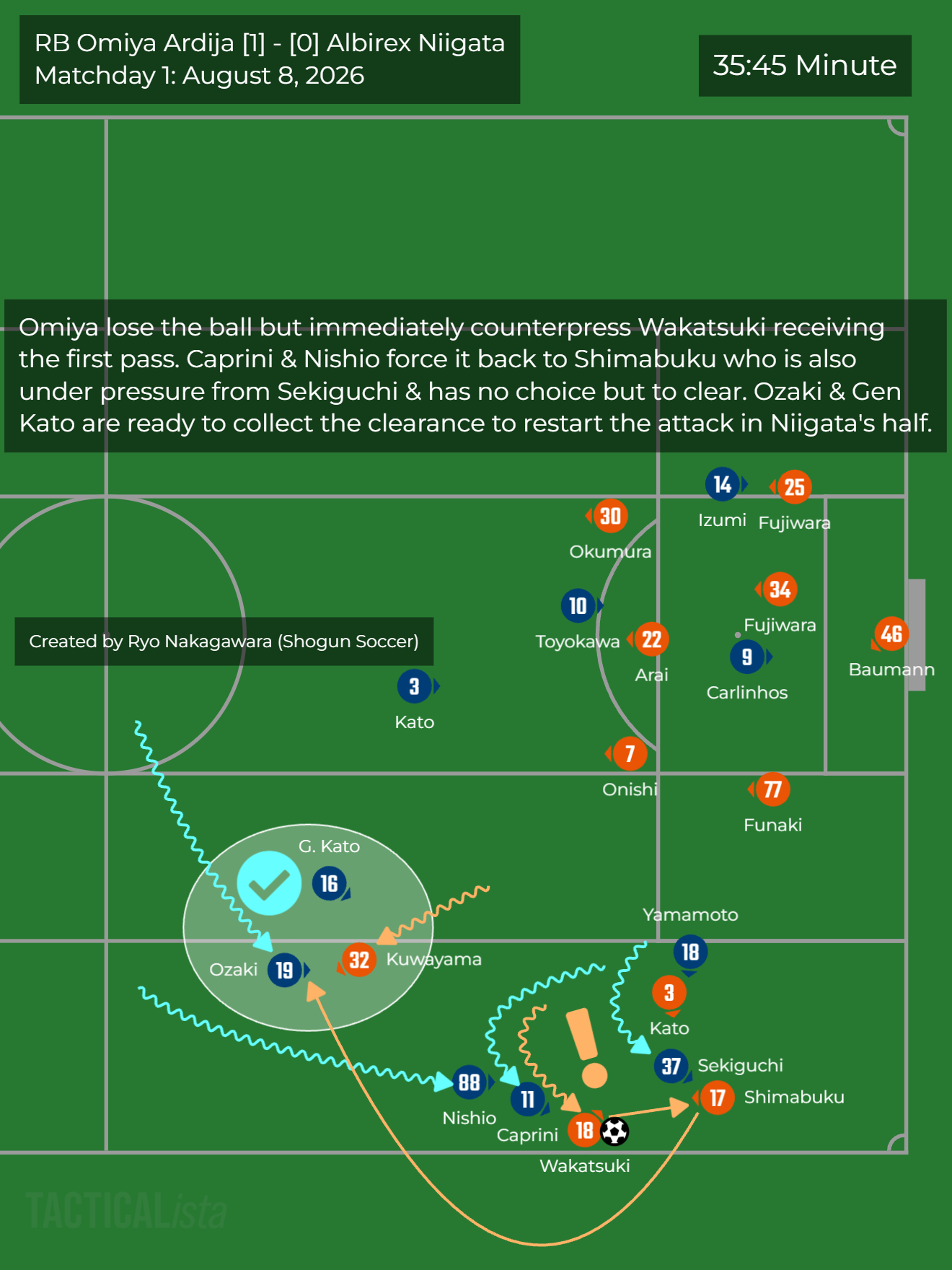
I’ve talked about Ota Yamamoto about a million times but he was very good again here, including scoring the winning goal with a good run and finish from a tight angle. Other highlights were Caprini and Carlinhos who are excellent players at this level (a good example being the 34th minute scene to escape pressure in the defensive third). Omiya should be favorites for promotion given the quality they’ve got in the squad but that brings with it a lot of pressure and expectations too.
Iwaki FC vs. FC Imabari
These two clubs have been very interesting to keep track of for the past few years due to their development of numerous young players and how Imabari have slowly built up their stadium in stages as they’ve hit various milestones. The eye-catching star here was the J.League debut of ex-Real Madrid academy starlet Takuhiro “Pipi” Nakai.
Unfortunately, I thought he had a somewhat anonymous game despite some of the highlights reel clips of him circulating on Twitter. Iwaki FC are a team that always make it hard for their opponents to play nicely in midfield due to the amount of pressure they exert but Pipi didn’t get on the ball much to dictate the team’s tempo. It was also weird to see FC Imabari playing in a 4-4-2/4-2-3-1 formation as over the past three years that I’ve followed them, they’ve mainly been a Back 3 team since their J3 days... Overall Imabari struggled against Iwaki’s pressing and also made some calamitous defensive errors to throw the match away. One positive was how effective long balls for Edigar Junio were and Yoshiaki Komai’s supporting runs showed some good chemistry in attack. There’s plenty of time for new Spanish manager Abel Mourelo to turn things around.
As for Iwaki FC, I thought Naoki Kumata and Yutaka Michiwaki played very well as the Front 2 strikers. Kumata especially is very dominant physically at the J2 level and took his goals well. It’s nice to see him back after he missed the 100 Year Vision League with injury. As for Michiwaki, I hope he can regain his form here. I do think if he had stayed with Kumamoto instead of taking the first flight out to Belgium he’d be far more equipped right now to go to Europe or at least be a J1 standard striker for Avispa Fukuoka at this point in his career.
I wrote about Haruto Nakano last month and he had another very good game here. I thought he was excellent covering for his teammates and got stuck in to win the ball.

Looking Ahead
Matchday 1 of the J.League kicked off with a bang! It’s quite nice to be back and there’s lots of excitement for what this new fall-spring format will bring. Across Japan there were record attendances with around 30,000 fans averaged across the opening J1 fixtures and around 11,000 across J2. Of course this was inflated by Yokohama F. Marinos vs. Kashima Antlers playing at the National Stadium in Tokyo which with a 63,960 attendance set a new J.League record!
For comparison, in 2025 the Chinese Super League averaged around 25,000 per match with a much bigger population & fewer teams (in the 2026 season so far, it’s up to a little over 30,000), while the Saudi Pro League was around 8,000 per match.
Both images below are from “FC公園” (Twitter: J_football_xxx), he’s an absolute must follow if you want attendance numbers every match day among other interesting tables/viz!


Matchday 2 kicks off on Friday night game between Tokyo Verdy and Kashiwa Reysol. Other potentially interesting games are whether Mito can upset an exhausted Gamba Osaka side that went to extra time against Gangwon?4 Can FC Tokyo bounce back in a difficult away game against Vissel Kobe? A clash of two young stars in Yudai Shimamoto and Shimizu S-Pulse taking on Shin Miidera and Yokohama F. Marinos!
I hope you enjoyed this format which is a lot closer to my season reviews and J-Talk Podcast appearances compared to my Shogun Soccer Scouting series. I can’t exactly do this every single weekend but perhaps small snippets of my favorite games of the matchday could become a recurring thing, we’ll see. I’ll probably need to limit myself to talking about 3~4 matches though because this turned out way longer than I wanted!
Anyway, below is a Matchday 1 highlights show for J1 that should be available in every country. No geo-block!
Thanks for reading!
Both teams are the only ones to have never suffered relegation to J2. Yokohama F. Marinos came mightily close in 2025 though…
I don’t think they are “bad” players, I like guys like Ishikawa, Tsukui, and Tanaka but I’m not sure they’ve got enough to keep JEF afloat here. Of course any minutes that Makoto Himeno sees against more J1 opposition will do wonders for his development but he’s still not exactly making a big contribution yet (and we shouldn’t be forcing that kind of expectation on a teenager!
Nagoya Grampus fans should be happy given he’s played well whenever he’s been available for Omiya.
This will also be a match-up between two former University of Tsukuba teammates in Gamba’s Ginjiro Ikegaya and Mito’s Kotaro Uchino!
