
Shogun Soccer Scouting #21: Haruto Nakano
Not Another Teen... Center Back!

I’m back! We are nearing the grand opening of the first fall-spring J.League season in early August. I thought about doing this one back in April~May but since I had done a lot of Center Backs recently it got shelved for the time being. I changed my mind because I think it’s better to just quickly get ideas out of my head and onto print so I can properly move on to the next one… so here it is!
Let’s get started!
tl;dr (too long; didn’t read): Versatile Center Back across any role in Back 3. Excellent distance management in 1v1 duels and strong physical engagement. Active in under/overlapping runs like a Full Back but poor end-product hinders consistent involvement.
Haruto Nakano (Iwaki FC)
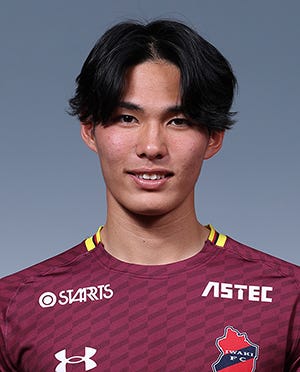
Date of Birth: May 6th, 2007
Age: 19 years old
Nationality: Japan
Position: Center Back (Back 4 or Back 3), Right/Left/Center
Club: Iwaki FC (J2)
Foot: Right
Squad Number: #15 (J2/J3 100 Year Vision League)
Height/Weight: 1.80m // 73 kg (Source: Soccer Digest)
Agent: Japan Sports Promotion
VIDEO NOTE: Iwaki FC’s HOME kits are maroon shirts with wine-red patterns, navy shorts, navy socks. AWAY kits are white shirt with white socks and shorts with black lettering. Also the player wears a hairband, usually red.
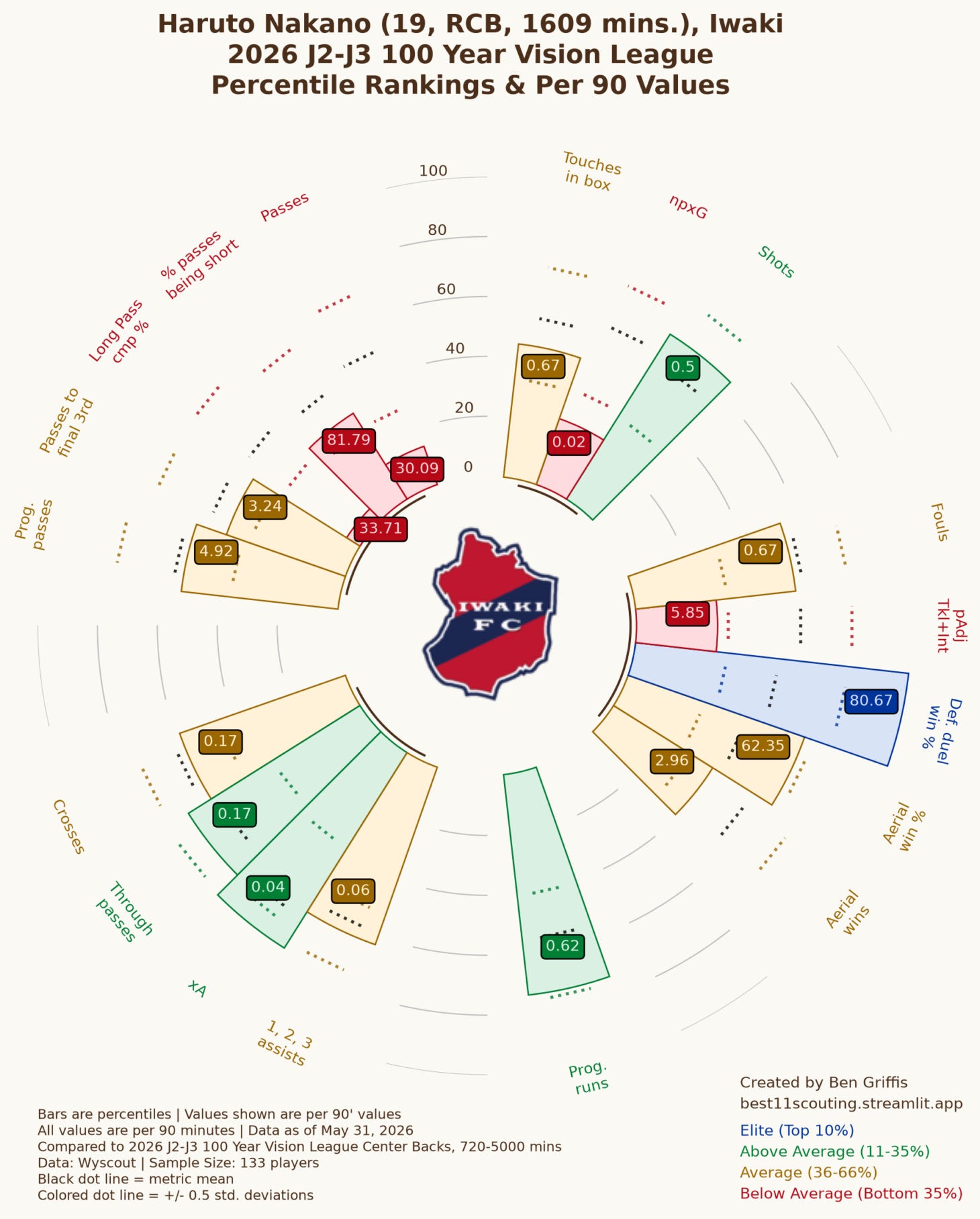
DATA NOTE: The percentile ranking stats are all from WyScout courtesy of Ben Griffis’ best XI app.
Defending, Off-The-Ball
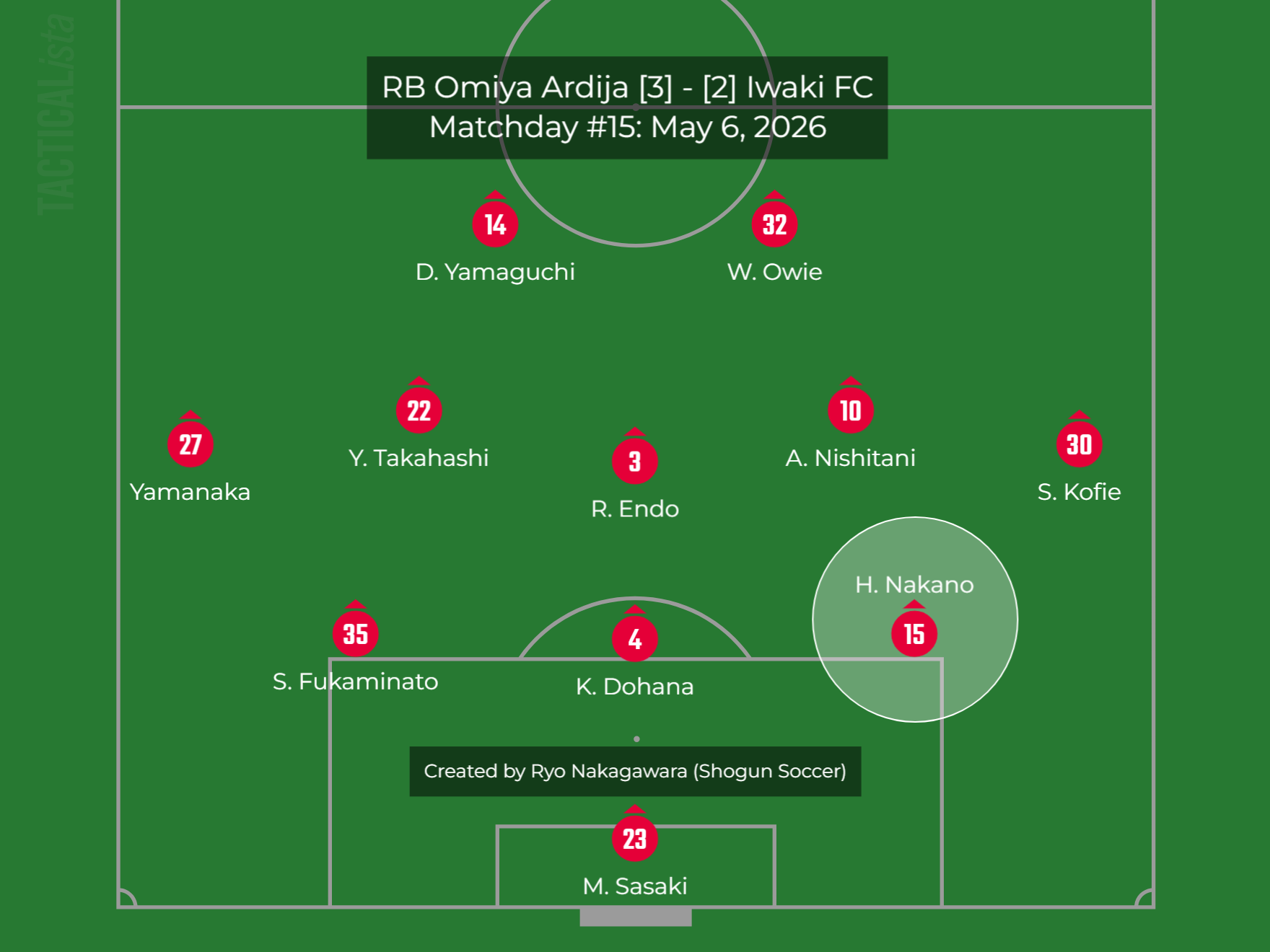
Haruto Nakano predominantly plays as the Right-sided Center Back in a Back 3, mostly paired with Shota Kofie at Right Wing Back. When he plays on the Left, Atsuki Yamanaka is usually at Left Wing Back. The defense line shifts into more of a Back 4 when Iwaki press high up and the wider Center Backs are positioned more like Full Backs when the Wing Backs push up. Nakano coordinates well with the Wing Backs and knows his duties, capturing his mark tightly to prevent them from turning forward and forcing them backwards.
Nakano’s ability to intervene effectively also extends to defending in a block. On the right side he works well as a unit with his Wing Back partner. With a ground duel ratio of 80% he wins a majority of engagements which is extremely good for a 19 year old in his first few months of professional football. Nakano knows to get goal side of his opponent before initiating contact and when stepping out from the block, he times his jumps forward well to close down attackers dropping to receive. I think Nakano’s major strength is how good he is at judging and maintaining the distance/spacing between the opponent and himself as he jockeys to win a 1v1 duel. In contact Nakano uses his arms well to wedge himself inside his opponent to get the ball and despite his frame, from a general physical standpoint he holds his ground well.
A strength of Nakano is his ability to cover all across the Back 3 no matter where his initial starting position. He has good instincts and awareness to shuffle behind/across when a teammate steps up to challenge and then the mobility and speed to execute on those judgement calls. You can see throughout the footage how Nakano prioritizes guarding the central zone and then pushes out. Due to his position in the Back 3, he is frequently supporting the wide areas and he executes this movement with good communication by handing off his marker to a teammate.
For Iwaki FC, Nakano is frequently entrusted with rest defense duties on set pieces due to his aforementioned mobility and covering ability. He sees a lot of action when the opponent counterattacks and has the capacity to stamp out the danger due to his quick speed and awareness.1 When defending in large open spaces, he is more cautious before challenging as he bides time for teammates to return. Perhaps one particular weakness to note is his body shape against more agile attackers as he can get turned around when opponents cut inside him in faster paced attacks.
Nakano’s aerial ability comes out at a somewhat reasonable rate of 62% success (via WyScout). His main job in these situations is knocking back long balls that threaten the back-line from opponent goal kicks or in open play. Nakano reads the flight of the ball well and it’s rare to see him get caught underneath or over the ball. Even when he’s not winning the ball outright, he jumps quite well and doing enough to get body contact which makes things difficult for attackers to cleanly get their intended action.2 Curiously he’s not involved much in attacking set-pieces.
On the other hand, I do have some worries when confronting big strikers inside the box. I will also say that in J2 he still hasn’t quite been tested by the biggest, toughest foreign strikers yet which is why I’d like to see him in J1 or in more national team contexts sooner rather than later. For the most part, Nakano positions himself well and in stances that allow him to keep a wide perspective to capture potential threats coming into the box. Overall, Nakano doesn’t really stand out from peers in terms of his defending inside the box especially since the responsibility is split between many more defenders in a Back 3~5.
Attacking, On-The-Ball
When the team has the ball in the build-up phase Nakano pulls wide to position more as a Full Back and the majority of his passes are played from these positions. What stands out about him in these phases is how good he is at back-pedaling or pausing to create space and time when receiving the ball. Nakano has a good awareness of the space around him which is why he opens up in a good body shape to receive and his thoughtful first touch sets up his subsequent pass or carry.
He shows good initiative to drive into open space with carries/dribbles. Although I do think he sometimes gets a bit caught up with looking ahead which makes his touch heavy or allows the pressing opponent to close him down quickly. Perhaps another reason is that he still needs to get used to the pace and lack of time at the professional level.3
On first glance, his passing numbers appear concerning with 73% pass accuracy and 33% long pass accuracy both being close to the bottom percentiles for all Center Backs in the J2/J3 100 Year Vision League. However, the nature of his role, especially when building up from deep, means that lofting long behind for Wing Back or attacker runners are supposed to be the majority of his contributions. The other key context is Iwaki’s team style that purposely aims for long balls for runners in behind and then aggressively chasing for the second/loose balls to gain territory.
Nevertheless, Nakano can punch grounded progressive passes into midfield as well. While predominantly Right footed, he doesn’t have issues passing with his Left when cutting in to pass across/inside as well. Some passes do get intercepted when he’s placed under pressure in tight spaces though. In general he can have moments of misplaced passes to the wrong foot of his recipient or slightly off into space which means that he needs to improve on communicating his intention before his passes. When Iwaki have possession further forward, Nakano can sneak balls to teammates between the lines by disguising his passes so if he can bring that sort of composure and vision into his actions in the defensive third, he’ll be an even bigger asset.
Nakano supports the attack in the final 3rd through under-laps and overlaps, playing off his Wing Back partner. He shows good positioning to receive in the half-spaces and various pockets that appear in the opponents block but he doesn’t quite do enough to consistently drag away markers or create space for others with his runs. Nakano gets into places you’d normally imagine a Full Back to appear in but he lacks any sort of end product through passes, especially crosses, and his very rare shots to make a consistent impact.4
Conclusion
Haruto Nakano is another defender in the recent generation of Japanese Center Backs that have the potential for top European leagues. The teenager graduated from Kamimura Gakuen a few months ago5, a powerhouse in the Japan high school football system. He was the captain on a team that won the two major high school competitions back-to-back in the form of the Inter High School Sports Festival (Summer) in August 2025 and the 104th edition of the All Japan High School Championship (Winter) in January 2026.6 His involvement in the youth national teams only started in the past year with the U-18s. Nakano also was part of the 2025 U-20 World Cup squad as a non-playing “training partner” and was highly motivated by seeing the top young talent of the world up close.
Nakano’s strengths as a defender are his great instincts in a block, knowing when to step up, fall back, or cover across for his teammates. On top of this, he doesn’t shirk his own 1v1s either as he wins duels especially well for a 19 year old in his first few months in a professional setting. His dueling ability is supported by his good judgment of space and distance when jockeying with attackers that inform his timing to challenge and win the ball. I do think Nakano’s aerial ability might be underrated given the metrics but by the eye-test he’s more capable than one would imagine.
On the ball, Nakano positively contributes in the build-up phase with his willingness to create space for himself to receive and actively play forward balls across a variety of ranges and angles, although it’s clear he is still getting used to being intensely challenged by opponent high presses. Further forward, he finds good spaces to combine well with his Wing Back and makes the occasional dangerous runs or dribbles but the final ball, especially crossing, needs to improve to be a true asset in this area of the game.
A lot of what makes Nakano intriguing comes from the fact that he is able to do all the described skills above as a teenager, straight out of the high school football scene!7
His future can branch out in many different ways due to his skill-set that can continue growing at Center Back or Full Back. Given his relative small size versus counterparts in the top European leagues, a future as a Full Back in a Back 4 could be one way forward. His synchronized pressing movements and strong ball-hunting abilities show he has the mobility and physicality for a modern Full Back. On the ball, Nakano has presented some good passing/combination ability across the thirds of the pitch and half-space running in attack, even if he doesn’t quite have the lightening quick pace to bomb up-and-down the pitch nor the 1v1 dribbling seen in the best attacking Full Backs. Otherwise, the track Nakano is on right now as a fluid Center Back in a Back 3 is the path of least resistance. A team that can involve him a lot in possession, maintain a medium-high line to take advantage of his covering ability in his clever delaying jockeys and safeguarding of central spaces.
The key aspect to keep track of is how Nakano continues to grow physically. His current 1.82m height and slim build may mean size could be an issue in a Back 4 but he has already proven to be useful in a Back 3 that shifts in-or-out of possession. It’s the major obstacle when trying to project him to the highest levels of the game, either becoming “just” a decent contributor outside the top leagues or an actual mainstay at the top 5 league level. In that sense, he is at the perfect club as Iwaki FC are known for improving player physicality at professional level for youngsters brought in via loan or through high school/university routes due to their unique relationship with Under Armour and top notch facilities.8 It’s also interesting to note that Nakano chose Iwaki over several J1 clubs as he decided it was the best place for his growth after a three week trial period. Given some of his weaknesses described in previous sections (especially building up under pressure) I do think he made the right choice to ease himself into professional football at the J2 level.
In terms of his character, as mentioned before he was the captain of Kamimura Gakuen. Throughout his time in high-school he would seek to lead by example, discussing how people wouldn’t follow a leader who wasn’t being pro-active and doing the things he ordered himself. This also extended to off-the-pitch behavior like punctuality, cleaning up the dorm rooms, preparing for training sessions, politely greeting people, etc.9
If he continues to win starts for Iwaki FC in this upcoming season, a J1 club should come in for him sometime in 2027.10 From there a move to a non-top 5 European league at around age 21 sometime in early 2028 would be the steady but sure pathway forward. I am usually very cautious and conservative with my timeline estimates though so he could grow and be ready far quicker. The player himself dreams of playing in Serie A and his role model is Junnosuke Suzuki, a Center Back that made a quick jump to the Danish Superliga and Champions League football after less than a year of being a J1 regular. Haruto Nakano already has a head-start in his career at his current age compared to the FC Copenhagen defender (at the same age) and could potentially surpass him in the years to come.
Verdict: Presents promising skills needed in a modern, versatile Center Back/Full Back profile but not ready to make the jump to Europe right now in the current summer 2026 window. Monitor further in the upcoming 2026-2027 J2 season & re-assess.
Thanks for reading!


Resources, Limitations, etc.
Video analysis: DaVinci Resolve 21
Tactical diagrams: Tacticalista
Time period: 2026 J2-J3 100 Year Vision League Season
Footage: Broadcast footage, no tactical camera
Stats: FBref, Transfermarkt, WyScout, FotMob
Player radars: Ben Griffis’s bestXI scouting app
Here again would be a nice place to have some physical data points for acceleration and other speed-related metrics!
Watching the footage made me think again how it would be useful to separate aerial percentages by different situations, as Nakano’s stats don’t seem to align with what I’m seeing on the video.
Nakano himself has mentioned how he had to get used to the speed, the intensity, and the mental load/fatigue at the professional level in his first few months.
Nakano’s sole assist during the season was from a counter-pressing situation high up the pitch.
He actually had to miss a match during the 100 Year Vision League to go back home and participate in his high school graduation ceremony.
Surprisingly, their first ever title in both competitions!
This is a praise of the high school football system in Japan and speaks to the competitiveness of this level.
Iwaki FC was started out by the official Japanese distributor for Under Armour, Dome. UnderArmour continues to supply the team with official kits, apparel, and fitness related know-how.
As much as I find Iwaki FC interesting, they unfortunately aren’t promotion favorites…