
2026 World Cup: Japan vs. Brazil & overall tournament review
Near the bottom percentile of all possibilities

Another World Cup, another knock-out game defeat. Brazil’s winner came in the 95th minute with only a minute left to go until Extra Time. Not a whole lot of pretty graphics or anything. A lot of words only.
For an audio version of a review, I hopped on to the J-Talk Podcast to discuss the game (do note this was recorded only a bit over 12 hours after the game).
Let’s get started!
The starting line-up wasn’t a surprise overall but it was concerning for me to see Junya Ito starting. This really put all our cards on the table from the beginning and given how the game progressed that ultimately hurt Japan in the latter stages.
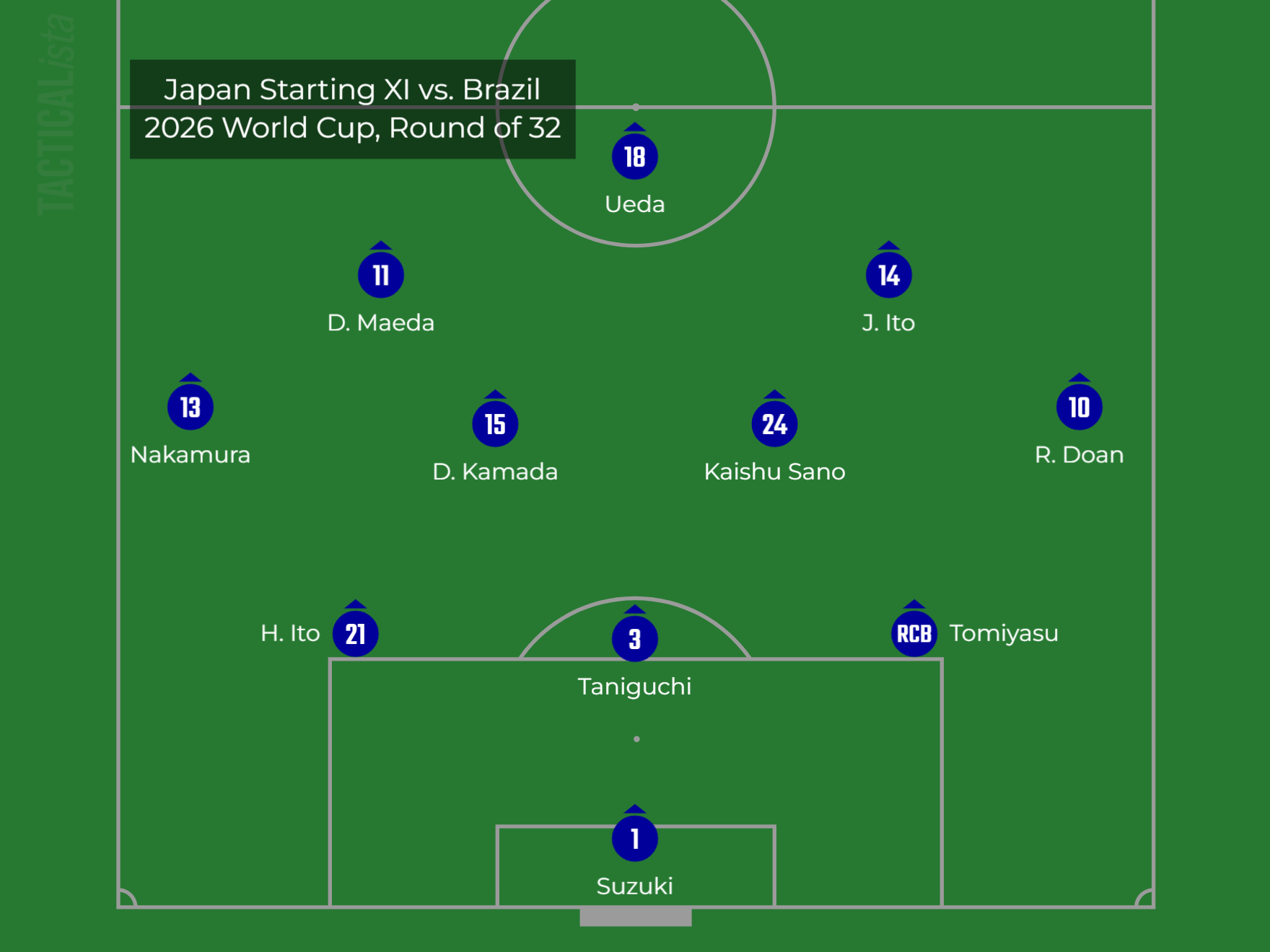
Another surprise was how aggressive Japan were pressing, especially from Maeda and Junya Ito that did cause Brazil a few issues as I don’t think they were expecting that as well. Eventually, after around 10 minutes, it did die down though and the game shifted into the mid-low block defensive game we’ve all become accustomed to when Japan plays against the elite teams.
The First Half wasn’t bad from a defensive stand-point but it was also helped by Brazil being rather confused on how to break us down. Vinicius Jr. shifting inside reduced his impact quite a bit as he was right in the sight lines of Takehiro Tomiyasu, then swamped by other defenders after receiving the ball. It was a testament to Japan that a lot of Brazil’s players were crowding around in the center, outside of Japan’s block, and frustratingly throwing their arms up as they passed in that dreaded U-shape.
Despite this, I do think there were a lot of issues with Japan’s play. The team clearly has players that can control, pass, and possess for long periods but the fact that Japan couldn’t… only invited more pressure on the team. I thought there were quite a few nervous moments passing out from the back from defenders who are usually good in these situations. Seeing Tomiyasu not able to complete a 5~10 yard passes, Hiroki Ito’s bizarre cross-field ball in the 20th minute that led to a dangerous Brazil counterattack, Taniguchi’s terrible pass from inside his own box in the 35th minute were all very disappointing. There was a 5~10 minute period near the end of the First Half that Japan were actually able to keep the ball and pass it around to force Brazil deeper to defend. However, there just wasn’t enough of that to keep Brazil honest and it was quite frustrating as it was a marked contrast to various periods in the group stage games.
Another big issue was both Kamada and Sano getting Yellow Cards in the First Half. I feel like this contributed to Japan not being able to push out and challenge from the deep block as the game wore on. Even still Sano’s interception and then great run led to a goal, interestingly enough his first ever international goal. If you’ve been watching the Bundesliga, you’ll know how good he is at driving forward with the ball after winning/intercepting it but I think everybody was surprised at him taking the shot himself (and scoring) here.
Of course, from the start of the Second Half, Brazil came out guns blazing and hemmed Japan inside their own defensive 3rd. In the Netherlands review I talked about Hajime Moriyasu winning the managerial game against Ronald Koeman, but here against Brazil it was Carlo Ancelotti who showed all of his experience through his tactical adjustments.
Pulling Vinicius Jr. wider put Ritsu Doan under a lot more pressure and exhausted him in defense. In general, I thought Vini had a lot more opportunities and space to dribble from out wide and he caused Japan all sorts of problems. Vini’s dribbling also pulled extra people away from the center that then created space inside.
With Vini pull defenders away, Brazil’s midfielders and even Center Backs were able to push forward to the edge of the box which helped Brazil’s field tilt even more. It was from these areas just outside the corners of Japan’s box that Brazil started to send in many diagonal crosses to threaten the goal.
On top of pulling Vini wide, Endrick came on for Paqueta (although it was forced due to an injury) and added more central presence inside the box. In general, Brazil were also able to start threatening and stretching Japan’s block from both sides.
Overall, it was clear how many potential adjustments that Ancelotti had in comparison to Moriyasu even putting aside the talent disparity on each team’s respective benches.
Brazil’s equalizing goal was the problem of playing attackers at Wing Back biting back at the worst possible time. As a reminder, Japan shifted to this 3-4-2-1 system after the disastrous 2023 Asian Cup as an extra precaution against the direct long balls/crosses that Iraq & Iran delivered to good effect, along with an attempt to get as many attacking players on against the deep-sitting blocks that Japan usually face in World Cup qualifying. Throughout the past two years, this seemed to have worked quite well and the industriousness of our attackers also meant that this formation could work somewhat well against the elite teams as well. However, for every solution there comes new problems. Attackers playing at Wing Back meant when Japan were hemmed into their own box, the lack of defensive nous in terms of positioning and actual defensive ability came to the fore here.
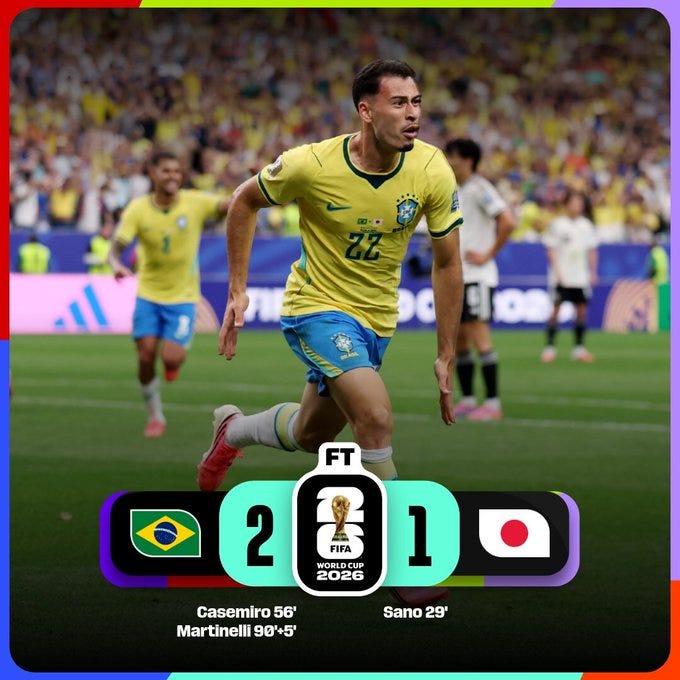
As seen in Brazil’s equalizing goal, it’s quite simple to just loft crosses to the far-post, where the farthest Center Back can’t reach, for an attacker to either over-power the Japanese Wing Back or simply sneak into the gap between defenders to strike home. For Casemiro’s goal, it was the latter, although Hiroki Ito didn’t quite cover himself in glory as he completely lost the Brazilian midfielder while at the same time Keito Nakamura was nowhere to be found in support. This felt eerily similar to Perisic’s goal in 2022 when Junya Ito was forced to play Wing Back. In general, given the quality of defenders that Japan has now, I thought regular crosses from out wide weren’t a problem. However, it was those diagonal crosses from the half-space edge of the box that kept poking at the weakness, the gap between the Center Back and Wing Back which hurt Japan the most.
Moriyasu’s substitutions were eye-popping as he took off not just Keito Nakamura but also Ritsu Doan. Both were clearly tired from all the defending they had to do but that is a black mark on playing them at Wing Back to start and then not having any recourse for settling possession and getting them more involved in attack as they should. This is exactly why I wanted Tomiyasu playing as the Wing Back to start in my match preview. In particular, I think Ritsu Doan performed admirably well sacrificing for the team by defending against Gakpo and Vinicius Jr. throughout the tournament but he’s supposed to be an attacker. When you compare to how impactful he was in attack in the 2022 World Cup, I thought it was a real waste to simply rely on his defensive work rate here. It’s to the point that I don’t even remember him taking a single shot in this entire World Cup!1
Overall, a problem with this game was that both the players nor the manager were not equipped to handle multiple layers of problems and then find solutions for each of them. To go far in a long tournament like the World Cup you either need to have a super clear talent advantage (which Japan obviously doesn’t have) or you have a main game-plan with various other plans in place for different tactical situations. Japan clearly lacked any way to shift gears and tempos aside from being able to “rest on the ball” against a very poor Tunisia team.
In 2022, the high intensity man-to-man pressing was used a lot and indeed the option also appeared in the Brazil friendly game in 2025 but it’s clear that the team didn’t have the energy to do that four games in, much like the Croatia game in 2022. It’s a shame because I thought given how we rotated throughout the group stages that it seemed possible but due to injuries and Moriyasu’s lack of trust in his call-ups in attack that Doan, Nakamura, Kamada, among others couldn’t get as much rest as we wanted. Japan have the technical players to be able to “rest on the ball” and not have to resort to kamikaze pressing but as I discussed earlier, a lot of our players seemed to be extremely nervous on the ball and had a difficult time even under a modicum of Brazilian pressure. This all resulted in Japan having difficulties pushing out from a low block and it simply got worse as the game wore on and drained the players further.
I also thought the Shuto Machino substitution was disappointing. The idea was to have another target for Zion Suzuki and the defense’s long balls/clearances and to have another body to support Ayase Ueda holding the ball up but it didn’t amount to anything. It was also pretty damning of Moriyasu to go with Machino, who was only called up as Endo’s replacement, and somebody who hadn’t even played in any of the group stage games either. This was Machino’s first minutes at a World Cup! Despite the large amount of attackers that Moriyasu brought to the World Cup, he didn’t end up using many for any significant minutes. Throughout the World Cup, it did seem odd to me how little he rotated the attackers which all led to guys like Maeda, Doan, Nakamura, Junya Ito all continuing to get the majority of the minutes. It didn’t seem like Moriyasu trusted his own squad choices.
Until Martinelli’s winner, Moriyasu had withheld the fifth substitution which was clear, alongside the introduction of defenders in Sugawara and Junnosuke Suzuki earlier in the game, that he wanted Japan to hold on and force extra time/penalties.
The biggest problem with the Japan National Team was that it was hampered by injuries to the top-end attacking talent which had knock-on effects at depth in a variety of positions. However, I do think Moriyasu could’ve done certain things differently and I feel like there were lots of choices and actions left on the table that makes this exit even more disappointing. I truly believe there were possible ways to hold out until Extra Time with a lot more “gas in the tank” and not having to hold out inside our own penalty box for 45 plus minutes. The players themselves aren’t blameless either given the individual mistakes in-possession and defensively that ultimately decided Japan’s fate.
Going Forward
Japan leave the tournament at the Round of 32. However, just because the end result that Japan haven’t ever won a knock-out game2 does not mean Japanese football hasn’t progressed, in my opinion. I think the group stage in this World Cup was far better navigated than 2022 or any previous World Cup with only the last 20 minutes vs. Sweden being the most negative period3. I do think Japan have improved to a point to have enough quality to progress to the knock-out stages without too many hassles. It’s certainly a stark contrast to previous generations where the team had to give 150% in the group stages to even have a chance (then be too exhausted in the Round of 16). I will also remind people that Japan is one of the few countries, importantly the only one outside of UEFA/CONMEBOL, that have consistently qualified for the knock-outs in each of the past three tournaments4. Of course, it’s clear that there are still many rungs on the ladder we need to climb to be able to comfortably advance through the knock-out stages, technique-wise and of course, mentally. Japan has made great strides in the past 40 years but the World has also evolved.
Japan continued to persevere with their low-mid block 3-4-2-1 but struggled to figure out ways to shift gears. From both a managerial and player perspective they couldn’t problem solve at multiple stages throughout the game when the initial plan didn’t work. The difference compared to top teams and managers was quite apparent. Aside from all tactics and strategy, Japan lacked a way to regain momentum after they lost it through substitutions (depleted squad didn’t help, of course), one game-changing moment by a star player, or any other method.
I do think the player depth is rising to good levels to approach being top caliber, but Japan’s squad still needs more quality and in more quantities to truly rise to that Quarter Final standard. Importantly, our players need to be able to defend against elite attackers 1v1 rather than constantly rely on double-teaming and exhausting attackers tracking back in defense. If we can do that then the team can shift to being able to keep the ball more and have the energy to attack too. I’ve talked enough about missing Mitoma, Minamino, and Kubo in previous articles but their absences linger as a huge “what if” for this tournament. I also feel that this tournament was a missed opportunity, especially in the group stages, to give the new generation enough World Cup playing time experience. It was a very weirdly balanced squad leaning toward many attackers but then those guys weren’t really used much at all…
While every team needs the “experienced, veteran, locker-room” presence type, I feel like having Yuto Nagatomo, Maya Yoshida, AND Takumi Minamino was a bit much. Surely, these players can develop some team spirit, cohesion, and not fall apart mentally with just one of these guys instead? Moriyasu probably had it right though as it telling that the squad’s practice the day after the Sweden game was unusually quiet without the regular players plus Nagatomo around to gee them up.
The clear MVP for Japan in this World Cup was Zion Suzuki. His big saves kept us in every game. Ayase Ueda deserves a mention given his selfless play up front defending but also his ability to score when we needed. I’m not faulting him too much for his performance versus Brazil when we didn’t give him a lot of service nor support when he held the ball up. We also can’t forget seeing Takehiro Tomiyasu at close to his 100% best. It was truly delightful to see how he elevates the entire team with his play. Hopefully this showcases to teams that he can handle the physical load now as he deserves to be playing in a Top 5 League team.
The managerial situation following the 2026 World Cup isn’t all that exciting. There’s been lots of speculation about Ange Postecoglou, Roger Schmidt, etc. but it’s clear that there are political hurdles within the JFA (some factions are opposed to a foreign manager after the Halilhodzic debacle) and also there is a lack of funds to pay the (somewhat) exorbitant salaries that foreign managers and their entourage of staff would demand5. From the Pivot channel, Kazu Kakiuchi has said it’s primarily down to Hajime Moriyasu staying or handing off the reins to U-23 manager Go Oiwa. Other media have also reported along similar lines. I’ve never been particularly impressed by Oiwa even with his accolades at Kashima Antlers (looking back at that squad I think a lot of managers could’ve done the same). With these limited choices, begrudgingly… I would prefer to keep Hajime Moriyasu through the 2027 Asian Cup then reassess once the tournament concludes. I think there should be a lot of scrutiny of Moriyasu and he shouldn’t be allowed to simply hide behind the injury-impacted squad.
In the future Tohru Oniki is probably the ideal domestic candidate while Makoto Hasebe needs to gain experience as a manager in Europe first. Ricardo Rodriguez is a foreign coach but one that has ample experience working in Japan already. While I have liked his football a lot (especially at Urawa Reds), I do feel that he has a certain stubbornness to his play-style that also won’t fix Japan’s current weaknesses. Long time readers will know how big a fan I am of Satoshi Yamaguchi and the fact that he is the U-20 manager should provide a hint to what the JFA has planned for him in the future.
I think it’s a big shame that the legacy this particular iteration of the Japan National Team leaves will be yet another knock-out first round exit. When everybody was fit-and-firing this team had enough about them to get to the Quarter Finals. A hard group, knock-out bracket, and injuries really limited the ceiling of this team and I think we ended up in a timeline that was near the bottom percentile of all possibilities.
There is another long journey ahead of us to the 2030 World Cup but first, it’s really time to regain an Asian Cup title in 2027.
Thanks for reading!


Doan took one blocked shot against Sweden. That’s it. That’s all he did!
I think we’ve all complained about how ridiculously unlucky the draw was for the knock-out bracket. Brazil, Morocco, or France… pick your poison!
Even that can be countered by the fact that we rotated a lot at that point and only needed a draw.
If you go back further to 2010 then Japan are one of 12 countries to have gone to the knock-outs at least 4/5 times.
Much like how Ken Griffin and other rich Americans helped pay for Mauricio Pochettino to join the USMNT, I’d like to hope Mikitani or even Masayoshi Son can be convinced to pay top dollar for an elite manager in the future. Please send me an email if you have their contact information.