
J.League (J1) 2025 Season Review
Kashima Antlers win their 9th title, their first since 2016!

It’s that time of the year again for the J.League Season Review! For those unfamiliar, I take a detailed look at each and every team with both data and my eyes. To be honest, the J2 season review was going to come first but I thought this year I’d wait until after the play-offs are completely finished as success/failure changes the complexion of the various team’s analysis. Anyway, this was the final season of the spring-fall schedule as after the World Cup next year, the league will switch to fall-spring from 2026/2027 onward.
Also, the J2 Season Review is also out!

This is a long read! I really recommend you read it one or two sections at a time. These reviews have a bit more casual, fun tone compared to my scouting reports.
This review consists of:
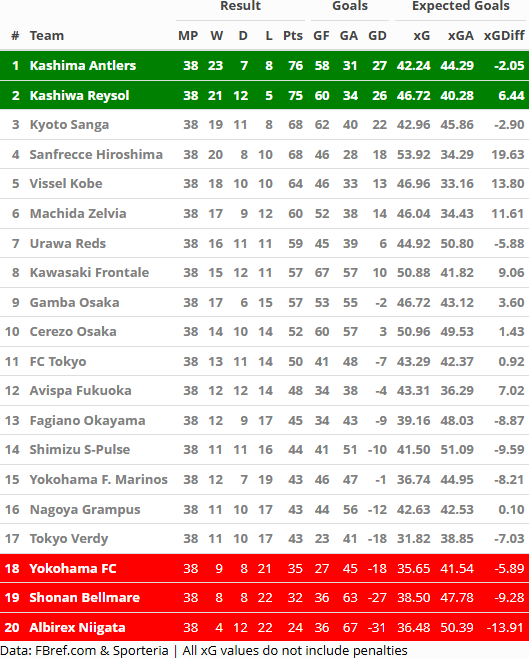
The league table
A section on every J1 team: Summary overview, tactics, data, players, etc.
A section on the different types of data viz: Explanations and link to the viz for every team
Some notes, warnings, disclaimers, etc.:
All the data stuff is done with R.
All the tactical stuff is created using Tacticalista.
To keep up to date with all of what’s happening in J1, I made a giant Twitter thread of lots of cool informed people to follow on Twitter for English language/international J.League content. You can find it here!
All of the shots and xG related stuff you see in the viz are non-penalty stats. Exceptions are stuff like the time interval and scoring situations plots. When I mentioned these stats in writing I usually mean non-penalty at the team level. At the player level it depends as some of my sources don’t go down to stripping out penalty xG.
Data sources: Transfermarkt, Sporteria, Football-Lab, FBref, Footy-Stats
Once again, this has taken up a gargantuan amount of time for me to watch/read/code/compile/organize so the best thing you can do for me is share it out to the world, especially if you work in the football industry!
Let’s get started!
League Table
A reminder that this season, only 1st and 2nd are guaranteed Asian Champions League Elite spots so the honor goes to Kashima Antlers and Kashiwa Reysol. The winner of the 100 Year Vision League next season gets the remaining Asian Champions League Elite spot for the 2026/2027 season. Due to the fact that Machida Zelvia won the Emperor’s Cup, they go into the Asian Champions League 2 next season. There are some other permutations if a Japanese team wins either continental competition so beware of that in the near future.
Kashima Antlers (1st, 76 Points)
23 Wins // 7 Draws // 8 Losses
Location // Stadium: Kashima // Kashima Soccer Stadium
Manager: Tohru Oniki
58 Goals (4th); 31 Conceded (2nd)
42.24 non-penalty xG (13th); 44.29 non-penalty xGA (12th)
Top goal scorer: Leo Ceara (20 goals plus 1 penalty)
Goalkeeper: Tomoki Hayakawa
Kashima Antlers are your 2025 J.League Champions! It’s been a long time coming for the traditional powerhouse club as this is their first title since 2016. There were a few periods where they dipped, three straight losses between matchday 8 to 10 and a worrying four game patch where they didn’t win but at the end of the day, you can’t deny the fact that they did not lose a SINGLE game after a July 5th loss in Matchday 23 to Kawasaki Frontale!
Things looked bleak for Kashima Antlers after they lost starting Center Back Ikuma Sekigawa, starting Left Back Koki Anzai, and important squad attacker Shu Morooka all to season-ending injuries but they managed to persevere. Their replacements within the squad and new signings all worked out near-perfectly, it was a real team effort from everybody involved on-and-off the pitch!
At the business end of the season, Kashima only conceded four in their last 10 games and did not allow more than a single goal conceded in a game since that crazy 3-2 win over Reysol back in the July! Getting the double over Reysol proved to be decisive as the teams only finished one point apart. All throughout the season, Kashima showed considerable grit, tenacity, and outfighting opponents rather than completely overwhelming them.
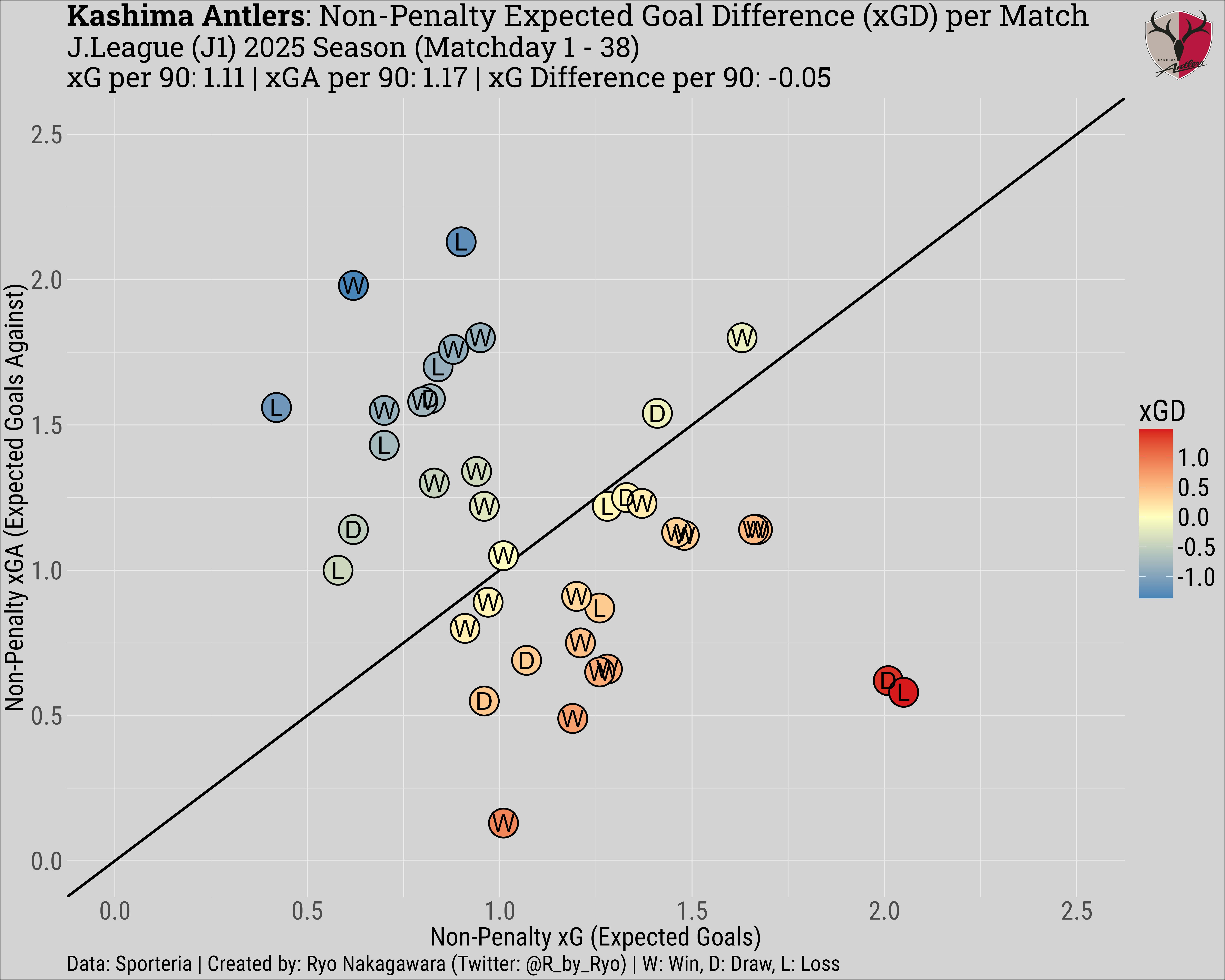
The biggest reason for their wins this season was their uncanny ability to score crucial goals at crucial times through brute force, wonder goals, and set pieces even when they struggled to break opponents down all game. After a while it became a self-reinforcing belief, an expectation that even with the struggles, that Kashima would score and somehow keep turning losses into draws and draws into wins throughout the season. For those that have been watching J.League over many decades, this might remind you of the same mysterious quality that dominant Kashima Antlers teams of previous eras had.
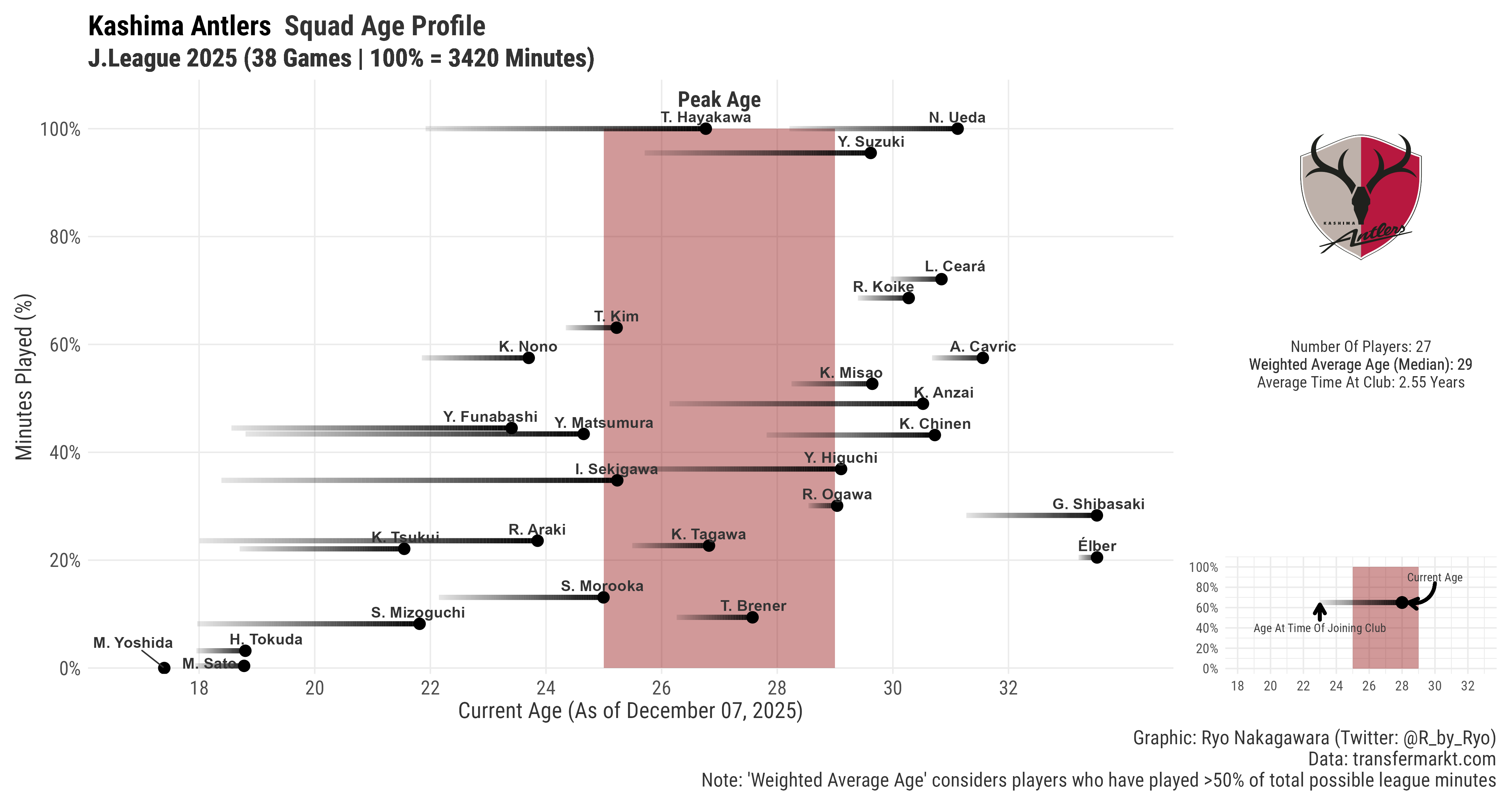
The two players that were essential to this was Leo Ceara and Yuma Suzuki. We’ve all seen over the years how much of a leader and character Yuma Suzuki is for his team, even begrudgingly as opponent fans. Along with his usual play-making role dropping and/or drifting to the left side he finished off as the team’s 2nd highest goal scorer with 10 goals from 8.68 xG.
After a fantastic two years at Cerezo Osaka, Leo Ceara moved to Kashima Antlers to much fanfare. The Brazilian managed not just to become the top goal scorer for both Kashima and the league in general but also set a career high goals tally if you remove penalties (last year he scored 16 non-penalty goals versus 20 this season). Ceara’s total of 21 goals came from 11.59 xG representing a both keen finishing streak in front of goal and the ability to consistently get on the end of good chances.


Funnily enough, the next best goal scorer was Kei Chinen but I’ll talk about him in the midfielder section. Yuta Matsumura returned to Kashima this season after a half-year on loan at Tokyo Verdy in 2024. While not quite a regular starter, he actually played in all 38 games of the season as Oniki prized him as a 2nd Half substitute to change the game up. His pace played an important role as he was tasked with making lots of runs behind against tired legs. Matsumura also ended up with 3 goals and 6 assists, quite a few being crucial to the title race including the assist for the last second equalizer vs. Kyoto, scoring the only goal vs. Verdy in the penultimate day, and of course, getting the assist vs. Marinos on the final matchday. In a similar vein, Aleksandar Cavric played a supporting role and made a difference with 3 goals and 4 assists.


All of the above was important considering that when you look at Kashima’s attacking data in the aggregate, it paints a rather curious picture:
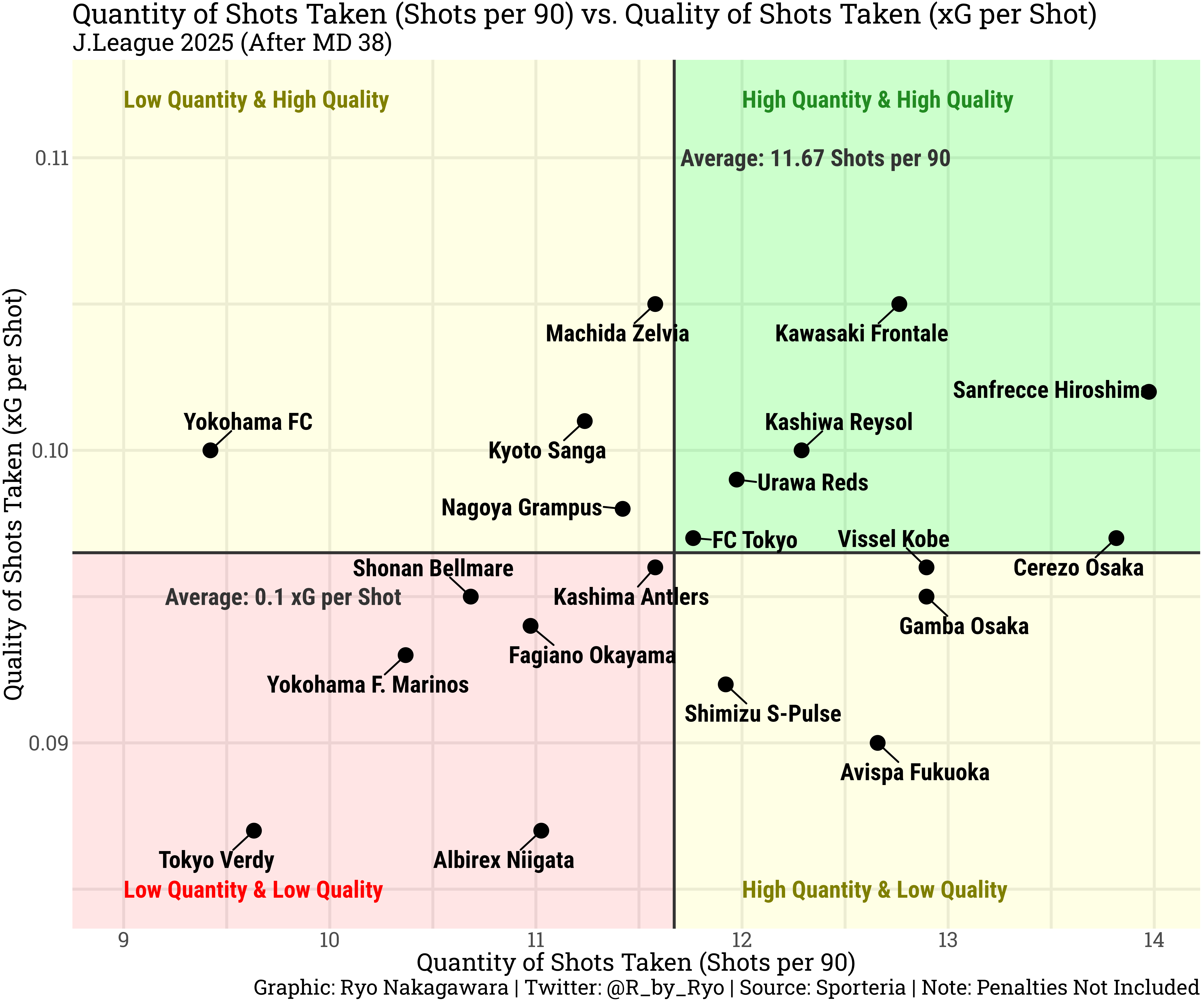
14th in final 3rd entries, 11th in penalty box entries, and 12th in shots
… and yet 5th in shots on target and 5th in goals scored!
In defense, I found it very odd how easy it was for opponents to punch passes into gaps in Kashima’s midfield. However, all that ball progression and conceding ground didn’t really matter when Kashima’s Back 4 were so good at defending their box by delaying and containing threats for support to arrive, as well as putting their bodies on the line for blocks and tackles. Even when opponents managed to get through all that, Tomoya Hayakawa was on his best ever form in goal to make the saves.


What was an interesting tactical bit we saw from Kashima this season was how they would shift to more of a Back 3 in the build-up phase as one of the midfielders usually dropped in and one of the Full Backs would really push forward. This platform either allowed the midfielder to dictate or it would give a little more space for Naomichi Ueda to hit long balls and long diagonals into the final 3rd to bypass the opponent’s block altogether. In terms of outfield players, I think Naomichi Ueda was as important as Leo Ceara or Yuma Suzuki. With 5 assists the defender was only behind Yuta Matsumura for most assists on the team!
With Ikuma Sekigawa’s season ending injury before the summer, it was up to Kim Taehyeon to step up to partner Ueda and he did quite a good job. So much so that he even earned his debut for the full Korean National Team. Otherwise there was not a whole lot of playing time for Keisuke Tsukui or any other Center Back as Antlers did not need to rotate much there.


Ryuta Koike made a big move from Marinos in the off-season and became a key player, interestingly he played a lot as a wide midfielder especially after Shu Morooka’s injury instead of his usual Full Back position. On the Left, Ryoya Ogawa, another returnee from Europe, made the Left Back spot his own after the summer and adding a lot of experience. Kimito Nouno did not have as crazy a season as he did in 2024 when he scored 9 goals. It made sense considering those goals came off of just 4.2 xG. In 2025, Nouno was reduced to just 1 goal off of 1.36 xG which was way more in line with expectations. I maintain the opinion I had in last year’s review that people were vastly overrating him because of those goals. To be clear, I do think Nouno has good attributes especially his intense physicality to make good runs forward to crash the final 3rd/box is exactly why he was in place to score those goals in the first place. Still, his defending isn’t much to write about and he’s not much of a passer from deep nor a particularly creative one either.


In midfield, Yu Funabashi came to the fore this season as passer (and set pieces), taking up the passer role from the veteran Gaku Shibasaki who looked like age was finally catching up to him. I quite like Funabashi as he supports build-up play quite well. He can also push forward and punch line-breaking passes to progress the ball. He didn’t win as many minutes as you’d imagine as by the season’s end, Oniki had a preference for more aggressive guys who could win 2nd/loose balls compared to the more technical abilities that Funabashi provided. Kento Misao was a jack-of-all-trades, dovetailing nicely with whoever happened to be next to him in the double pivot while Kei Chinen continued his odd cosplay as a central midfielder. I’m not the biggest fan of him there but he fills the role of being super physical and winning the ball!


A curious part of this season was how Tohru Oniki decided to adapt more to “Kashima’s Way“ rather than forcibly imposing the style that he cultivated to great success at Kawasaki Frontale. What I really liked about his management was how aggressive he was about using substitutions, many times even at Half Time, which I think is a good thing and something more managers should be doing. While Oniki kept a core of Hayakawa, Ueda, Koike, Ceara, and Yuma Suzuki there were a lot of rotations in most other positions, especially in center midfield. Although perhaps not what people want to read from a tactics & data piece but so much about Kashima’s season was also about fighting spirit and the “intangibles” of football.
It will be interesting to see in the subsequent seasons how much Oniki tries to pull Kashima towards the football he enchanted many at Frontale or whether he will continue molding his style with what he has available at Kashima. It is unlikely that Kashima can repeat the same results with the same underlying performances that they showed throughout this season, there is a lot that needs to be improved. However, this season’s results has given Tohru Oniki enough of a cachet to continue improving the team tactically and also convince Kashima’s higher-ups to spend in the transfer market to realize his vision: multiple league titles and a Asian Champions League title that was out-of-reach for even his monstrous Kawasaki Frontale sides.
Kashiwa Reysol (2nd, 75 Points)
21 Wins // 12 Draws // 5 Losses
Location // Stadium: Kashiwa // Sankyo Frontier Kashiwa Stadium, “Hitachidai”
Manager: Ricardo Rodriguez
60 Goals (tied 3rd); 34 Conceded (4th)
46.72 xG (6th); 40.28 xGA (6th)
Top goal scorer: Mao Hosoya (10 goals plus 1 penalty)
Goalkeeper: Ryosuke Kojima
Kashiwa Reysol have been in a rut over the past few seasons, mired in relegation trouble and looking rather directionless. In came a breath of fresh air, the start of Ricardo Rodriguez’s Reysol Revolution! The Spanish manager who previously transformed Tokushima Vortis and Urawa Reds was able to work his magic with Kashiwa too. An overhaul of their playing style to something clear, distinct, and effective in such a short period of time. Overall, Reysol never fell below 5th in the table for the entire season! This was remarkable considering their recent prior seasons where they were quite bad... nearly relegated as a matter of fact.


Koki Kumasaka was the eye-catching player of the first half of the season, his performances earned him his first ever call-up. However, disaster struck as he suffered an ACL injury in training… Kumasaka was an interesting profile because at 185cm he is quite tall for a Japanese Center Midfielder. With his size he could snap into tackles and win duels but also had a lot of technique in terms of his turning ability in tight spaces and good range of passing. Kumasaka was exactly the kind of midfielder that suited Rodriguez’s new-look Reysol team with his ability to support his teammates in possession and receive in the right places.


In a blink of an eye Reysol had a ready-made replacement. Nobuteru Nakagawa surprisingly left off where Kumasaka began and continued to orchestrate play from the middle of the park. Nakagawa has a similar passing profile to Kumasaka although he is much smaller and doesn’t quite have his overwhelming physical traits. On the other hand is far more involved in the final 3rd and contributed with 3 goals and 4 assists.


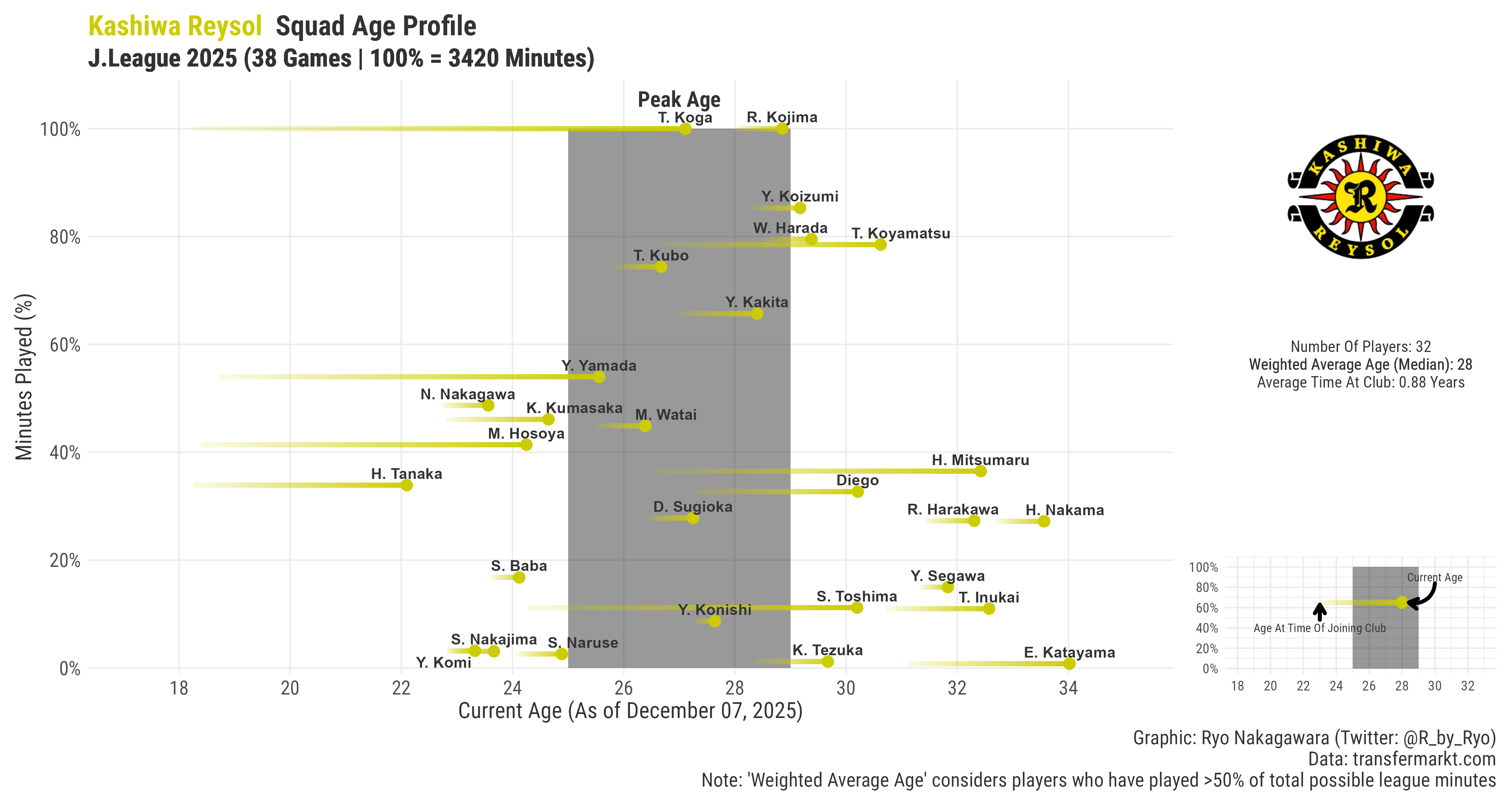
Due to the deserved accolades given out to the two above, Yuto Yamada was often overlooked but he was quite good as well. Unfortunately he also suffered a major injury in the closing months of the season…
Taiyo Koga led the back-line and was the only field player to play every single minute of the league campaign. It wasn’t just his good defending but also his ability to pass the ball equally with both left and right foot that made him a leader for Kashiwa in possession as well. However, vital mistakes in crucial games, especially the one against Kashima Antlers in the summer will surely haunt him. There was a whole rotating cast of other Center Backs around him as the season progressed, including many who were converted due to the demands of the “Wide Center Back” role in the Back 3.
Wataru Harada, having played in similar positions at Sagan Tosu, took like a fish to water under Ricardo Rodriguez’s playstyle. Operating equally as a Wide Center Back in the half-space but also pushing forward like a Full Back, he was quite integral to supporting the wing backs in attacking sequences. Others such as Seiya Baba, Daiki Sugioka, and even the veteran Hiromu Mitsumaru slotted in at various times to mixed effect. Hayato Tanaka looked promising at V-Varen Nagasaki in J2 last year, I had high hopes as I thought he’d be the kind of ball-playing CB that Rodriguez would like. Tanaka had a decent enough start but has completely disappeared from the squad altogether in the 2nd half of the season as Rodriguez seemed to prefer a different profile in the Wide Center Back role.
The only other player to play every single minute of the league campaign was the goalkeeper Ryosuke Kojima. Well-known for his frequent involvement in the build-up phase, he was exactly the type of goalkeeper that Rodriguez would’ve requested. Kojima’s involvement, the Back 3 shifting to a Back 4, there was a whole lot of variety in Reysol’s build-up patterns that made it difficult for the opposition to press them. Further forward, there were also lots of rotations across positions to create space and keep the ball to bamboozle opposition blocks and discombobulate man-marking schemes.


Out-of-possession, Reysol’s defensive numbers were pretty good and it was fantastic in the run-in as they only conceded once in the final six games. Overall Reysol posted the 5th best in shots against and 6th in non-penalty xGA, however were 14th in xGA per shot. Reysol were vulnerable in the usual ways when playing a 3-4-2-1 formation in long balls behind the space vacated by the Wing Backs and subsequently dragging the Back 3 away from the center to defend against crosses.


Tojiro Kubo’s excellent performances earned him a call-up to the EAFF Japan squad in July. His dribbling skills and creativity provided a whole lot of danger down the Right Wing. A medium-term injury at the end of the summer meant he missed a huge chunk of the final games though. On the opposite flank, I thought Tomoya Koyamatsu was great with 3 goals and 10 assists. He’s been a solid contributor across a number of teams for many years but he needed to be platformed in the correct way as a winger/wing-back for maximum impact. Koyamatsu’s output this year compared to the past two seasons under extremely poor management represents this day-and-night difference very well. If Kubo leaves for Europe than Yusei Yamanouchi might be the guy to replace him, he made a smattering of appearances near the end of the season. Still very raw but shows some promise with his good physical traits that gives him the ability to bomb up and down the wing.


Yoshio Koizumi was reunited with his ex-Urawa Reds manager and performed at his best again. He was a leader in the sense that he clearly knew what was required by Rodriguez and set the standards very high for his teammates to follow. On the other hand, Takuya Shimamura and Yota Komi were quite disappointing after the unofficial “swap” deal with Albirex Niigata.
The striker position was an interesting case this season. Mao Hosoya became the top goal scorer with 11 goals, yet he only started 13 out of 36 games! His strength and hard-running made him an ideal super-sub against tiring defenses and he answered with some vital goals throughout 2025. To me, Hosoya has always had the physical capabilities to succeed in Europe but I do think the best time for him to leave was in the 2023 season when he banged in a career high 13 goals but from various reports he seems to prefer to stay in Japan. It was Yuki Kakita that started most games up top and he provided the brawn and sacrificed himself so others could run or pass into the spaces he opened up. Despite not getting a whole lot of shots due to his activity outside the box, the big man still managed to contribute with 6 goals and 5 assists.


Their attacking metrics overall seemed quite good on the surface. Reysol ranked 1st in terms of both final 3rd entries and penalty box entries showing how effective their possession game was in advancing into danger areas. As you might imagine, a lot of their goals came from intricate passing sequences and cut-backs/crosses following a half-space run into the box.
However, a lot of their goals came in spurts. There were quite a few games where they simply couldn’t break opponents down and add that final touch to finish off chances. This is what led to the fact that Reysol drew 12 games this season, a league record tied with Kawasaki Frontale, Avispa Fukuoka, and Albirex Niigata. In particular, four league draws in a row especially against fellow title contenders Kobe and Sanfrecce in September really cut down their title hopes during the month of September. Those eight points dropped along with the painful 2-3 loss vs. Kashima Antlers back in late July was ultimately the difference!
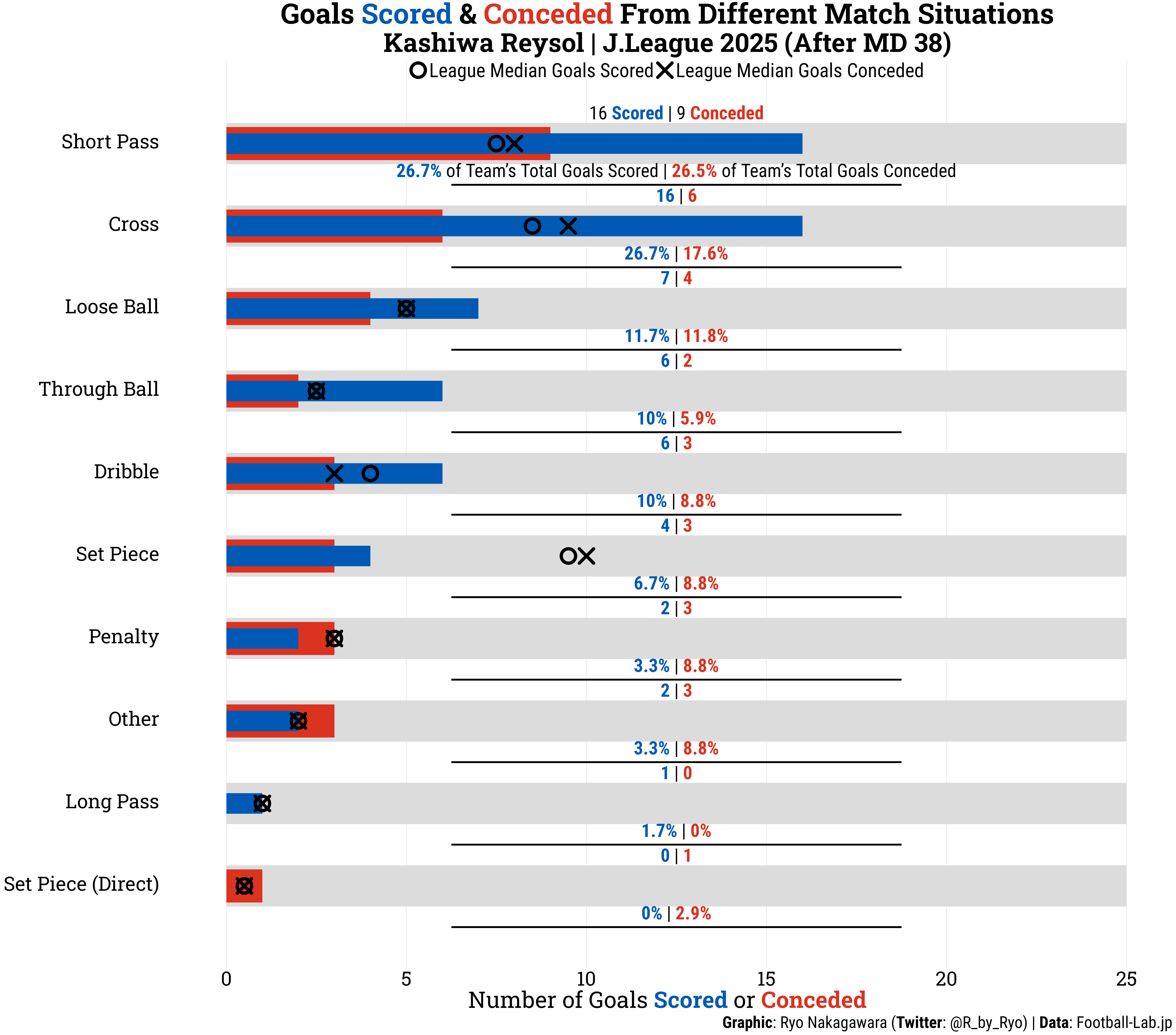
Much like Skibbe’s first season in charge at Sanfrecce a few years ago, Ricardo Rodriguez was a huge catalyst in moving a stagnant Kashiwa Reysol toward a new direction in quick time. They fell just a point short and a big factor was that Reysol weren’t able to record a win against any of the other teams in the top 5 (all of Antlers, Kobe, Sanga, and Sanfrecce!), especially being defeated twice by Antlers. Crucially they could not convert (or conceded) in tight games which meant that they drew a lot of games they could/should have won instead. For how good of a season it was, football is a cruel sport and they also lost in the final of League Cup too.
There was lots of heartbreak but in turn there should be a lot of optimism for Reysol going forward. Reysol’s front office did a good job shaping the squad to Rodriguez’s stylistic preferences quite quickly but there’s still more work to be done in identifying more players especially with the Asian Champions League to worry about next autumn.
Kyoto Sanga (3rd, 68 Points)
19 Wins // 11 Draws // 8 Losses
Location // Stadium: Kyoto // Sanga Stadium
Manager: Cho Kwi-jae
62 Goals (2nd); 40 Conceded (8th)
42.96 xG (11th); 45.86 xGA (14th)
Top goal scorer: Rafael Elias (15 goals plus 3 penalties)
Goalkeeper: Gakuji Ota
It was a historic season for Kyoto Sanga but perhaps it could’ve been even more of a success? The purple team from Kyoto actually started the season quite poorly having only won once in their first 5 games but from then on they never dipped below 7th and were in the top 4 for the majority of the season.
Unfortunately, the wheels started to come off in September as injuries piled up and a long string of draws in the fall, including allowing a last millisecond equalizer to title rivals Kashima Antlers, then a devastating loss to Yokohama F. Marinos the next matchday spelt the end for Kyoto’s fairy-tale run.
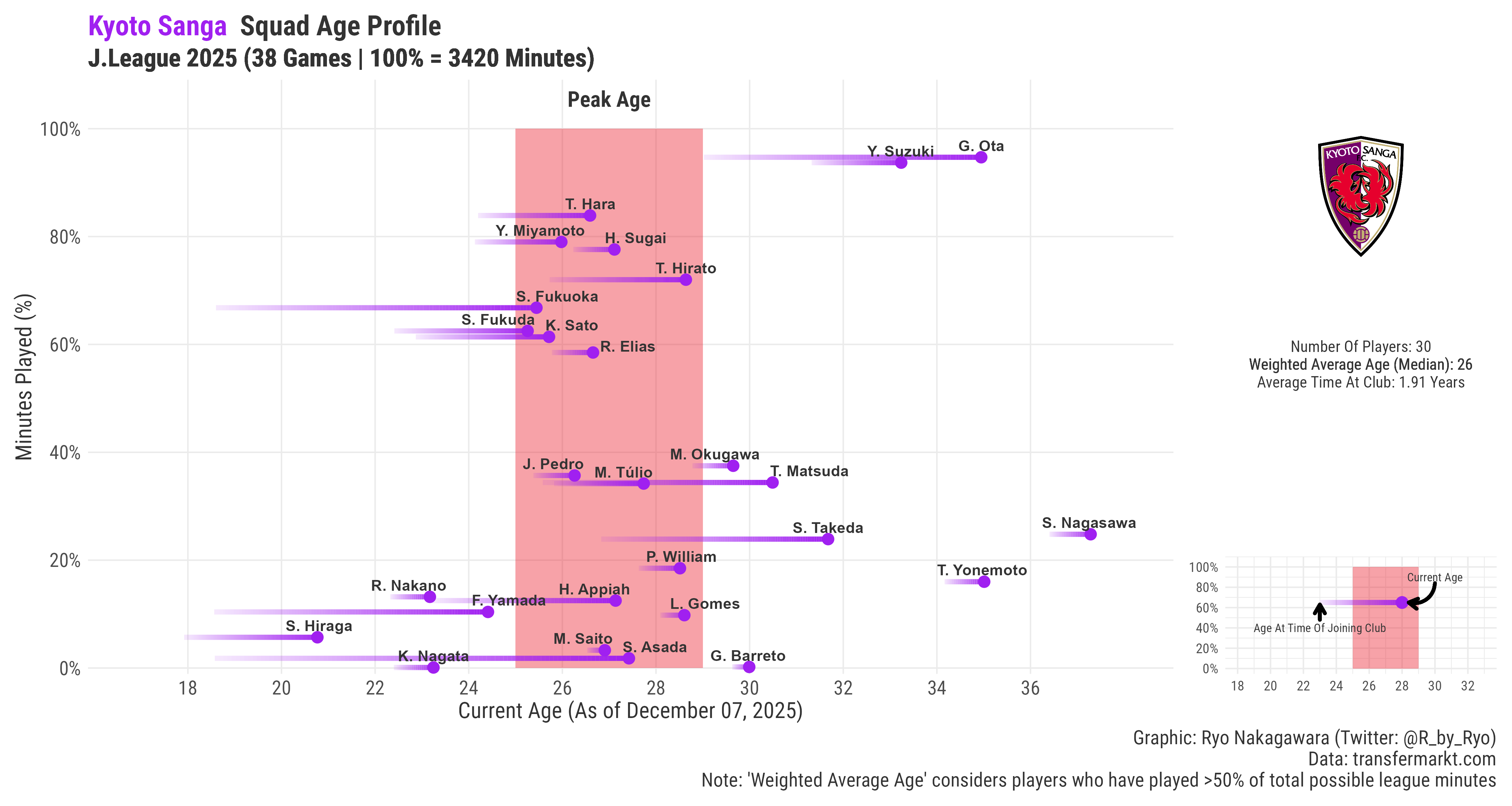
A lot of Kyoto’s form over the past two-ish seasons has been riding on the coattails of consistently elite finishing from Rafael Elias or Taichi Hara. The Brazilian finished the season with a fantastic 18 goals from 11.3 xG and struck fear into every single J.League team. Funnily enough Hara scored only 5 goals from 8.7 xG this season but in his stead both Masaya Okugawa with 7 goals from 3.7 xG and Marco Tulio with 6 goals from 2.5 xG have taken up the “clinical/lucky finishing” mantle. Okugawa had a funny habit of popping up at random moments to score despite not visibly doing much aside from his monstrous amount of pressing.


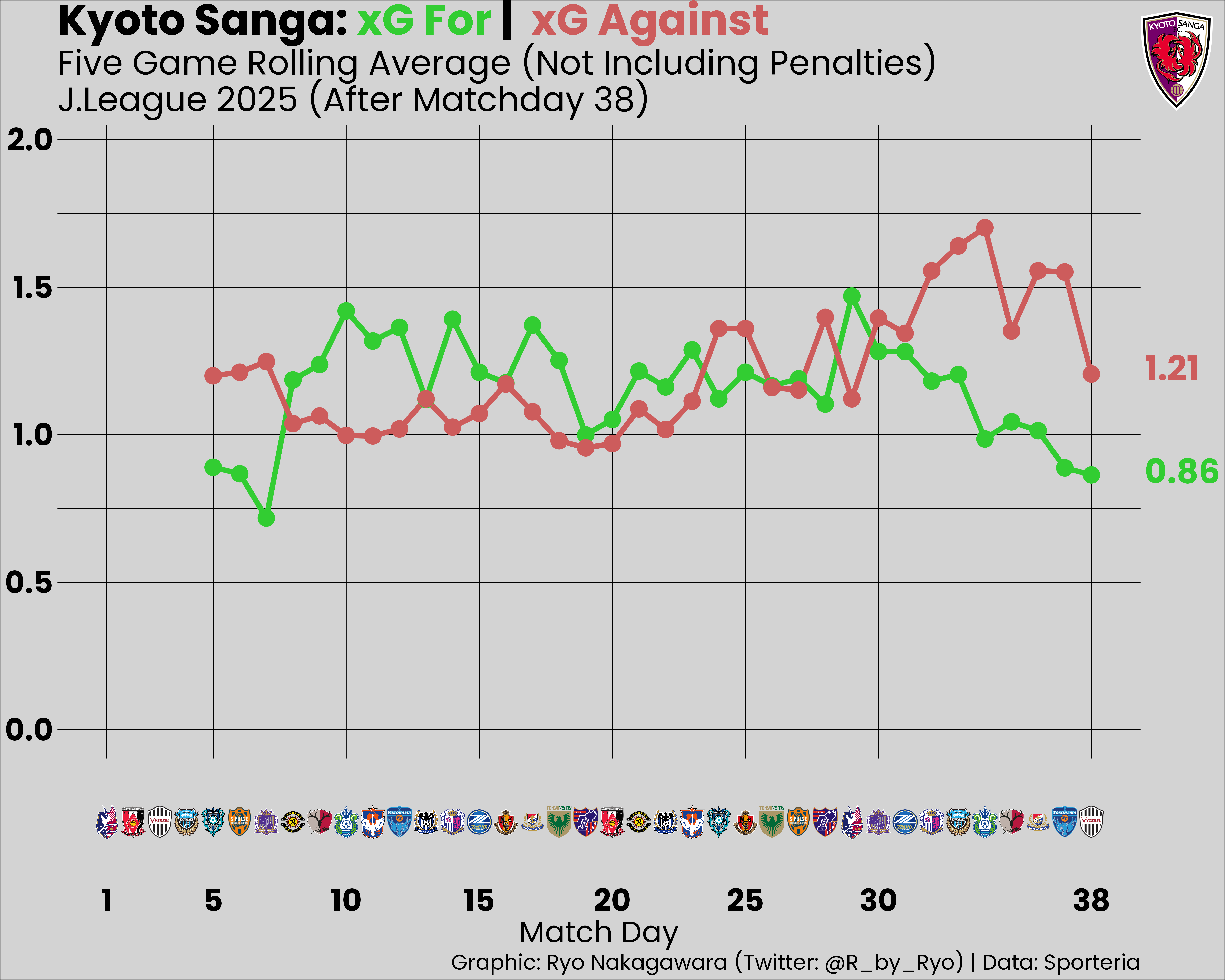
Kyoto as a team don’t take a whole lot of shots, they were 14th in the league for shots taken while also arriving in the final 3rd the 16th most and entering the box the 15th most per game. However, they were ridiculously efficient when they did get chances as they have the 3rd highest shots on target per game which led to having the 2nd most goals scored... again this is all from having the 7th lowest shots per game in the league as well as only a mid-table rank xG!


However, at various points of the season the attacking unit was left running on fumes due to various injuries and the goal scoring sputtered to a halt in the last 10 games of the season. Funnily enough, Shun Nagasawa of all players did his part, chipping in with 3 goals from 2.95 xG and 3 assists across crucial matches like the winner vs. Cerezo Osaka in late September and the assist to open the score vs. Kashima Antlers in late October. This just about kept them in the title race until October.
It’s honestly incredible that Kyoto were able to make it this far considering their transfer misses with Murilo, Gustavo Barreto, Patrick William, Joao Pedro all flattering to deceive... At least Marco Tulio was somewhat effective with 6 goals and 3 assists but considering how much they paid for him and his wages, I think you’d be hoping for a lot more?
In the middle of the park, Shimpei Fukuoka did a decent enough job as the single pivot supporting play on either side of the ball while Taiki Hirato was a big threat on set-pieces and ended the season with 6 assists. Of course, the real star of the show was Sota Kawasaki who started off his Kyoto career as more of a #6 and slowly turned into more of a box-to-box player. He’s not the best passer but super energetic and supports play in every 3rd of the pitch. As per for a Kyoto player, very physical and likes to get stuck in. Unfortunately Kyoto let him, their captain, leave on a LOAN DEAL (yep, you heard that right) in the middle of a title race to Mainz 05 in the summer!


Kyoto’s defense wasn’t great but for the most part it was a settled line-up compared to many other teams. Yuta Miyamoto and Yoshinori Suzuki back-line continued being somewhat OK enough to keep them in the title race even as injuries in attack mounted ahead of them. I mean, neither Api Tawiah nor Shogo Asada made much of a case to win a starting spot. I think Miyamoto provided a lot of passing from deep but it’s clear how he is a converted Full Back playing in the center given how poor his aerial ability is.
Shinnosuke Fukuda continues to be a pocket-rocket down the Right, lots of rumors about a move to Charlton Athletic that fell through in the summer, I imagine they and other teams will be back for him this winter. Hidehiro Sugai had a very good season that harkens back to the promise he first showed at Ventforet Kofu a few years ago.


Overall though, the defensive numbers were never good and they had to have Gakuji Ota have an unbelievable season between the sticks (only topped by Tomoya Hayakawa for Antlers).


Just three wins in the last 10 games of the season including managing to snag a draw from the jaws of defeat at Shonan to then only snatch a draw from the jaws of victory a week later in the decisive game vs. Kashima Antlers, put a damper on what was otherwise an enormously successful season.
The key question now is: do they have the ambition to spend some money in the short term?
It’ll be really interesting to see how Kyoto evolve as a club from this unforeseeable experience and their movements in the upcoming winter transfer window. Unless they credibly improve their defending outside of their energy-intensive pressing, I have considerable skepticism that they can keep this momentum going through the 100 Year Vision League and into the 2026-2027 season...
Sanfrecce Hiroshima (4th, 68 Points)
20 Wins // 8 Draws // 10 Losses
Location // Stadium: Hiroshima // Edion Peace Wing Stadium
Manager: Michael Skibbe
46 Goals (10th); 28 Conceded (1st)
53.92 xG (1st); 34.29 xGA (2nd)
Top goal scorer: Sota Nakamura (6 goals)
Goalkeeper: Keisuke Osako
Michael Skibbe and Sanfrecce Hiroshima celebrated yet another League Cup victory (this time a set-piece fueled 3-0 win over Kashiwa Reysol) but they fell flat in all other competitions. The ACL2 campaign was a disaster as Sanfrecce accidentally fielded the ineligible Valere Germain which got their first leg vs. Lion City Sailors turned into a 0-3 defeat, their Emperor’s Cup run ended in a semi-final defeat vs. Vissel Kobe, and the same issues plaguing this team over the past few years reared their ugly heads again to another disappointing league finish. As has been the case for the entirety of Skibbe’s tenure, Sanfrecce drew too many games or lost out as opponents were just more clinical than them.
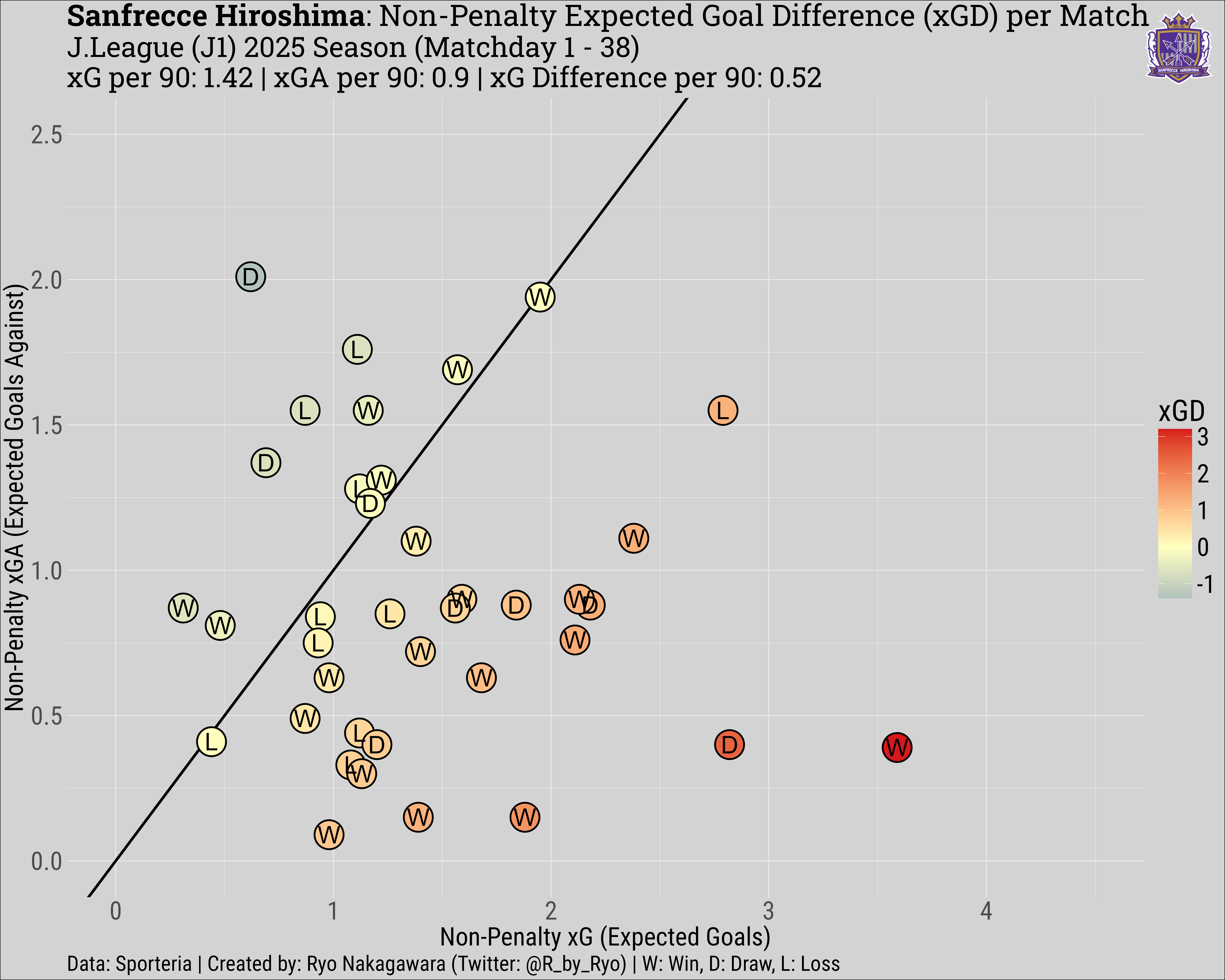
So once again. Every year under Skibbe. Every six months when I write about Sanfrecce Hiroshima these past few years the big topic has been about finishing & xG.
Here is an excerpt from last year…
The problem with them is that while Sanfrecce rack up the shots and the xG on paper, it’s more of a result of the absolute volume of shots they are willing to take rather than consistently making medium-to-high quality shots.
> from the J1 2024 Mid-Season Review
… and another…
Sure, they have the highest xG but when you consider that all these years, the plan has been to take hundreds of shots… but poor quality ones mainly created via crosses (most per game in the league), it’s no surprise that their xG per Shot is fairly low and their finishing from those chances have also been low. To put it simply, it’s quite telling that they are 3rd in shots taken… yet 14th in shots on target and 13th in goals scored!
> from the J1 2025 Mid-Season Review
Whether it’s simply a personnel issue and/or a tactical issue I feel like I’m repeating myself every six months when it comes to Sanfrecce’s review section, it really drives me crazy. When I mean tactical issue I feel like they are playing in a particular way that ends up in creating certain type of chances that are hard to score. With Skibbe leaving this season I imagine something will change, at least I hope for everybody’s sanity.
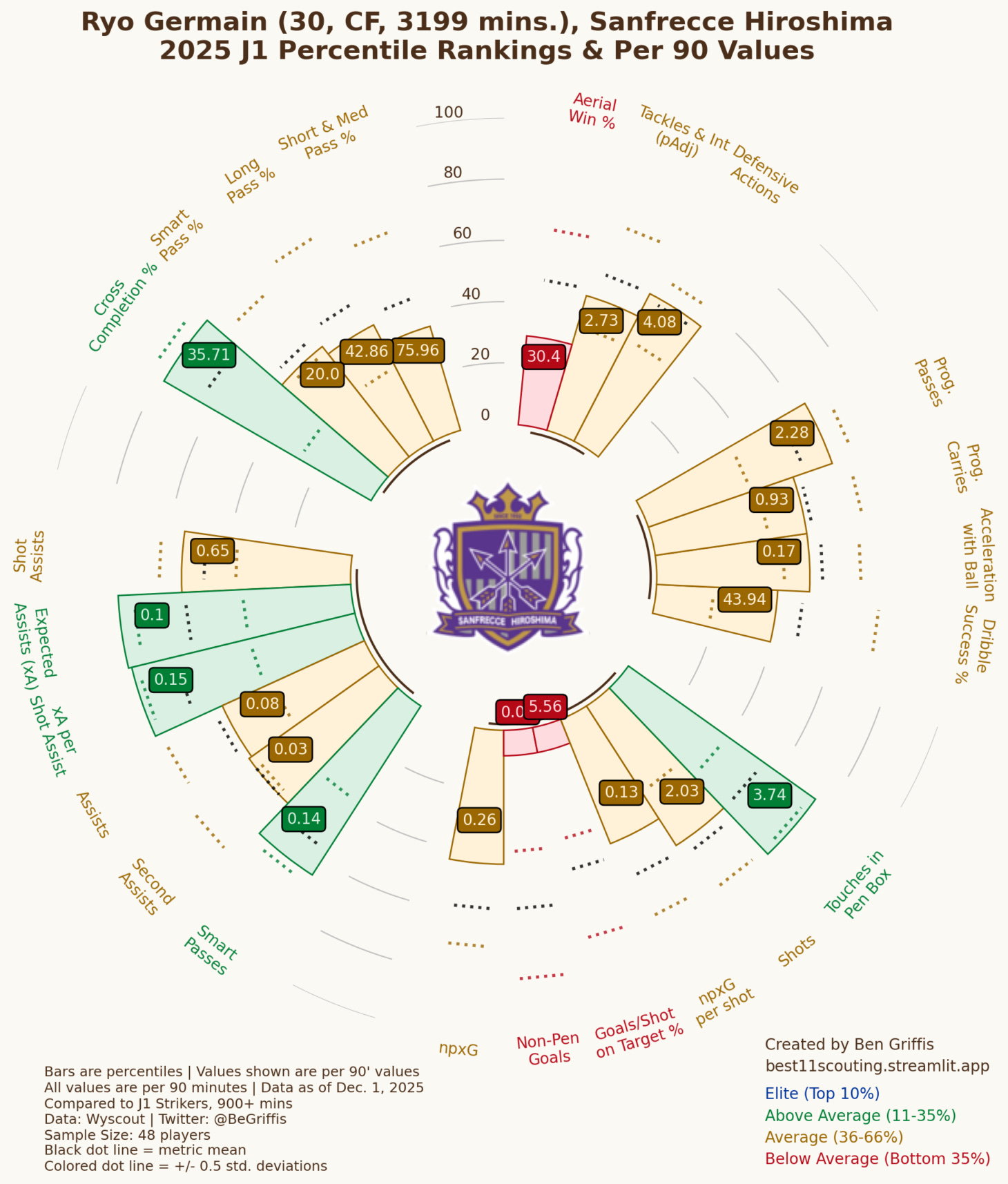
Valere Germain was another transfer dud at the striker position. Much like with Sotiriou, Ben Khalifa, etc. Sanfrecce have had a poor record with foreign striker signings over the past few years. Still, the headline grabber for this season was, of course, Ryo Germain’s horrible-no-good-very-bad finishing season! 4 goals from over 10 xG. 3 of his 4 goals were penalties. So in reality that’s 1 non-penalty goal from close to 8 non-penalty xG! Using FotMob’s data, Germain generated 0.28 non-penalty xG per 90 but turned that into only 0.17 xG On Target per 90. Despite taking 2.47 shots per 90, he only got 0.60 per 90 on target!
Looking at the very few positives… then yes, Germain contributed a decent amount in build-up play, hold-up play, sacrificed himself a lot in physical battles and making runs for others. He had 3 assists. No matter how you slice it though, Ryo Germain’s 2025 J1 season will live on in infamy. Kosuke Kinoshita ended up with 6 goals and 2 assists since coming over from Kashiwa Reysol in the summer. I still don’t think he’s a great player but he was more like the best out of a misfiring bad bunch and in only a half-season too.
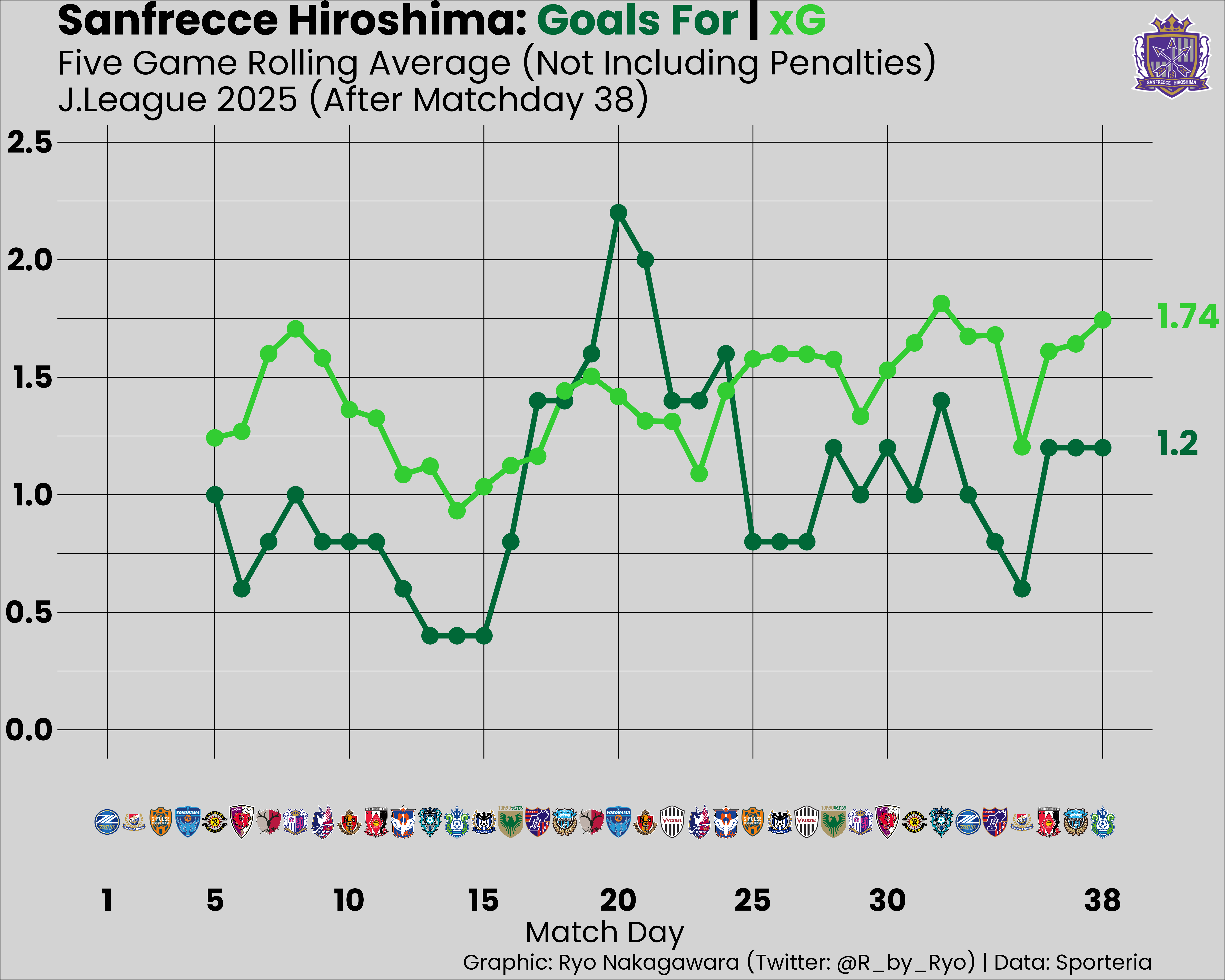
So Sanfrecce ended the season taking the most shots (again, obviously), getting into the final 3rd the 4th most times in the league, entering the opponent box the 3rd most times… but only taking the 7th most shots-on-target leading to just 8th in total goal scored… In the below graph, see how the dark green line is hanging out down low underneath the light green line for most of the season? It’s a clear demonstration of their main issue this season.
In the unit just behind the striker, Sanfrecce saw a new talent blossom straight out of the university system. Sota Nakamura was a revelation after joining from Meiji University this year. Extremely fast, sharp, and technical. He does pop up with various “wow” moments but if I’m going to be honest I do have some doubts about how he’d scale up to a European league level, even at a non-top 5 league which might be scrutinized if I take a closer look during the off-season. Nakamura is definitely the best university graduate “rookie” in J1 this season though. Despite missing a chunk of the season through injury and being forced to play at Wing Back at various times, he still ended up being Sanfrecce’s top goal scorer with 6 goals (although from just 3.76 xG) to add to his 6 assists.
It was a frustrating season for Naoki Maeda. He’s got lovely movement making runs behind or on the dribble but he just doesn’t have any end-product with just 2 goals off of 4.3 xG. Unfortunately, Tolgay Arslan suffered a huge injury in the spring. The German was also one of the few players that was actually clinical from low quality chances (as seen last season) so Sanfrecce lost that “edge” too. Marcos Jr. was also injured for most of the season and I think his time is done, he just can’t make an impact on the game like he used to which is a huge shame since he was enormously fun to watch at Marinos. Indeed, it was announced in late November that the Brazilian and Sanfrecce are going separate ways.


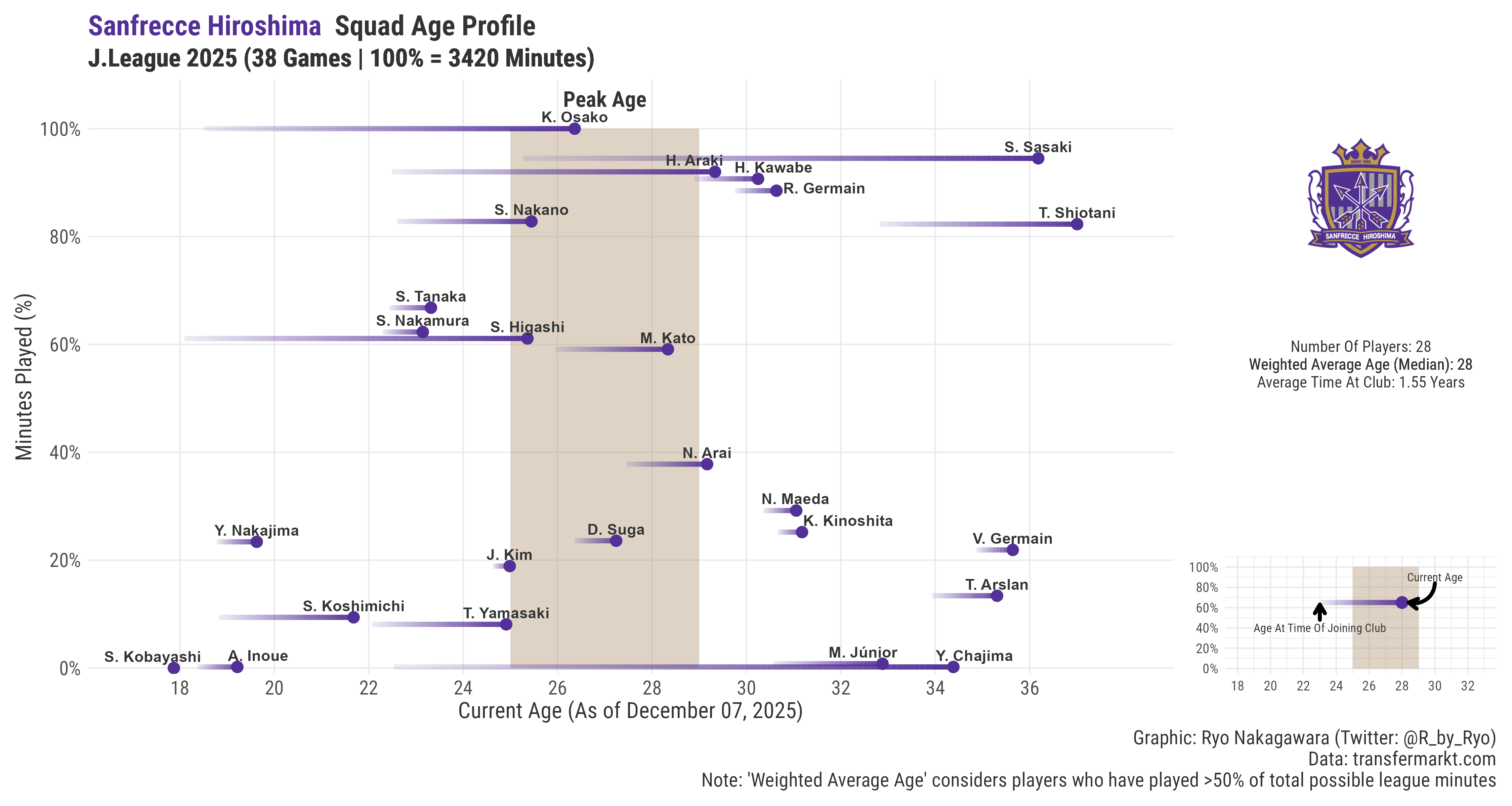
It’s been very clear for several years now that Sanfrecce have one of the league’s best defenses. 2025 was no different even as Tsukasa Shiotani and Sho Sasaki look to be on their last legs. Hayato Araki and Keisuke Osako’s gargantuan efforts led to both receiving Japan National Team call-ups and not just the domestic-based EAFF Cup either but the full squad. Players like Osamu Iyoha and Hiroya Matsumoto had been waiting for a long time in the wings to take over from Shiotani and Sasaki, it never quite happened and both players left. However, the arrival of Kim Ju-Sung in the summer really signaled the fact that the time to phase out at least one of the two veterans was coming soon. The Korean defender took a bit of time to settle in and only ended up playing in eight league games.


At Wing Back, it was the usual suspects again with Shuto Nakano, Shunki Higashi, and Naoto Arai sharing responsibilities with Sota Nakamura occasionally filling in. Long time readers will know I’ve been a big fan of Shuto Nakano, especially after a fantastic 2024 season and yet he’s never been considered for the national team (not even the EAFF Cup!). While he’s not as refined on the ball as the more coveted Japanese defenders out there, Nakano brings a whole lot of physicality to the role bombing down the wings while also being able to play as a Center Back due to his aerial dominance and duel strength. An added bonus is he can take long throw-ins too. Shuto Nakano is certainly an interesting profile but at age 25 the window of opportunity is closing.
On the left flank has been Shunki Higashi. He is the more technical counterpart to Nakano and is the team’s primary set-piece taker. However, compared to last season’s 8 assists Higashi had zero but did score 3 goals instead. Higashi may have been a victim of his teammate’s profligacy here…


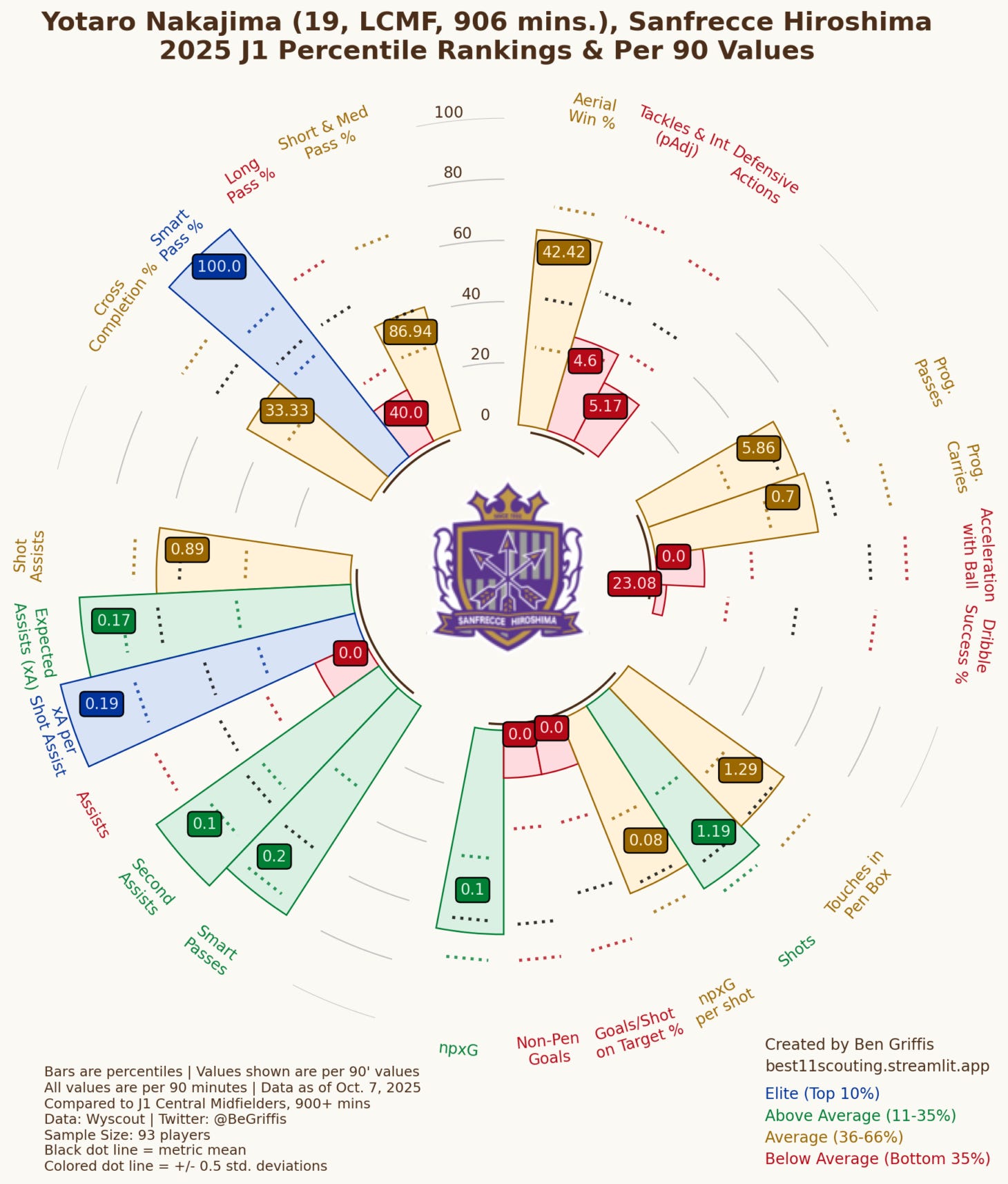
The midfield was fairly settled throughout the season with veteran Hayao Kawabe being paired up with Satoshi Tanaka for the majority of 2025. The newcomer here was Yotaro Nakajima, who had made a number of cameo appearances in the 2024 season. The 19 year old possess a startling knack for controlling the tempo of the game with his passing and great spatial awareness. Unfortunately, what should’ve been his break-out season was marred by injury issues and missing league games due to national team duty. I’m hoping Nakajima can spend the off-season recovering and gearing up for a big 2026 season.
Shogun Soccer Scouting #16: Yotaro Nakajima

Happy Halloween, well soon enough anyway! This report should neither be spooky nor a surprise to most people who watch Japanese football as today I’ll be talking about Yotaro Nakajima! On the other hand, if you’re interested Kawasaki Frontale do a Halloween-themed starting XI graphic
Satoshi Tanaka is another old favorite of mine. Despite his initial foray into Europe with Kortrijk not succeeding, he put his head down and improved to a point where Sanfrecce brought him into the fold ahead of the 2025 season. Tanaka exhibited his usual tenacity in duels and keen awareness in interceptions but also an ability to get forward and threaten himself in the final 3rd. He really is such an all-rounder now that can perform box-to-box roles with his energetic displays and not limited to sitting deep and destroying. European teams really should be looking to give him a second chance soon.
With Tolgay Arslan’s devastating injury, Shion Inoue deemed to not be intense/aggressive enough for Sanfrecce’s style of play, and the fact that Taishi Matsumoto left for Urawa, Sanfrecce Hiroshima were stretched thin here at various points in the season as everybody except for Hayao Kawabe spent some time in the doctor’s room. As such Tsukasa Shiotani had to be pulled out from the Back 3 to play in his original position as a midfielder for medium-sized chunks of the season.


Sanfrecce’s pressing was sharp, intense as usual but big problems arose when the midfielders stepped up but couldn’t prevent the forward pass, either because they were too late or not in sync with the Front 3. This meant that it could be fairly easy to break past Sanfrecce’s lines as the space between the forwards/midfielders and Back 3 would be stretched open which defeated the whole point of being so gung-ho and aggressive in the first place. In a high-mid block, when the opponent shifted the ball out wide, the midfielders also shifted over very aggressively to trap players against the sideline but it also meant the defense were very exposed if the opponent managed to escape that pressure.
Over the years opponent teams have learned to cleverly pin the Back 3 deep and open up the gap between Sanfrecce’s midfield and defense lines to exploit these spaces. Of course, a lot of these dangerous attacks from the opponent were extinguished by the aforementioned strength of the Back 3 and Osako in goal but it’s not something that should be taken lightly.


By the numbers, Sanfrecce Hiroshima should’ve won the league at a canter. However, football doesn’t quite work that way! It was another year of “so close, yet so far” as despite a thumping League Cup win vs. Kashiwa Reysol, Sanfrecce fell short in the league (slumping to a 4th place finish), lost in the semi-finals of the Emperor’s Cup, and embarrassingly lost in the ACL2 due to an administrative error.
It was announced in late November that Michael Skibbe will indeed leave the club. The German leaves a strong legacy but also a lot of “What Ifs” considering the amount of firepower his teams across the past four seasons were able to generate but just couldn’t convert into actual fungible goals. Still, it’s evident that Skibbe had a huge impact on the club as he completely transformed the play-style and elevated Sanfrecce Hiroshima back into consecutive years of title contention after a number of seasons in mid-table. Sanfrecce have returned to accept high standards now and any prospective manager has available a very good squad along with an energized fan base in a fantastic new stadium.
Vissel Kobe (5th, 64 Points)
18 Wins // 10 Draws // 10 Losses
Location // Stadium: Kobe // Noevir Stadium
Manager: Takayuki Yoshida
46 Goals (tied 8th); 33 Conceded (3rd)
46.96 xG (4th); 33.16 xGA (1st)
Top goal scorer: Taisei Miyashiro (11 goals)
Goalkeeper: Daiya Maekawa
The two-time defending champions had a slow start to the season which was highlighted by a disappointing Asian Champions League Round of 16 exit to Gwangju FC in March having led 2-0 in the first leg (I will note that Shandong Taishan’s withdrawal penalized Kobe the most out of any ACL team when they should’ve finished 2nd in the league stage instead of 5th). Kobe also lost the pre-season Super Cup to Sanfrecce Hiroshima and then didn’t win until the fifth league game of the season. From there though, Kobe was back firing on all cylinders pushing themselves into title contention in a tight table for most of the season in the true gritty fashion that we’ve come accustomed to in the past few years. Things fell apart in October after a loss against Urawa Reds dropped them down from 2nd and Kobe didn’t recover from that with three straight draws eliminating them from the title race altogether. To top it all off, Kobe reached the final of the Emperor’s Cup for a fight against Machida Zelvia only to hand the upstart team their first ever trophy.


Kobe’s successes in the past few years have been built on former Japan internationals, Yuya Osako and Yoshinori Muto. While the former came back to appear and contribute with 8 goals and 3 assists, the latter struggled to get back into the groove of things with injury troubles and finished with a paltry 1 goal and 1 assist, a far cry from the MVP-winning 13 goals and 7 assists in the 2024 season.
In the veteran duo’s various absences, it was Daiju Sasaki, Taisei Miyashiro, and Erik that powered Kobe’s attack for a good chunk of the season. Taisei Miyashiro led the team with 11 goals and 4 assists, taking up minutes in the Front 3 but also in the #8/#10 position that Kobe employ in their shifting 4-3-3-ish shape. He’s an interesting player that can play multiple roles, working hard on-and-off the ball, being decent in the air and somewhat creative as well. Ren Komatsu came in during the summer to back-up and eventually replace Osako due to his similar profile as a fairly physical, aerial threat. However, he barely played in the league, less than an hour in fact!


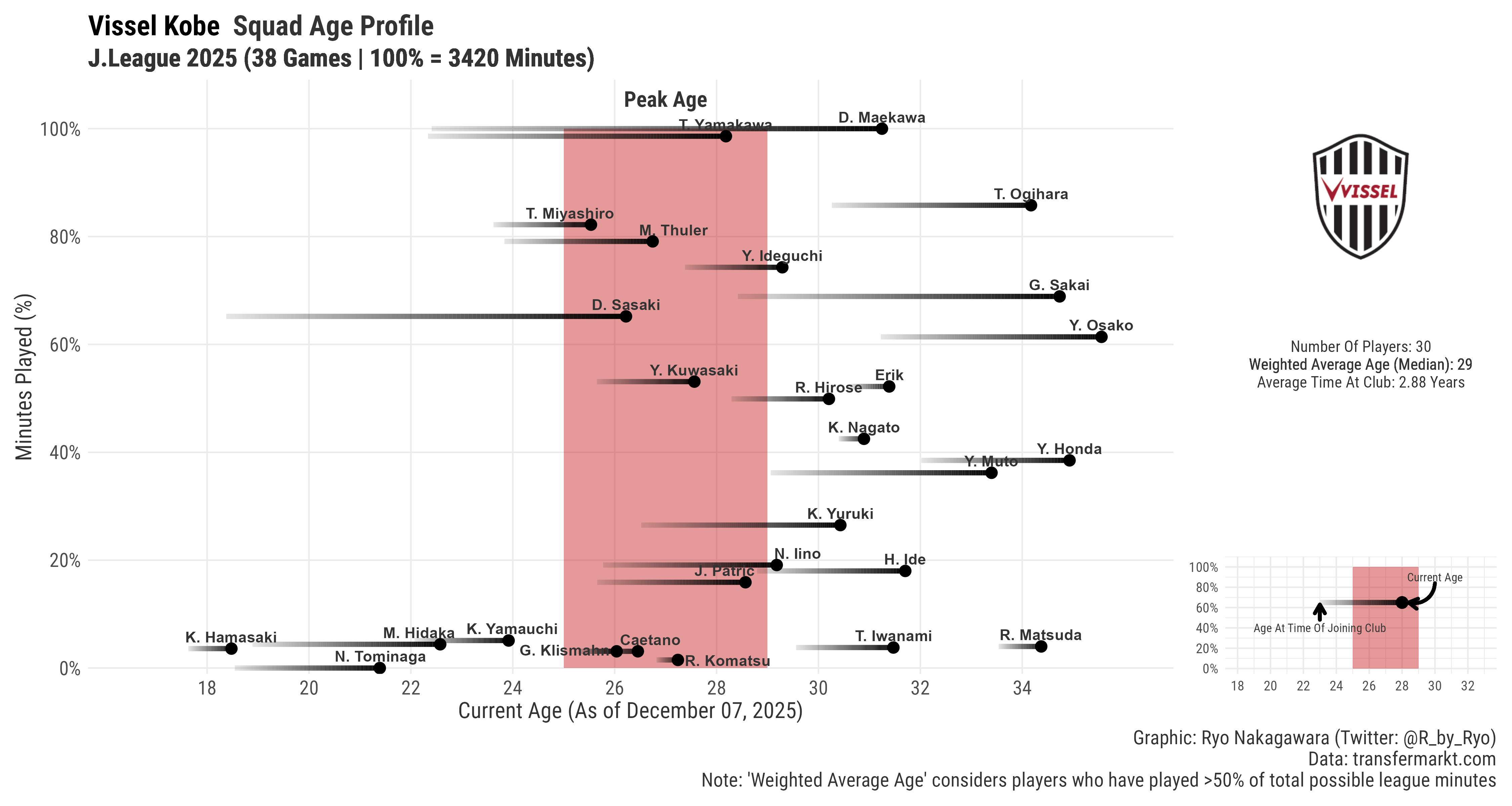
Yosuke Ideguchi took up most of the minutes being very active in the midfield engine next to Ogihara. Takahiro Ogihara continued to defy his age of 34 years with indefatigable performances, appearing and starting in the second most games among outfield players. The ex-Marinos man’s distribution from deep as well as his intelligence in covering for Kobe’s pressing attackers made him the foundation of Kobe’s play both in and out of possession. Meanwhile Haruya Ide who had been a pretty solid squad player was surprisingly absent for most of the season.


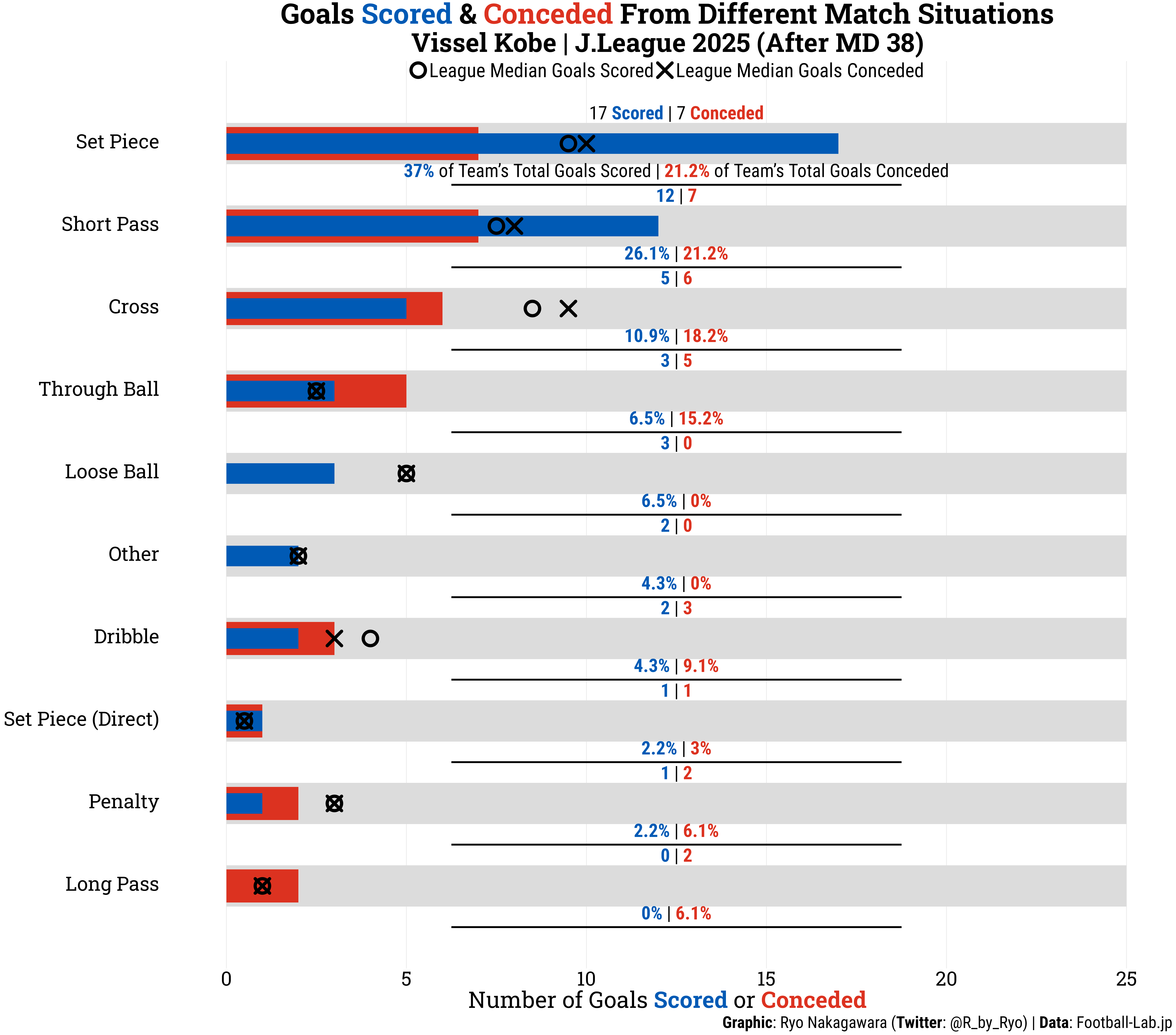
As seen in various scenes highlighted above, Kobe are known for their high intensity off-and-on the ball. In possession they are very direct with lots of line-breaking runs and overlaps down the wings. A majority of their goals have come from open-play crosses and subsequent set-pieces that they win off those situations.
In defense, Kobe press high, keep the block high and compact between-the-lines and immediately counter-press when they lose the ball. They can shift more into a 4-2-3-1 without the ball compared to their 4-3-3 in-possession. While their back-line is aging, their best player is still in his prime as Matheus Thuler continues to be a dominant J1 Center Back. Alongside the Brazilian has usually been Tetsushi Yamakawa. On the flanks Gotoku Sakai remains a very good Full Back on either side at this level despite increased competition in recent years from Nanasei Iino, Katsuya Nagato, and Yuya Kuwasaki.


In goal, Daiya Maekawa is... fine at the J1 level? That’s it though. He makes lots of good saves but I’ve always been extremely skeptical about his decision-making coming out for crosses or sweeping behind the defense line.


Kobe rotated a lot this year given their participation in many domestic and international competitions. This was an experienced squad that have won a bunch of trophies under Takayuki Yoshida in the past few years and yet... they (finally) fell short in a surprising fashion this season. Losing to relegation battlers Yokohama FC in the summer, then going win-less from October onward... including giving up a 2-0 lead vs. Albirex Niigata to a dire 2-2 draw punctured any ballooning hopes of a title repeat before even November! Kobe finished the season in poor form with no league wins since late September…
I’ve been saying this for the past few seasons now but Osako, Sakai, Muto, Ogihara aren’t getting any younger. Credit to Kobe though that they have actually been preparing for this eventuality by bringing in a number of slightly-younger guys to fill out the squad. I had written most of this section thinking manager Takayuki Yoshida would stay but he announced he was leaving the club at the last home game of the season! In a way it does make sense that Kobe want to look in a different direction as despite the unprecedented successes, this season laid bare some of the limitations of the team reliant on a few stars in attack.
I think a lot of Kobe’s transfer movements will depend on whether Taisei Miyashiro stays or goes to Europe and then turn to how to freshen up the aging defensive unit surrounding Matheus Thuler. Kobe are still one of the top dogs in J1 but things are shifting dramatically around them. I imagine with a new manager and purported new direction, Kobe are going to change considerably over the 100 Year Vision League as they prepare for the 2026-2027 season.
Machida Zelvia (6th, 60 Points)
17 Wins // 9 Draws // 12 Losses
Location // Stadium: Machida // Machida GION Stadium
Manager: Go Kuroda
52 Goals (7th); 38 Conceded (tied 5th)
46.04 xG (7th); 34.43 xGA (3rd)
Top goal scorer: Yuki Soma (8 goals plus 1 penalty)
Goalkeeper: Kosei Tani
A second season in J1 for Machida Zelvia under Go Kuroda and while the club were competitive across a increased number of fronts, it’s difficult to call it a true success given the mixed record across all competitions. Machida’s league form oscillated wildly between very good runs of form and some truly dire runs. An eight game winning streak from late June to August rocketed Machida back into title contention after a slow start but a solitary win in their last 11 matches of the season spelt the end for Machida’s title and ACL hopes in the autumn... On the other hand, Machida fought their way to a Emperor’s Cup victory, their first piece of major silverware in their entire history!
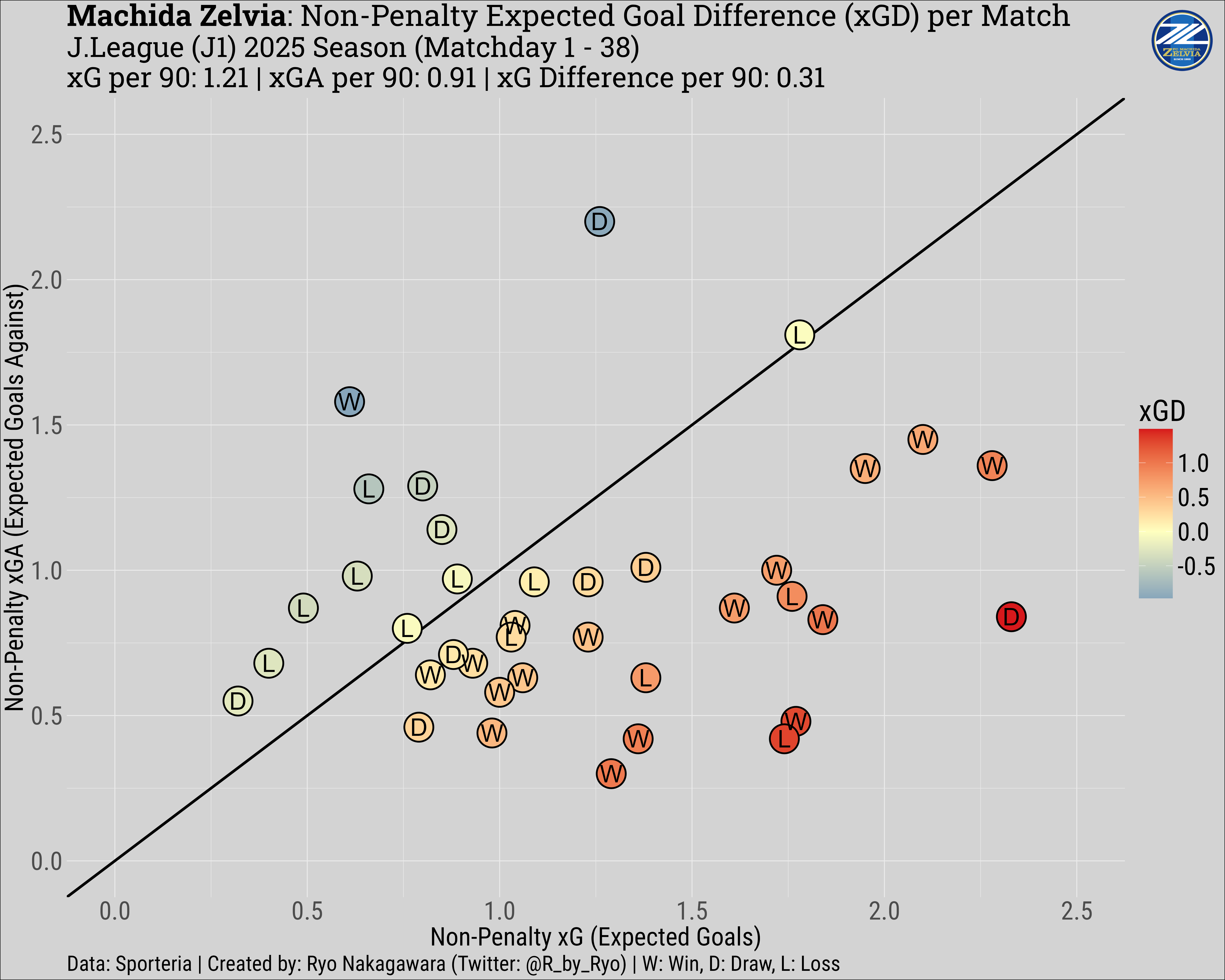
Some aspects of their notoriously miserly defending fell apart as they had some uncharacteristically heavy defeats like a 0-3 loss vs. Marinos and a crazy 3-5 loss away at Kawasaki Frontale but looking at things on the aggregate level things were still very good. However, the real story was their continuing attacking woes as I do feel like Machida struggle if one of their attackers don’t have a really good finishing day (or Yuta Nakayama blasting shots in from 30 meters out somehow...). Indeed, as the season came to a close, it became pretty obvious that their entire attack was Yuki Soma. That was it, just him. One guy. 2025 ended with a career high 9 goals and 9 assists for the winger as he also earned 5 caps for the Japan National Team.
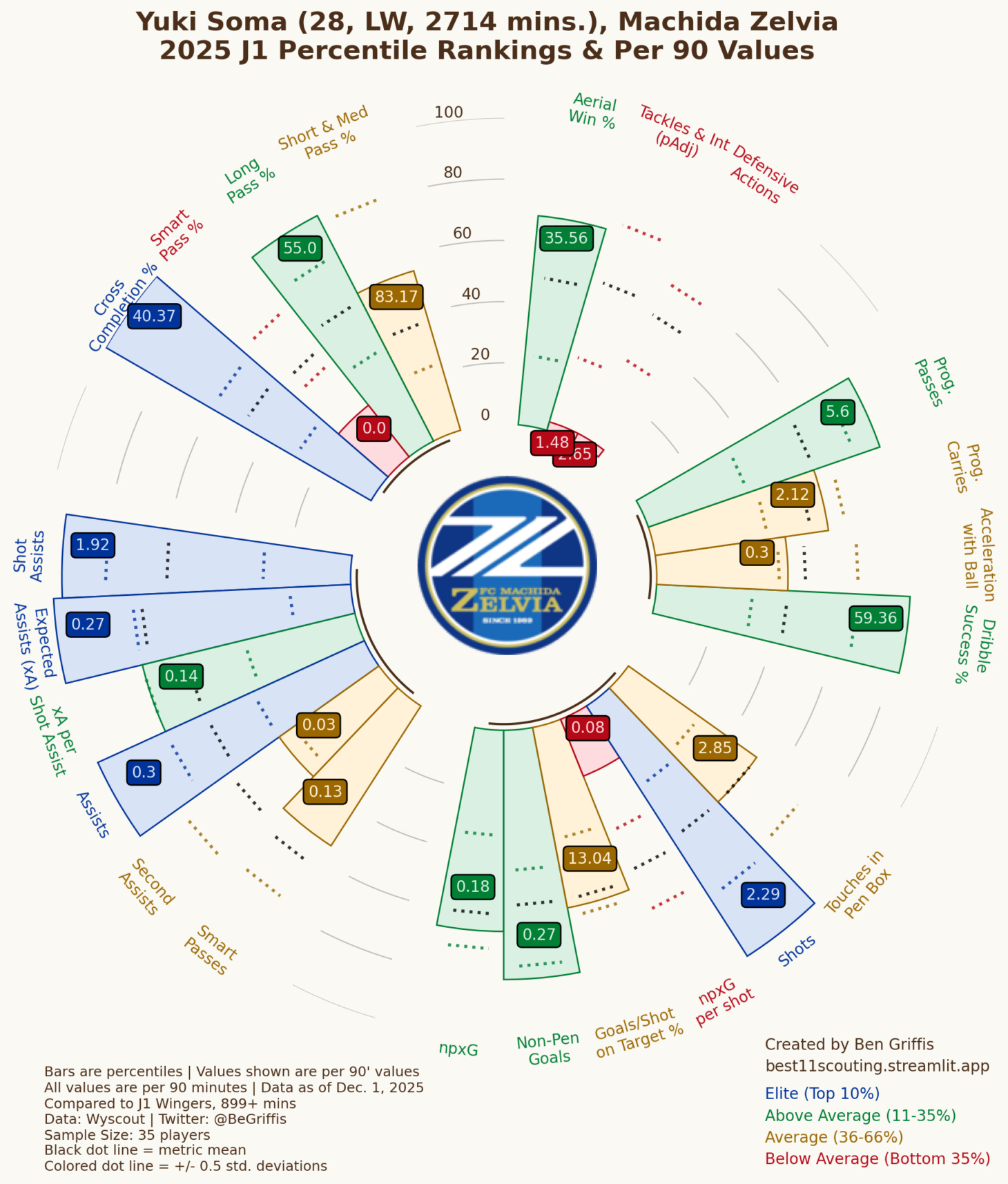
Well, to be a bit more charitable to the other attackers, Takuma Nishimura did a pretty good job with 7 goals and 4 assists but I do feel he’s more of a guy that adds the finishing touches rather than really driving the team like Soma did this season. Na Sah-Ho has provided value as more of a super-sub this season as well. Up front Oh Se-hun, Shota Fujio, and Mitchell Duke all brought the physicality and fit Machida’s need for a strong presence for long balls and crosses but there’s not a whole lot of goals between them (2, 2, and 3 goals respectively). Machida’s attacking substitutions consist of rotating these guys and it was all one and the same much-ness.


Otherwise, Kotaro Hayashi made a copious amount of crosses and long throws while Henry Mochizuki continued to be an useful tool for ball progression. Mochizuki is an unique profile to come out of Japanese football. I have various concerns about his individual 1v1 defending and general inexperience handling defensive situations. However, his physical aspects can’t be denied and it’s a big reason why Moriyasu has been happy to give him minutes for the national team. Mochizuki’s strengths are as a “wide target man” for long balls and diagonal passes around the middle 3rd of the pitch, from where he then uses his powerful strides to push into the final 3rd. Unfortunately his end-product isn’t particularly noteworthy when he gets into dangerous areas and his ball carrying ability doesn’t extend to taking opponents on the dribble to enter the box. Already (surprisingly) 24 years old, I’m not sure how much upside he has, especially if he has to play against opponents who can easily match his physicality and then are also vastly more experienced on top of that.


Kuroda is going to really have to re-jig how the attack works because Machida have shown themselves to be vulnerable enough that simply relying on set-pieces isn’t enough for narrow 1-0 victories. I expect some considerable expenditures for some attackers in the winter window, especially with the ACL knockouts looming in February.
Looking at their attacking metrics:
7th in xG, 7th in goals
11th in shots taken, 13th in shots on target, 2nd in xG per shot
10th in final 3rd entries, 14th in penalty box entries
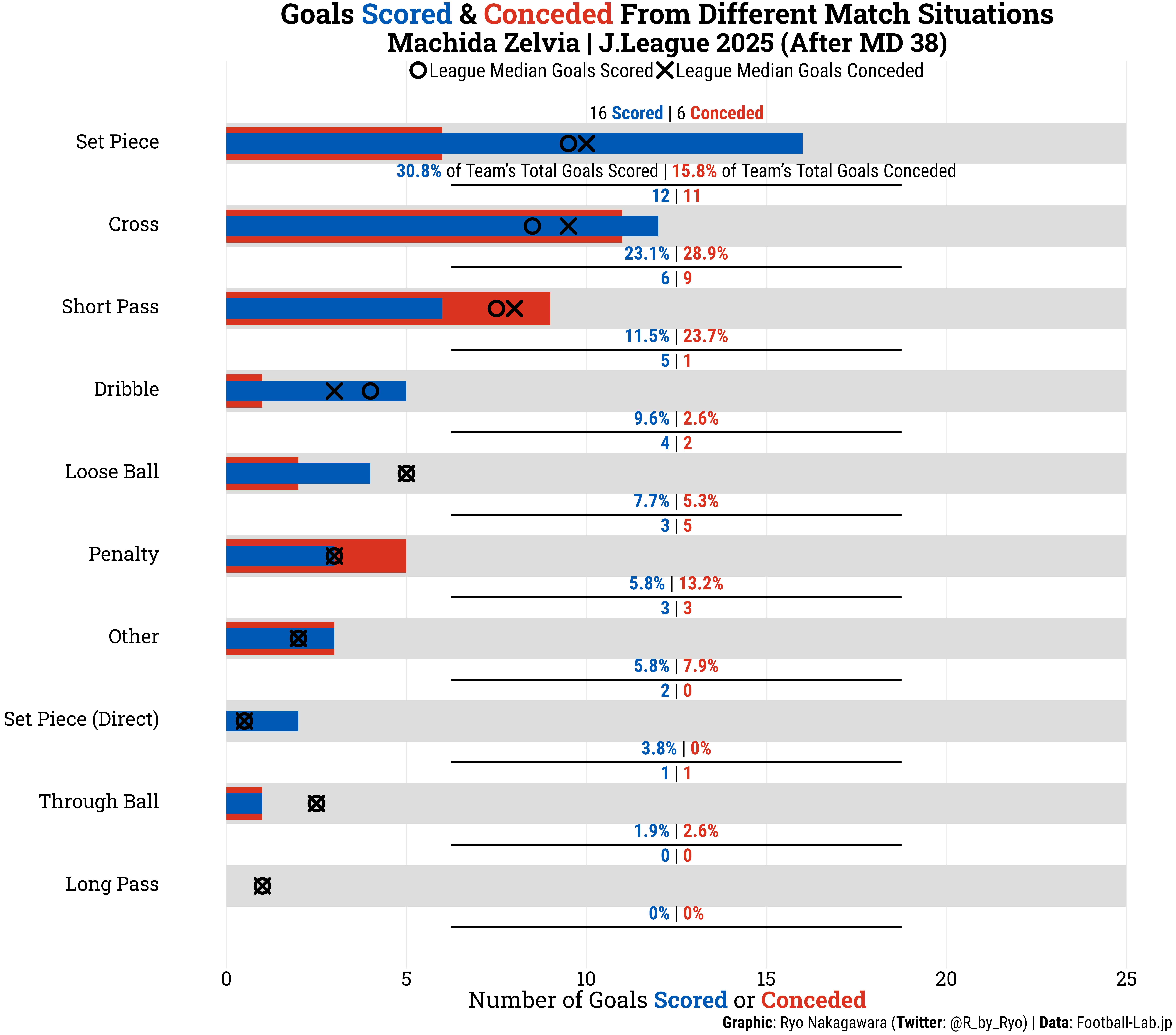
Their goals came in spurts and bursts like trying to get the last of the ketchup out of a bottle. The winning run in the summer came off a long stretch of games where they managed to score more than 2 or more goals for all but one game in a eight game winning streak. That was followed by a period where they were kept goalless for four games and another four with only a single goal scored in the remaining 11 games of the season. As we’ve become accustomed to over 30% of their goals came from set-piece situations and a further 23% were from open-play crosses.
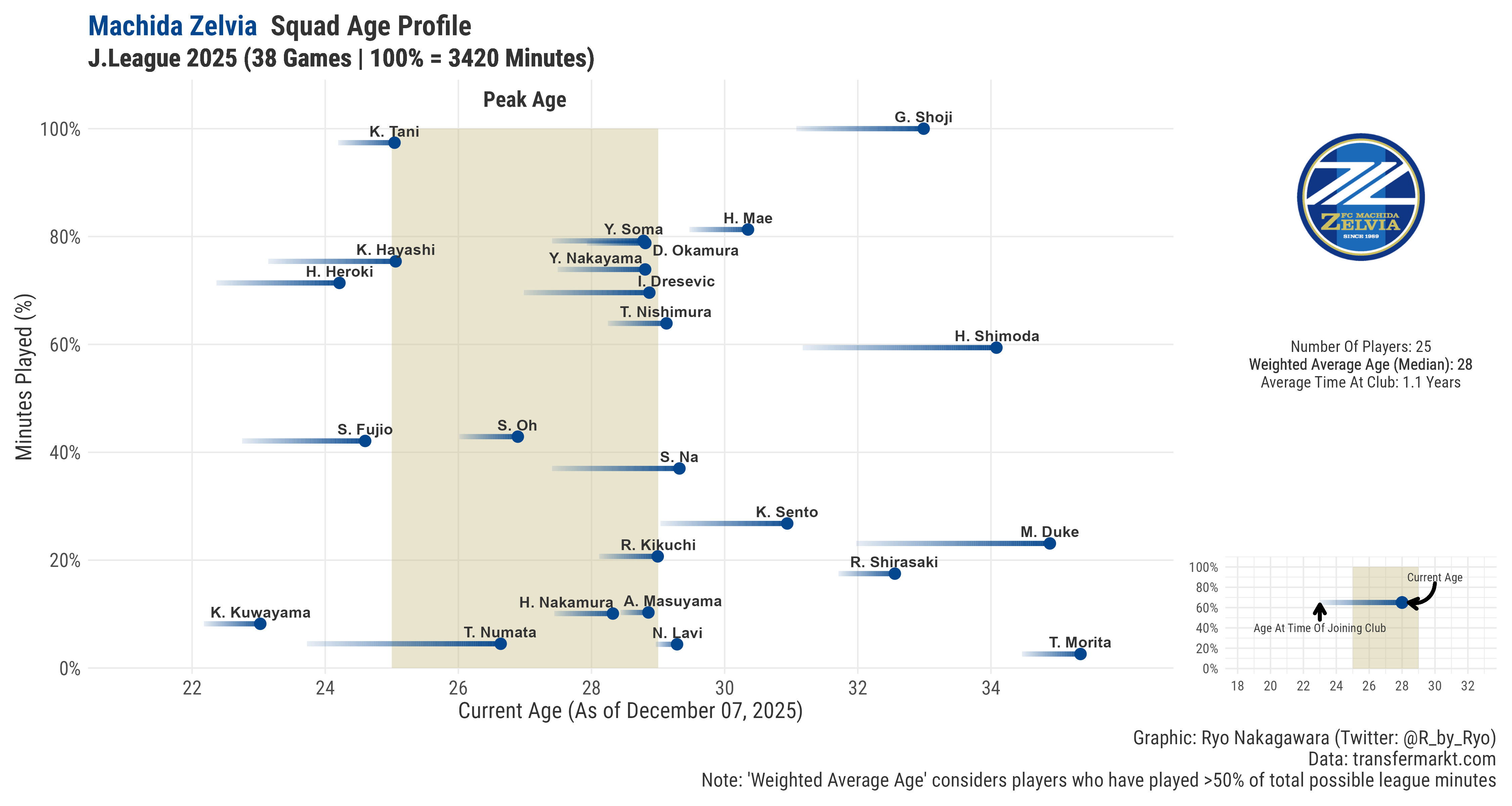
The key player in defense was Gen Shoji. All of his experience marshaled another strong season from the Machida defense line in general. Shoji in particular though, excelled not just in his defensive duties but also for his long range passing which was a major means of switching play and providing ball progression via Henry Mochizuki as the outlet. Daihachi Okamura joined last winter to add even more height and brawn and he looked the part until an injury curtailed a good debut season. In terms of injuries, Ryuho Kikuchi suffered yet another knee injury that will keep him out for the foreseeable future. With all these injuries around him, Ibrahim Dresevic was a reliable and fairly consistent member of the back line along with Yuta Nakayama who also stepped into midfield a few times. Machida continued to really do well in terms of suppressing the total number of shots conceded as they kept themselves in the top 3 for this metric two seasons in a row.


Hiroyuki Mae has turned into a midfield regular and their best ball-winner in the middle of the park as Hokuto Shimoda slowly continues to age out. Keiya Sento barely played to the point that Yuta Nakayama played in midfield a lot more compared to previous years. Curiously despite all the fanfare of his signing Neta Lavi barely got game-time but perhaps he’s still getting used to the very different tactics employed at Machida compared to his former team.
Overall, a first ever major trophy and steady but unspectacular progress in Machida’s maiden Asian Champions League campaign so far so even with the middling league form it was a good season. It’ll be interesting to see how Machida’s Asian Champions League campaign continues in February as they will be the only Japanese representatives with managerial continuity heading into the knock-outs…
Urawa Reds (7th, 59 points)
16 Wins // 11 Draws // 11 Losses
Location // Stadium: Urawa // Saitama Stadium
Manager: Maciej Skorża
45 Goals (11th); 39 Conceded (7th)
44.92 xG (8th); 50.8 xGA (19th)
Top goal scorer: Ryoma Watanabe (7 goals)
Goalkeeper: Shusaku Nishikawa
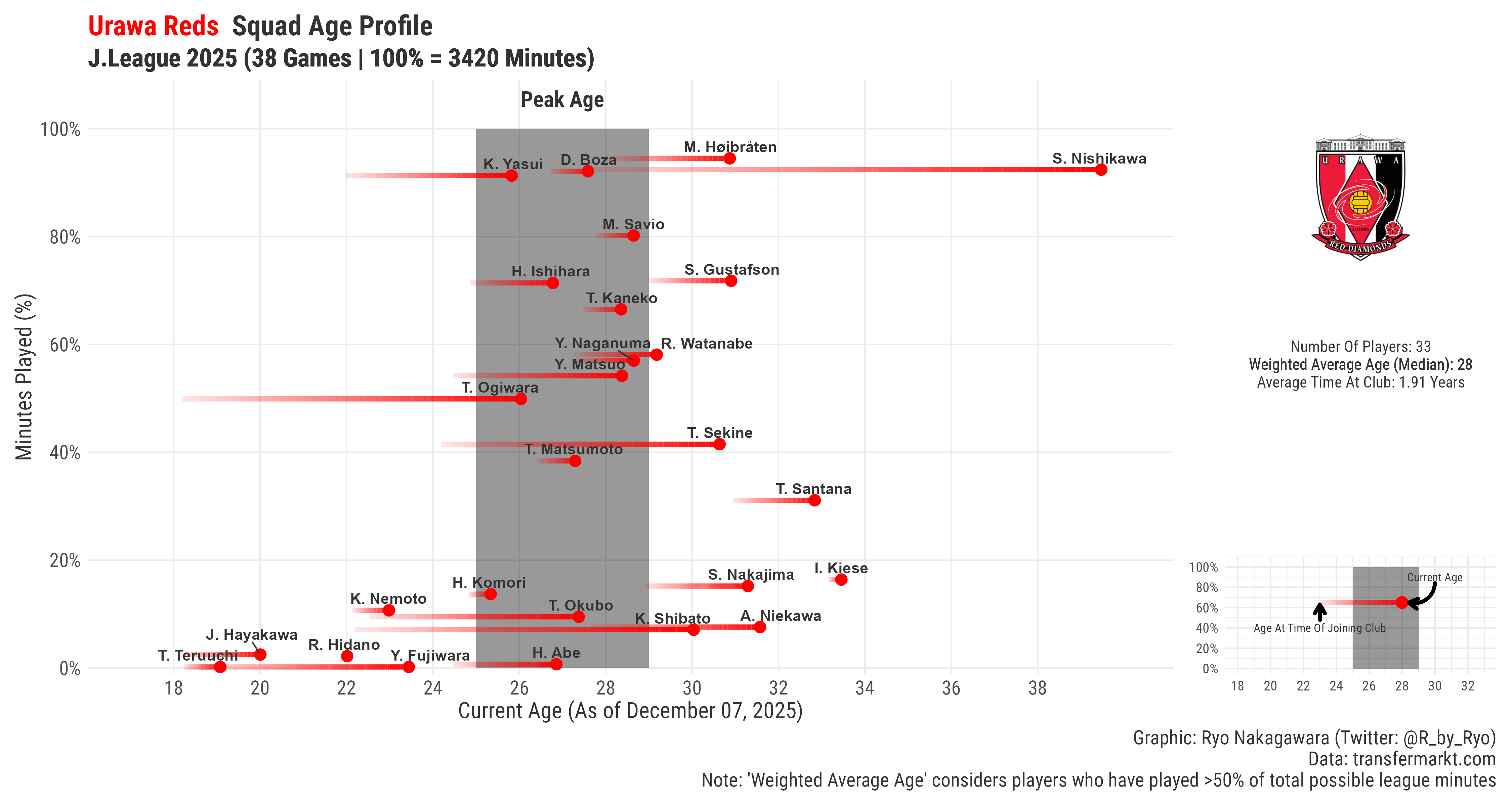
Despite an appearance at the inaugural Club World Cup, it was another truly disappointing season for Urawa Reds. There was supposed to be a coherent multi-year plan building up to the big tournament but it all finished in a whimper as the Reds crashed out in the group stages despite their vociferous fan support in the American stands going viral. In terms of actual J1 league play, the less said the better. Despite multiple years under Maceij Skorza across two stints, this Urawa Reds team lacks a consistent play-style and identity. The Reds once again finished in a disappointing mid-table position, far away from even an Asian Champions League spot.


The biggest question for me over this season has been... what exactly is Urawa’s play-style? Skorza has been gifted with lots of talented individual pieces but over two separate tenures spread out over nearly three seasons the Pole hasn’t managed to figure out the actual tactical plans to platform them in the best way... which is his main job. A lot of Urawa’s goals and victories seem to come from individual brilliance that has papered over the cracks of a lack of coherent strategy at the managerial level and also at an organizational level. It shouldn’t be surprising then that over the past few years Urawa have usually run out of steam and finished seasons on a down note.
In the build-up phase, players don’t seem to see eye-to-eye with each other at all even though some of them have been playing together for quite some time now! Veteran goalkeeper Shusaku Nishikawa has always looked a bit awkward in these situations despite the fact that his long-range passing is superb. It’s no wonder why Urawa had been in for somebody like Ryosuke Kojima a few years ago but I’m surprised they didn’t continue pursuing him nor try to get someone similar instead. I suppose they’re just going to refresh the goalkeeping unit with Ryusei Sato coming from Tsukuba University next season instead of buying someone outright especially as I don’t think Niekawa, Matsuyama, etc. are quite good enough.
I’ve never really been convinced by Marius Hoibraten but Danilo Boza has been a positive for Urawa’s back-line in my opinion. At the very least both have been very fit this season and have kept the competition sat on the bench which led to Rikito Inoue leaving for Cerezo Osaka. With Hoibraten leaving I imagine Kenta Nemoto will be given a lot of time to adapt but numbers-wise Urawa will need to grab another veteran Center Back, especially if they don’t think Yudai Fujiwara, Kota Kudo (coming back from loan), among others are considered good enough by management.


To me, an issue aside from the tactics is at Full Back. Over the past few seasons, Urawa have gone from having solid-to-very-good players like Hiroki Sakai, Takahiro Akimoto, and Ayumu Ohata… to Yoichi Naganuma, Hirokazu Ishihara, and shoe-horning Takahiro Sekine there. The only half-decent player is Takuya Ogiwara. The first two came from bottom-half clubs and haven’t impressed while the latter has never convinced me in any position, let alone at Full Back (I just don’t understand Skorza’s obsession with him playing there...). I think reinforcing the Full Back position is going to be of huge importance in the winter transfer window.
What surprised me the most looking at the data was that if you look at non-penalty xGA and xGA per Shot, Urawa are pretty much the worst in the league in both metrics! Yet, they have somehow only conceded 39 goals from 50.8 xGA which shows you the amount of quality saves that Nishikawa has been pulling off and the fact that Urawa have been let off by poor opponent finishing. They also conceded the 3rd most shots.


The base of midfield is fine-ish. I’ve been a huge fan of Samuel Gustafson but he keeps being linked back to his homeland for a variety of reasons. Kaito Yasui is a cromulent J1 level midfielder. He’s a bit of a jack-of-all-trades in my opinion and is very good at supporting his teammates in possession. The other options were Kai Shibato who was injured for a large chunk of the season and Taishi Matsumoto who is probably better as depth in the #10 position so all in all center midfield is yet another position that Urawa will need to invest in especially if Gustafson leaves.


Matheus Savio, take the game “by the scruff of the neck” and drags team forward but... I do feel Urawa are too reliant on that, it’s not enough to just give the ball to him and hope for the best. The Brazilian puts in enormous effort in attack and defense, usually showing up as the player that has covered the most distance in any given Urawa match. And yet you ideally want him to be using that energy efficiently, targeting it within a tactical structure rather than just wasting it fighting fires or bursting forward without support. Nevertheless he finished the season with 4 goals (from 4.5 xG) and 8 assists, pretty good despite the circumstances! Alongside the mercurial Brazilian, Ryoma Watanabe finished as the team’s leading goal scorer with 7 goals... but he only scored once in the 2nd half of the season. Once again, he put in a lot of effort across a number of different positions and was one of the most important members of the team.
I do wonder how Urawa will organize their attacking options as they have a lot of them. They’ve managed to move on Naoki Maeda and Genki Haraguchi but if we assume Ryoma Watanabe, Savio, and Takuro Kaneko are the main starters (depending on whether or not Matsuo is playing Striker), then you still have Shoya Nakajima, Tomoaki Okubo, Takahiro Sekine, and Jumpei Hayakawa on the books (I won’t count Hiroki Abe for obvious reasons). I do think they might need to let go of around two of these players, especially when you consider Taishi Matsumoto and Kaito Yasui can step into the attacking midfield spots as well.


Thiago Santana’s Urawa Reds stay fizzled out this season as his play-style never quite gelled with what Skorza wanted out of his strikers and during the worst periods of the season, Santana was also getting into arguments with fans. The striker position has been a huge problem for Urawa over the past few years. Out of the various attempts, Toshiki Takahashi finally moved on permanently to S-Pulse, Motoki Nagakura has been fitting in very well on-loan at FC Tokyo, while Rio Nitta is probably not good enough and may benefit from another loan to Shonan in J2 next season or an outright sale. However, Hiiro Komori & Isaac Kiese-Thelin might finally be the light at the end of the tunnel. Komori in particular, despite some injury woes, have shown that cunning fox-in-the-box movement that made him so dangerous for JEF United and finished the season with 4 goals in very limited playing time. With all the turmoil up top, it’s been Yusuke Matsuo’s job to lead the line for most of the season. He even earned some plaudits at the Club World Cup for his energetic displays. I do like him but he’s not quite the 20-goal-a-season striker that Urawa need and should return to playing out wide if Komori & Kiese-Thelin can consistently perform next season.


Two wins and even worse, just two goals in the final 10 games of the season… well this sentence was ruined by the fact that Urawa somehow managed to scored 4 in their last match of the season! Anyway, the point is that this period really put things into perspective for Urawa Reds, they are miles off where they want to be. There are so many questions to be had:
What is medium-long term plan for the next few years?
What football do they want to play and can they clarify that for their fans and across their organization?
Can their recruitment team acquire players for that vision?
Can they bring along a manager that can understand that vision and handle the pressures of managing the big expectations that Urawa has?
It’s not just the plan itself but the process with which they go forward that will be key. It will be interesting to see how Urawa handle an increasingly competitive J.League as traditionally strong teams around them reset and refresh, while other teams start pushing up from the lower divisions as well such as neighborhood rivals Red Bull Omiya Ardija. Urawa already announced in mid-November that Thiago Santana and Marius Hoibraten were being released at the end of the season and 18 year old Luka Didulica will be joining the club in January, so there’s already some movements on the player front. A day before this newsletter was sent, Urawa announced that Maciej Skorza will be staying on next year. The 100 Year Vision League should period give Urawa some time to really look inward and think about the next few years...
Are they willing to accept they need time to rebuild, will their pride allow it?
Kawasaki Frontale (8th, 57 Points)
15 Wins // 12 Draws // 11 Losses
Location // Stadium: Kawasaki // Todoroki Athletics Stadium
Manager: Shigetoshi Hasebe
67 Goals (1st); 57 Conceded (tied 17th)
50.88 xG (3rd); 41.82 xGA (8th)
Top goal scorer: Tatsuya Ito (13 goals)
Goalkeeper: Louis Yamaguchi
With Tohru Oniki leaving after eight years and unprecedented success at the helm, Kawasaki Frontale entered a new era under the appointed successor, Shigetoshi Hasebe. The season started off well with Frontale only losing twice in their first 15 games of the season (albeit this included seven draws...) along with a heroic Asian Champions League campaign that saw them lose in the final to Al-Ahli. I thought things looked quite good in the 1st Half of the season, then it all just fell apart! In the mid-season review I wrote about how I thought they were a bit unlucky with their finishing while opponents were very clinical.
However, from the 2nd half of the season their defense just got progressively worse especially after Kota Takai left for Spurs and Yuichi Maruyama got a long term injury. Bonkers scorelines like a 4-3 win vs. Nagoya Grampus, 2-5 loss vs. Avispa Fukuoka (an early red card by replacement defender Uremovic helped with that, of course), two separate 5-3 wins vs. Shimizu S-Pulse and Machida Zelvia, and finally a 4-4 draw with Kashiwa Reysol represented a very chaotic Kawasaki Frontale team.


Let’s be honest, the 2nd half of the season was basically saved by Tatsuya Ito going “Super Saiyan Mode” to keep Frontale in mid-table despite the rapidly declining consistency and performance levels across the board. He scored 13 goals but 11 of them came from July onward. Ito had two separate spells where he scored in four consecutive game stretches! Of course, it wasn’t just his shooting but his dribbling was a threat all season long.


Marcinho continued to provide pace and trickery out wide, although his 6 goals and 3 assists left a bit to be desired compared to his past seasons. It does look like Akihiro Ienaga is finally on his last legs at the age of 39 as his appearances dramatically declined from the previous year. It’s been quite an incredible run for the veteran considering his best seasons and trophies have come after his 30th birthday! The very definition of “aging like fine wine”!


Despite Ten Miyagi’s 4 goals, he did not start a single one of his 19 appearances and it remains to be seen whether he, along with a few other young attackers on the fringes of the squad like Toya Myogan and Hinata Yamauchi actually have a future at Kawasaki Frontale.
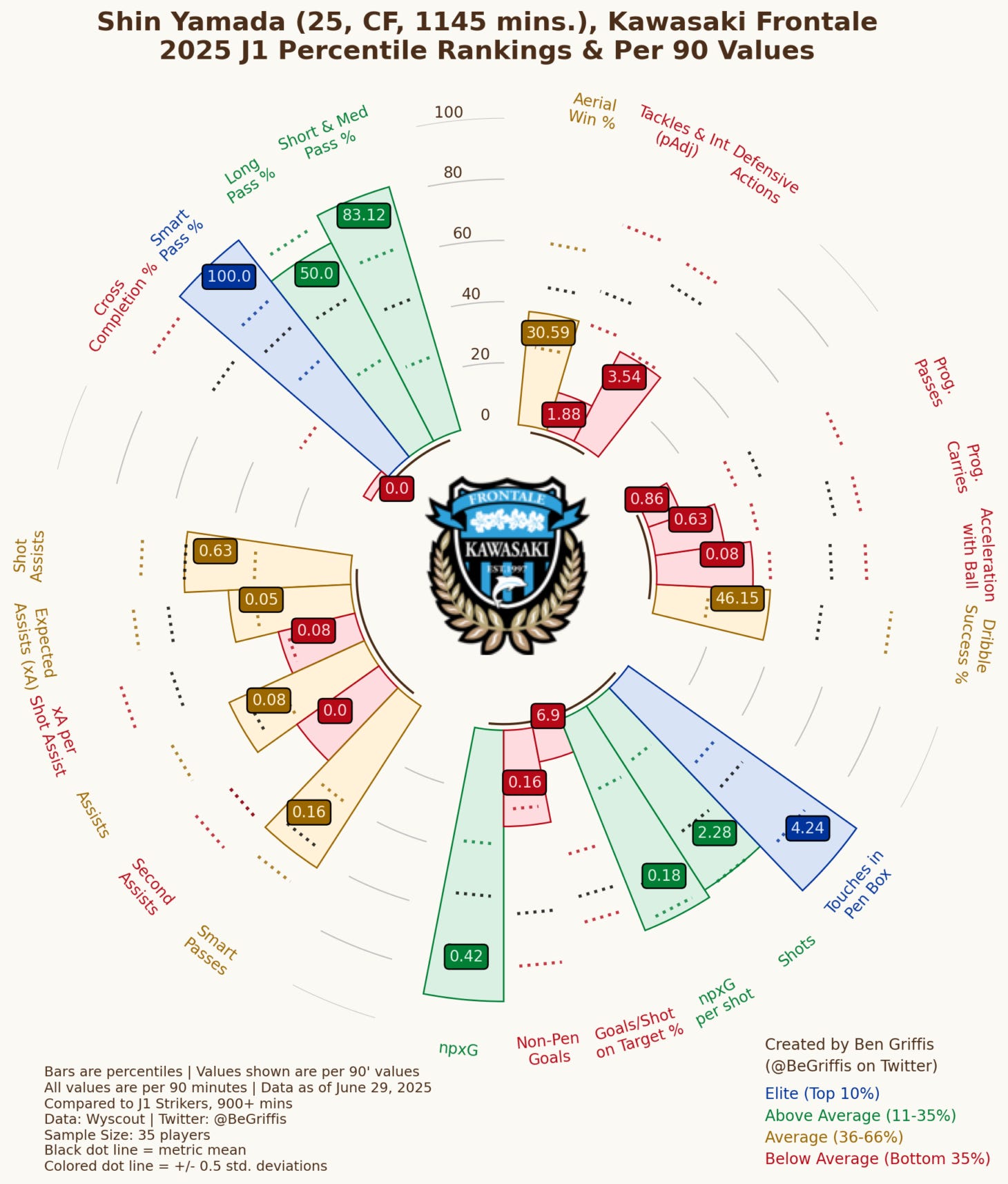
Erison fired home 12 goals from 10.39 xG which was a good return. It’s clear he’s the top dog up top now with Shin Yamada misfiring and then leaving for Celtic in the summer. The Brazilian’s physicality and dogged desire to get shots off in the box is a huge positive. Yu Kobayashi is well past it now but provides some use as a back-up while Soma Kanda will be hoping for more playing time next season. Lazar Romanic was brought in after Yamada’s summer exit but hasn’t quite got going at all, the Frontale faithful will need to be a bit more patient with him I guess.
Shogun Soccer Scouting #9: Shin Yamada

Hello! The J.League season is in full swing now since my last newsletter and I’m back with another scouting piece. No, this is not an April Fools. We’re at #9 in this series now so it’s only right that it’s about a striker… Shin Yamada.
So Kawahara and Yuki Yamamoto became the clear midfield double-pivot under Hasebe this season as Kento Tachibanada fell down the pecking order, then suffered a medium term injury in the final months of the season. Yamamoto continues to be great and I was very surprised to see him not be selected for the EAFF Japan squad. I was a bit disappointed Yuto Ozeki didn’t get more minutes but hopefully his time will come next season and he did get a decent amount of playing time throughout the various youth national team tournaments he was a part of anyway.


Shogun Soccer Scouting #5: Yuto Ozeki

Hello, welcome to another Shogun Soccer Scouting feature, this time on Yuto Ozeki.
Ozeki’s lack of minutes can be attributed to the fact that Yasuto Wakizaka remains the nailed-on starting #10 on this team as well as one of the best players in the entire league. I can’t stop gushing about how fantastic Wakizaka is. Incredible spatial awareness to face forward on the half-turn and of course wonderful passing ability to create numerous chances per game. It will always be a huge shame that many people won’t know his brilliance and his lack of major opportunities at the national team level will always remain baffling. In any case, Wakizaka looks set to emulate his idol Kengo Nakamura after receiving his #14 shirt to also retire at Frontale as a one club man.


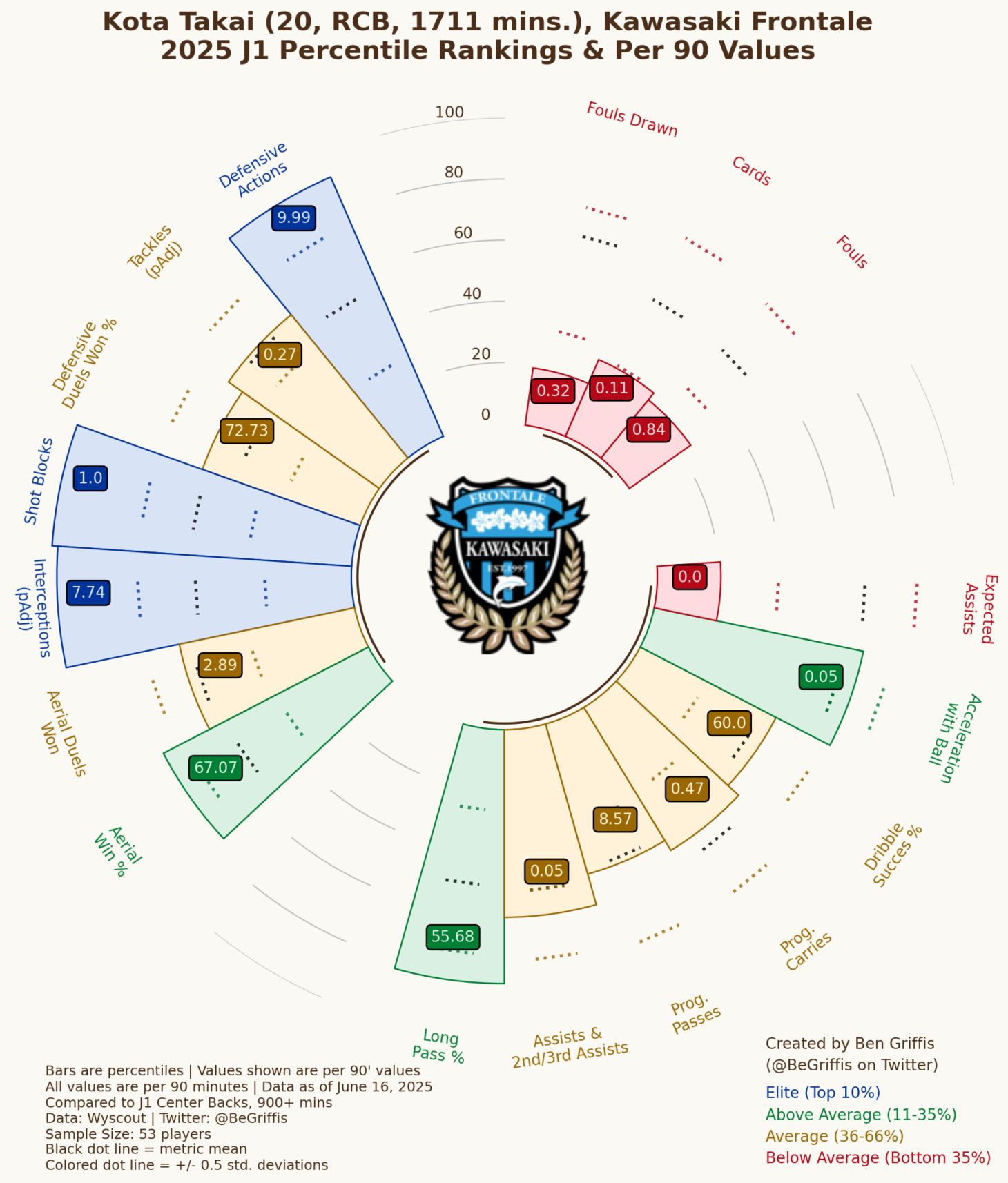
Kota Takai leaving was well-within expectations but then losing Yuichi Maruyama to a season-ending injury really put a spanner in the works as summer signing Filip Uremovic needed time to adapt. This also had the knock-on effect of pushing Asahi Sasaki permanently back inside to Center Back, which then left the Full Back depth pretty bare. Sota Miura played quite well, bombing forward whenever he was on the pitch but those recurring injuries do make me worried for him.
Shogun Soccer Scouting #13: Kota Takai

After releasing a newsletter on Hayato Inamura earlier this week, big news hit that very night with Kota Takai linked to Spurs. Various outlets are saying all that’s left is the medical! It’s obviously not official yet but this will mostly be written up with Tottenham Hotspur in mind.
It’s pretty clear that Shuto Tanabe is simply not good enough at the J1 level and Full Back will need some reinforcements in the winter... I do think Asahi Sasaki was probably the MVP of this team due to his efforts all across the defense. It’s hard to fault him too much for Frontale’s defensive frailities when things were in a flux around and in front of him for the 2nd half of the season.


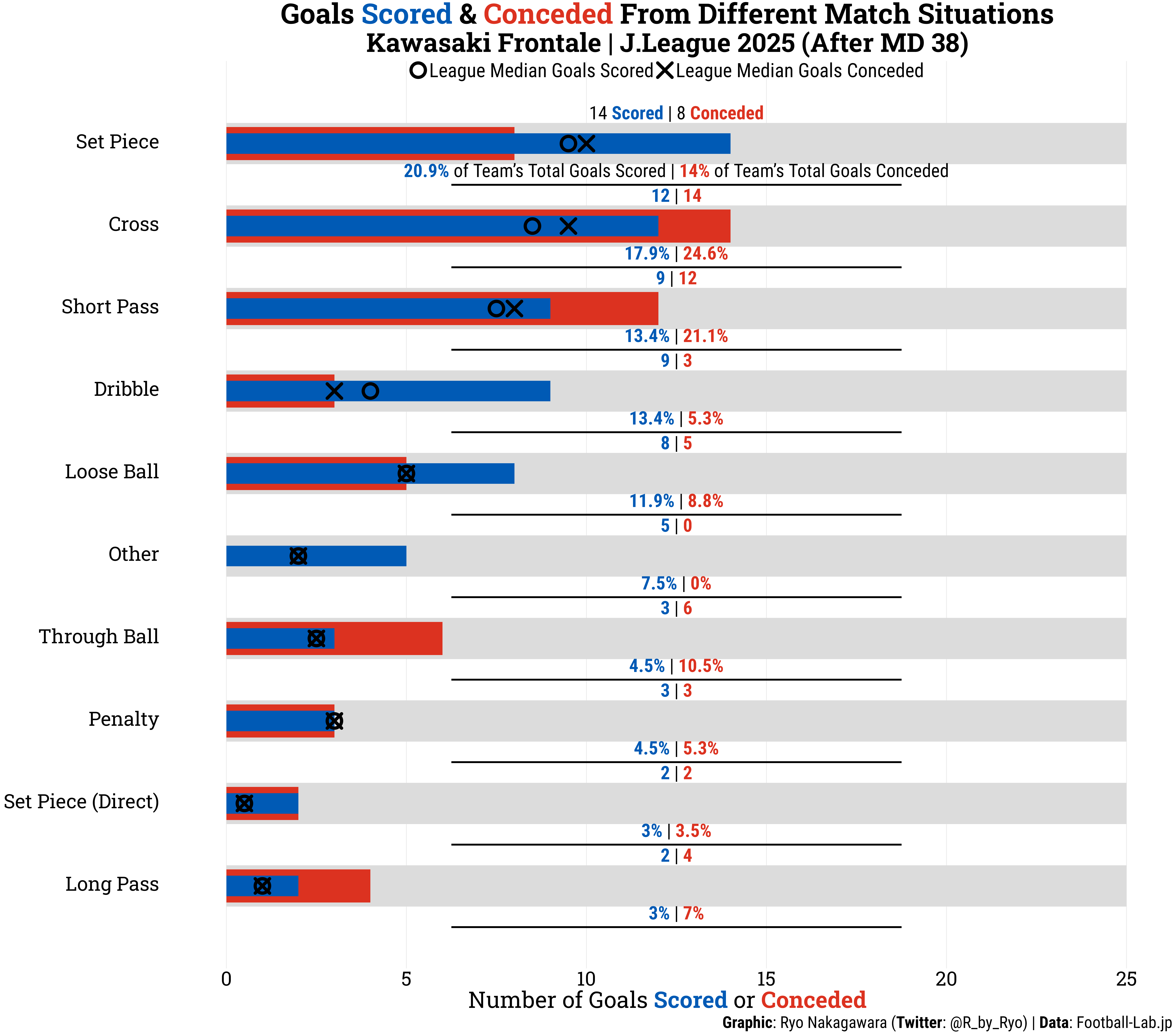
In terms of the data, it’s a bit difficult to delve further without more detailed data available to me. However, what does stand out from the aggregated data is that the fact that opponents finished their chances to score far more goals than the actual xGA value conceded by Frontale (something I discussed in the mid-season review) continued in the 2nd half of the season. I was a bit surprised by the fact that Frontale only conceded 41.82 xGA which put them 8th in the league compared to their goals conceded total which was down in 17th place. Frontale were particularly vulnerable from chances from crosses and intricate passing moves which make sense considering how porous their pressing and block were. It also didn’t help that Louis Yamaguchi was quite mediocre throughout the season…
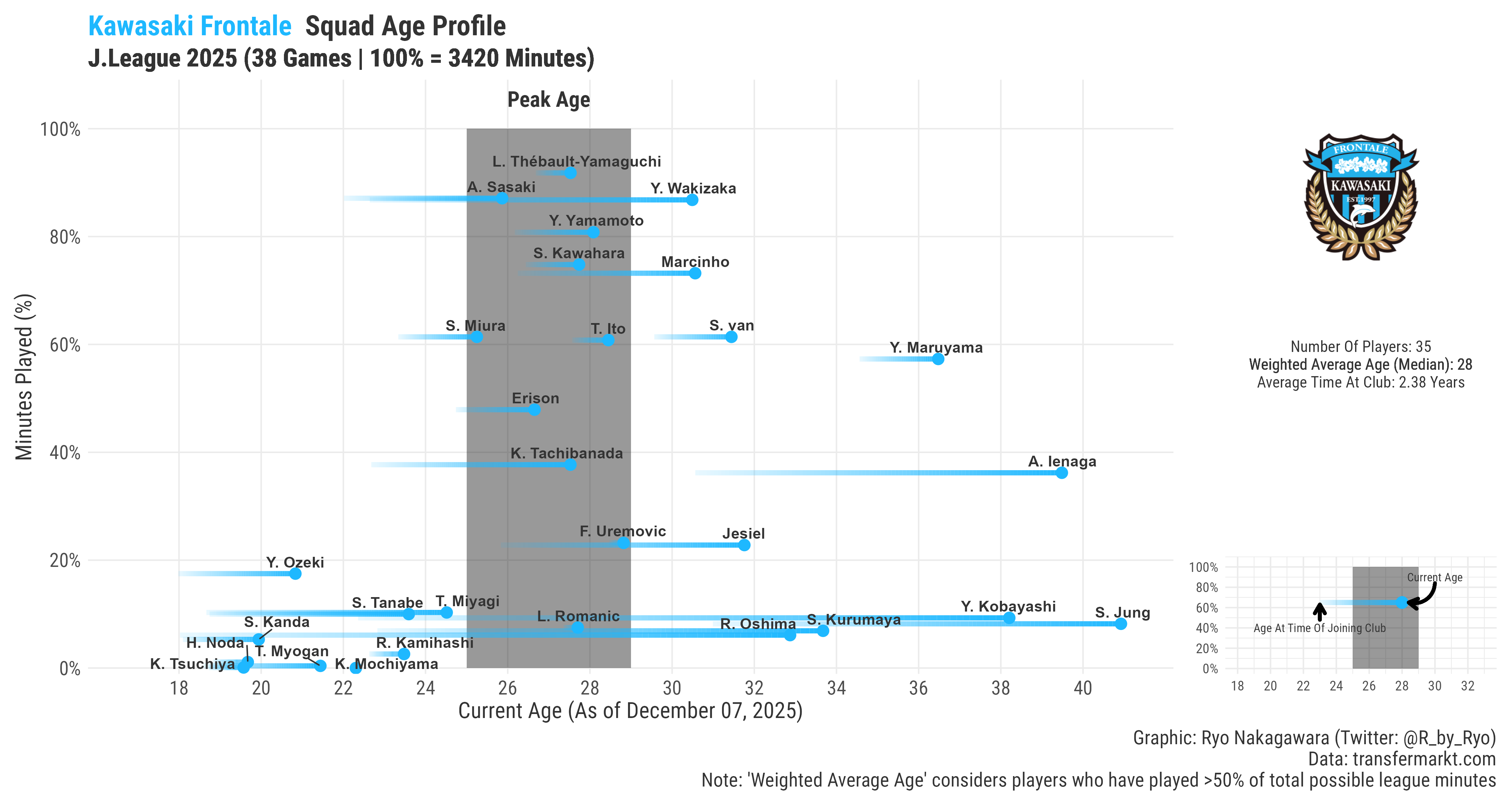
I don’t think there are any other teams in the world (outside of the J.League that is) that would continue to keep not just one, not just two, but all three of Shintaro Kurumaya, Jesiel, Ryota Oshima given their injury records for as long as Kawasaki Frontale have. However, Kurumaya announced his retirement in mid-November while Jesiel announced that he was leaving as well. Frontale have been operating without counting on them too much for several years now but more recent reinforcements like Uremovic and Romanic clearly still need time to adapt to J1 football.
In the 2nd half of 2025, it did seem like Frontale shifted to becoming far more attacking and sacrificing a lot of cohesion as a result of injuries and an evolving squad. This is still a team with a lot of quality in every position (except perhaps goalkeeper) so I do think the league position is disappointing.
As a result, I expect quite a bit of transfer turnover during the winter. Frontale will definitely need another Full Back (or two if Sota Miura/Asahi Sasaki leaves), a Winger (as Segawa left, Ienaga is finally showing his age, and I don’t think Myogan nor Miyagi are going to be good enough), one more ready-made Center Back (while also trying to develop Kaito Tsuchiya and Ryota Kamihashi). In addition, I expect Shigetoshi Hasebe to re-emphasize his defensive tactical instructions during pre-season as there are lots of issues that aren’t just personnel related in my opinion.
Gamba Osaka (9th, 57 Points)
17 Wins // 6 Draws // 15 Losses
Location // Stadium: Osaka // Panasonic Stadium
Manager: Dani Poyatos (Spain)
53 Goals (7th); 55 Conceded (16th)
44.5 xG (4th); 41.08 xGA (11th)
Top goal scorer: Takashi Usami (6 goals plus 2 penalties)
Goalkeeper: Jun Ichimori
After a very good 2024 season, Dani Poyatos seemed to have finally figured out how to get Gamba clicking so the results in 2025 were a complete disaster. Some of this was out of his hands as a big blow was losing Dawhan in pre-season to a Chinese club. Subsequent reinforcements weren’t forthcoming which led to Gamba’s middling start to the season where they won only four out of their first 10 games. Just as things started to stabilize, they lost Neta Lavi to Machida Zelvia in the summer. Although ironically that precipitated their best run of the season when they won five straight games through late August to the end of September. Overall though, Gamba mostly bounced around upper-and-lower mid-table without really threatening the title chasers nor having any fears of relegation which made for a pretty drab season.
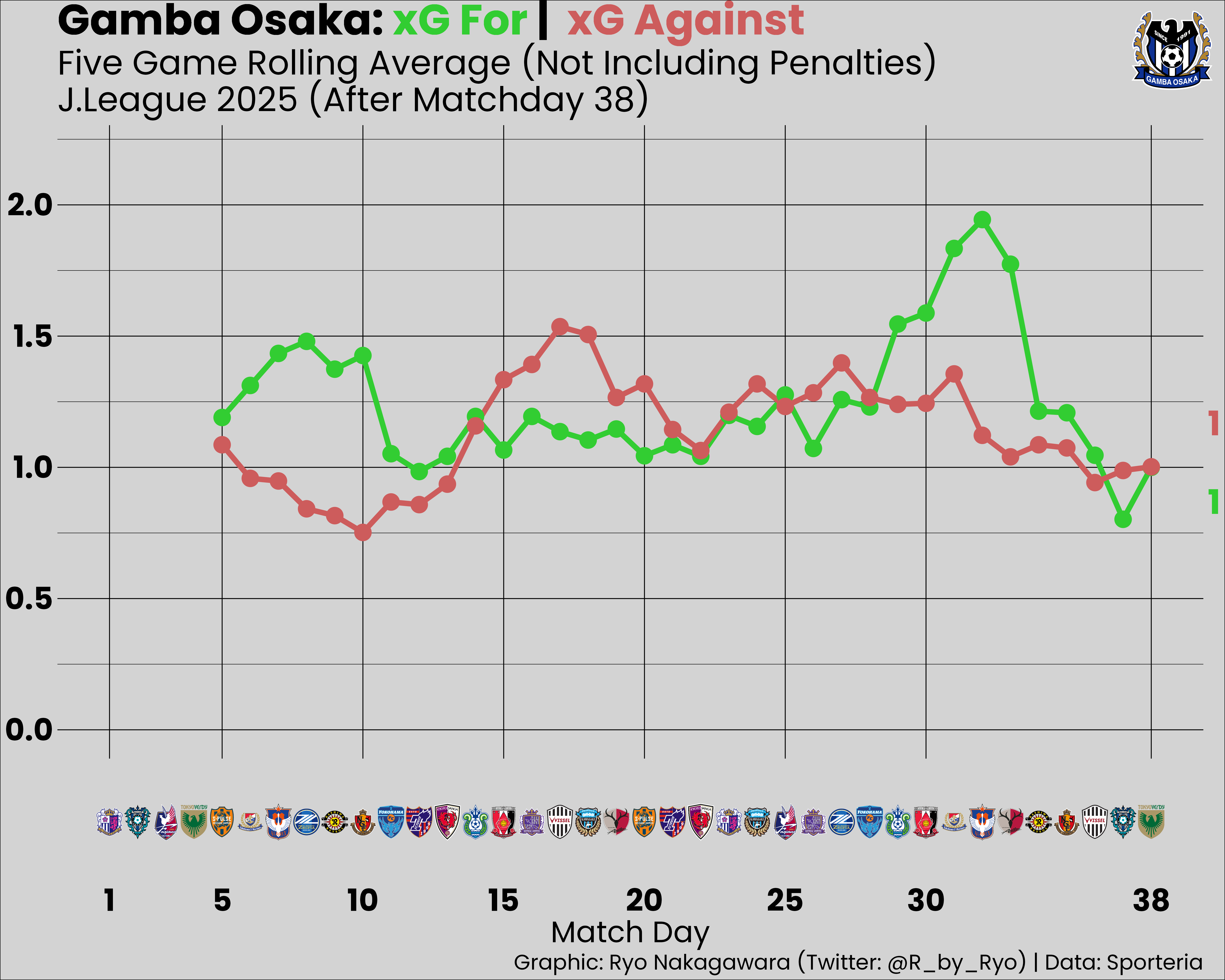
Of course, it wasn’t just transfers that derailed Gamba’s season but injuries to various players had an impact as well. Star winger Welton was injured for large portions of the season along with marquee signing Kanji Okunuki. Ryotaro Meshino disappeared for most of the season. Juan Alano who has been a decent depth piece also suffered from injuries. Ryoya Yamashita ended up being the only true winger that was able to stay fit for most of the season and he was tied with Hummet as the 2nd highest goal scorer, chipping in with 7 goals and 1 assist. He’s always been absolutely rapid but added a lot more end product this season.


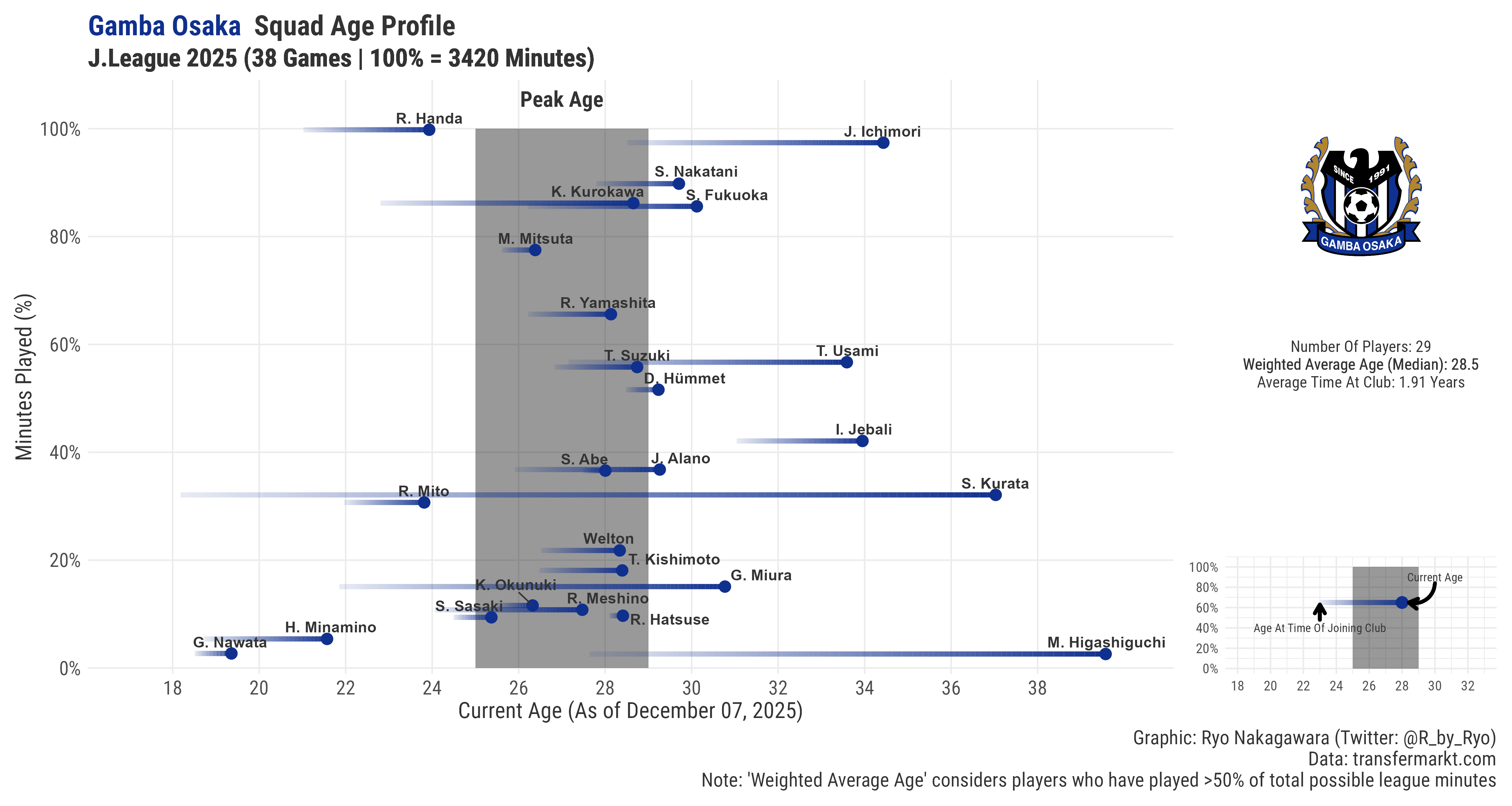
Genta Miura was extremely slow to get back to full fitness after a major injury and then was left out in favor of Shota Fukuoka anyway who has really stood up during the former’s absence. Daichi Hayashi has barely been seen since his arrival last year... Even still Dani Poyatos was hesitant to use young players like Gaku Nawata and the recalled Harumi Minamino as they spent a lot of the season on the bench.
In terms of Gamba’s tactics, it’s been a development throughout Poyatos’ tenure of a tidy mid-block out-of-possession along with a shifting Back 4 to Back 3 in-possession. To facilitate this Tokuma Suzuki or Neta Lavi would drop deep and push the Center Backs wider. Out wide Riku Handa would invert while Keisuke Kurokawa pushed forward on the Left. Ryo Hatsuse’s return to Gamba in the summer allowed a bit of respite for Kurokawa who had been running the gauntlet given the lack of alternatives at Left Back.


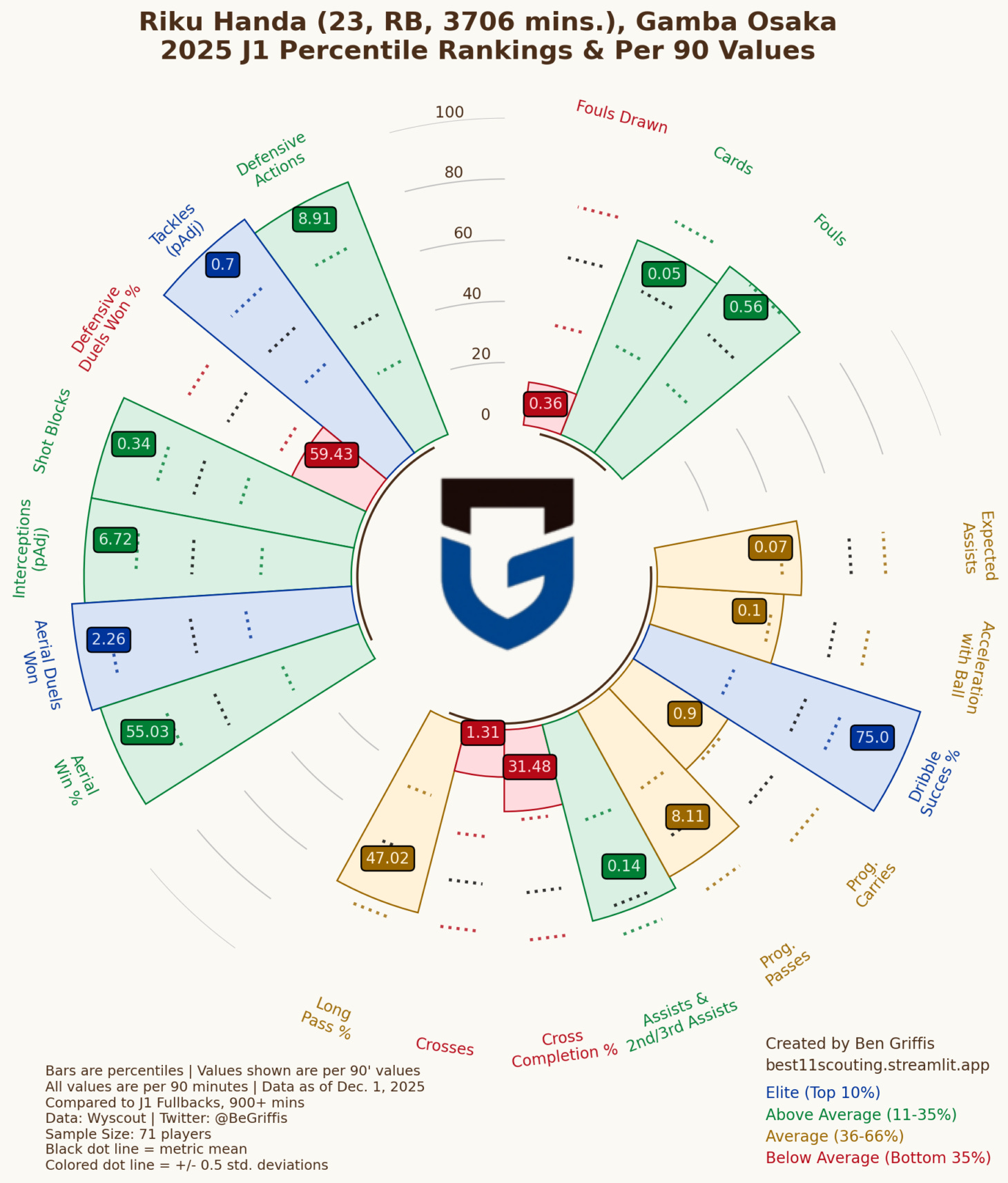
Riku Handa in particular had a very good season and his ability to sustain possession and create space for the attackers in dangerous areas in the middle and final 3rd allowed Gamba to progress smoothly across areas of the pitch. Indeed, according to Football-Lab Gamba Osaka entered the final 3rd the 3rd most times per match in the league and entered the penalty box the 5th highest amount of times.
Shogun Soccer Scouting #14: Riku Handa

It’s been a busy summer! Lots of players moving to Europe over the past few months, perhaps I’ll make a roundup post when the transfer window closes to put all of my notes/thoughts about these players in one place. Recently I’ve been doing a lot of media appearances:
Overall, Gamba’s attack was pretty decent, by the stats:
Able to dominate possession (4th highest average ball possession per game)
Create a good number of chances per game (3rd most shots taken, 5th most xG).
Up front Deniz Hummet slowly picked up form and finished off with a decent 7 goals and 3 assists. The veteran Issam Jebali also chipped in with 5 goals and 5 assists off his usual physical back-to-goal play-making. It was also nice to see Takashi Usami continue to have his renaissance at 33 years old. The Gamba legend led the team with 8 goals and 2 assists.


Makoto Mitsuta was the emergency signing in midfield in late February but he was forced to play in the double pivot for a majority of the season due to injuries or players leaving. It was always an awkward fit when Usami continued to be in such good form in his preferred #10 position and it also couldn’t be helped that Rin Mito just isn’t very good (he’s probably fine as a bench/rotation player but not as a starter for a team trying to be in the top 3). To rectify this, Shuto Abe was a genuinely good purchase in the summer to fill an absolute need in central midfield. However, the double pivot always felt a bit awkward with two #8 or #10 types playing alongside each other.
The center midfield issues tied into how bad Gamba’s defending was throughout the season. While as individuals, Shinnosuke Nakatani, Riku Handa, and even Shota Fukuoka (in the absence of Genta Miura) were fine, as a unit they were exposed a lot by the lack of midfield shielding in front of them. Their defensive metrics were fairly mediocre all round (xGA, shots conceded, etc.) but most importantly Gamba shipped the 6th most goals in the league in 2025.


This iteration of Gamba Osaka was fairly OK but not quite as great as hoped given the pre-season excitement and their performances were dragged down by their defending. At least Gamba fans can be a bit satisfied by finishing just above their rivals Cerezo. It was a very up-and-down season due to so many ins-and-outs related to both injuries or transfers, many of which was out of Poyatos’ control but that’s the way the dice roll sometimes! It was announced in late November that Dani Poyatos would leave the club after the season.
It’s been three full seasons but there hasn’t been huge progress that was expected to get Gamba back into title contention even with some promising signs at various points so I can understand the decision. At the very least, Poyatos’s reign at Gamba stabilized a free-falling club that had been mired in the relegation zone. The Spaniard, after a rough first season, put them back in mid-table for consistent seasons for the first time since the pre-COVID days and implemented a new tactical plan that didn’t just rely on hoping Patric & Usami did something magical up front. Whoever comes in to the managerial hotseat next will step into a fairly solid foundation along with a cadre of young players relishing a chance for some first team action.
Cerezo Osaka (10th, 52 Points)
14 Wins // 10 Draws // 14 Losses
Location // Stadium: Osaka // Yodoko Sakura Stadium
Manager: Arthur Papas
60 Goals (tied 3rd); 57 Conceded (17th)
47.91 xG (3rd); 46.95 xGA (18th)
Top goal scorer: Rafael Ratão (17 goals plus 1 penalty)
Goalkeeper: Koki Fukui
The Arthur Papas Revolution was a mixed one but overall positive in terms of the foundations that the new Aussie manager was able to build. In pre-season, losing Leo Ceara to Kashima Antlers was a huge blow especially considering how lopsidedly reliant they were on the Brazilian striker for absolutely anything remotely to do with goals. However, Cerezo made some good re-investments into the squad (although some took a while to gel than others) and Papas was able to instill his playing style on the team. Throughout the season Cerezo Osaka genuinely showed good stuff in possession and lots of fire power in attack. However, due to their playing style and lack of good defensive personnel, things were very busy at their own end of the field as well. I was skeptical considering how poorly they started the season despite a bombastic opening day derby win vs. Gamba Osaka as they did not win their next six games. Cerezo had their best run through May and June before slowing down again through October. The purple-half of Osaka finished the season with three straight losses, three straight wins, then two defeats. Ultimately, this divergence between attack-defense and inconsistency throughout the season had Cerezo Osako finishing in mid-table.


Ratão got over his early season finishing slump to become a dependable J1 level striker. He had massive boots to fill from the departed Leo Ceara but did a very good job in the end. With 18 goals from 12.6 xG, he’s running fairly hot in terms of his finishing but is still getting on the end of good chances and taking plenty of shots as well. The Brazilian is very much your penalty box striker with all of his goals coming inside the area.


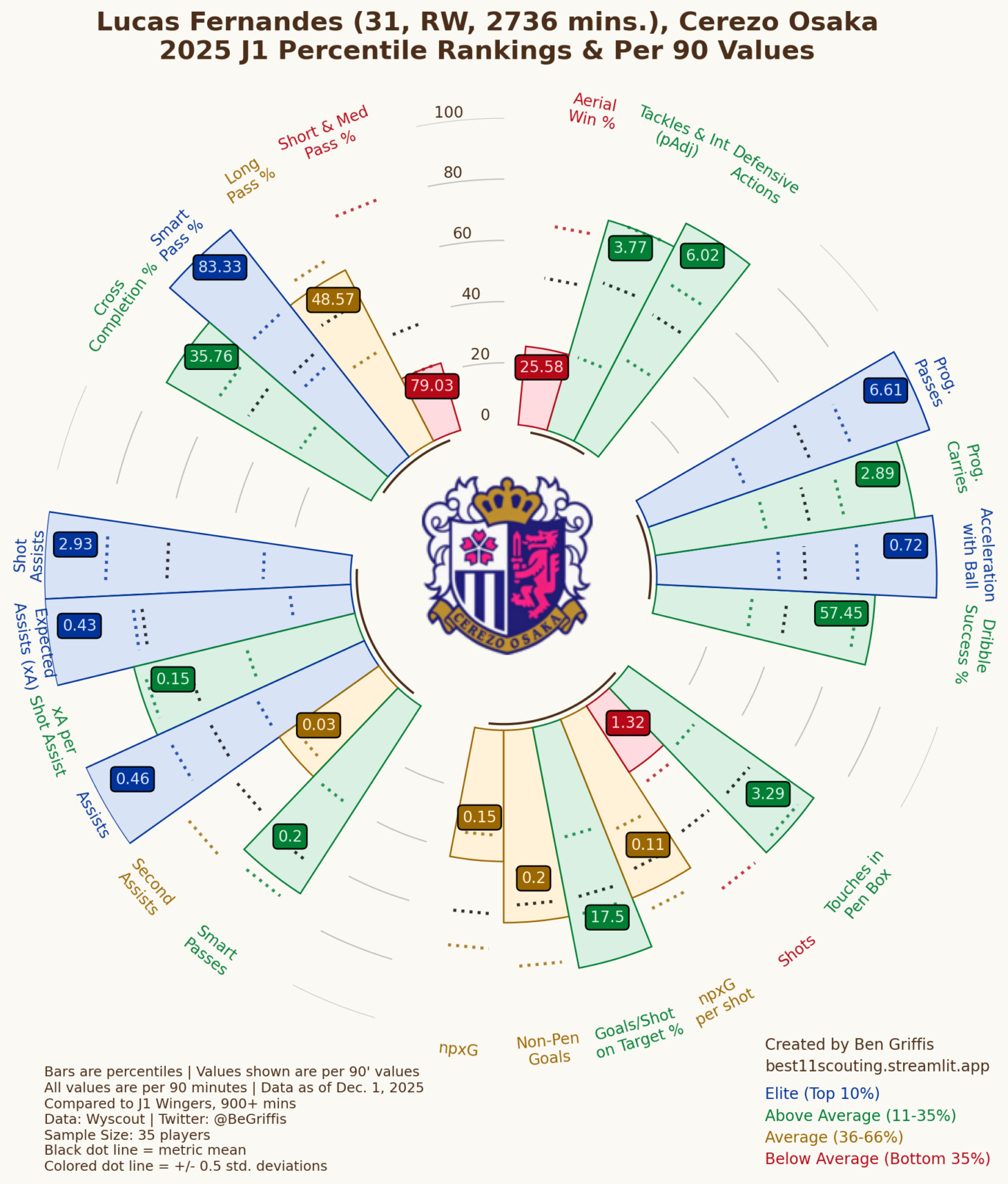
Lucas Fernandes’ season ending injury in late September put end to a fantastic run of form of 7 goals and 15 assists (the latter league-leading). An absolute all-timer of a season from a Right Winger. On the opposite side Thiago Andrade wasn’t a super-star but solid enough, contributed with 4 goals and 4 assists. I was hoping to see more of Shion Homma but he only had 2 starts and lots of appearances off the bench, his career since leaving Niigata has been quite disappointing but at 25 he still has time to get back to his best.
Overall, Cerezo have...
3rd most goal scored
Most shots taken, Most shots on target
2nd most final 3rd entries
3rd most box entries
Their attack was genuinely fantastic and the goals were spread fairly well between both set-pieces and open-play. Cerezo loved funneling the build-up to their dangerous wingers and then pull their Full Backs inside and forward to add depth to their attacks.
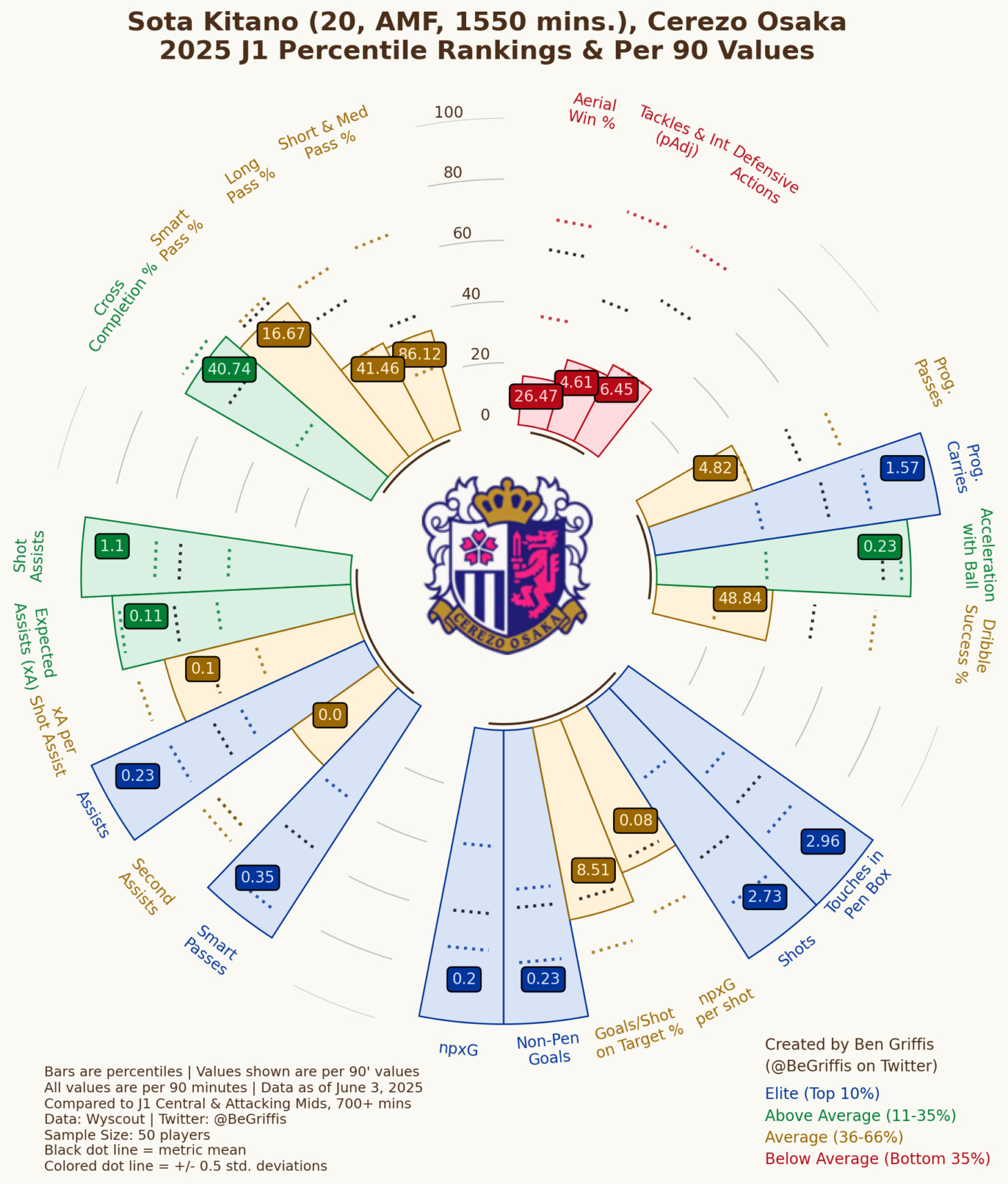
Sota Kitano was the talk of the team in the first half of the season. His intensity on-and-off the ball along with his lovely technique made him a target for Europe and he left for Red Bull Salzburg early in the summer transfer window. I wrote in-depth about him back in May so I’ll leave it here:
Shogun Soccer Scouting #10: Sota Kitano

A problem I have is that I don’t get to talk about enough players/teams/matches because I spend so long on any particular single newsletter. I watch so many J.League games that I don’t end up talking about which I feel is a waste. This is my first attempt to strike a balance between
Another player who made waves this season was Motohiko Nakajima who played about five different positions in attack and midfield. Nakajima spent the past several years being a key player for Vegalta Sendai down in J2 and finally got the chance to play for his boyhood club as a regular fixture in the starting XI.
Masaya Shibayama slowly won appearances as the season came to a close and he answered the call with 4 goals and 2 assists. He’s had it rough trying get game time since his arrival from Omiya Ardija a few years ago but perhaps this season will be the catalyst after filling in the gap left by Sota Kitano.


Shunta Tanaka really embraced his role as the deep-lying midfielder in Cerezo’s possession system. His ball progression through his passing was a crucial and he is also the only midfielder who can do some defending too. He had a mid-season injury scare that I thought would derail Cerezo’s season but he came back astonishingly quickly (compared to the actual reports about his injury...). Despite his age, Shinji Kagawa continued to show his class, providing a lot of value with his passing and for the past few seasons he’s been occupying an extremely deep role orchestrating things from the double pivot.


When it comes to Cerezo, there wasn’t a more clear case of “Jekyll & Hyde” than when looking at their fantastic attack… along with their contrasting horrible defending. It was a running theme over the past few years under the previous manager Akio Kogiku as well.
Okuda, Nishio, Hatanaka, Inoue, Nico Takahashi, Shindo were all similar flavors of mediocre-to-just-OK defensively and to me that’s what is holding them back from being true contenders at the top end of the table. Although at the very least Shinnosuke Hatanaka provides a lot on the ball which is what Cerezo need to make their playstyle work. Ayumu Ohata was one of many Japanese players who returned home after a limp six month attempt in Europe. He showed he was a good player at Urawa so I’d like to imagine he gets back to his best next year. Dion Cools came over in the summer to shore up the Full Back department and he’s been OK enough. With how their Full Backs are inverting in-possession Cerezo can be vulnerable down the wings if they lose the ball poorly as the Center Backs are left with a lot of space to cover.


It shouldn’t be a wonder then that Cerezo have the 3rd worst xGA, and been subjected to the most shots against in the league.
Koki Fukui became a starter at the J1 level for the first time in his career as Kim Jin-Hyeon has been showing his age. Fukui was… fine. You could upgrade him but I think there are other bigger priorities that need to be handled first. Funnily enough, in what seems to be a theme across many J.League teams, despite Cerezo’s prowess at scoring set-pieces and crosses, they themselves are particularly vulnerable to them as well... 26.3% from set-pieces and 22.8% from open-play crosses. I find it incredible they managed to keep a positive goal difference despite shipping a whopping 57 goals but that just shows you how insane their attack was.
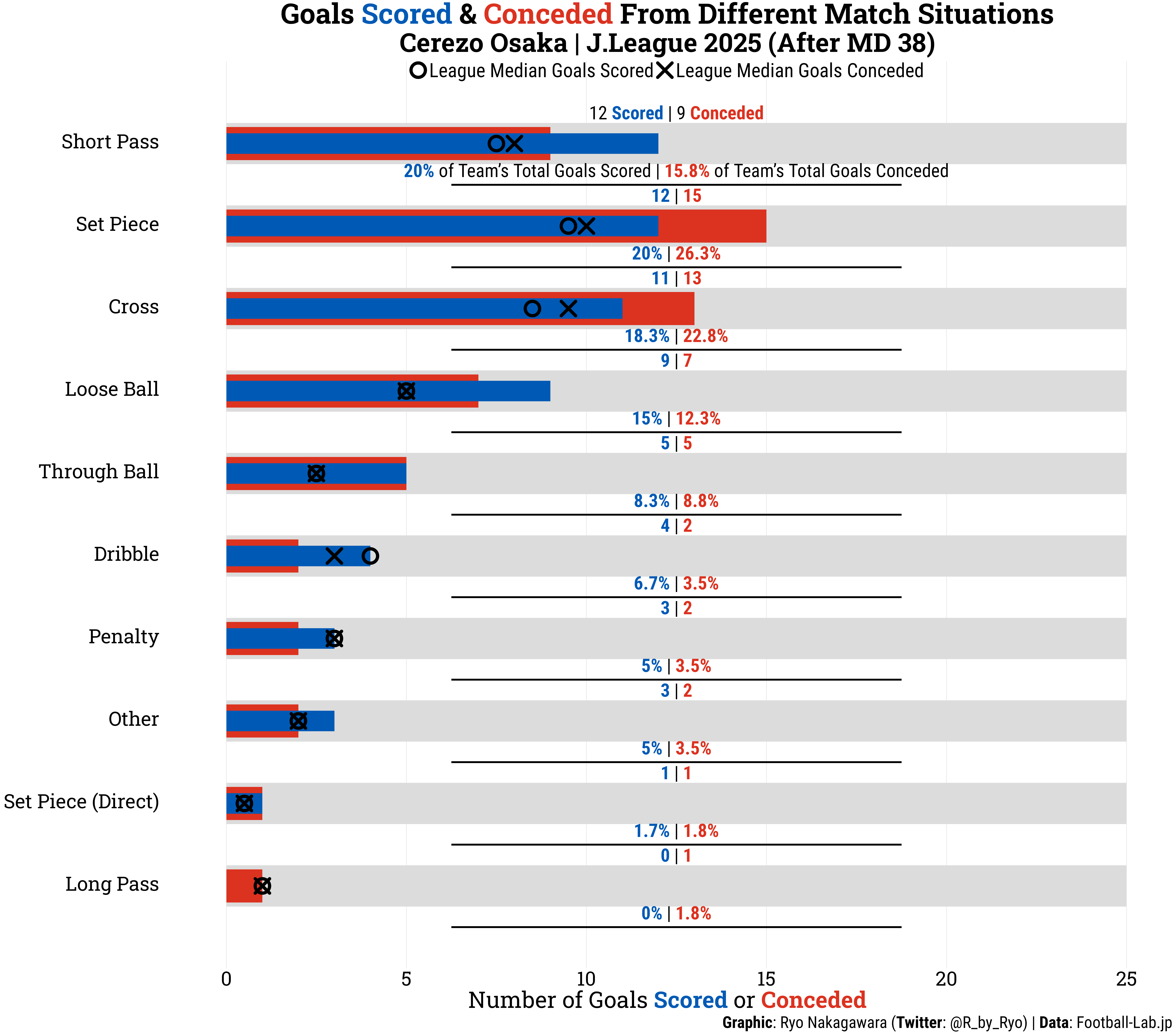
Overall, Cerezo finished in mid-table, and crashed out fairly early in both domestic cups. Success in the near future hinges on:
Whether they can buy Ratao out-right, which is looking very difficult due to his ownership status and majestic form inviting a lot of competition from richer teams like Kobe and Machida (according to rumors).
What condition Lucas Fernandes comes back in from his major injury.
Whether they can fix their leaky defense without compromising on the on-ball qualities they require from the back-line personnel.
Nonetheless, I think there’s cause for plenty of optimism over in the purple-half of Osaka. There’s plenty of time for Papas to work on the flaws of his system during the 100 Year Vision League and get the team firing on all cylinders for a proper title charge in 2026-2027.
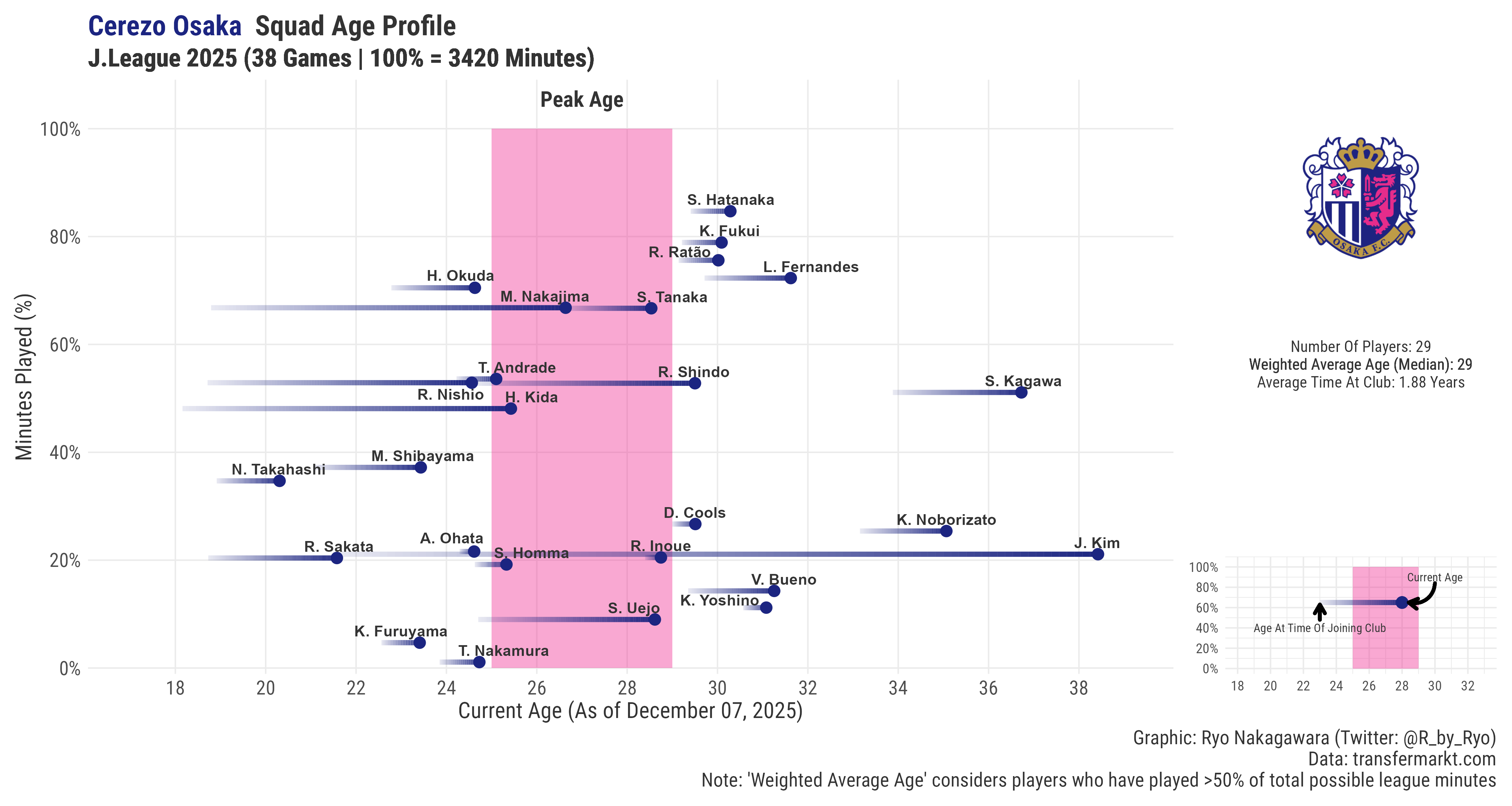
FC Tokyo (11th, 50 Points)
13 Wins // 11 Draws // 14 Losses
Location // Stadium: Tokyo // Ajinomoto Stadium
Manager: Rikizo Matsuhashi
41 Goals (14th); 48 Conceded (13th)
43.29 xG (10th); 42.37 xGA (9th)
Top goal scorer: Marcelo Ryan (6 goals plus 2 penalties)
Goalkeeper: Taishi Nozawa // Kim Seung-Gyu
Another dreadful season from FC Tokyo. It started off OK with 2 wins in the first 3 games but then the team didn’t win a single game until late April, eight whole league games later. The patchy form continued and FC Tokyo were truly dragged into the relegation fight by the beginning of summer. Three consecutive wins against Verdy, Frontale, Avispa in September saved the season but it took major transfer window activity over the summer to put a bandage over the issues seen in the first half of the season.


Sei Muroya returning to the club was a big positive especially with regular Right Back Kosuke Shirai sidelined for most of the 2nd half of the season. Muroya had to fight a few of his own injury issues but his experience was very important especially defending 1v1 against opponent wingers. Alex Scholz was probably the best out of the summer signings as his passing and carrying from the back brought a lot more nous to an often confused defensive unit on the ball.
Taishi Nozawa’s occasional foolhardy tendencies on the ball was often covered up by some fantastic saves. There were a lot of rough edges to his game but clearly some promise and he left for Royal Antwerp in the summer. With Go Hatano not exactly a consistent figure between the sticks, even with his useful locker room presence, FC Tokyo brought Kim Seung-Gyu back to the J.League after the Korean recovered from a major ACL injury. Compared to the at times erratic Nozawa, Kim S-G brought some stability to the build-up even if it came at the expense of some of the more eye-catching abilities of the former.
Seiji Kimura barely played but somehow managed to move to Europe with a summer move to Westerlo. Henrique Trevisan with his superb aerial ability would’ve been nice to have in a team extremely allergic to defending crosses but his poor on-ball abilities and consistent injuries hampered making regular appearances for the team once again. In general, from front to back there were issues with the press or individual errors that marred FC Tokyo’s performances in games, not to mention the build-up issues which meant the team was shooting itself with the foot even during the team’s own ball possessions.


Kanta Doi is one of the next generation of FC Tokyo defenders but his performances this season made it evident that he still needs more time before blasting off to Europe like his other teammates. Despite his height and aerial win % numbers, Doi’s poor positioning and simply not being available to get into these duels in the first place made me think that his duel % might be a bit inflated. I do think there is a lot of promise especially when it comes to his passing and carrying abilities from the back. In the mould of a “modern” defender, his technical abilities also allow him to shift into different roles in the build-up phase in a Back 3 or Back 4. Along with his large stature (186cm) Doi is a good candidate to be another Japanese export if he can improve on his weaknesses further.


While I praised some of the individual defenders, a huge problem despite all the experience in the back-line, was that no one could seemingly take some leadership and arrange a proper box defense. This consistent horrendous crossing/set piece defending derailed any improvements in possession or other aspects in the 2nd half of the season. Tokyo conceded 25% of their total goals conceded from crosses and a further 27% came from opponent set-pieces!


Kento Hashimoto came back to FC Tokyo which was nice to see. He built a good partnership with Takahiro Koh in the double pivot although they weren’t helped too much by the tactics employed. Koh nevertheless had his best season in an FC Tokyo shirt, as alongside his usual passing from deep he also popped up with 2 goals and 4 assists. Kei Koizumi was his usual industrious self, good for rotating in whenever there was a need.
The zombified corpose of Keigo Higashi continued to haunt FC Tokyo. Slow, a terrible first touch that kills possession play, and a tendency for horrific tackles to get himself booked. He just won’t retire nor will be the club release him for some reason and instead try to play Kyota Tokiwa more (or another of the other midfielders sent out on loan to J2). Maki Kitahara looked interesting in his brief cameos, he made his debut at just 15 years old! Of course, given his age it made sense that the club didn’t push him to play too many minutes. Hopefully we’ll see more of him, gradually, in the next few years.


Keita Endo was fine in limited bursts as predictably he was sidelined with injury a lot this season but still scored 4 goals. Teruhito Nakagawa is really showing his age now despite appearing in 32 games, he only started 18 of them, and barely contributed with just 2 goals. At age 33, I think it’s time to part ways. Leon Nozawa is extremely mediocre, he has some utility in making runs behind but doesn’t do a whole lot on the ball once he receives it. A lot of attacks late in games die when he receives the ball in the final 3rd to the frustration of many fans. I’m not a big fan of Soma Anzai either but at least he’s not playing Left Back anymore.
Kota Tawaratsumida continues to flatter to deceive. I remain resolute in not bothering to write up anything deeper on him until he actually shows signs of improving his end-product. It’s been three seasons at this point but he still hasn’t pieced it together, although of course the state of the team around him hasn’t helped much either. Still, Tawaratsumida’s “promise/potential” given his fantastic dribbling technique has a lot of people hoping and he even earned a national team call-up in a rotated squad back in June.
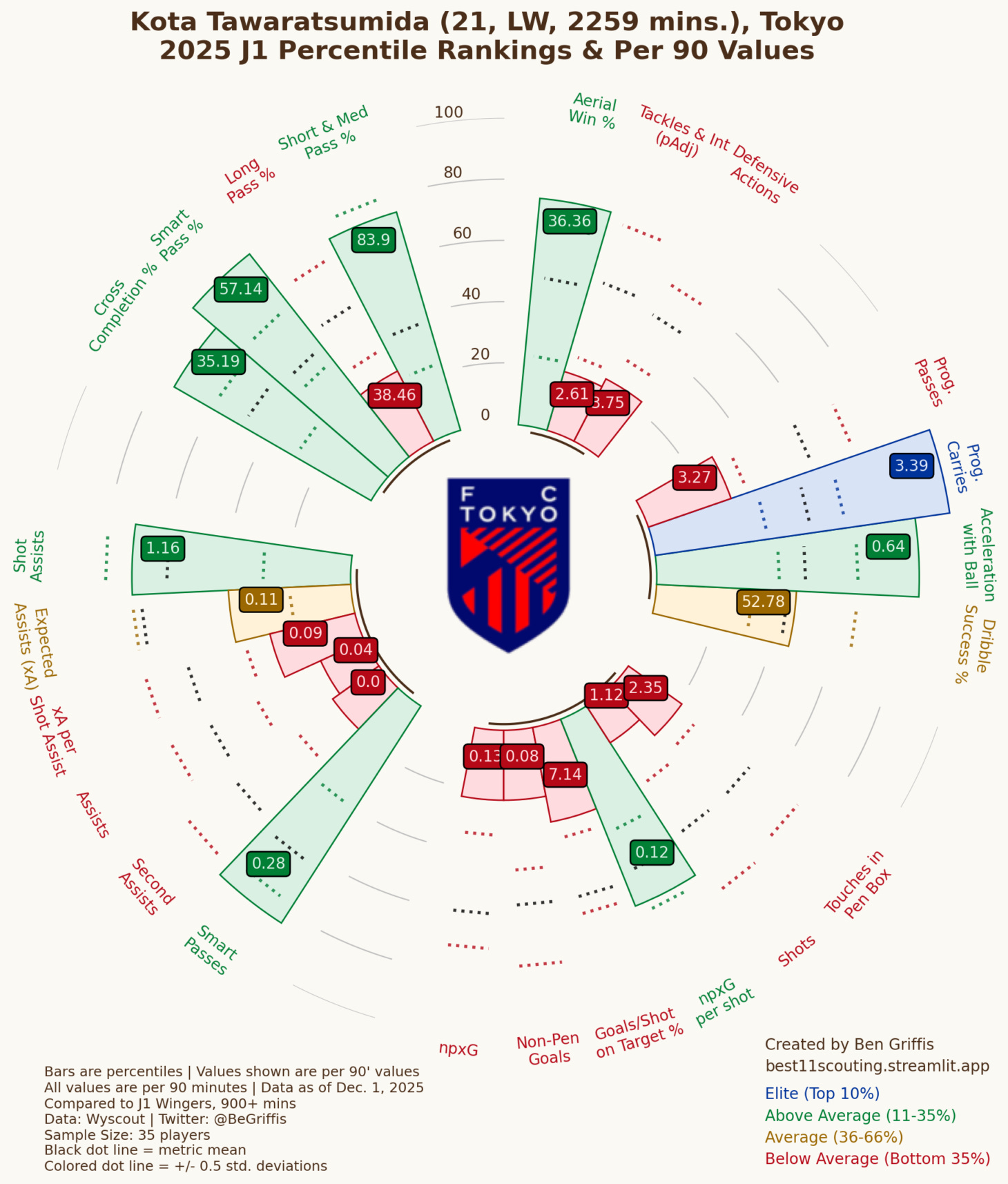
While emphasis will be placed on how the summer signings saved the season, it’s also important to look at how these players were platformed to succeed. Along with Alex Scholz and Kim Seung-Gyu providing a more solid base to pass out the back, it was a balancing act between a more intricate build-up and being more direct through fast breaks that proved to be the ticket out of the relegation fight. Further forward a big part of this was Motoki Nagakura’s fantastic movement. His ability to drop and find spaces improved Tokyo’s build-up by a hundred fold as the Urawa Reds loanee provided a platform for fast breaks.


Kein Sato had shooting woes early in the season but his driving runs, pace, and overall energy was been good all season long. Fortunately for FC Tokyo, he even found goal scoring form in the last few months of the season and finished off with a very good 7 goals and 5 assists. Marcelo Ryan showed inconsistent shooting even with his team leading 8 goals but he was a scary sight for any J.League defender when he was able to run full sprint at them.


Did you all notice what the consistent theme across all the positions I discussed? Everybody got injured, which meant that there was a constant cast of players rotating in-and-out of the line-up. No amount of momentum nor chemistry could be built like this and in this regard I do feel some sympathy for manager Rikizo Matsuhashi. There were only a handful of players who made it to 20 starts this season and only one above 30. In defense it was a big problem that only Kanta Doi, who barely played in the 2nd half of the season, got to 20 league starts along with Masato Morishige (ironically as the 2nd oldest defender on the team). Players like Kashif and Ogashiwa are unlikely to ever be fit for a full season again. Marcelo Ryan for all his goals was injured a lot and had to keep coming on/off the bench instead of playing the full 90, same with Nagakura.
For a visual representation of Tokyo’s plight, look at how out of the entire squad (even taking into account rotation, etc.), only Takahiro Koh, Kein Sato, and Kota Tawaratsumida played over 60% of total league minutes!
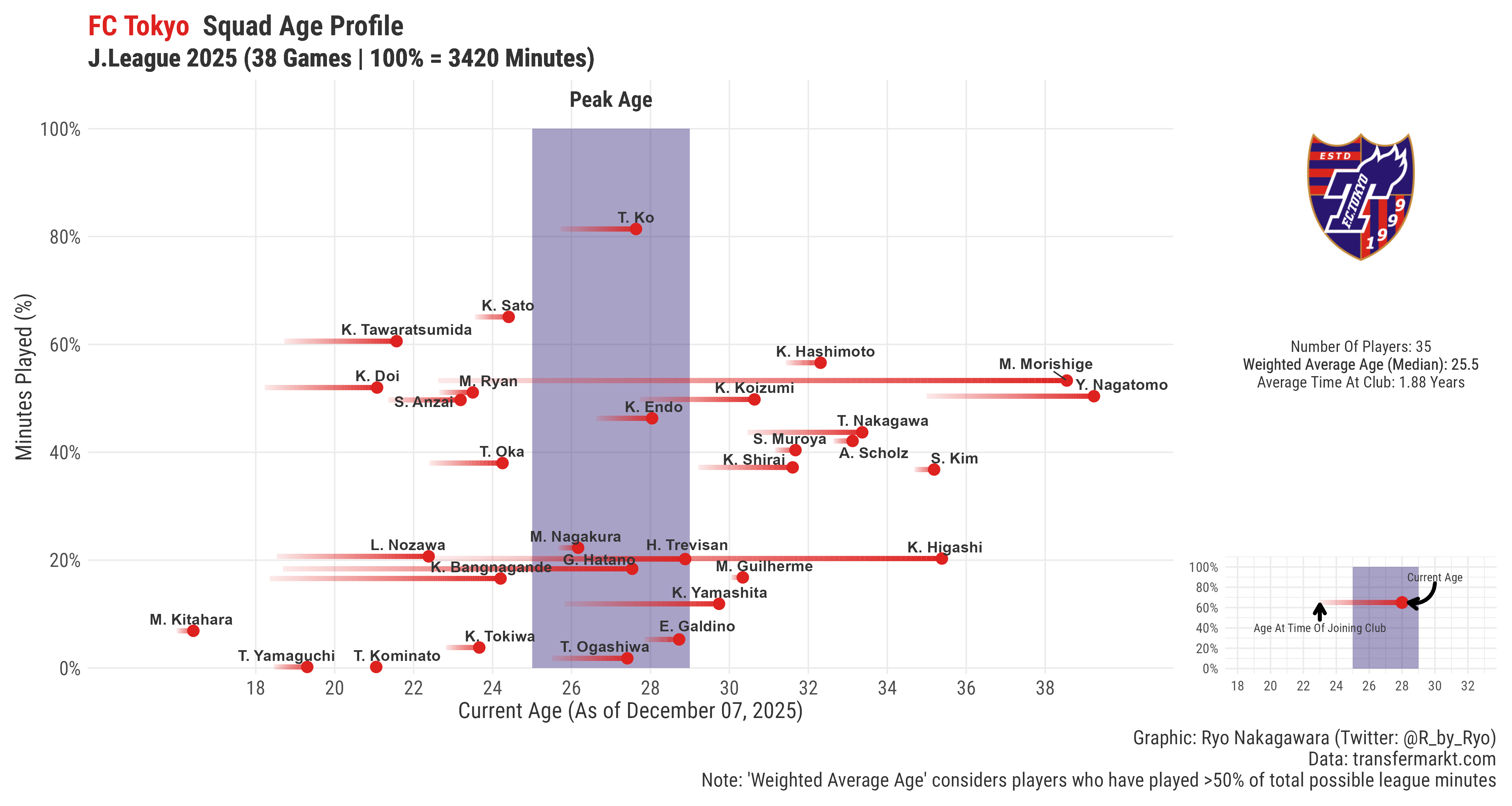
It might surprise people that FC Tokyo only lost once in the last 10 league games (that terrible game vs. Marinos in late September) but … did that really matter? Safety was almost all but assured after the three consecutive 1-0s leading up to that Marinos defeat anyway so the last 1/5th of the season was on auto-pilot mode aside from the Emperor’s Cup. For all the excitement and expectation that semi-final ended in a miserable 0-2 defeat in an half-empty National Stadium. FC Tokyo were a mere stepping stone toward Machida Zelvia’s first ever title and you can imagine they are in a far better position to continue winning more trophies in the near future than FC Tokyo. I’m just not sure what FC Tokyo’s overall strategy is going forward.
Over the past few years since MIXI took over the club and with the current GM in charge, we’ve seen some genuinely terrible recruitment, especially signing injury-prone players or those that don’t really fit into what various successive managers need. At the very least FC Tokyo did try to go with a younger team at the start of this sason, especially with a back-line consisting of Kanta Doi, Soma Anzai, Teppei Oka, and Taishi Nozawa but manager Rikizo Matsuhashi couldn’t figure out a safe way to make it work. I see a lot of praise for the summer recruitment but it wouldn’t have been necessary if the club had done a good job not just in pre-season but in prior transfer windows as well. As a result the club have their hands tied to a bunch of extremely old guys who saved the current season but don’t really push the club forward in the medium-term. The extremely aging back-line is a brittle band-aid that threatens to fall off very soon (especially given some are closer to age 40 than 30…) and the club will be back to square one again within a year or two.
I get that having a revolving door of managers isn’t going to help but I really don’t think Rikizo Matsuhashi is The Guy going forward either. His player selections were wonky and then he often made things worse with his terrible substitution patterns… Even still, there’s so many other issues at this club like the recruitment or the medical department. Specifically, it is curious to see that the only thing that the club absolutely does not want to change are the people like the GM Mitsuhiro Obara and other leaders at the very top.
Avispa Fukuoka (12th, 48 Points)
12 Wins // 12 Draws // 14 Losses
Location // Stadium: Fukuoka // Best Denki Stadium
Manager: Kim Myung-hwi
34 Goals (17th); 38 Conceded (5th)
43.31 xG (9th); 36.29 xGA (4th)
Top goal scorer: Tomoya Miki (3 Goals plus 3 penalties)
Goalkeeper: Masaaki Murakami
Before the season there was a lot of fanfare about bringing in Kim Myung-hwi & transforming Avispa Fukuoka from the Shigetoshi Hasebe era. The result was, sure, a somewhat more possession-style but ultimately leading to not a whole lot of end product. When you look at Avispa’s final record of 12 wins - 12 draws - 14 losses it really gives off the “mid-table mediocrity” vibes.
There was a lot of grumbling from fans especially during two periods, once in spring when they went winless in 9 games and in the summer where Avispa only won once in 11 games. However, the team managed to calm the fans down as they finished the season extremely strongly, not conceding in the last 6 games of the season until a late late late penalty in their last league game against Nagoya Grampus! There were various tactical tweaks that I’ll discuss but even still, Avispa definitely need to make more personnel changes to realize the vision. Perhaps more patience is needed.
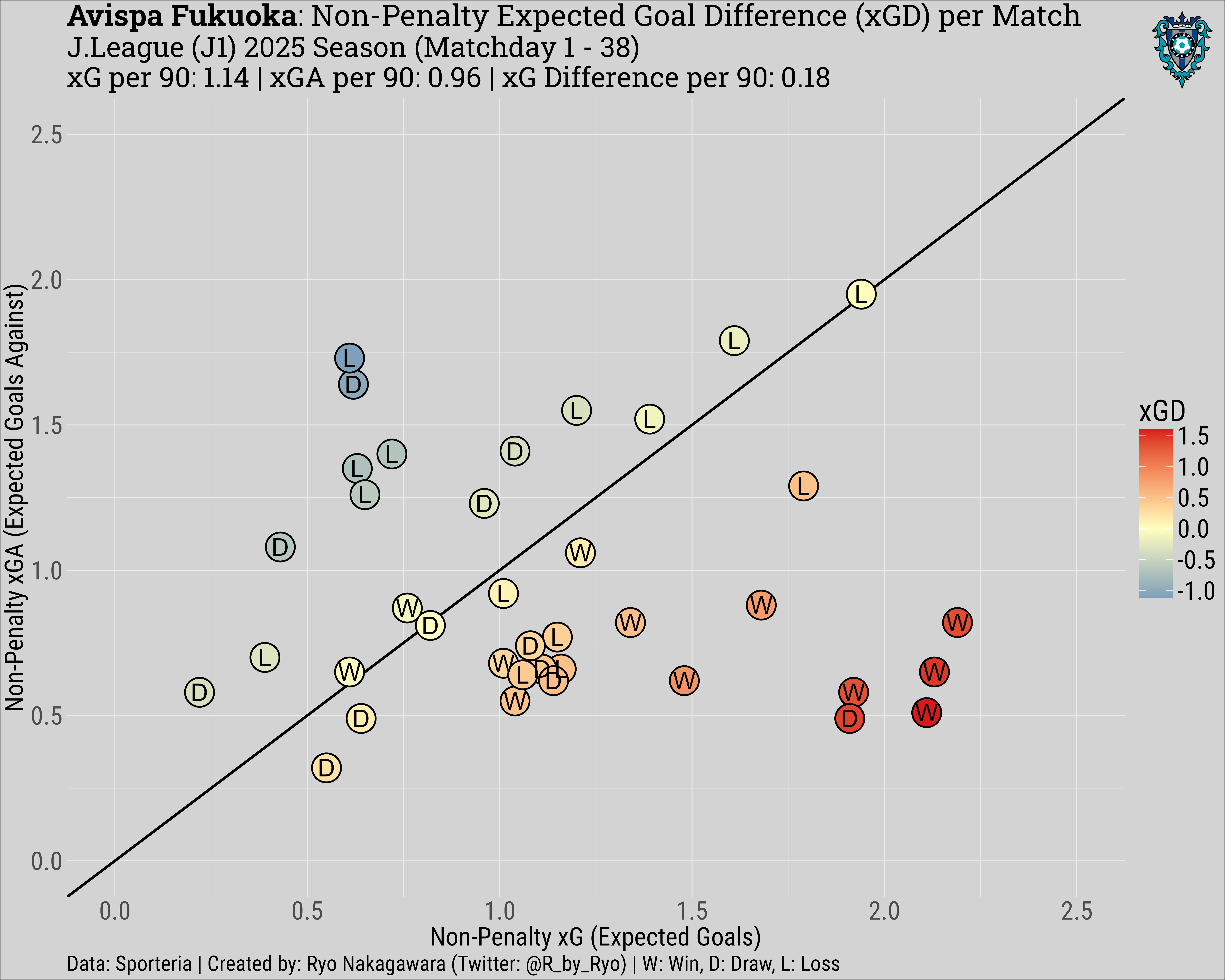
The defense was quite good overall and that’s how they survived this season. By the numbers:
6th best shots against (behind teams like Sanfrecce, Kobe)
3rd best xGA per shot (only behind Machida Zelvia and Vissel Kobe)
4th best xGA (again behind the usual solid defenses like Sanfrecce, Kobe, Machida)
Avispa carried over a lot of the defensive discipline that they had under Shigetoshi Hasebe in their 5-2-3 block, although a clear change was that they were set up a bit higher as a high~mid block under Kim Myung-hwi rather than the mid~low block of previous seasons.
In the goalkeeping department, as is tradition at Avispa Fukuoka it seems, even with a new manager at the helm there was a lot of musical chairs involving the goalkeepers. However it does look like Yuma Obata is going to be the main man given his younger age and ability with the ball at his feet. It’s a sign of the changing times in football that Obata moves up far out of his box and lines up with the Center Backs to involve himself in build-up play. In the Back 3, it was the veteran Masaya Tashiro as the leading guy while I was a bit surprised to see Takumi Kamijima lose his place near the end of the season. An issue surrounding the defense was that there were a lot of injuries. Jurato Ikeda spent most of the season out as did Itsuki Oda and Tatsuki Nara (though the latter came back in the 2nd half of the season).


A lot of Full Backs were playing in the Back 3 which has been a trend in football in recent years as the shape changes in-possession. Whether it was Obata pushing up from goal or one of the midfielders like Tomoya Miki dropping in, the Back 3 would shift into a Back 4 with the Center Backs on the outside turning into more conventional Full Backs.
Tomoya Ando came into prominence this season as he operated on the Left of the Back 3 and turned into a Left Back often. It was quite surprising just how far he’d push up down the wing to contribute in attacking phases. His influence was so much that Avispa’s possession was extremely tilted toward the left in most games. His performances caught the eye of Hajime Moriyasu, especially considering Japan play a Back 3 in similar ways and Ando was rightfully awarded with a call-up and debut for the national team. If you remove penalties, Ando actually finished as the team’s top goal scorer with 4 goals!


On the flip side, Avispa did absolutely nothing in attack once they got into the final 3rd. Well, they take a fair number of shots but the average quality is very poor, on top of bad finishing to boot. Highlighting this is the fact that Avispa have taken the 6th most shots but xG per shot is the 3rd worst in the league.
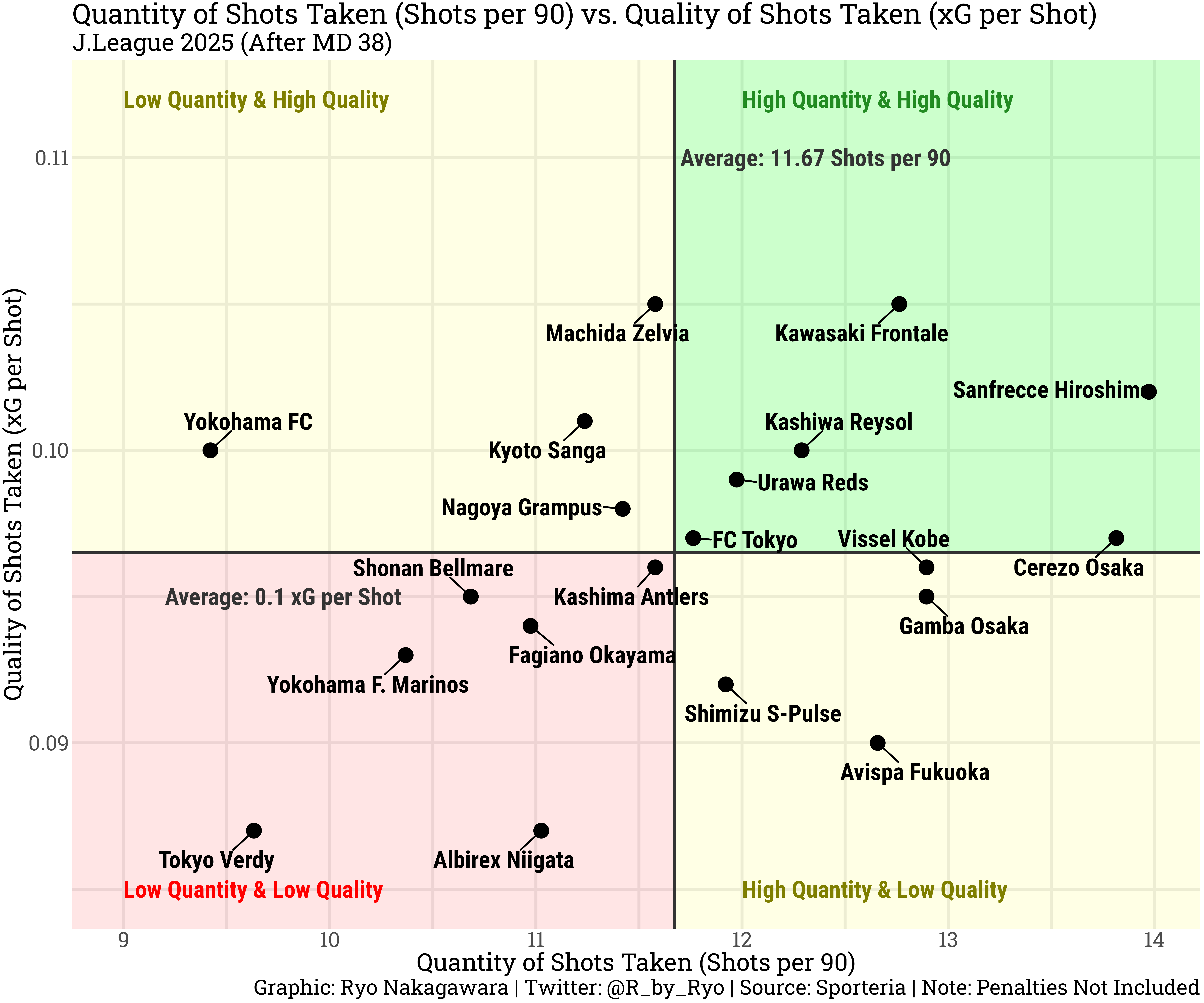
Shintaro Nago did OK, while he had nowhere near the goals/assists like at Kashima last season, given the player quality downgrade at Avispa in comparison its understandable. Kazuya Konno for all his dribbling, ending up with only 3 goals was extremely disappointing and his crossing volume was way down compared to previous seasons. Daiki Matsuoka did a lot of sweeping up in front of the defense... but that’s all he does now. It’s quite disappointing when he was much more of a passer/tempo-controller when he was at Sagan Tosu...
The star of the show (for me) was Tomoya Miki who surprisingly came down south to Fukuoka from Tokyo Verdy. He was the leading goal scorer with 6 goals, although half were penalties which again emphasizes Avispa’s goal scoring issues. Miki was a hugely important part of Avispa’s possession game with his passing and positional sense, frequently dropping into the back-line and freeing up the Center Backs to push forward.


The striker position at Avispa seemed cursed this season, everybody was allergic to scoring goals. Shahab Zahedi somehow managed to score a whopping 0 (zero) goals from 3.57 xG! The ol’ Brazilian battering ram striker Wellington go only 2 goals from 3.57 xG. The veteran was released at the end of the season. Shosei Usui missed his chances as well but managed 3 goals after arriving in the summer, maybe he blows up next season once he’s more accustomed to playing at the J1 level (like Sho Fukuda did for Shonan), who knows! It’s no wonder then that Avispa Fukuoka have only 34 goals from 43.31 xG. There’s certainly cause for complaint about the strikers not being able to finish but you also look at the extremely low xG values and realize that the strikers were simply not being served a whole lot of good chances in the first place!
Unfortunately, given the lack of goals it was perhaps not the exciting football revolution that fans (or neutrals...) were hoping for... but as outlined above there were interesting developments if you were looking very closely. Japanese media and fans love to conveniently forget stuff like this but Kim Myung-Hwi’s appointment was/is still very controversial given his past power-harassment charges. Even with all this in the background, I do think a lot of groundwork was built up over the course of the 2025 season. The transfer market moves during the winter will be important as reinforcements are clearly needed especially up top. Avispa will need to do a lot of convincing to keep their star players like Miki and Ando around as well.
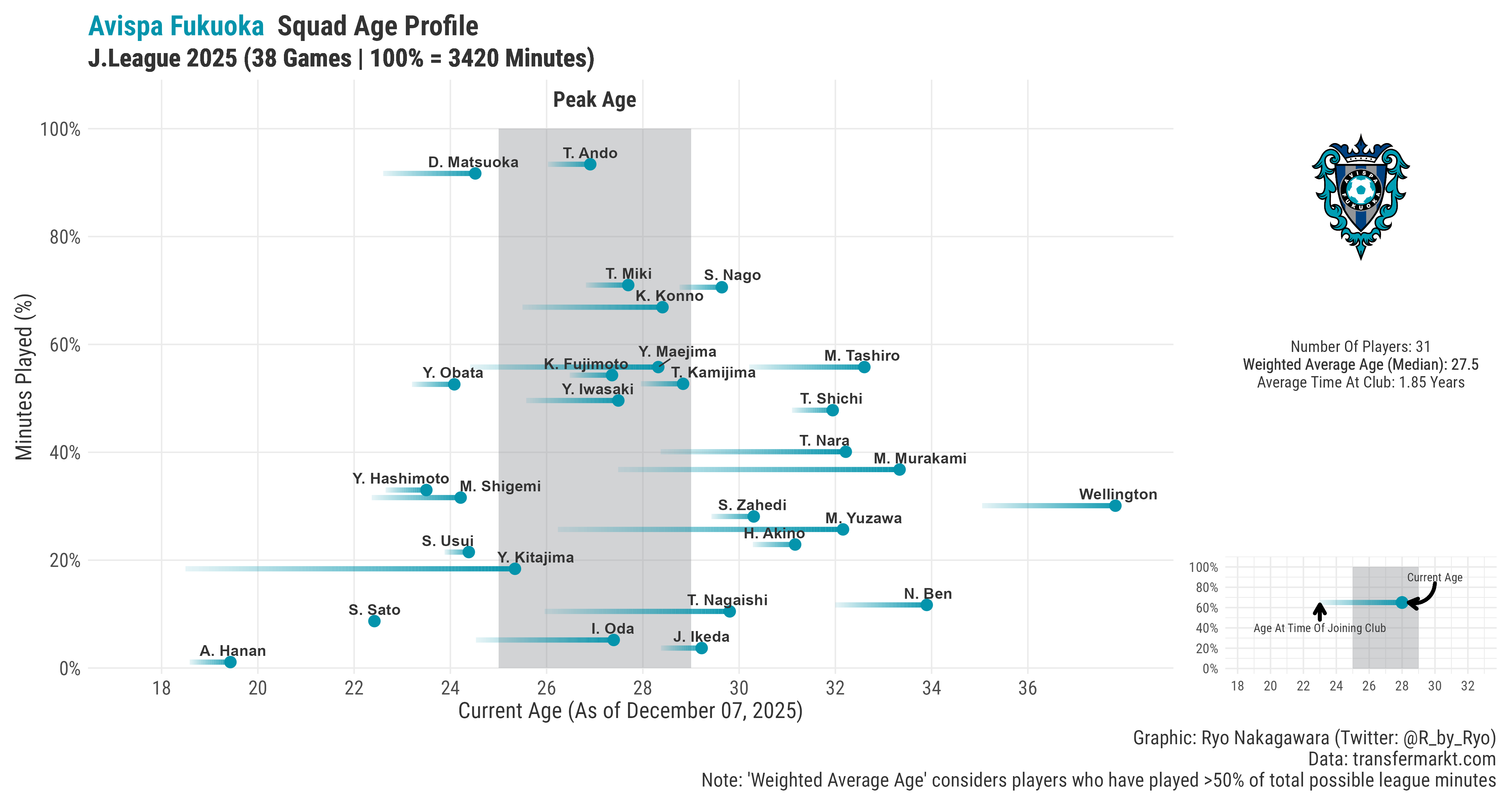
Fagiano Okayama (13th, 45 Points)
12 Wins // 9 Draws // 17 Losses
Location // Stadium: Okayama // City Light Stadium
Manager: Takashi Kiyama
34 Goals (18th); 43 Conceded (10th)
39.16 xG (15th); 48.03 xGA (17th)
Top goal scorer: Ryunosuke Sato (6 goals)
Goalkeeper: Svend Brodersen
Mission Accomplished! Fagiano Okayama grinded and struggled and just about finished safe from relegation. For most of the season they were fairly comfortable in mid-table and I feel like “on paper” safety was assured quite early. However, they hit their worst form in the autumn as their last league win came in late August! Ultimately, Okayama had banked enough points early on to survive.
The underlying numbers beneath their decent results really weren’t good at any point... in many cases they were actually quite bad in both attack and defense. Along with the actual results cratering in line with their performances in the 2nd half of the season, a lot of work still needs to be done over the 100 Year Vision League so that they don’t get sucked into the relegation fight when the new 2026-2027 season rolls around.
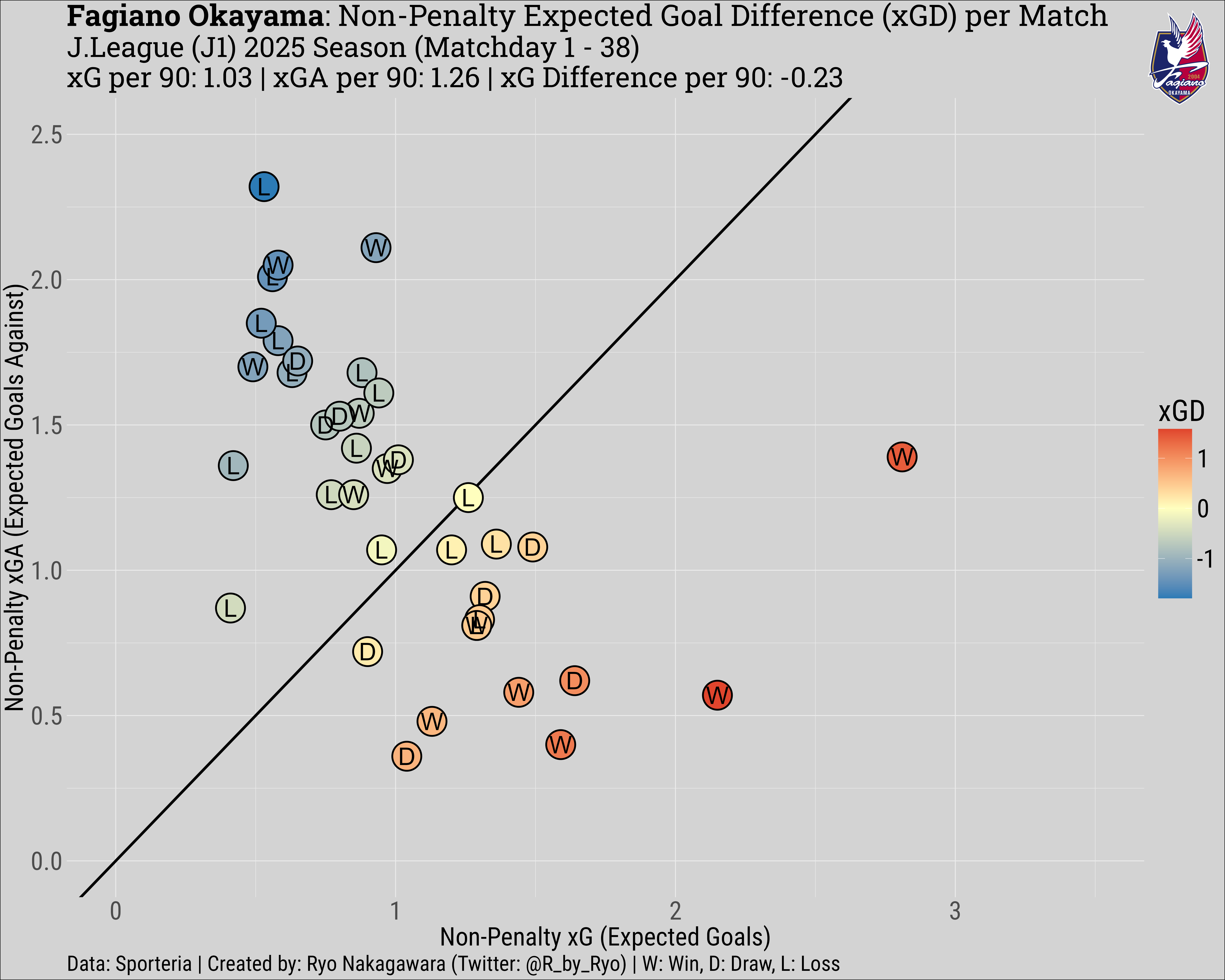
I was surprised that Kota Kudo was picked up after only a J3 loan at Giravanz Kitakyushu last year but he made the step up from J3 to J1 to a decent level. I’m not sure whether it’s good enough for Urawa to integrate him so perhaps another J1 loan will be on the cards. Okayama will hope they can acquire him again. The veteran Daichi Tagami proved he could handle the rigors of J1 football with occasional assured displays and the much maligned Yugo Tatsuta looked somewhat better in a different set-up as well.


Overall though, the defensive unit was actually quite mediocre.
15th in shots conceded
16th in xGA
17th in xGA per shot
I do feel like Okayama looked much better in terms of results compared to their actual poor defensive performances because Svend Brodersen was able to keep the ball out of the net a lot of the time. The German is now one of the most recognizable goalkeepers in the league with his good reflexes, bald head, and post-match dance moves (as of early December he is linked with a move to Kawasaki Frontale).
Shifting over to the attack, Ataru Esaka was the creative hub of the entire team in the final 3rd with his excellent passing and dribbling whether it was in the very few times Okayama had sustained possession or in the more frequent transition/counter-attacking situations. Aging like fine wine. Ibuki Fujita did quite well but did miss the last few months of the season due to injury. I talked about him a lot in the mid-season review so I’ll skip him here.
Ryunosuke Sato finished as Okayama’s top goal scorer. His 6 goals did only come from 2.34 xG though which is a yellow flag of sorts but he contributed in many other ways outside of his finishing skills. Playing at Wing Back instead of his traditional attacking role (although he rotated there in the 2nd Half of a number of games), Sato put in a big shift week-in, week-out running up-and-down the wing to support the defense and attack. Technically sound but also willing to exert a lot of physical effort, he is exactly the kind of player European teams are looking for. Depending on movement in the winter transfer market, I’ve made preparations to write something deeper on him. (Dec. 27, 2025: full report on Ryunosuke Sato below!)


In the forward positions, Okayama relied on the physicality and mobility of Lucao, Takaya Kimura, and Hiroto Iwabuchi who popped up with a few goals each. Along side open-play crosses, Okayama also relied on set-pieces, mainly taken by Ryo Tabei and Yuta Kamiya, and combined together these situations provided over half of their goal total. Overall though, for all their graft and the occasional moments of brilliance from Sato or Esaka, the attacking metrics were pretty bleak as shown in Football-Lab’s data:
17th in goals scored
16th in shots taken
16th in shots on target
19th in final 3rd entries
16th in penalty box entries
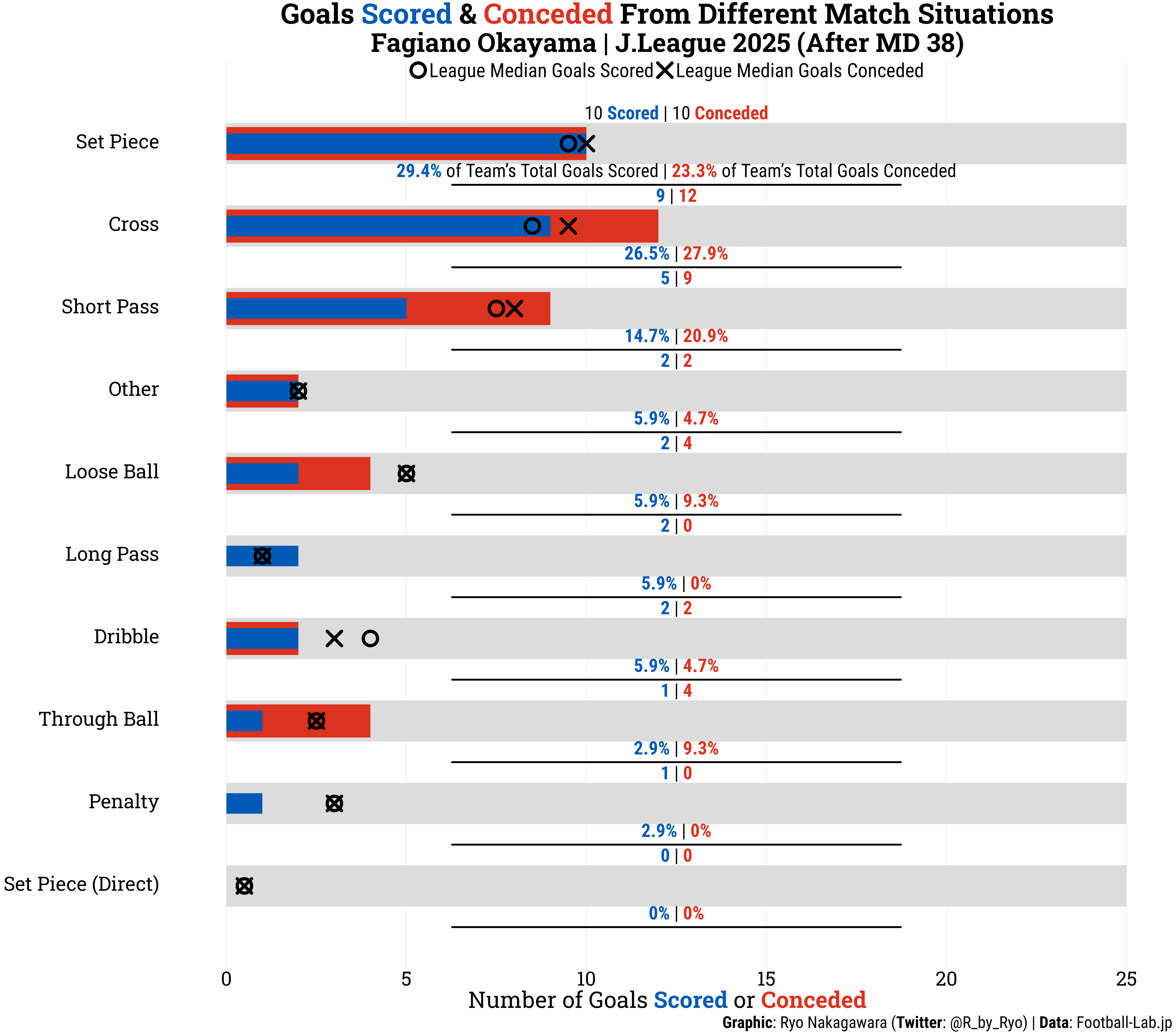
Fagiano Okayama were “pretty much” (even if not mathematically) safe by the summer. It was an incredible effort in the first half of the season even if, as the metrics show, that they rode their luck quite a bit. However, I do think that their form in the last four months of the season was quite alarming. So where do Okayama go from here?
A big off-the-pitch storyline throughout the season was how jam-packed the City Light Stadium was for home games and it was made quite apparent that calls for a new proper football-specific stadium are appropriate. The big question is whether Okayama can keep the good vibes and momentum going to continue surviving at the J1 level and not suffer from “2nd season syndrome” as many other promoted teams have in the past. Okayama have time as their ally as the 100 Year Vision League gives them a half-season to truly prepare for what should be another grueling top flight season in 2026/2027.
Now that they have secured safety, Okayama have a lot of thinking to do as it’s still obvious that upgrades in a number of positions are needed. They will need to spend money wisely or make smart loans like they did with Kudo and Sato. Quite a few of their best players with lots of minutes are also quite old so Okayama will also need to freshen up in this regard as well.
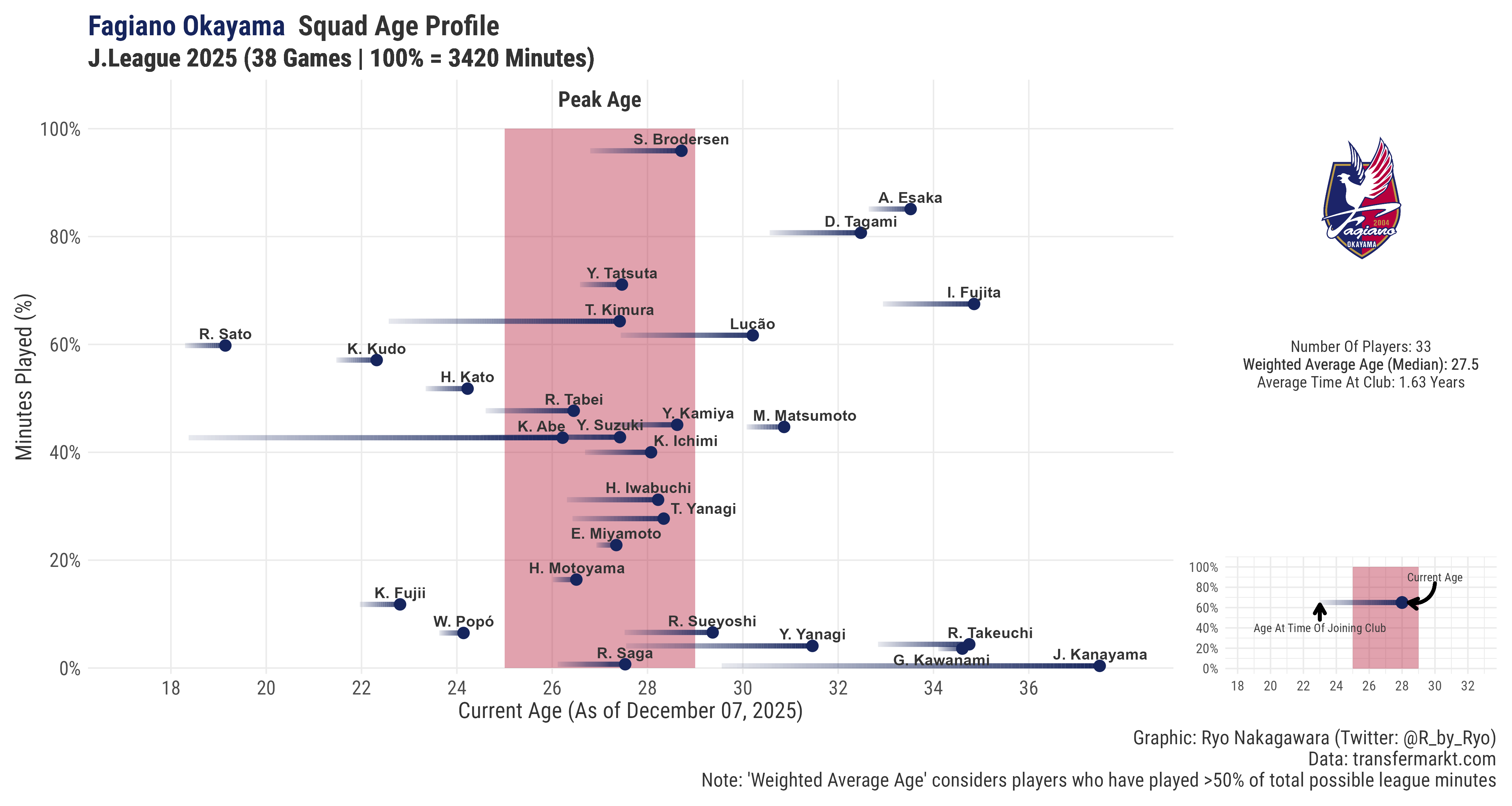
Shimizu S-Pulse (14th, 44 Points)
11 Wins // 11 Draws // 16 Losses
Location // Stadium: Shimizu // IAI Stadium Nihondaira
Manager: Tadahiro Akiba
41 Goals (14th); 51 Conceded (14th)
41.5 xG (14th); 51.09 xGA (20th)
Top goal scorer: Koya Kitagawa (4 goals plus 6 penalties)
Goalkeeper: Yuya Oki // Togo Umeda
S-Pulse’s return to J1 was... OK. Overall, what mattered was that they didn’t get relegated but it wasn’t super convincing at times. The team never quite strung together decent winning form for even a month as they alternated between wins-draws-losses throughout the season. I don’t think they were a bad team, there were plenty of that in the table below them that are far more deserving of that label, so S-Pulse were right around “mediocre”. Nothing more, nothing less.
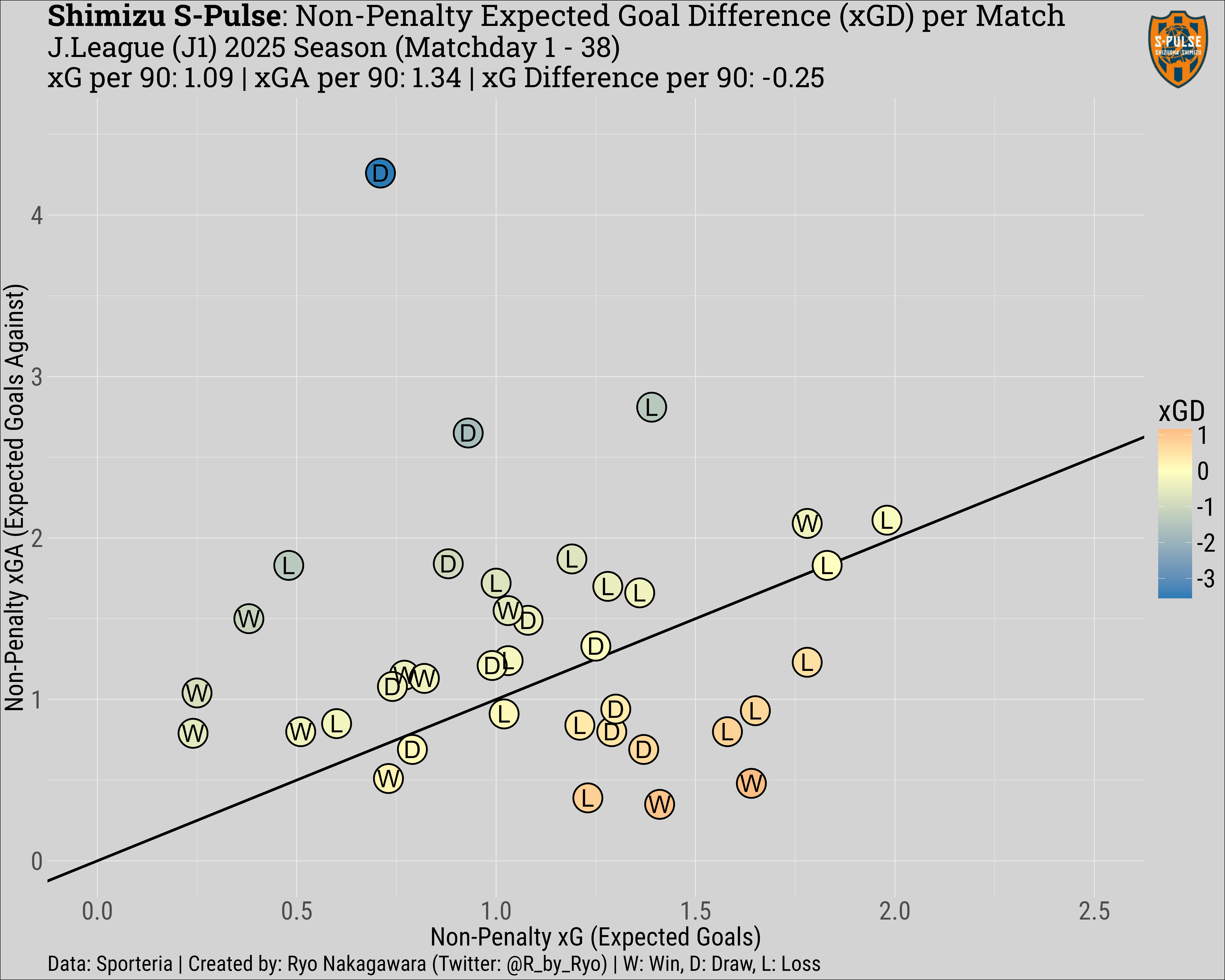
Like I discussed in the mid-season review, S-Pulse weren’t entirely reliant on Takashi Inui anymore but still needed him for that little extra bit of magic in open-play. Through the season it was Kai Matsuzaki who started to take on more responsibility. I quite like Matsuzaki who, after a disappointing step up to J1 with Urawa Reds a few years ago, dropped back down to J2 with S-Pulse and really improved himself to prove his doubters wrong. Matsuzaki’s good dribbling and carrying ability is enhanced by the fact that he has some actual end product too with his creative passing. He could do with being more of a shooting threat though. Motoki Nishihara did get the odd cameo appearances but I would like to see him involved more regularly in the 100 Year Vision League next year. S-Pulse still need to figure out ways to give Matsuzaki and Inui help in attack though, especially with how dire the striker situation is outside of Toshiki Takahashi.
Koya Kitagawa appeared to have a decent record with 10 goals this season... then you realize that 6 (six!) are actually penalties and that perception changes quite a bit. It’s been a big failure of their recruitment team to buy even a half-decent striker in the past few years, aside from Thiago Santana. Alfredo Stephens, Ahmed Ahmedov, Douglas Tanque, and Aziz Yakubu were absolute flops. Also S-Pulse keep recalling Kanta Chiba from loan... then not playing him... Poor guy. Toshiki Takahashi was decent though and a very smart out-right buy (surprisingly not a loan) during the summer. I’ve highlighted his smart striker runs throughout the season, they’re hard to draw on the tactics diagrams so go watch some Youtube clips. S-Pulse should be building their attack around him and Kai Matsuzaki in the short-medium term.


Zento Uno & Bueno are a genuinely decent midfield partnership at this level both on-and-off the ball. I do think that the way S-Pulse unsuccessfully press does make things very difficult for the midfield to screen the defense though. Uno brings a whole lot of intensity that was sorely missed when he was injured.


Yudai Shimamoto had a number of cameo appearances and looked OK. Defensively shaky but good on the ball. I was hoping to see a bit more from Masaki Yumiba who I thought was decent at Oita Trinita in the past few seasons.


The defense was a real problem throughout the season and in the last few months were saved by Togo Umeda taking over from Yuya Oki to go on a ridiculous saving spree to save S-Pulse’s blushes. S-Pulse had the worst non-penalty xGA in the league, the 2nd most shots conceded, and 3rd worst xGA per shot!
Sodai Hasukawa and Jelani Sumiyoshi were fine enough at the J2 level as individual defenders but I wasn’t convinced of their quality at the J1 level. Of course, with the defensive strategies employed, I do feel they were needlessly exposed a lot of the time which made them look far worse, especially when veteran Yuji Takahashi went down with a long term injury in the summer. Kim Min-Tae’s arrival in the summer was a sign that the club thought along similar lines.
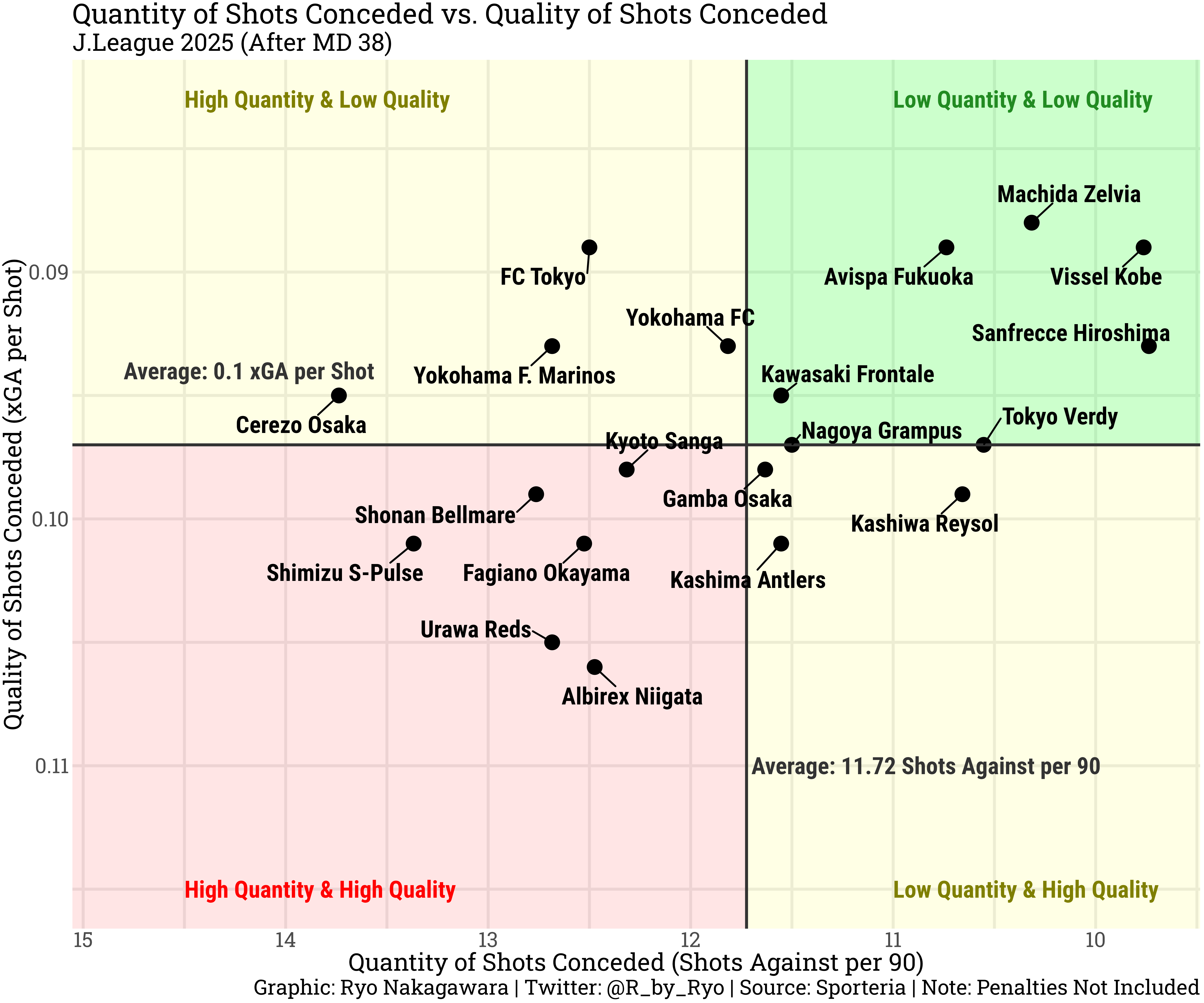


Sen Takagi was equal parts defensively decent and good on the ball. Also quite good in the air considering his smaller stature. However, injuries curtailed what could’ve been a more successful season for him. I’m tentatively interested to see what he can do next year. I’ve been a big fan of Reon Yamahara over the past few years and I feel like he maybe could’ve gone further in his career if he left S-Pulse when they got relegated back in 2022. Anyway, he was a huge part of their chance creation process with his excellent crossing skills in open-play and set-pieces.


It should be no surprise that in general, S-Pulse scored a majority of goals from set-piece situations (whether taken by Yamahara or others). It should also be noted just how many penalties S-Pulse had this season, 9 of which only 6 were scored by Kitagawa… if they had scored all 9 then that would’ve been nearly a 1/4th of entire goal haul which is pretty significant.
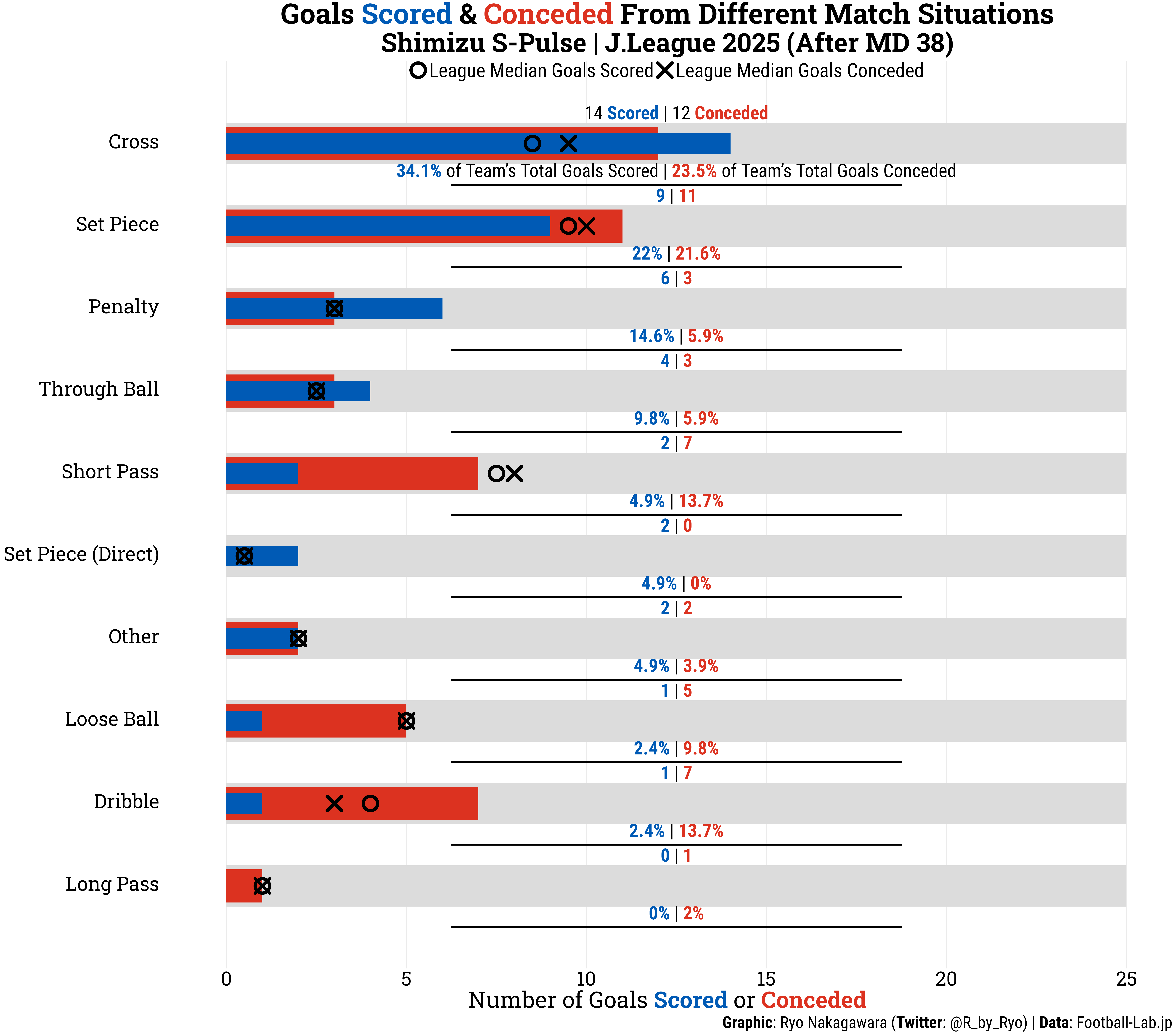
At the end of the season, the team’s performance was adequate considering the main goal was J1 survival. Mission accomplished and all that, etc. However, if S-Pulse want to get back near the top of the table then they still have a lot of work to do. At the very least they will have some time to figure out what kind of team they want to be during the 100 Year Vision League period. Tadahiro Akiba was confirmed to be leaving and Kobe manager Takayuki Yoshida is the front runner according to rumors… (Note: Yoshida was officially confirmed for next season)
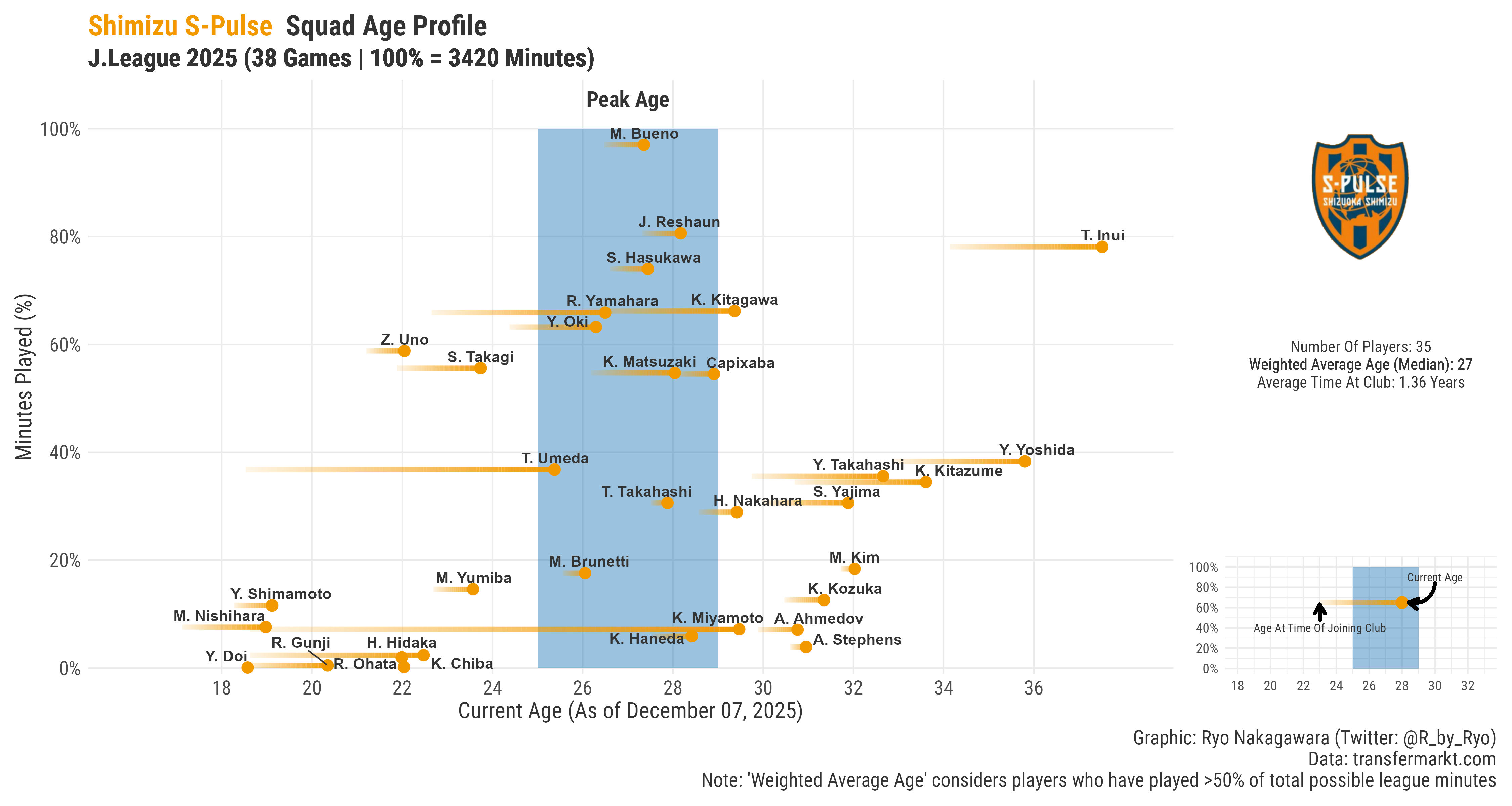
Yokohama F. Marinos (15th, 43 Points)
12 Wins // 7 Draws // 19 Losses
Location // Stadium: Yokohama // Nissan Stadium
Manager: Steve Holland (to late April) // Patrick Kisnorbo (to June) // Hideo Oshima
46 Goals (10th); 47 Conceded (12th)
36.74 xG (17th); 44.95 xGA (13th)
Top goal scorer: Asahi Uenaka (8 goals)
Goalkeeper: Park Il-Gyu
2025 was a truly terrible time that will marinate in Marinos minds for many months. Of course, it’s been a chain of events across the past few seasons that led to this point. It all started at the beginning of the 2024 season when Harry Kewell was awful, flamed out by mid-season and John Hutchinson finished as the interim. Then in 2025 Steve Holland was announced with much fanfare only to be dumped in April for Patrick Kisnorbo... only to then be replaced by Hideo Oshima in June! Five managers in two seasons, it was Udinese/Watford levels of managerial merry-go-rounds. There was a lot on the line this season as Marinos have the prestige of being one of the two remaining teams to have never been relegated from J1. In the end, they went on a winning run from late September to overtake Shonan Bellmare, Albirex Niigata, and Yokohama FC to finish above the relegation zone and safety. However, it was a very tight affair considering they had only won a single game in the first 16 games!


Marinos have not looked themselves for some time now. Various managers have tried to evolve or outright change the playing style that made Marinos a powerhouse during the Ange Postecoglou and Kevin Muscat days to middling success. Sporting Director Tsutomu Nishino and the managers this season did the rather ambitious and controversial action of transferring away the famed Brazilian Front 3 of Elber, Anderson Lopes, and Yan Mateus that had been their lifeline but... it seemingly worked? On a logical level, there was some sense in it as both Elber and Lopes were on the wrong side of their 30s with the potential to physically decline quite quick in the near future. Yan Mateus was in his prime but that also meant Marinos could get the most money out of him to rebuild their squad.
A huge strategic shift occured on top of the transfer activity, a fairly simple new plan:
Play with more directness/verticality, crosses, and set-pieces!
Pairing up Jordy Croux (ex-Jubilo Iwata, Avispa Fukuoka, Cerezo Osaka) with Kaina Tanimura (Iwaki FC) was a masterstroke. Croux has always been a bit of a one trick pony, he would cut in to his left foot and cross or shoot. In tandem, Marinos also brought along Tanimura, who had been a striker in an Iwaki FC team infamous for their extraordinary volume of crosses and set-pieces. As you can guess, Tanimura became the prime target for Croux’s supply of crosses with his excellent movement in the box. It was very un-Marinos of them to score 12 from set-pieces as well.


Of course, there were also injury issues that plagued the team with Taiki Watanabe, Takuya Kida, Jeison Quinones, Daiya Tohno (a specially big miss considering his early season form), Ryo Miyaichi, among others all suffering from medium-to-long term injuries at various points of the season.
In attack Asahi Uenaka was decent. I’m not nearly as high on him as others who think he can go to Europe but he played his part in staving off relegation. Despite his 8 goals from 4.64 xG I still don’t think he’s a consistent goal threat. His 4 assists also came from just 1.68 xA, denoting how his teammates’ finishing did a large share of the work there.


After the short-lived disaster of William Popp last season, the veteran Park Il-Gyu returned in goal alongside Hiroki Iikura but this means that they have a very old goalkeeping unit. I’m really hoping they’ll be willing to give Ryoya Kimura an actual go during the 100 Year Vision League (Marinos eventually gave him a debut in the last home game of the season).
Jeisson Quiñones was genuinely decent. Even during the Steve Holland times, he looked the part defensively. He was a huge miss through most of the season until he came back in the last few months. The Colombian’s return from injury along with the return of Ryotaro Tsunoda from Europe helped stabilize things in defense and this pairing is what Marinos should build around going forward. Kanta Sekitomi showed up for a handful of games in the final months of the season. He still needs a lot of work but there does seem to be some promise in him. Marinos clearly see his potential as although he was originally supposed to join in 2027, his arrival was expedited to 2026!
In the past few seasons Marinos have slowly shifted to more of a 4-4-2 shape from the 4-3-3 we all saw during Ange’s pomp. Successive managers have also changed to more of mid-block that’s somewhat more solid (especially improved once Oshima came in) but not without its own issues.


After calamitous season, Tsutomu Nishino (of Urawa Reds fame or should it be infamy now?) left the club after just a single year in charge. There were rumors, which were later confirmed as I was writing this section, about Hideo Oshima remaining in charge for next season which fills me with some trepidation. I’m always very wary of the ol’ “keep the guy that helped you escape relegation” trick because the aims and methods of “doing everything to prevent relegation” are very different from actually developing a winning team to push back up the table.
In the case of Marinos in particular, I do feel that their end of season winning run had some easy results go their way vs. teams that would normally have given them more trouble! To be clear, I think Hideo Oshima did an OK enough job under very difficult circumstances but I think they only want to kept him because of their still-precarious financial situation which means searching for a legitimate new manager is going to be difficult, both money-wise and the fact that they now have no sporting director.
Comparing between Steve Holland and Patrick Kisnorbo vs. Hideo Oshima on the other splits the season up almost evenly (before vs. after Matchday 20). Looking at the data:
Holland & Kisnorbo (to matchday 20):
xG: 17.2, xGA: 27.4, goals: 17, goals against: 29
Oshima (matchday 20 ~ 38):
xG: 19.6, xGA: 17.5, goals: 25, goals against: 14
So what is clear is that Oshima’s tenure managed to rein in the quality of opponent chances while also getting a bit more clinical/lucky with scoring themselves. The goals make sense given the emphasis on crosses after the summer, as chances from crosses are usually low xG but they got guys like Croux and Tanimura who were specialists in these situations.
Aside from questions about the managerial hotseat, Marinos have already done a lot of work to completely revamp the squad over the past transfer window so there’s considerable room for improvement that may still come as all these players get used to playing with each other more, especially without the pressure of relegation hanging over them during the 100 Year Vision League. Perhaps we’ll see a true resurgence of Yokohama F. Marinos in 2026/2027?
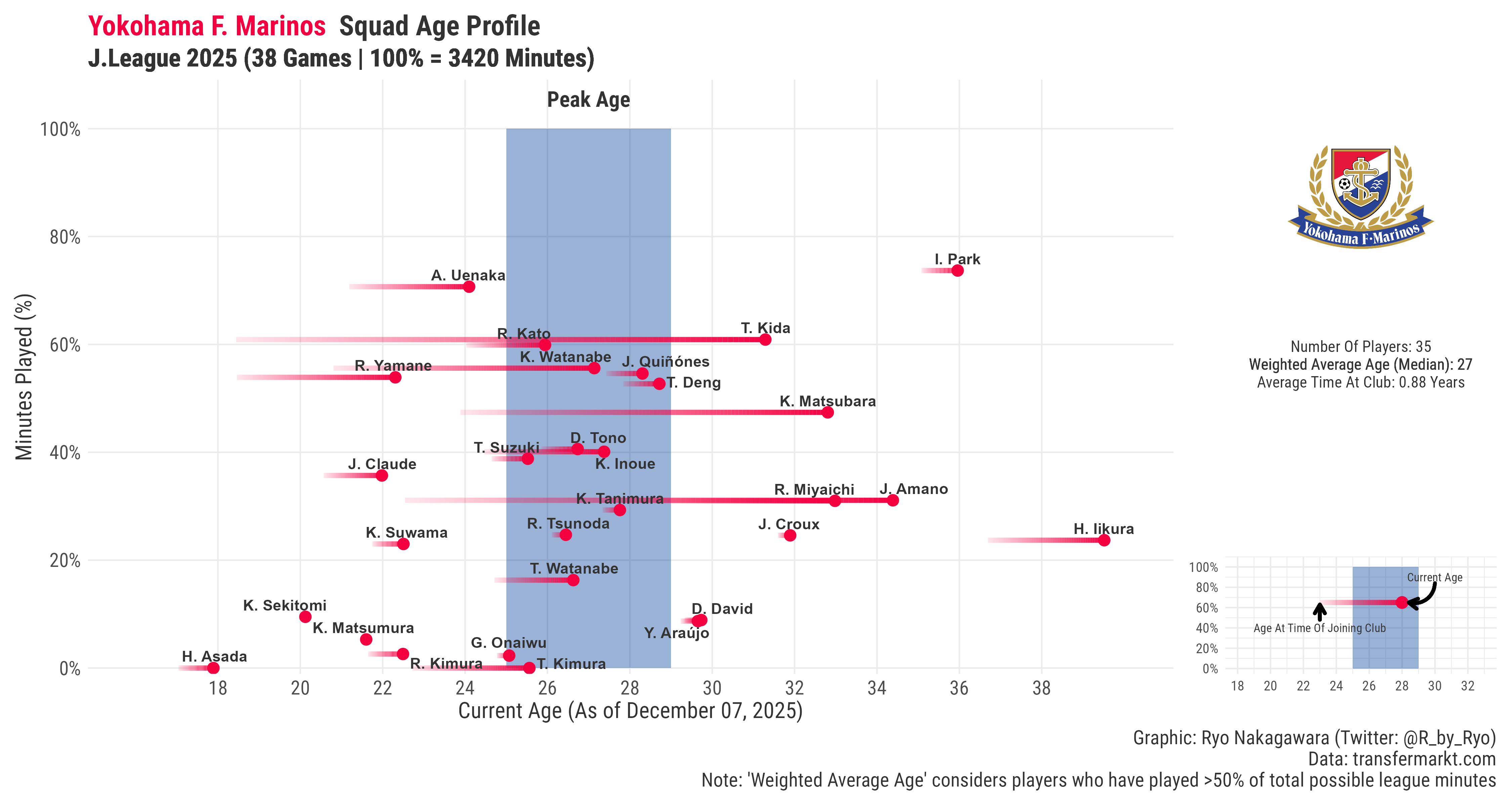
Nagoya Grampus (16th, 43 Points)
11 Wins // 10 Draws // 17 Losses
Location // Stadium: Nagoya / Toyota // Toyota Stadium
Manager: Kenta Hasegawa
44 Goals (12th); 56 Conceded (16th)
42.63 xG (12th); 42.53 xGA (10th)
Top goal scorer: Sho Inagaki (5 goals plus 6 penalties)
Goalkeeper: Alexandre Pisano // Daniel Schmidt // Yohei Takeda
After multiple years of mediocrity (and admittedly one League Cup triumph), Kenta Hasegawa’s infamous reign over Nagoya Grampus has finally ended. My particular expectations for Nagoya Grampus and therefore my harshness in these season reviews over the past few years stems from the fact that this team can/should do much better given Grampus’ financial outlay in terms of transfer fees and wages spent as well as the strong foundation of a passionate fanbase.
Things were looking wonky even before the season as Kasper Junker and Daniel Schmidt both got injured. The team seemed all out of sorts from the get-go and were deep in the relegation zone having not won a single game until the seventh game of the season. Grampus were able to recover a little bit to push themselves away when they lost only once between matchdays 15 and 23 which had people thinking the team was stabilizing. However, in another twist they dipped in form again while Marinos started to rack up wins and Nagoya somehow managed to drag themselves back down into the relegation fight. During all this the defending League Cup champions somehow fell to Kataller Toyama in the 2nd round back in April while also losing to Sanfrecce Hiroshima in the Quarter Finals of the Emperor’s Cup in the summer.


Kenta Hasegawa is usually known for being able to coach a fairly solid defense but the team looked all over the place this season. The pressing was a wash most of the time, all it would do is open up large holes in the midfield that Sho Inagaki would inevitably charge out to cover, which then only further exposed a rather lackluster Back 3 behind him!
I’ve been very skeptical of KenedyEgbus Mikuni. There’s occasions when he looks competent, very aggressive in challenges but ultimately he just isn’t very good. He was deservedly dropped after Haruya Fujii came back to Japan. Yuki Nogami was showing his age and drifed in-and-out of the team. I really don’t think Akinari Kawazura is any good and in my opinion he only gets chances because he’s left footed. Yota Sato is alright while I genuinely like Teruki Hara but he never got to show his best under Hasegawa. A small positive was upstart 18 year old Right Wing Back Soichiro Mori, it will be nice to see more of him next season.


I’m a big fan of Haruya Fujii so I was bitterly disappointed that he had to come back to the J.League. He has magically shown no signs of injury troubles now that he’s back in Japan though. This meme still applies though:
Hasegawa finally gave up his weird fixation with Takuya Uchida at Center Back, although to be completely fair some of this was squad recruitment related and not entirely on Hasegawa.
On a slightly more positive note, Alex Pisano’s sudden rise was quite nice to see. Playing regularly at the J1 level at such a young age gave him the opportunity for a U-20 World Cup starting place and national team debut at the EAFF Cup. Of course, I think he still has a long way to go as he’s made more than a few mistakes but in a league where very old goalkeepers reign, it was a nice change of scenery for me. In contrast, Daniel Schmidt’s career keeps taking a nose-dive since his failed move to Metz in 2023 that set off a whole chain reaction of events that scuppered Japan’s 2023 Asian Cup. Schmidt was brought in as a starter but numerous unjuries made this season a complete write-off.
What is even more perplexing is how this team seemingly can’t function without Sho Inagaki. In the mid-season review, I half-jokingly called him the “Japanese Frank Lampard” but where would Nagoya be without his goals and all around midfield engine? The issue is that the guy is nearly 34 and has had the workload of 2~3 players all by himself. I’m not sure how long he can keep this form up and in that sense, switching managers should allow the team to wean themselves off their huge dependence on him.


Of course, both Ryuji Izumi and Tsukasa Morishima did a good job too. The former has always been able to play a billion different positions but the latter has played a lot deeper in recent years to decent effect. I still think Morishima should be pushed up higher though. I personally would like to see Taichi Kikuchi fit-and-firing and broken out of jail (the bench). He’s genuinely a good player. Hopefully the new manager coming in recognizes this.


Mateus had a very mixed season. He ended the season as the tied 2nd highest goal scorer on the team but his 5 goals only came across three separate games. His fitness became very stop-start after July and it was announced that he got an ACL injury in October. To go on a bit of a segue, as much as it had hurt to lose Mateus in the middle of the 2023 season, it made sense in terms of his age and the significant financial compensation they received. Ideally, Grampus would’ve used that money to rebuild. But of course, they wasted that money on a bunch of transfer duds (Jose Carabali? Yves Avelete? Yuya Asano was quite disappointing as well even though the move made sense on paper) and they then brought Mateus back from the Middle East in January this year! He’s now much older, more injury prone (he had a major injury while in Saudi Arabia), and now will be close to 32 when he returns from injury. Just really fantastic transfer strategy all around from Nagoya...
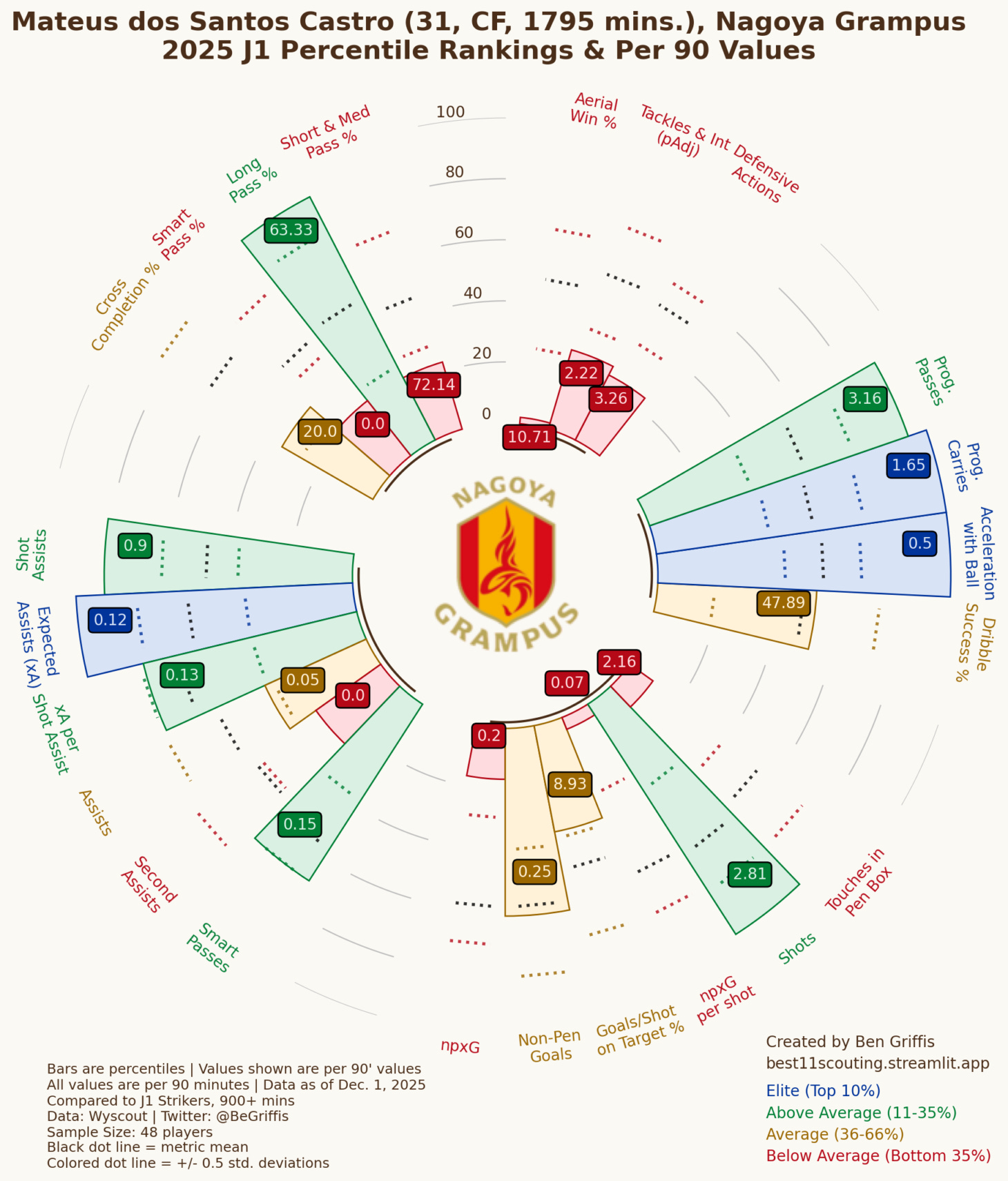
Another problem is that Nagoya have had so many strikers in recent years but so few goals. Following the aforementioned Inagaki, the top goal scorers were Center Back Yota Sato (!!!), Mateus (major injury since October), and Ryuji Izumi (who has not scored since late August)! To be clear, I think both Yuya Yamagishi and Kensuke Nagai do a lot outside of just scoring goals, I get what they provide and I especially like Yamagishi honestly. However 3 goals and 2 goals respectively is extremely poor returns. Kasper Junker was always injured (again) while Yudai Kimura was bought for a decent chunk of changes but hasn’t quite got going yet either... It is/was a real big issue.
According to Football-Lab, Nagoya were:
17th in the league for final 3rd entries
17th in box entries
13th in shots and 12th in shots on target
All leading to 11th in goals scored!
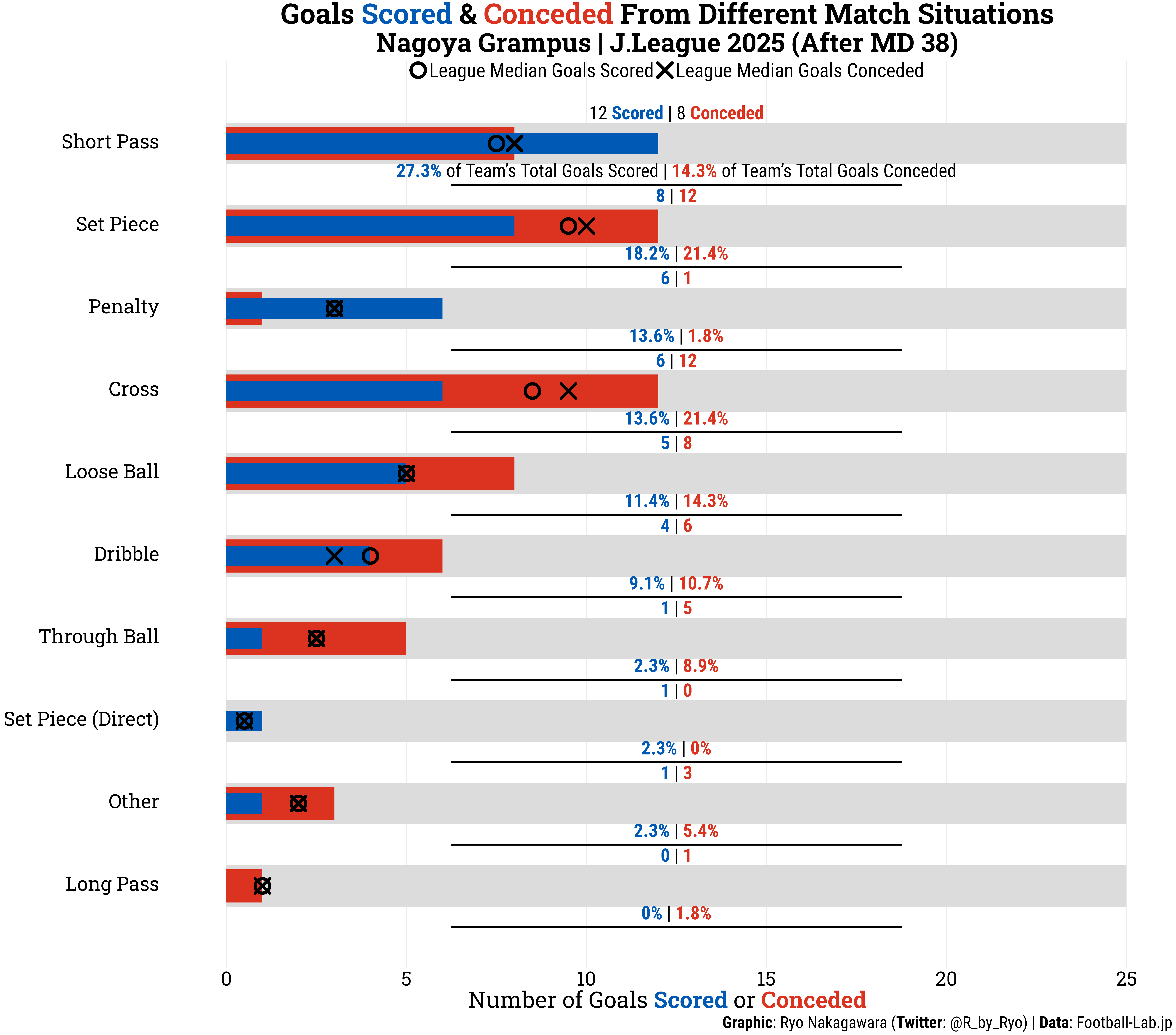
When you consider the entire squad there’s a decent player pool (but not great and an aging one, to be clear) but they aren’t functioning at all properly in attack and defense, this is mostly down on the manager in my opinion. Of course, the recruitment team has a lot to answer too and Nagoya have actually done just that by letting go of both the GM and the Head of Recruitment a few days after the team secured safety from relegation in November. Over the past few seasons they have consistently had the oldest squad by average age so that’s something the new executives will have to address.
Rumors have swilled around over potential managers this past month… The worst being reports that Grampus are considering Mischa Petrovic. Please don’t, please spare me from having to talk about Mischa Ball in the Year 2026 (as I’m finalizing this write-up in December, the rumors are only getting stronger…). My mental sanity aside, now Nagoya fans can breathe a sigh of relief as the team can spend the next six months during the 100 Year Vision League to try out new personnel both on and off the pitch as it gears up for a refreshed run in the 2026-2027 season.
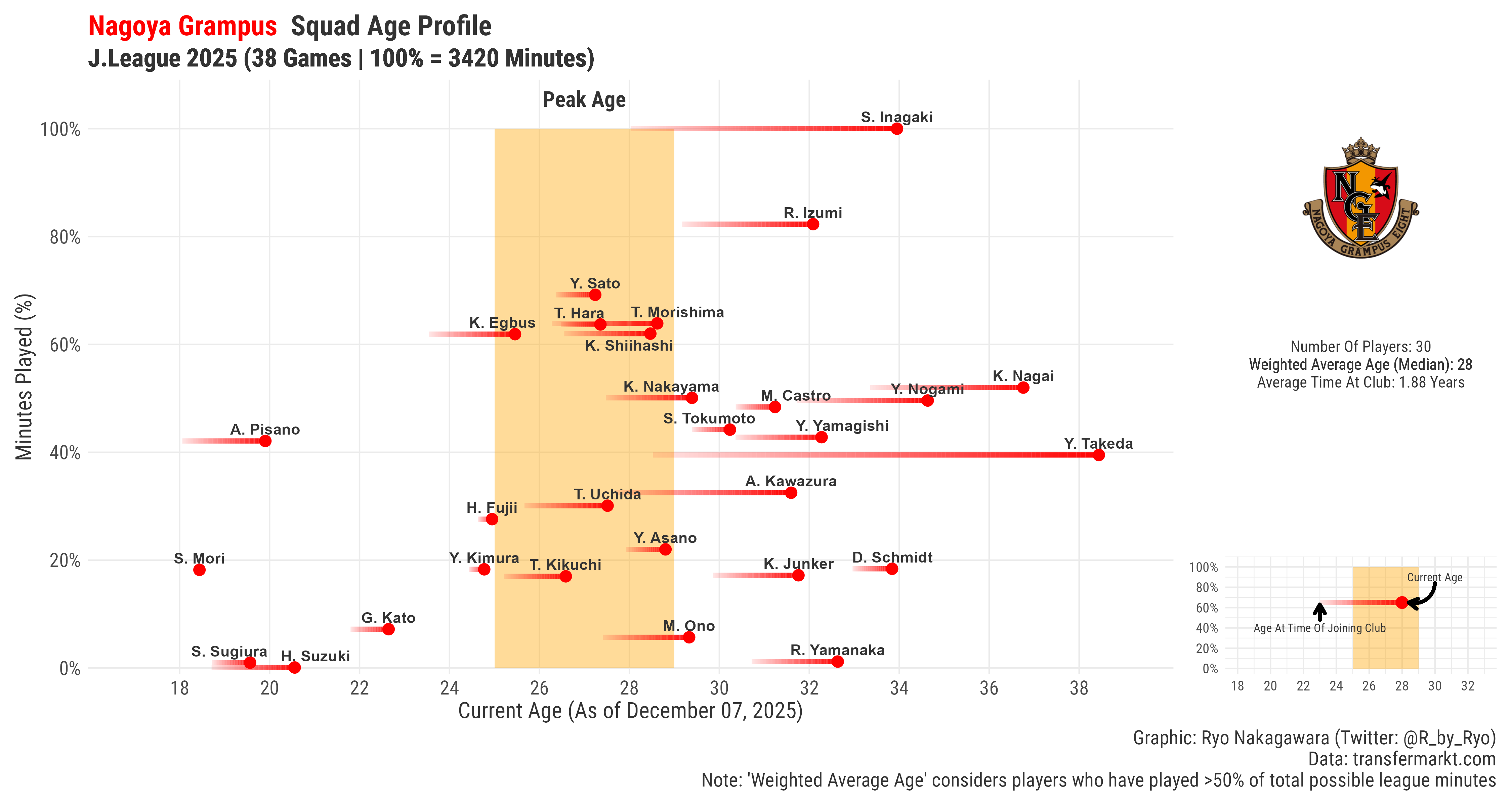
Tokyo Verdy (17th, 43 Points)
11 Wins / 10 Draws / 17 Losses
Location // Stadium: Ajinomoto Stadium
Manager: Hiroshi Jofuku
23 Goals (20th); 41 Conceded (9th)
31.82 xG (20th); 38.85 xGA (5th)
Top goal scorer: Itsuki Someno (5 goals)
Goalkeeper: Matheus Vidotto
Second season syndrome hit like a 18-wheeler truck! Verdy last season looked awful but got results and at the time that was acceptable as survival was an absolute necessity. While Verdy did do enough to survive again this season, the cracks have appeared throughout the fanbase (and most neutrals) as the football on display has continued to be extremely painful to watch, some might say it’s somehow worse. Their defense has generally been pretty solid, a very physical middle-block that also pushes out to do a lot of pressing from their energetic outfield players. However, Verdy’s attack was genuinely the worst in the league. Using a five game rolling average, Verdy’s xG and goals for only jumped above one (1!) just a few times this season...


In terms of positives, Kosuke Saito & Koki Morita were an absolute joy to watch. They are extremely good at pass-and-move sequences that befuddle the opponent press and tightly packed blocks with their positioning and intelligence in finding gaps between-the-lines. Verdy are honestly quite good to watch in the first 2/3rds of the pitch due to these two and Hiroto Taniguchi making plays.


However, this brings me back to the big problem plaguing Verdy which is that they have only scored 22 goals this season. Yes, you read that right! 22! Twenty-Two! In 38 games! Itsuki Someno was the top goal scorer with 4 goals from 6.89 xG and also got 4 assists. The previous top goal scorer was the departed Yuto Tsunashima with 3... along with Hiroto Taniguchi, another Center Back. In the summer Verdy sold Yudai Kimura (just 2 goals…) to Nagoya Grampus then brought in Shimon Teranuma, who then hardly played for some reason…
This all led to a Verdy team that according to Football-Lab are:
LAST in goals scored (as previously mentioned)
19th in shots taken
19th in shots on target
18th in final 3rd entries
18th in box entries
Do I really need to say more?
Shifting to the defense, Yuto Tsunashima continued to play well following a good 2024 season which led to a Japan national team call-up for the EAFF Cup in July. A few weeks later he moved to Royal Antwerp in the Belgian League. I did write about him in the mid-season review already so I’ll refrain from doing so again here.
While Hiroto Taniguchi has not got the kind of outright physicality like Tsunashima that would be immediately enticing for European clubs, I do think plenty of J1 clubs at the higher end of the table will be very interested in him, especially since he is only 26. His small height for a Center Back and age probably rules out a move overseas although his aerial win % isn’t actually that bad. A huge value though is his ability on the ball from the back-line. Taniguchi has equally good amount of ball progression though his passing and carrying abilities.


The goalkeeping department is a low priority for change as Matheus Vidotto is largely fine but maybe it’s time to try out Keisuke Nakamura during the 100 Year Vision League. I was a bit surprised when Verdy sold Hjiri Onaga off to V-Varen Nagasaki as he’s a decent player but he was getting older and the one thing Verdy absolutely have is a bunch of young-ish guys who can run around a lot that you can throw into the Wing Back position so I guess it was fine. Verdy have so many of this type of player like Yuta Arai (who has also played in attack a fair bit), Yuan Matsuhashi, Yosuke Uchida, etc. None of these guys are going to be superstars but considering the fact that Verdy don’t have a whole lot of money to buy good-to-great players so they can’t be too picky and they are quite young so maybe you could flip them for some profit in a year or two. Verdy do have a great academy though, unfortunately we haven’t seen Joi Yamamoto, Keisuke Nakamura, nor Gakuto Kawamura get a chance in the league yet…
I feel like Hiroshi Jofuku has burnt through a lot of the goodwill he’s bought over the past few seasons as fans have become frustrated at the football on display but on the other hand, can Verdy really do more given their finances? With continued J1 survival it’s clear that their financial situation is improving year-on-year now but how long will it take for them to get them back to their 90s pomp? Can they make smart(er) decisions in the meantime to prevent being stuck in a relegation fight every year even with limited resources? I think Jofuku has set his team up well given their good defending, build-up play, etc. A lot of the attacking/finishing quality woes are player recruitment related that are somewhat out of the manager’s hands.
In the last months of the season, two narrow 1-0 victories over relegation rivals Shonan and Albirex Niigata was what ultimately sealed Verdy’s safety but it was a very close run thing. Mission accomplished yet again so hopefully there’s time to start anew and experiment a bit more during the 100 Year Vision League. Perhaps a bit more excitement for the fans, a couple more goals (into the opponent’s net) every game to cheer about?
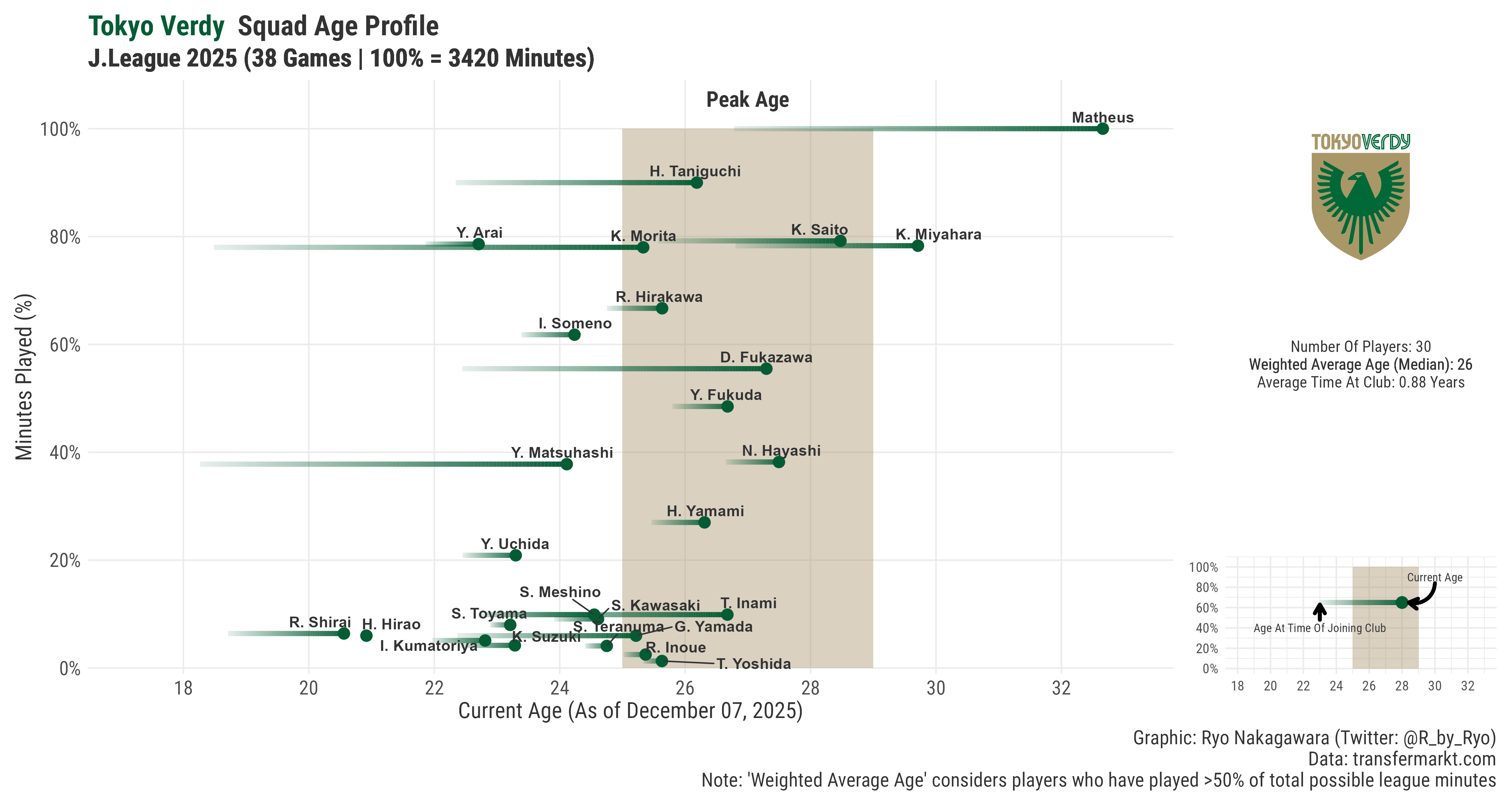
Yokohama FC (18th, 35 Points)
9 Wins // 8 Draws // 21 Losses
Location // Stadium: Yokohama // Nippatsu Mitsuzawa Stadium
Manager: Shuhei Yomoda
27 Goals (19th); 45 Conceded (11th)
35.65 xG (19th); 41.54 xGA (7th)
Top goal scorer: Solomon Sakuragawa (4 goals)
Goalkeeper: Akinori Ichikawa // Jakub Slowik
Yo-yo-kohama FC are relegated once again. This means we’ll see them back in J1 in 2027, right? Shifting back to the present, it was yet another awful showing from Yokohama FC on the J1 stage. Manager Shuhei Yomoda, who presided over the past few yo-yo-ings, started the season extremely poorly with a solitary win in the first 16 league games which included a seven game losing streak and eleven game winless streak! He was surprisingly only fired in late July... and replaced by Fumitake Miura, who has bounced around as a coach (and occasionally manager) across different J2 level clubs and was part of the Yomoda’s coaching staff from this season. Unfortunately, the tides didn’t change as despite winning half of the last ten games of the season, Yomoda’s tenure had left them in too deep of a hole to dig out of along with rivals Yokohama F. Marinos’ resurgence in the autumn months. Perhaps if the front office had gotten rid of Yomoda earlier, they might have had enough oomph to pip Marinos to safety but it wasn’t to be.


The underlying issue has been that Yokohama FC over the past few years have had a decent J2 squad but an outright bad-to-below-average J1 squad. They also don’t help themselves with some horrible recruitment strategies that make it harder to dig themselves out of in subsequent windows. This season probably takes the cake though because they had nearly a starting XI of first team Goalkeepers on the books! It’s even more crazy when you consider that four of them have been J1/J2-level regulars in the past few years. Of course, some consideration does need to be made over the fact that Tsubasa Shibuya was brought in as the starter, only to suffer a major injury in pre-season which started off this goalkeeper merry-go-round...
Still though, even acknowledging their poor financial position relative to the league, Yokohama FC collected far too many veteran players. The fact that a lot of the actual younger players they’ve brought in (from J2 or from university sides) have done much better across the long season should give the front office a hint at how they should be strategizing for next year though.
While there was a short period where Kaili Shimbo lost his place to Kyo Hosoi (more on him next) overall, Shimbo showed that he could do a decent enough job at this level despite the increased physicality of J1. He is very good at driving forward with the ball and crossing it, he absolutely will have suitors across J1. FC Tokyo might make sense for him.
Shogun Soccer Scouting #4: Kaili Shimbo

Hi all! I’m back with another Shogun Soccer Scouting feature… on Kaili Shimbo.
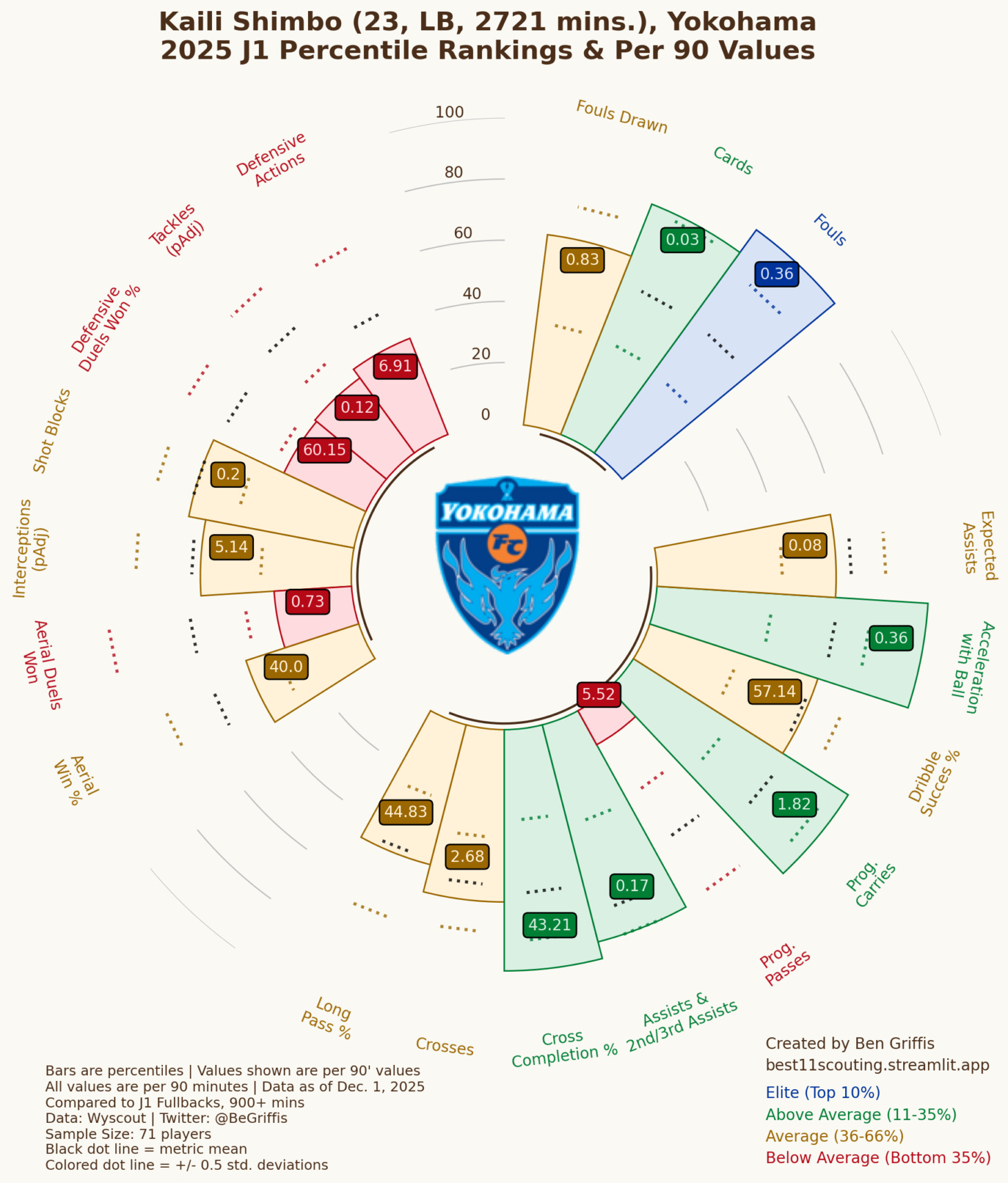
Kyo Hosoi was a big surprise especially since he was coming into a position that didn’t really need an upgrade in Left Center Back / Left Wing Back. Putting aside my skepticism over why they didn’t do this in other positions, Hosoi performed quite admirably and made a very good case for starting next season in the 100 Year Vision League.
Akito Fukumori continued to play quarter-back for this team with his excellent medium-long range passing and set piece ability. Like I said in the mid-season review, his defensive liability in open space is ameliorated by how Yokohama FC play and the fact that he gets actual support from his teammates unlike at his previous club. He is still getting up there in age though so there’s going to be some hard decisions during “contract re-negotiations” this winter though. Nduka Boniface has his bone-headed errors but has usually been OK enough at the back. He is one of the few assets that would be worth something if they want to reinvest so it’ll be interesting to see what happens to him over the winter.


Looking across this squad, there just isn’t a whole lot of quality. Solomon Sakuragawa for all of his bullish endeavor and strength up top... ultimately he doesn’t quite have the agility nor skill to actually score many goals. Admittedly, he was still the best of a bad batch with 4 goals and 3 assists. I think there’s a market for his type of profile for him to stay in J1 but I’m just not a big fan of his.
Let’s look at the Brazilians! Joao Paulo was fairly useless. Michel Lima played 7 (single digits, seven) whole minutes in the league and was binned off in half a season. Lukian clearly doesn’t have the legs for it anymore. Adailton looked threatening but he’s really at the twilight of his career and I thought he’d gone riding off into the sunset after a good J2 season with Ventforet Kofu in 2024. I do feel coming back to the J1 level was too a bit too much for him. Yuri Lara is tough tackling and can be somewhat useful but his lack of mobility is a huge issue that makes it hard to play anything other than a low-mid block!


Overall, Yokohama managed to concede fewer goals relative to the bottom half but they mostly did this by sacrificing any sort of attack and ultimately that’s what sunk them. I’ll be honest, they have always been a difficult team to watch as a neutral. Most of their defensive metrics were in the mid-table range but their attacking metrics were in the gutter.


This team needs a big reset. There’s way too much waste on the wage books especially on expensive old Brazilian attackers that didn’t actually help them survive J1! I’m not sure how they’re going to get rid of these contracts because contrary to popular (Japanese) belief, a lot of these guys had definitely signed multi-year contracts! There are plenty of young or young-ish guys from university teams and J2 that Yokohama FC have filled up on over the past few transfer windows that they should be building around instead. Can they successfully rejig their strategy during the 100 Year Vision League to come back swinging for promotion in the 2026-2027 season? They’re going to have to as the Japanese and Brazilian veterans they have aren’t going to last until 2027 anyway but time will tell.
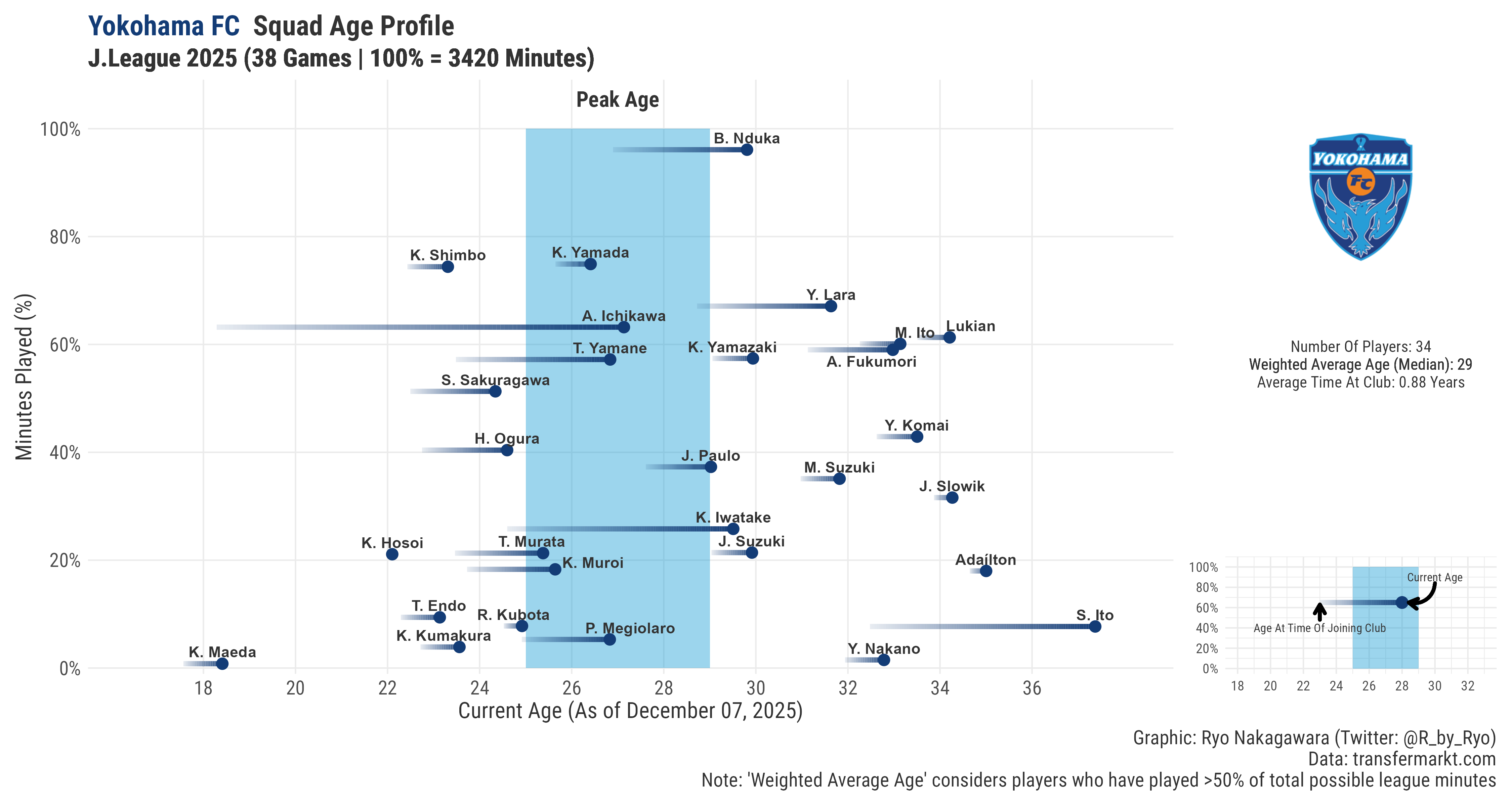
Shonan Bellmare (19th, 32 Points)
8 Wins // 8 Draws // 22 Losses
Location // Stadium: Shonan // Lemon Gas Stadium Hiratsuka
Manager: Satoshi Yamaguchi
36 Goals (15th); 63 Conceded (19th)
38.5 xG (16th); 47.78 xGA (15th)
Top goal scorer: Akito Suzuki (9 goals)
Goalkeeper: Naoto Kamifukumoto // William Popp // Kota Sanada
Remember when Shonan were leading the league? It seems eons ago but it was back in March! Shonan were undefeated in their first five league games of the season but it was all downhill from there especially after losing a huge chunk of their starters to European clubs in the summer (Junnosuke Suzuki, Sho Fukuda, Taiga Hata). What followed their 2-0 win against Verdy in May was a ninteen game (!!) winless streak, including a seven game losing streak between August and October, that was only broken by a 5-2 win over Albirex Niigata in early November. However, that came a week after their relegation had already been confirmed after a heartbreaking loss against Avispa Fukuoka conceding off a last second penalty.


Honestly, it’s very hard to blame manager Satoshi Yamaguchi a whole lot here. I’ve been pretty sympathetic to his plight considering he has to work with a box of scraps every single year and the somewhat decent and/or young players get plucked away every transfer window.
Let’s do a brief segue to highlight some of the important players that left in the summer:
Sho Fukuda was a real live-wire in the attacking line. His physical output was incredible with huge amounts of sprints and accelerations per game. He used his speed for carries and runs behind in attack while also for counterpressing in defense. This sort of physical intensity made him ideal for Europe and he went off to Denmark. I wrote a quick report on him here:
Shogun Soccer Scouting #11: Sho Fukuda

Here is a short-and-quick read on Sho Fukuda. I’m actually in the middle of writing my big J1 mid-season review but he’s a player I really like so I’m writing this one up real quick from my notes before shifting back. This will be much shorter and less detailed than my usual scouting pieces. Time is of the essence,
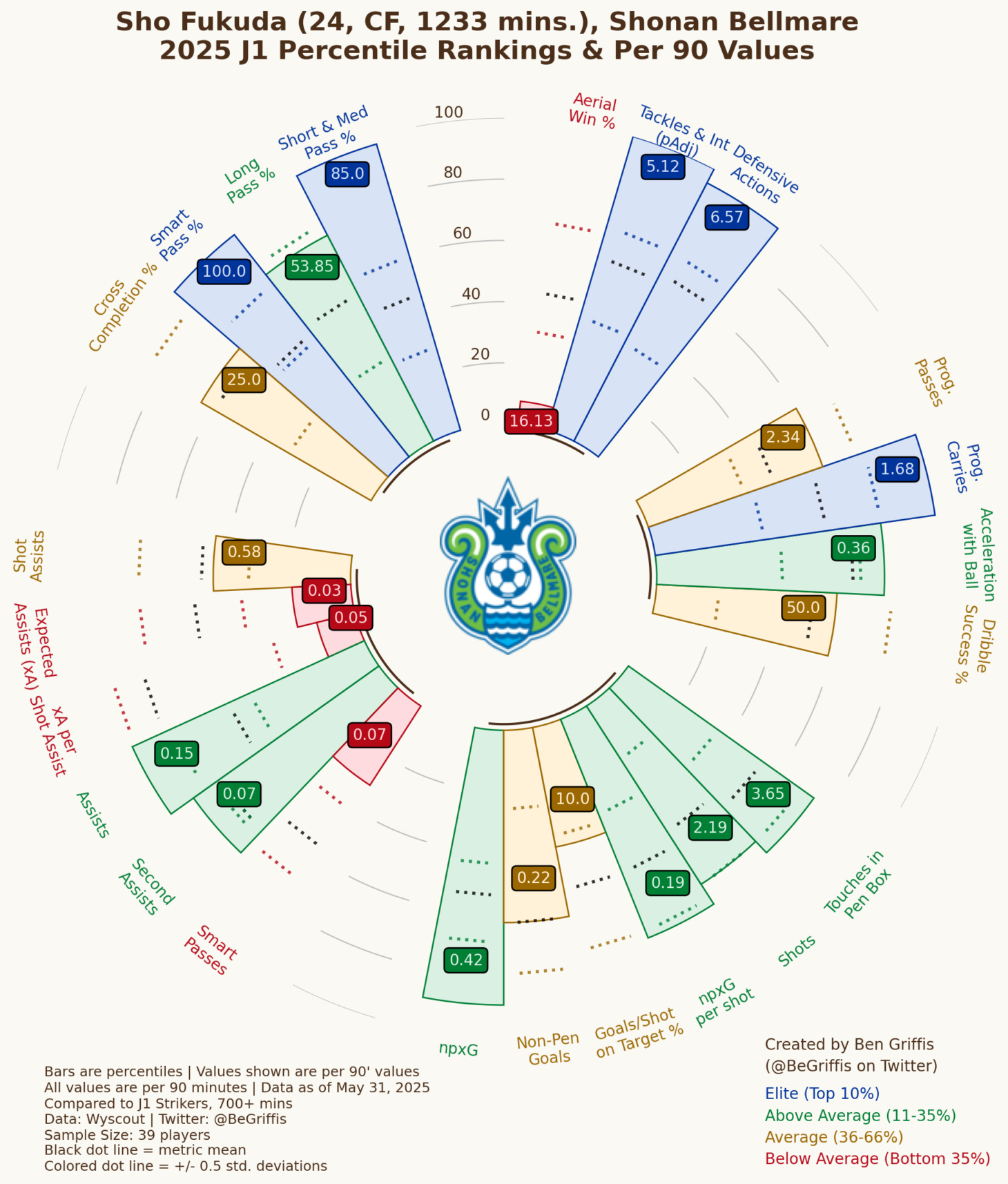
Junnosuke Suzuki exploded into prominence in the latter half of the 2024 season and continued his fine form in 2025. As a converted midfielder to the Back 3 Center Back position, he was unique due to his midfielder-like qualities on the ball but doing so from a much deeper position. He improved far quicker than what I thought possible and earned a move to FC Copenhagen in the summer but not before earning his full Japan National Team debut in June and then continuing to earn caps while playing in Denmark throughout the autumn. The report I wrote on him back in February is one of my favorite and most comprehensive pieces:
Shogun Soccer Scouting #8: Junnosuke Suzuki

Hello, I’m back with another scouting piece ahead of the 2025 J.League season. I’m very excited to have access to StatsBomb and Hudl’s event and physical data for the J.League to enhance my analysis. This report is on Junnosuke Suzuki!
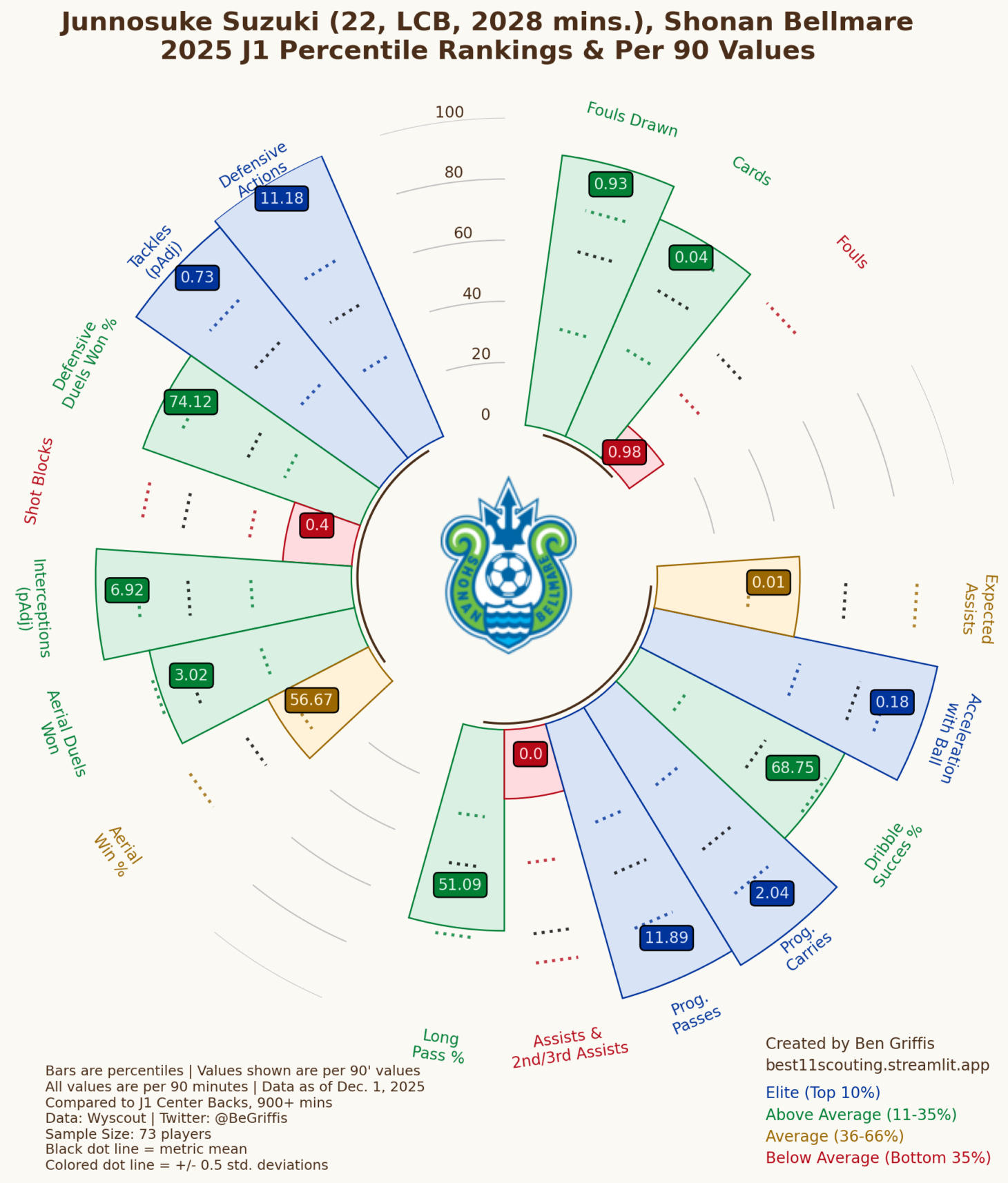
Taiga Hata’s career had been marred by continuous injuries but he’s been far more fit and ready over the past year or so. As a result he was picked up by Sint-Truiden during the summer due to his immense physical endurance that enabled him to progress the ball through his passing and carrying.
Now to point out some positives out of those players that did stay. Taiyo Hiraoka continues to be criminally underrated, unless you’ve been reading my work for the past 5 years and know how much I’ve praised him since 2022. Unfortunately he doesn’t quite have enough end-product which is a shame considering the real good quality of his off-ball running.


Akito Suzuki was doing it all, leading the press up front, taking shots, and creating. He had the whole club’s weight on his shoulders. I do quite sympathize with him as he’s a good player, clearly putting the effort in, and rallying the troops every game as the new captain. Suzuki’s numbers didn’t really pop but he still managed 9 goals and 4 assists, a career high in goal involvements despite being on a far weaker iteration of Shonan Bellmare.


In terms of the other attackers, Yutaro Oda was a dud with only a single goal to his name. Rio Nitta, who was brought in over the summer on loan from Urawa, fared slightly better with a goal and 2 assists. All these misfiring attackers aside from Akito Suzuki meant Luiz Phellype kept coming back into the line-up and managed to score 4 goals. Stuff like this is probably why J.League clubs continue to hit the “emergency random Brazilian striker” button inside the glass case at the club house every single season... Otherwise, the underrated Kosuke Onose provided 6 assists. He’s a veteran now at 32 so it’ll be interesting to see if he stays or goes.
In midfield, Kohei Okuno, covered decent amount of ground but probably does not have the mobility to cover it quickly enough especially when Shonan lose the ball poorly. The rest of their midfield is full of guys on the older side like Akimi Barada and Hiroaki Okuno, Kosuke Onose (more of an attacker anyway) or guys like Masaki Ikeda and Taiyo Hiraoka who aren’t quite good defensively either.
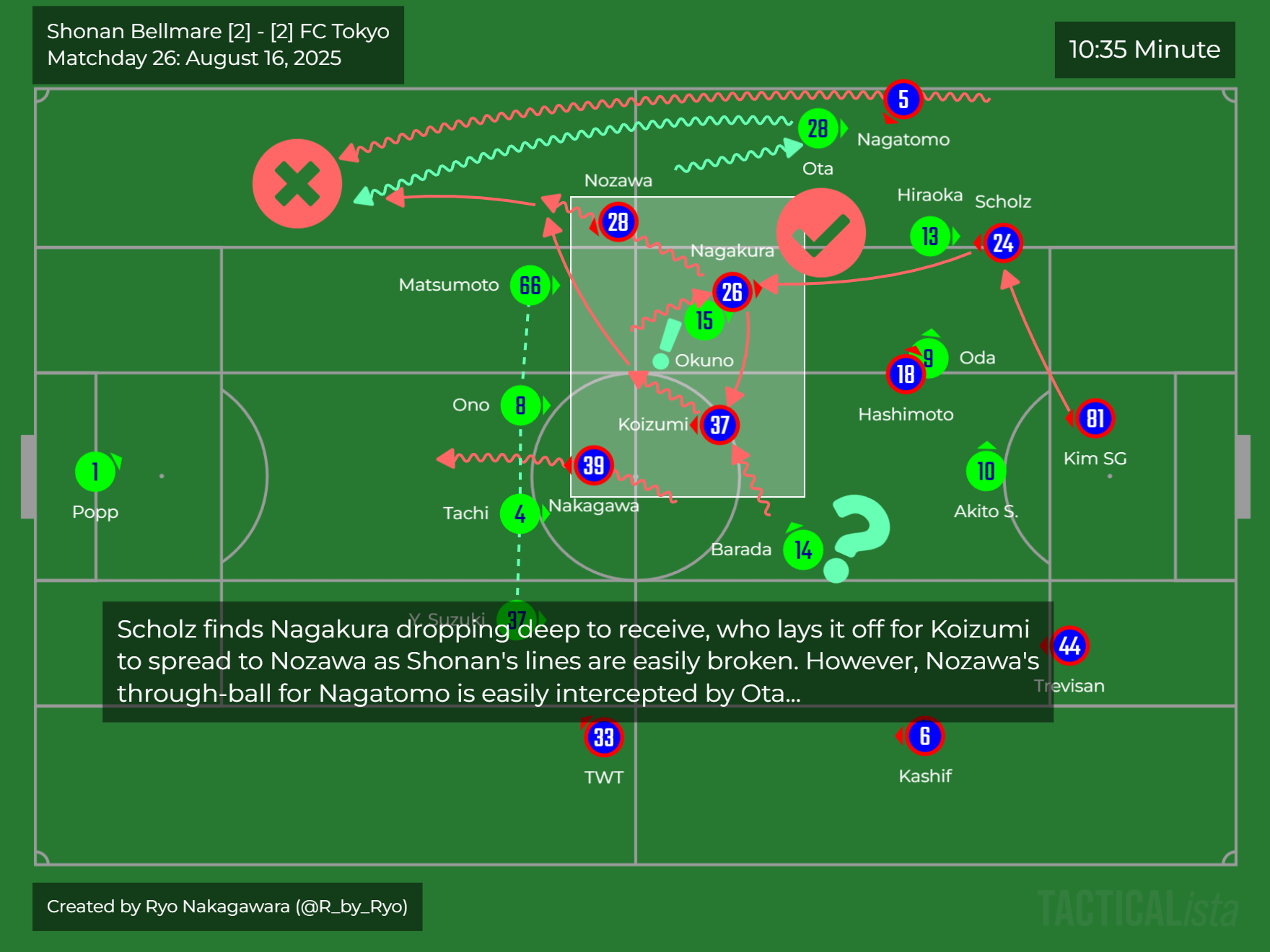
Ultimately though, even with the issues with the press and midfielders, the quality of defenders was… well. Simply put, most of them can’t actually defend. I was very confused about the departure of Kim Min-Tae on loan to fellow relegation battlers Shimizu S-Pulse. He was Shonan’s savior a few seasons back, so I’m really wondering what happened there? As such, Shonan were left with the calamities-in-human-form in Kazunari Ohno, Koki Tachi, etc. and things went as you’d expect... In the summer, Shonan drafted in some help in the form of Shinya Nakano and Hiroya Matsumoto who were both OK-to-fine but it was much too little, too late at that point. About the only defender that I would give props to was Yuto Suzuki, who had a heavy load on his shoulders especially when you consider that he was super important when Shonan had the ball as well.
Overall, Shonan’s defending shipped the 3rd most shots conceded, 6th worst xGA per shot, and the 6th worst non-penalty xGA. It was real bad, folks!


Naoto Kamifukumoto had been his usual god-like (with the occasional horrifying mistake) presence between the sticks for Shonan but unfortunately the wily old veteran suffered an ACL injury in June. Shonan decided to fix their goalkeeping issues by buying William Popp who had lost his place for Marinos... I couldn’t believe my eyes! Aaaand sure enough, Popp was binned off after conceding 21 goals in 7 games for Kota Sanada (the previous time he was a regular goalkeeper was in 2022 for a JFL team...) and emergency loanee Shun Yoshida. Not great!
A theme of their defending was their poor set-piece readiness, Shonan conceded 17 goals from these situations, over a quarter of their total!
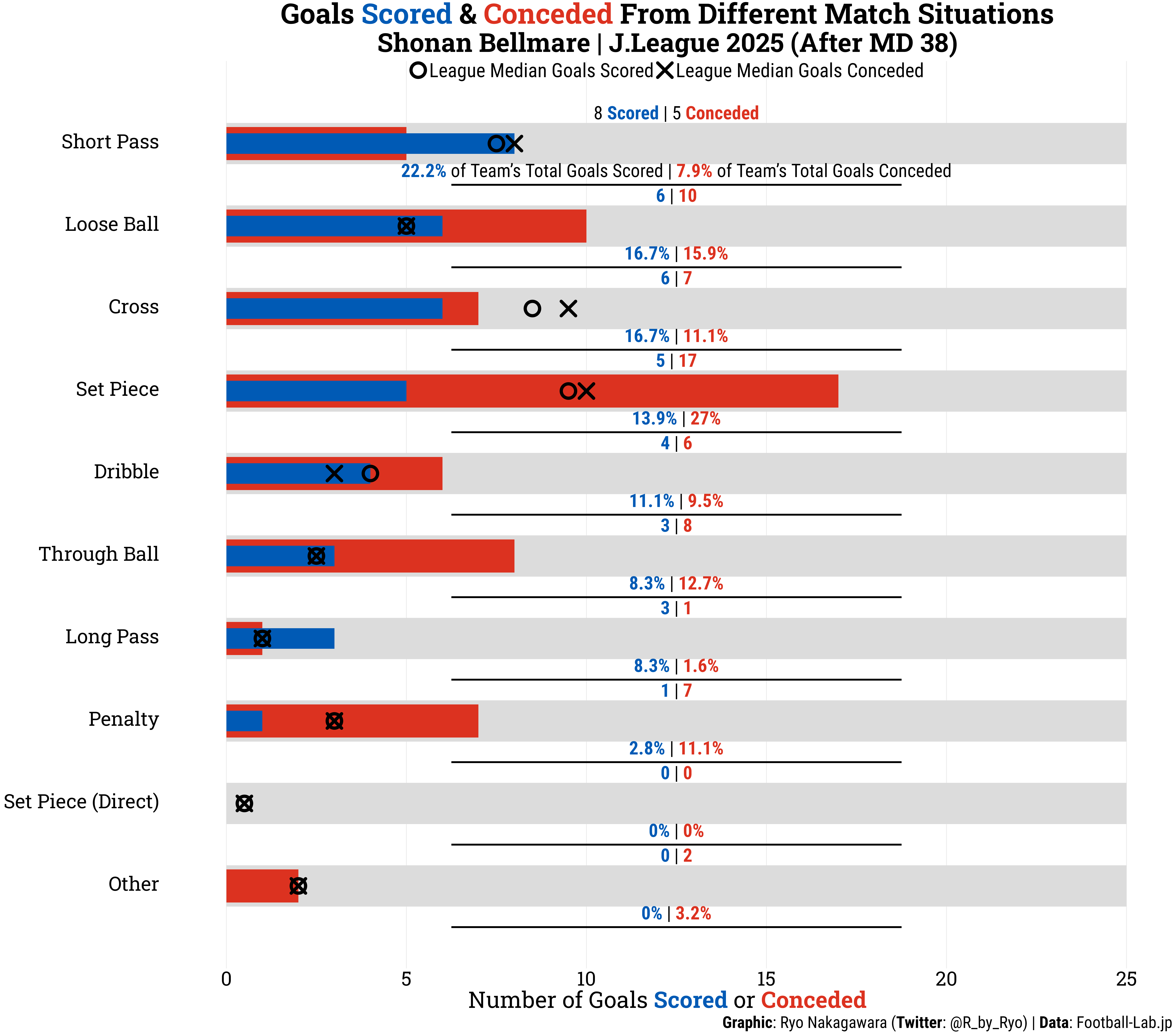
Shonan gathered just 7 (seven!) whole points in the entire 2nd half of the season, or at least since I wrote the mid-season review. It captures how they were never able to get into any sort of form after that magical first month. Shonan have always relied on a somewhat youthful core alongside lots of old veterans (mostly from free transfers) due to their financial constraints. When you always look at Shonan’s squad age profile, you can clearly see a lack of players playing significant league minutes in the “peak age” category. This is something I call the “Shonan gap”. What’s going to be interesting is who of those players they are going to be able to keep as I imagine a lot of teams (both Japanese and European) will be looking at Hisatsugu Ishii, Taiyo Hiraoka, and Akito Suzuki... Rumors also point to ex-Omiya Ardija boss, Tetsu Nagasawa, taking the reins at Shonan which will definitely be interesting as I did like how he was able to rebuild Omiya from the ground up after their J3 relegation (NOTE: Nagasawa was officially appointed on the morning this newsletter was released).
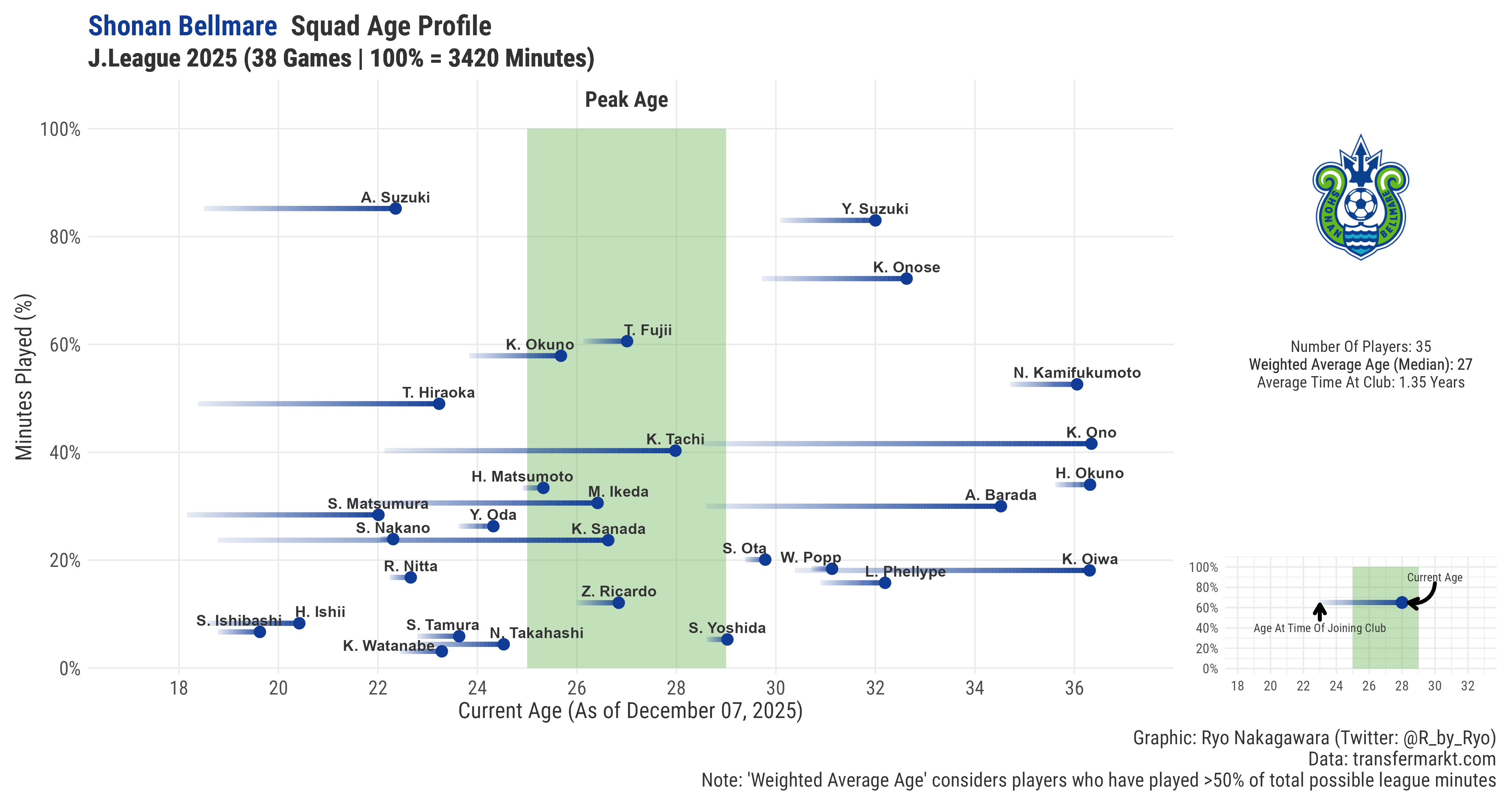
Albirex Niigata (20th, 24 Points)
4 Wins // 12 Draws // 21 Losses
Location // Stadium: Niigata // Denka Big Swan Stadium
Manager: Daisuke Kimori (to June) // Toru Irie
36 Goals (13th); 67 Conceded (20th)
36.48 xG (15th); 50.39 xGA (18th)
Top goal scorer: Motoki Hasegawa (7 goals)
Goalkeeper: Kazuki Fujita // Daisuke Yoshimitsu // Ryuga Tashiro
A horrible season for Niigata and to be honest, they were well and truly sunk by the summer in my opinion. They did not win a SINGLE game after June 15th! A six game losing streak, a draw, then another four game losing streak after a win over Marinos effectivey resigned them to relegation, although it wasn’t official until late October. It was a plethora of issues that plagued them and once it all started snowballing, nothing could really stop the momentum of their downward slide.
Niigata as usual lost plenty of players and even manager Rikizo Matsuhashi after the 2024 season but managed to keep Hayato Inamura and Hiroki Akiyama. However, incoming transfers weren’t great as Yamato Wakatsuki, Miguel Silveira, Ken Yamura, Ryuga Tashiro, Jason Geria, etc. couldn’t quite hack it at the J1 level. It was to the extent that some players like Riku Ochiai and Ken Yamura went back on loan to their former J2 team within six months...
The team also hired a completely unproven manager in Daisuke Kimori (who’s spent most of his career as a coach at Mito HollyHock) to lead on the ostentatious idea that they wanted to nurture a new kind of manager from scratch. Niigata couldn’t quite stick to their guns despite their whole song-and-dance about giving coaches a chance and fired him in June!
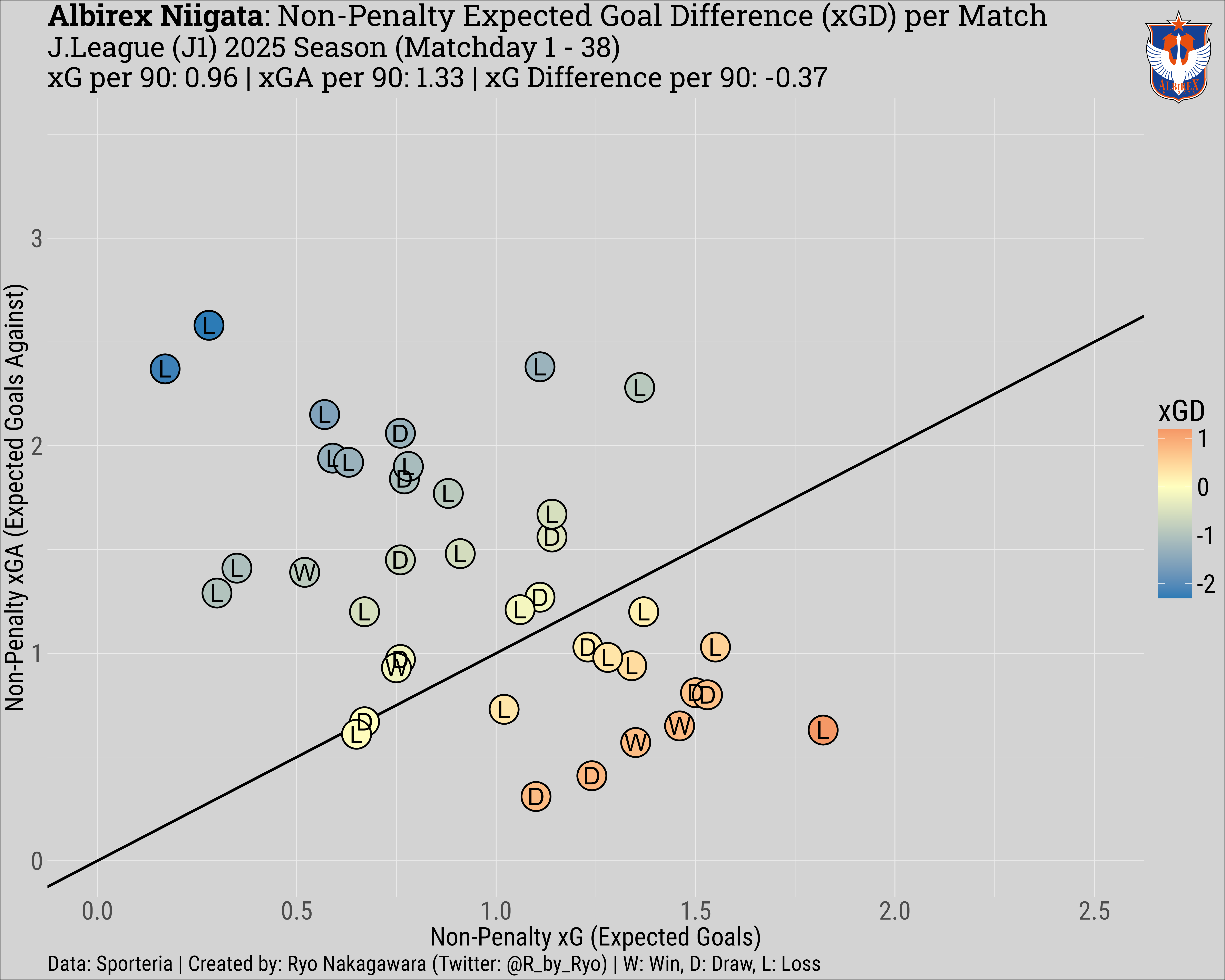
In came Toru Irie who had been a coach at Albirex Niigata for quite some years. However, he was unable to gain a single win in nearly 20 games in charge. Of course, he wasn’t helped by the fact that Inamura, Akiyama, Komi, and Miyamoto all jumped off the sinking ship in the summer (at the very least Inamura and Akiyama went to European clubs which was understandable). Boudah, Funaki, and a few others coming in helped a bit but it was too little, too late. The quality of players in the squad cratered over the past 12 months and the playing style that Niigata were known for suffered for it. Despite continuing to possess the ball the 2nd most in the league (53.7% on average across all their league games), Niigata didn’t offer a whole lot of actual attacking threat. Even when they were able to create or take shots, they didn’t have the player quality to finish those chances at all aside from Motoki Hasegawa (7 goals from 6.17 xG). Despite Boudah’s decent efforts in general attacking play, his 0 goals from 4.94 xG was pretty damning.


On top of that, for me the biggest issue is that outside of any tactical or player quality issues on the ball... this entire team simply can’t win duels! It’s incredibly easy for opponents to dribble past Niigata players, they lose 50-50s, and can’t settle the ball to win possession in loose ball situations, etc. From there it was all too easy to crack their lines and get into their box. The overall defensive numbers, league worst xGA per Shot, 3rd worst xGA, 7th worst shots conceded tell a definitive story.


Goalkeeping was poor to say the least. Ryuga Tashiro was a disaster and Kazuki Fujita wasn’t much better, both were even dropped/injured for the veteran Daisuke Yoshimitsu for certain periods as well. I remember both keepers were OK enough (with caveats as they made some highlight-reel, social media buzzing clangers at various times) at the J2 level and matched Niigata’s preferences for being willing to play with their feet. However, as actual Goalkeepers neither proved good enough at the J1 level.
The defense really collapsed after Inamura left. This on top of the fact that Inamura himself had plenty of teething issues in his first actual professional season. MJ Fitzgerald and Kazuhiko Chiba are way over the hill at this point (and have been for the past few years in my opinion). Fumiya Hayakawa was simply never good enough to be starting week-in, week-out at the J1 level but I can’t entirely blame him as the team was completely uprooted around him and he was the last guy left standing... by default. The Full Backs are again, good on the ball but poor (to various degrees) defensively. I do imagine they’ll be some interest in Left Back Kento Hashimoto (who already looked good at Tokushima Vortis and was a decent buy on Niigata’s part) and I’m always surprised to see that Soya Fujiwara is already 30 years old.


Hayato Inamura was clearly the star man in 2025 after making waves while still playing for his university team last year. I’ve talked about him plenty over the summer due to his transfer to Celtic and in the mid-season review, so I’ll leave my big piece on him here:
Shogun Soccer Scouting #12: Hayato Inamura

Hello! Another quick one for you all. There was big news about Hayato Inamura being heavily linked to a transfer to Celtic FC that appeared in the past week or so. I was rather surprised as although I had been preparing stuff on him, I didn’t think I would have to use it so soon! Of course, this rumor may not actually happen so I’ll still make it fairly…
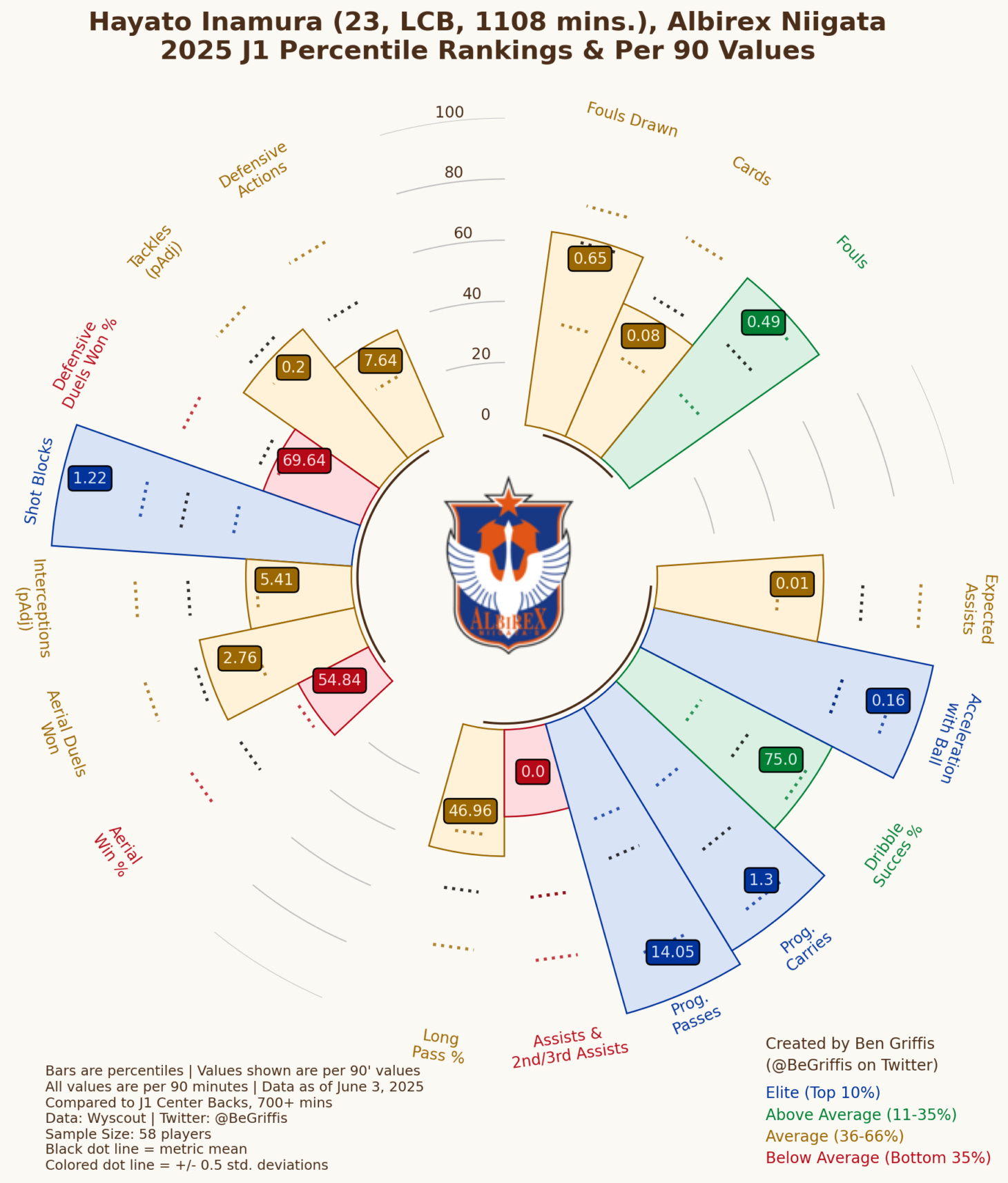
Hiroki Akiyama was the other key figure in the team before he also left for Europe. His passing and conducting from midfield was keenly missed.


Motoki Hasegawa only managed to score one more goal since the mid-season review for a total of 7 goals... However, the team did have him play much deeper in central midfield for a solid chunk of the final few months which didn’t help either. He’s pretty decent honestly, I do think he’ll manage to find himself a new team in the top flight if he wishes.


On the other hand, I was disappointed in Yamato Wakatsuki as I quite liked him at Renofa Yamaguchi last season while Kaito Taniguchi continued to be very streaky and his occasional bombastic finishes didn’t completely mask his inconsistency. Otherwise, Jin Okumura is an OK player but not good enough at this level, I imagine he can do a decent enough job in J2 though.
Overall, this was a humbling experience for Albirex Niigata. Multiple terrible decisions stacked up in terms of their managerial appointments and transfer market failures. The team somehow got worse after Daisuke Kimori was fired. A number of interesting players still remain that may be of interest to surviving J1 clubs like Motoki Hasegawa and Kento Hashimoto. Clearly a big restructuring needs to happen, the current squad might still be well-equipped to handle J2 especially given their younger average age compared to the rest of the league, so their success in the next 1.5 years will depend on how many of their core players they can keep over the winter. It was announced that long-time veteran Yuki Horigome is surprisingly leaving at the end of the season along with the fact that Niigata signed ex-U-20 Japan manager Yuzo Funakoshi as the new manager, which signals a complete overhaul. There’s lots to ponder and reflect upon in the Niigata cold. Winter is coming.
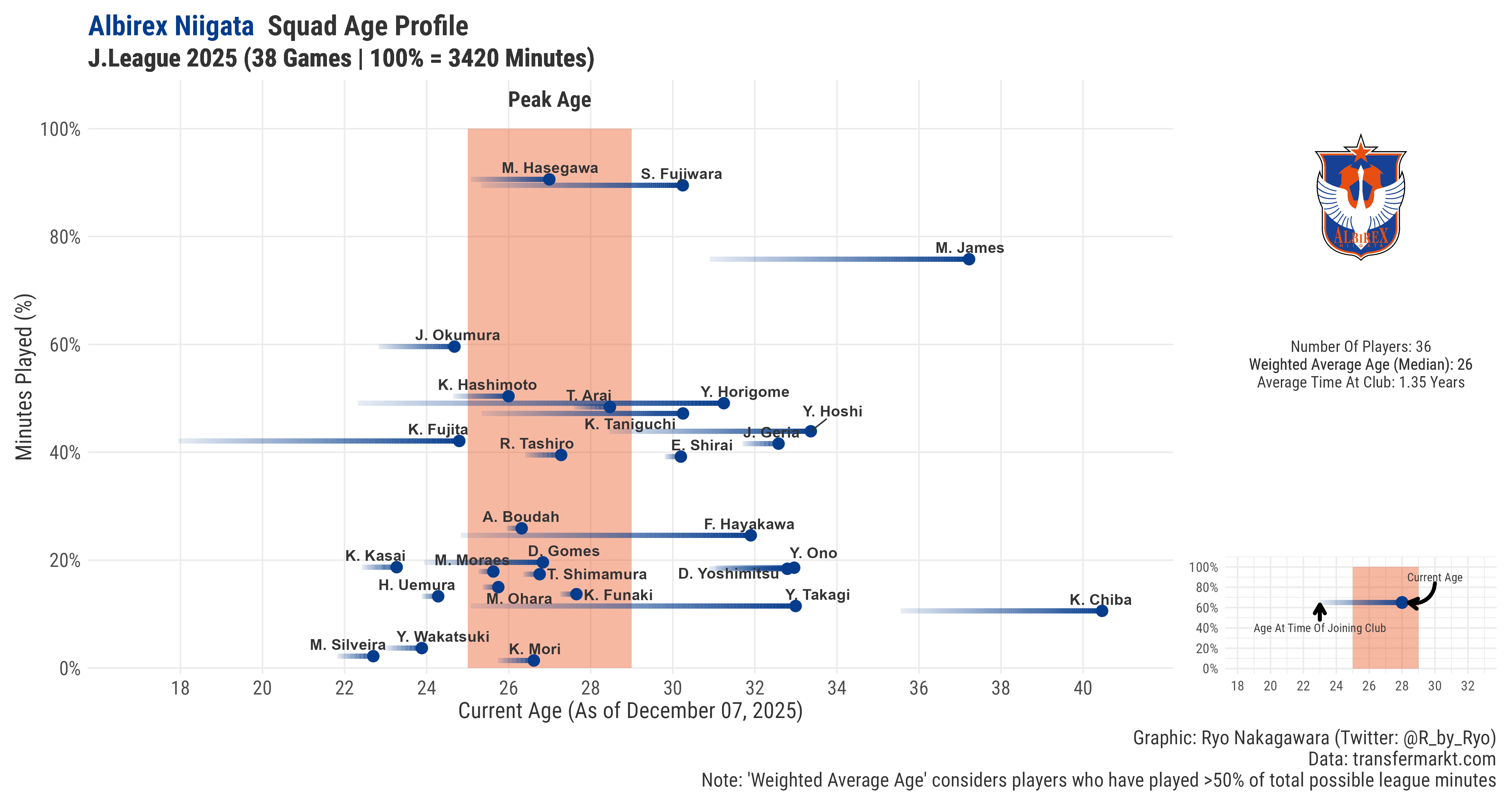
Data Visualizations
Squad Age Profiles
I changed the calculation of a squad’s median age up a bit by simply taking into account only players that have played 50% of more of total possible league minutes. This is so when looking at the ‘average’ age of a team, we’re doing a better job of considering players who are regulars in the team. I am not sure how other people might do it but from playing around with the raw data it looks OK, most teams have around 9~12 players that meet this threshold so I do think I’m capturing the right selection of players in any given team.
Anyway, here’s the list of the U-23 players in the league with the most minutes played so far this season (filtered for those that have played more than 50% of total possible league minutes). You might want to keep an eye on these guys in the short-to-medium term. One of the simplest ways to judge a player’s quality is minutes played. It doesn’t matter how much talent you have or how much potential if, in the end, you don’t actually see minutes on the pitch to show it off!
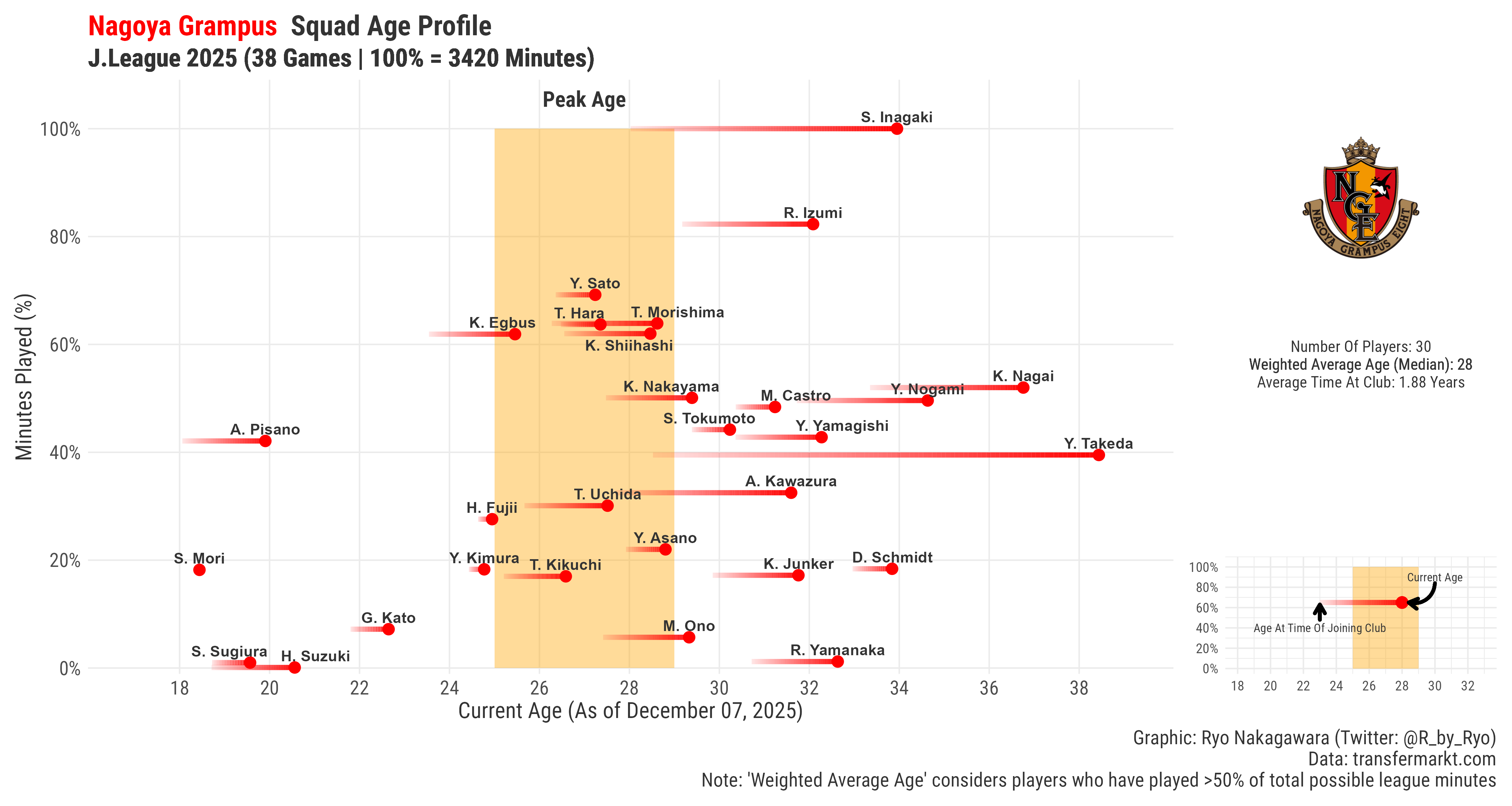
Scoring Situations
Ideally, I would have data that concerns all shots or xG accumulated from different match situations as that would mean a much larger sample of data to power any insights (as goals are only the end result and may not give us information about a team’s actual performance).
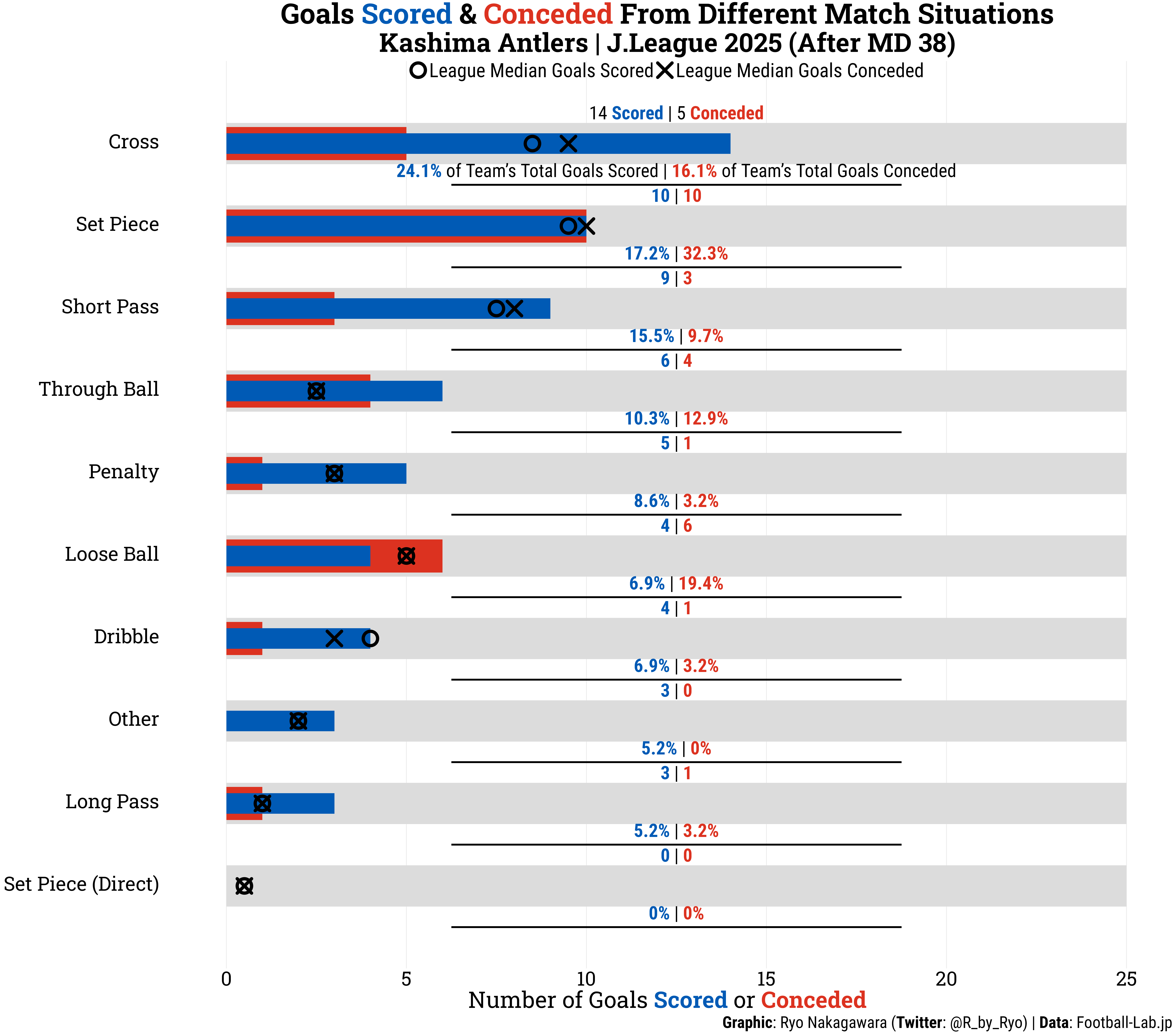
Team Shot Quantity & Team Shot Quality
In the previous few sections we got to know a lot about the goals that J.League teams scored. However, in a sport like soccer/football goals are hard to come by, they might not really accurately represent a team’s actual ability or performance (even if ultimately, it’s the end result that matters). To take things one step further I was able to gather data from Sporteria on shot quantity to dive a bit more into team performances. I’ve reversed the order of some of the stats in these next few plots so that in all cases the top right is best and bottom left is the worst teams when looking at their respective stats.
So, what exactly is expected goals (xG)? Expected goals is a statistic where a model assigns a probability (between 0 and 1) that a shot taken will result in a goal based on a variety of variables and is used for evaluating the quality of chances and predicting players’ and teams’ future performances. A xG model only looks at the variables up to the point that the player touches the ball for a shot. Post-shot xG models covers the information about where in the frame of the goal the shot went (“post” as in all the information after the player touches the ball for the shot) but I won’t cover that here.
For some quick primers on xG check the links below:
The following two sections use xG data from Football-Lab. I’m not privy to all of what goes into their model but the explanation page on their website (in Japanese) tells us about some of the information they used:
Distance from goal?
Angle from goal line?
Aerial duel?
Body part used?
Number of touches? (one touch, more than two touches, set plays, etc.)
Play situation? (Corner kick, direct/indirect free kick, open play, etc.)
So, the usual variables that you might recognize from other xG models are being considered. Combining shot quantity and shot quality numbers gives you a much better idea about a team’s performance on either side of the ball.


xG Difference
xG Difference is pretty much the same thing as Goal Difference except that we use xG and xGA rather than goals and goals against. This lets us see very quickly which teams generally outperformed their opponents in terms of quality of chances created to quality of chances conceded based on a xG model. This time around I also included the team’s results inside the bubble points. So it’s easier to see whether a team that had a positive xGD in a specific match couldn’t manage to win the game or vice-versa. You ideally want to be below the diagonal line and winning (W) these games as well.
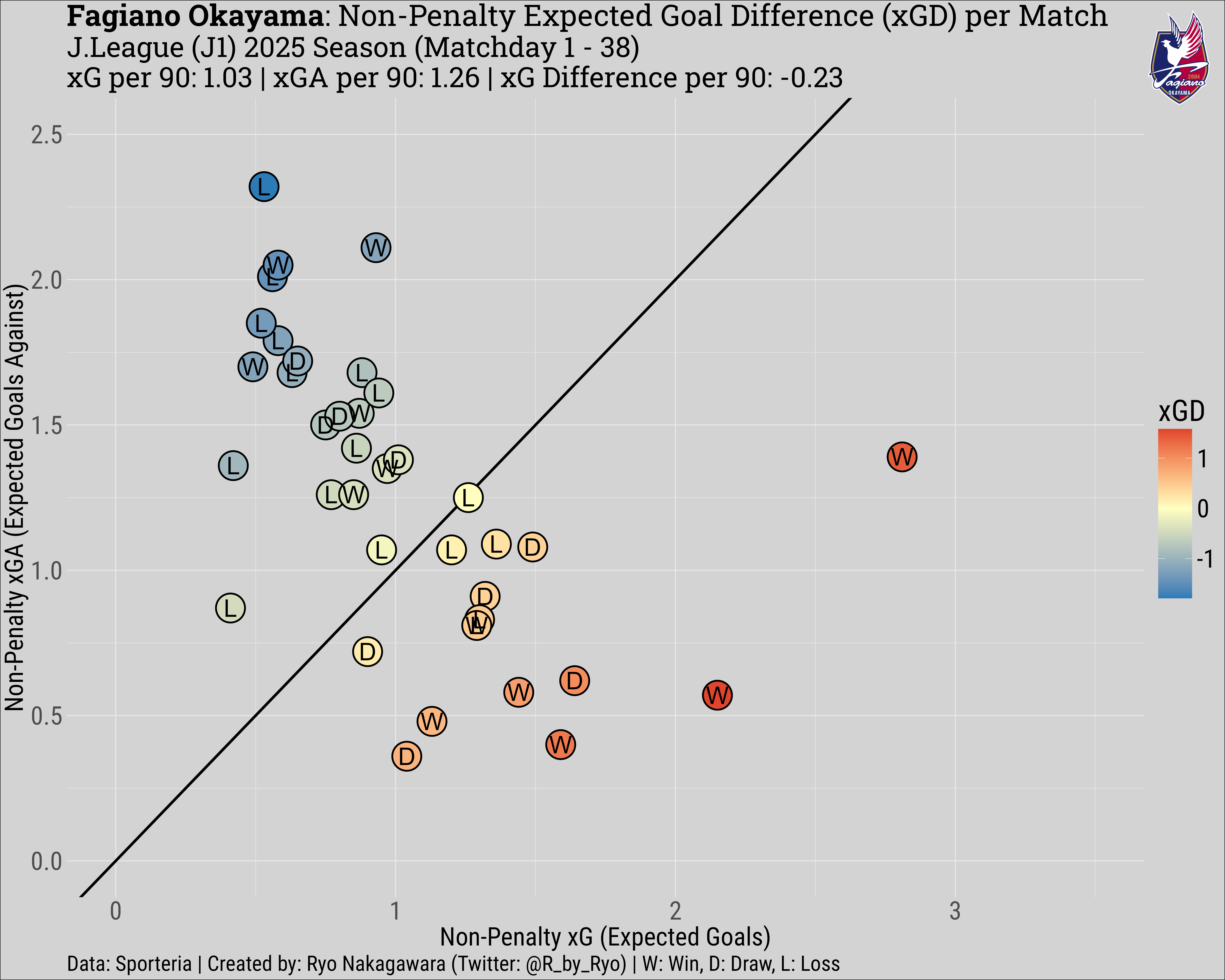
Five Match Rolling Averages
Goals vs. Goals Against
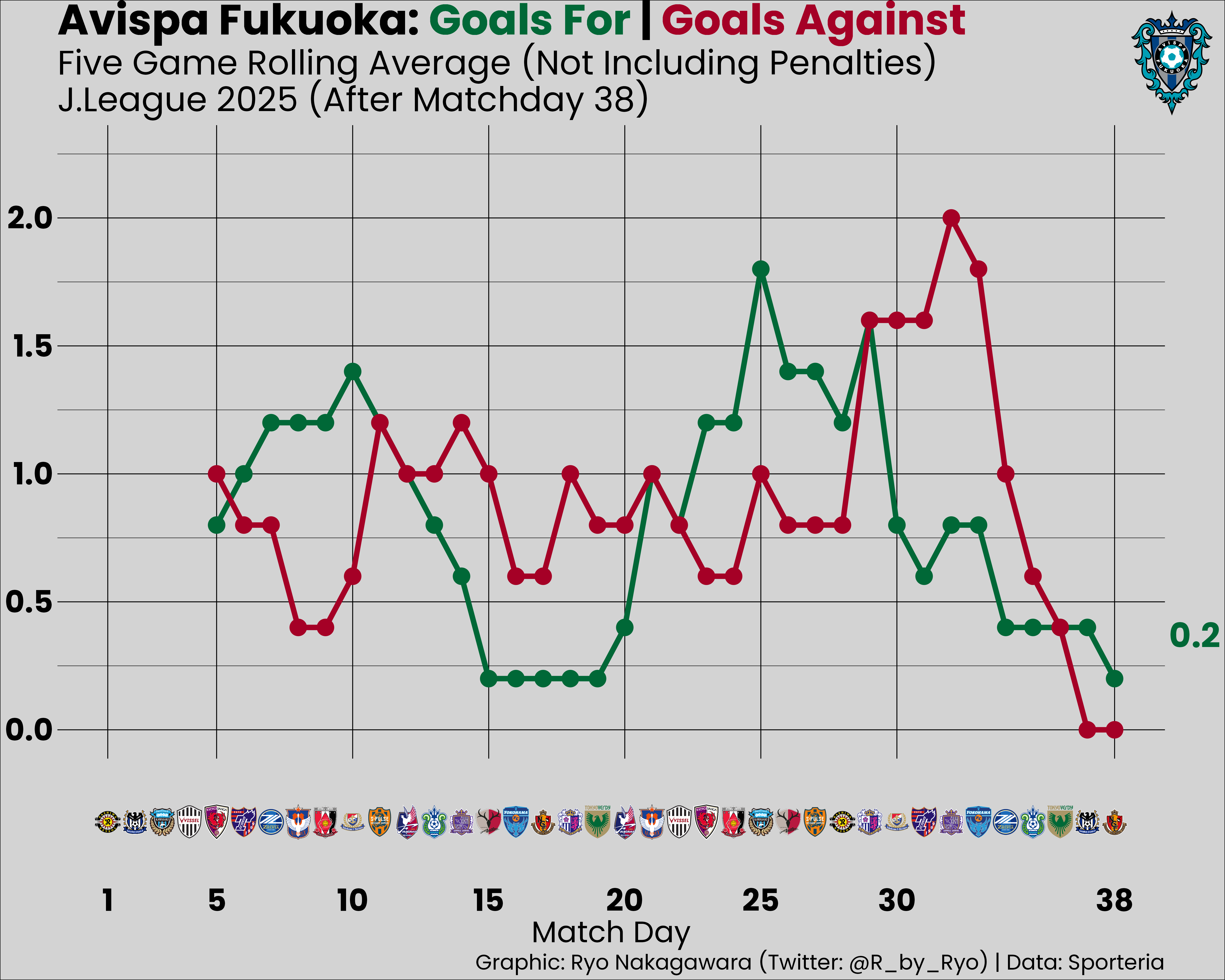
xG vs. xGA
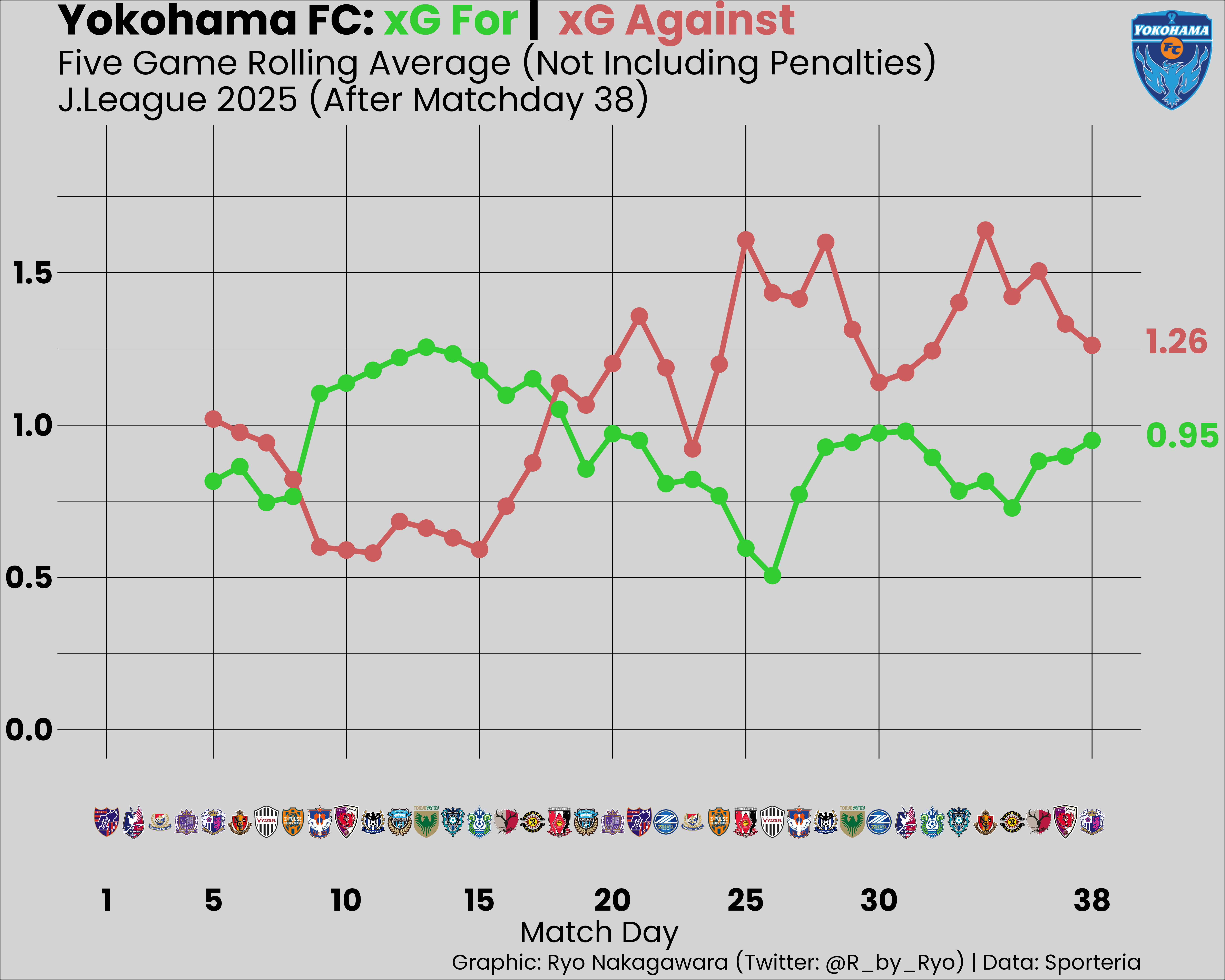
xG vs. Goals
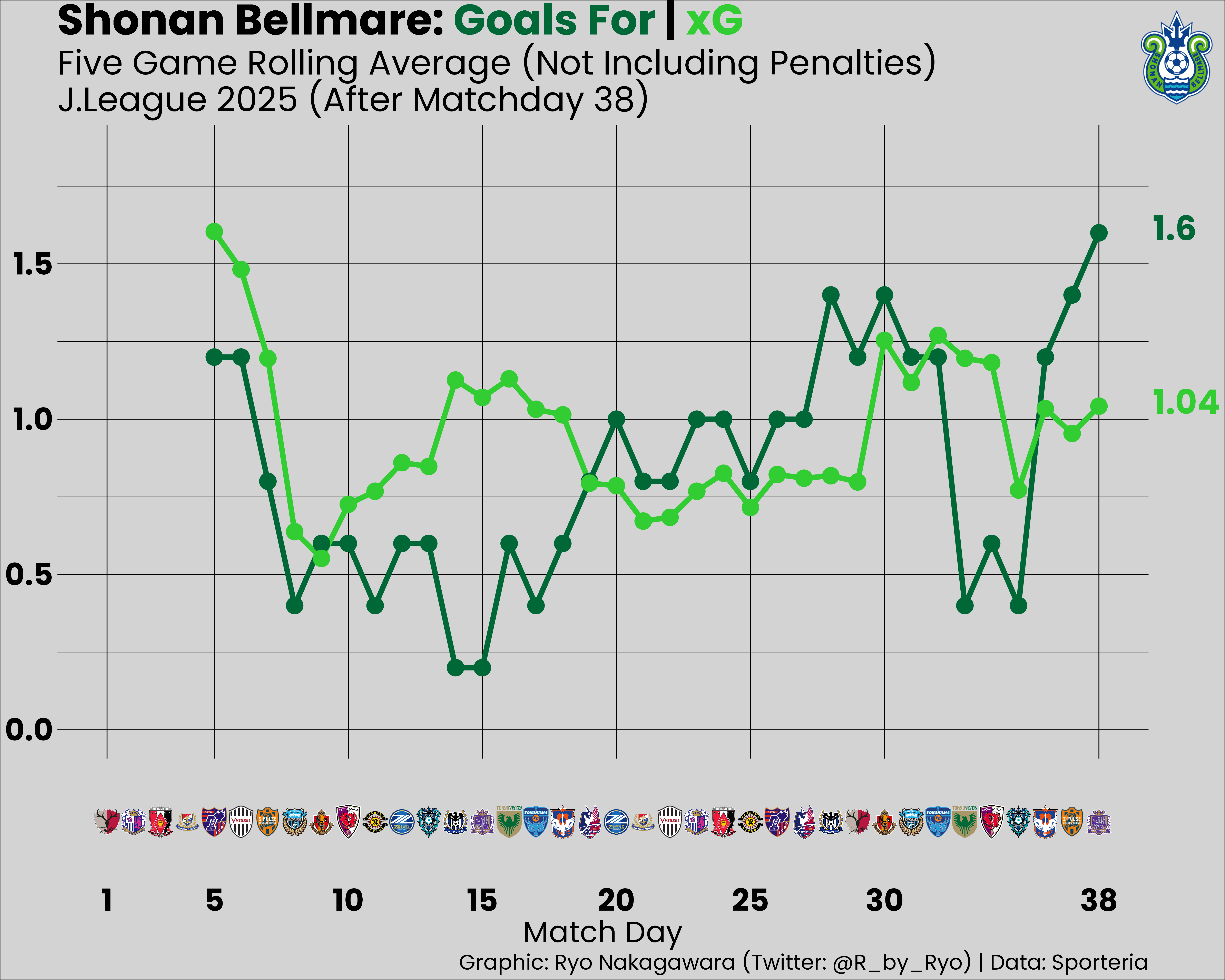
xGA vs. Goals Against
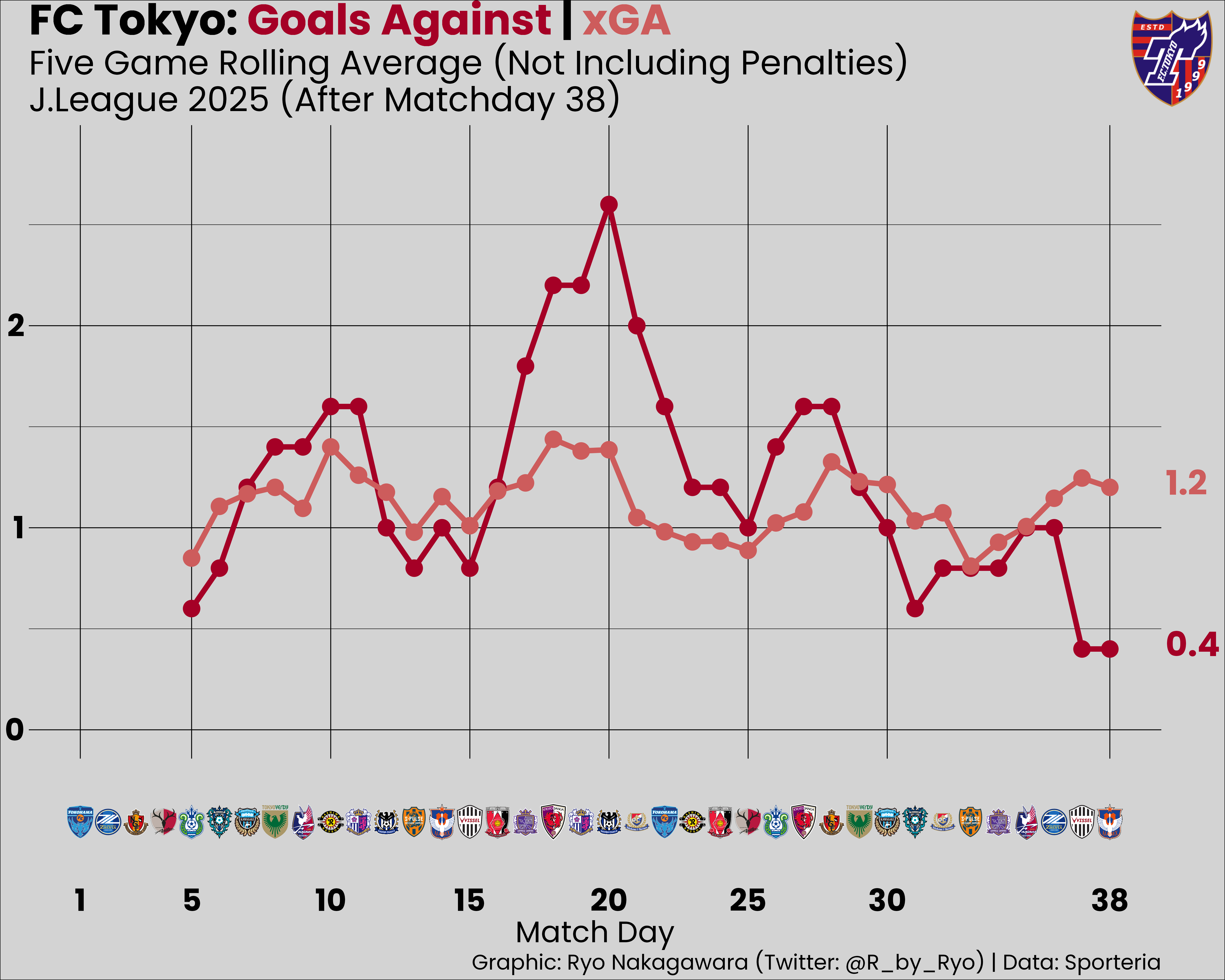
Conclusion
The 2025 J.League season was another cracker with the title race going down to the last matchday. Kashima Antlers came out on top, a perfect end to a transformative season under Tohru Oniki. Once again, this season was centered on teams with intensity, directness, and velocity in their play styles succeeding with only Kashiwa Reysol really bucking the trend, which mad them the neutral’s favorite in the title race.
Not all things were positive however with many teams exhibiting the poor squad management and a habit of making the same mistakes we’ve seen time and time again. A particularly damning indictment was that only 17 (!) players aged 23 and under played more than 50% of available league minutes (leaving out some players who left mid-season that may have achieved this if they stayed longer).
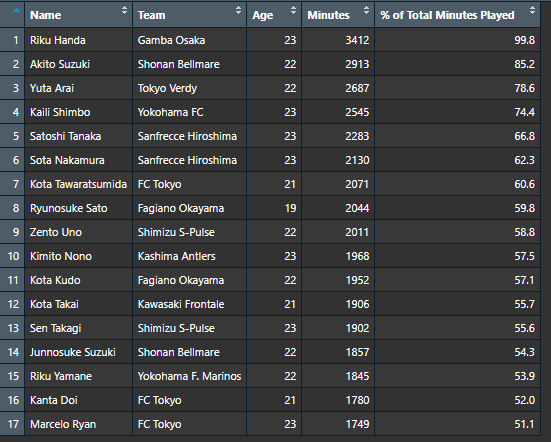
In particular, with the exception of Alex Pisano (who needed a couple of 1st Team keepers to get injured) and Taishi Brandon Nozawa, there was a glaring lack of young goalkeepers playing at the J1 level. I hope that the 100 Year Vision League allows more teams to be a bit more adventurous in playing young(er) players but also be bolder in recruitment and management. With the rumors flying around already, I’m a bit disappointed to see the same revolving door of (failed) managers being touted for various jobs. That also has to do with the JFA’s licensing policies but that’s a topic for another time…
I would also like to give special thanks here to Sporteria, the website which has supplied the data for hundreds of visualizations seen in these season reviews for the past five or so years. Unfortunately they are shutting down their services as of this month. As such I will be working on a new pathway to grab data over the off-season. Of course, if you know good ways to get detailed data on the J.League I’m always happy to hear from you.
If you’ve read this far, thank you! This is a work done out of love and the newsletter continues to be free for all. If you want to show your appreciation, please share it far-and-wide. If you want to go even further you can always drop me a tip.
Thanks for reading!
P.S. The J2 Season Review will come out next week!
This is epic. AMAZING work!