
J2 2025 Season Review
Mito HollyHock are champions! JEF United return to J1 for the first time since 2009!

The J2 Review is back! I didn’t make a mid-season review this season because I was super-duper busy with the summer transfer window activity between Japan and Europe. Quite a few of you may not have finished reading the J1 Season Review yet but well, now you’ve got two things you can read over the holidays! This is definitely shorter than the J1 version but still longer than previous J2 reviews, simply because I watch a lot more now and have a lot more to say.

Thank you all for your support this year! This might be the last newsletter of 2025. I’ll be enjoying the holidays but still doing some prep work for newsletters in anticipation of January transfer window activity (of course, a lot of teams might announce before then so…).
This review consists of:
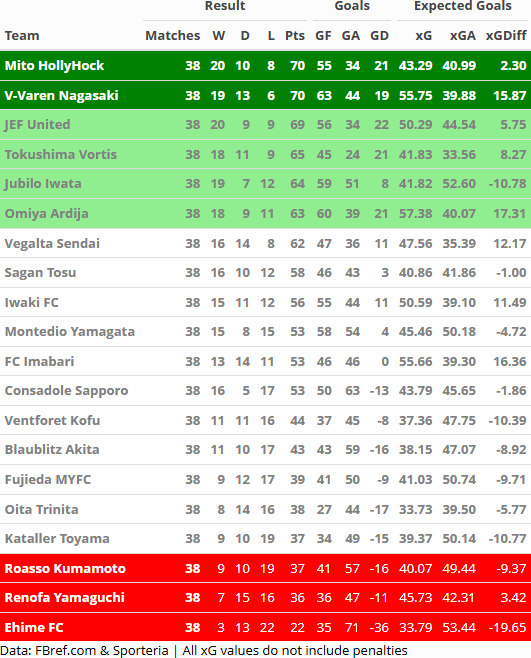
The league table
A section on every J2 team: Summary overview, tactics, data, players, etc.
A section on the different types of data viz: Explanations and link to the viz for every team
Some notes, warnings, disclaimers, etc.:
All the data stuff is done with R.
All the tactical stuff is created using Tacticalista.
To keep up to date with all of what’s happening in J1, I made a giant Twitter thread of lots of cool informed people to follow on Twitter for English language/international J.League content. You can find it here!
All of the shots and xG related stuff you see in the viz are non-penalty stats. Exceptions are stuff like the time interval and scoring situations plots. When I mentioned these stats in writing I usually mean non-penalty at the team level. At the player level it depends as some of my sources don’t go down to stripping out penalty xG.
Data sources: Transfermarkt, Sporteria, Football-Lab, FBref, Footy-Stats
Once again, this has taken up a gargantuan amount of time for me to watch/read/code/compile/organize so the best thing you can do for me is share it out to the world, especially if you work in the football industry!
Anyway, let’s get started!
League Table
Mito HollyHock finally made their great escape after spending the past 25 years in the 2nd tier. It’s quite remarkable considering they had not finished higher than 7th in their entire history thus far. After spending big on players and a shiny new stadium, V-Varen Nagasaki’s investment paid off with promotion and avoiding the play-offs. JEF United, Tokushima Vortis, Jubilo Iwata, and Omiya Ardija were left to fight it off in the play-offs as Vegalta Sendai agonizingly missed out on the last matchday. After a lot of drama, JEF United won the play-offs to punch their ticket back to J1!
There was drama at the bottom too as Kataller Toyama managed to overcome a -4 goal difference in the last minutes of the game to crawl ahead of a unwitting Roasso Kumamoto. Renofa Yamaguchi’s win over Omiya was also in vain while Ehime FC had been confirmed relegation for quite sometime before the final matchday.
Mito HollyHock (1st, 70 Points)
20 Wins // 10 Draws // 8 Losses
Location // Stadium: Mito // K’s Denki Stadium
Manager: Naoki Mori
55 Goals (tied 6th); 34 Conceded (tied 2nd)
43.29 non-penalty xG (10th); 40.99 non-penalty xGA (8th)
Top goal scorer: Arata Watanabe (11 goals plus 2 penalties)
Goalkeeper: Konosuke Nishikawa
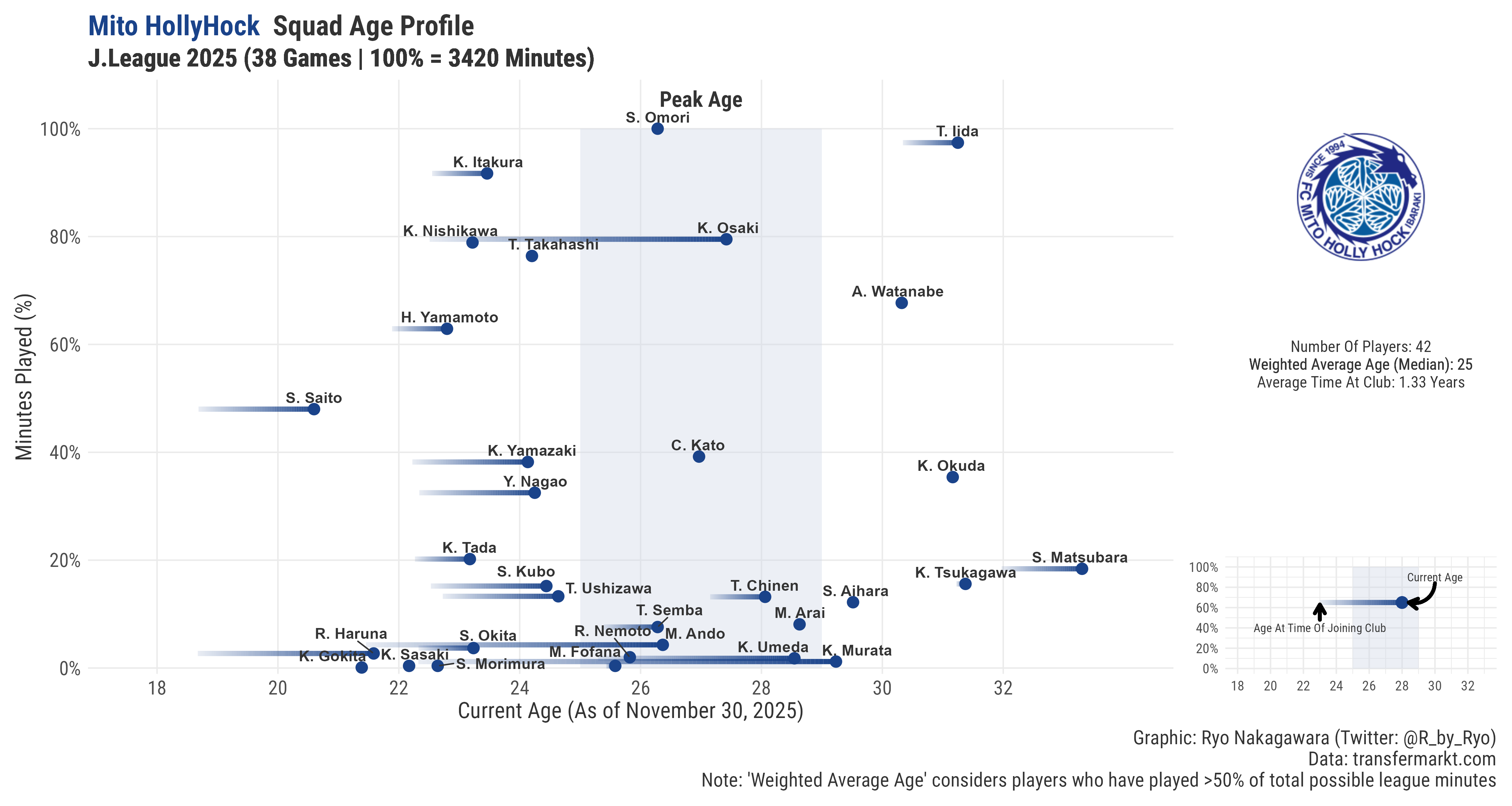
Mito HollyHock were unequivocally the biggest surprise of the season led by Naoki Mori. They were leading the league for a good chunk of the 2nd half after a slow start. This included a 15 game stretch where they didn’t lose a single game! A rocky end to the season nearly derailed things when they lost to three of their promotion rivals in the final six games. However, they managed to steady themselves and win the final game of the season for the J2 championship title and their first ever promotion to the top flight!


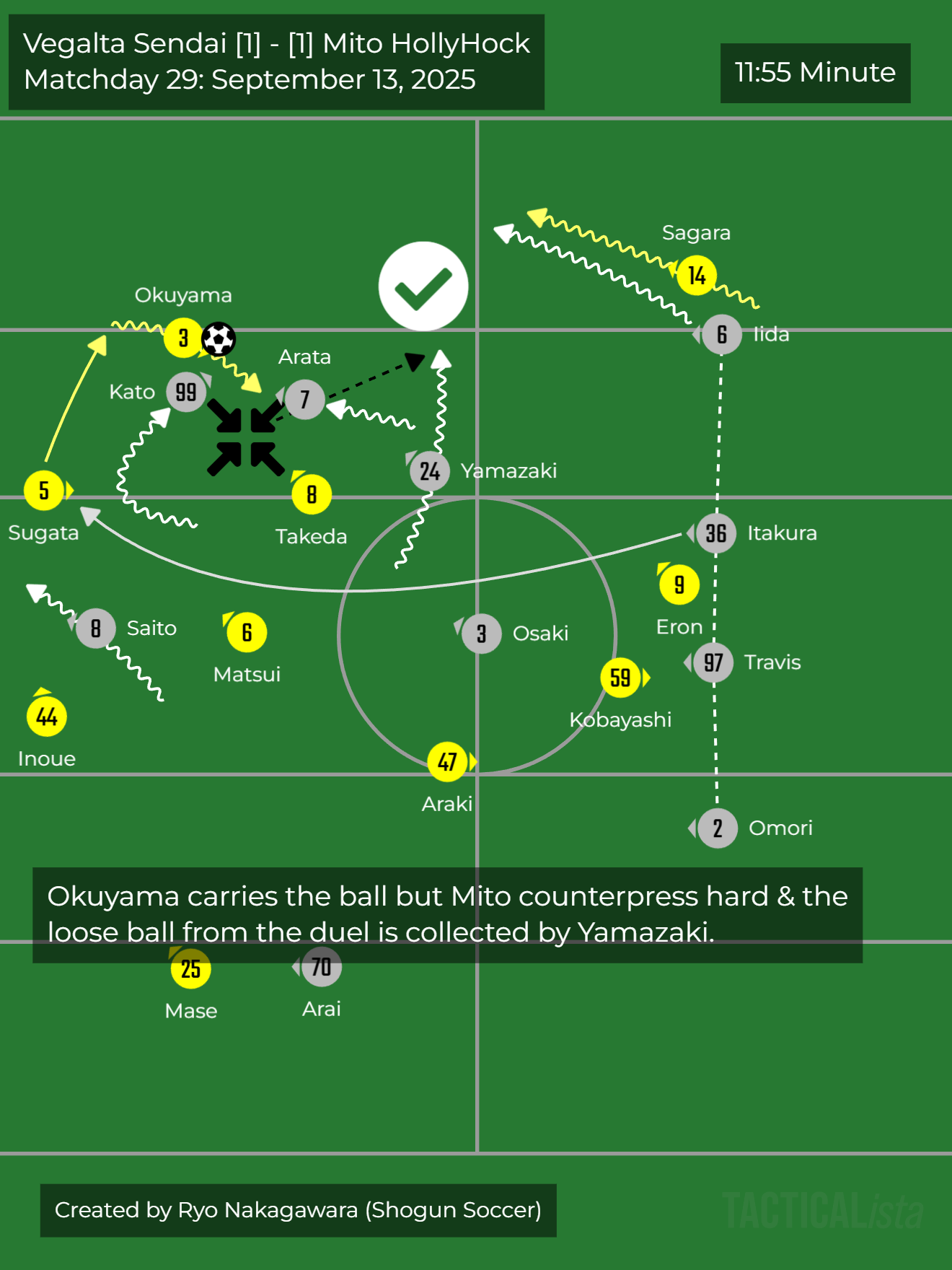
What stood out for me when watching Mito were their lightening quick transitions. They were always aggressive, pressing or counter-pressing to win the ball and found willing runners behind through the middle like Arata Watanabe or support down the wings in the form of their Full Backs. Arata Watanabe and Shunsuke Saito combining quickly with limited support was a common sight.
Shunsuke Saito, although he missed a number of games while busy on international duty with the U-20 National Team, still managed to score 8 goals from out wide. He is a fast, technical player that is great on the dribble and perfect fit for Mito’s transition game. However, one warning is that a lot of his value is coming from “kick ball hard, ball go in net” energy where his xG and xG per shot numbers are nowhere near his goal tally. His 8 goals came from just 3.7 xG.
Arata Watanabe had a come-back season for the ages, 13 goals from 9.2 xG and 7 assists after some very drab years at Oita Trinita (of which I was heavily critical about in the past... sorry!). It was Watanabe’s career best season and to me he was Mito’s most important player as he was the spark that ignited attacks as he would usually be the first or second player to receive the ball in good spaces after the ball was won.


Otherwise players like Hayata Yamamoto and Seiichiro Kubo filled out the attack and contributed with a number of important goals. Also, since I didn’t do a mid-season review, I should mention Takumi Tsukui who looked very dangerous in the first half of the season. I was worried when Tsukui was then plucked by Omiya Ardija, and to a lesser extent when Shimon Teranuma was taken by Verdy, in the summer but Mito weathered those departures quite well.
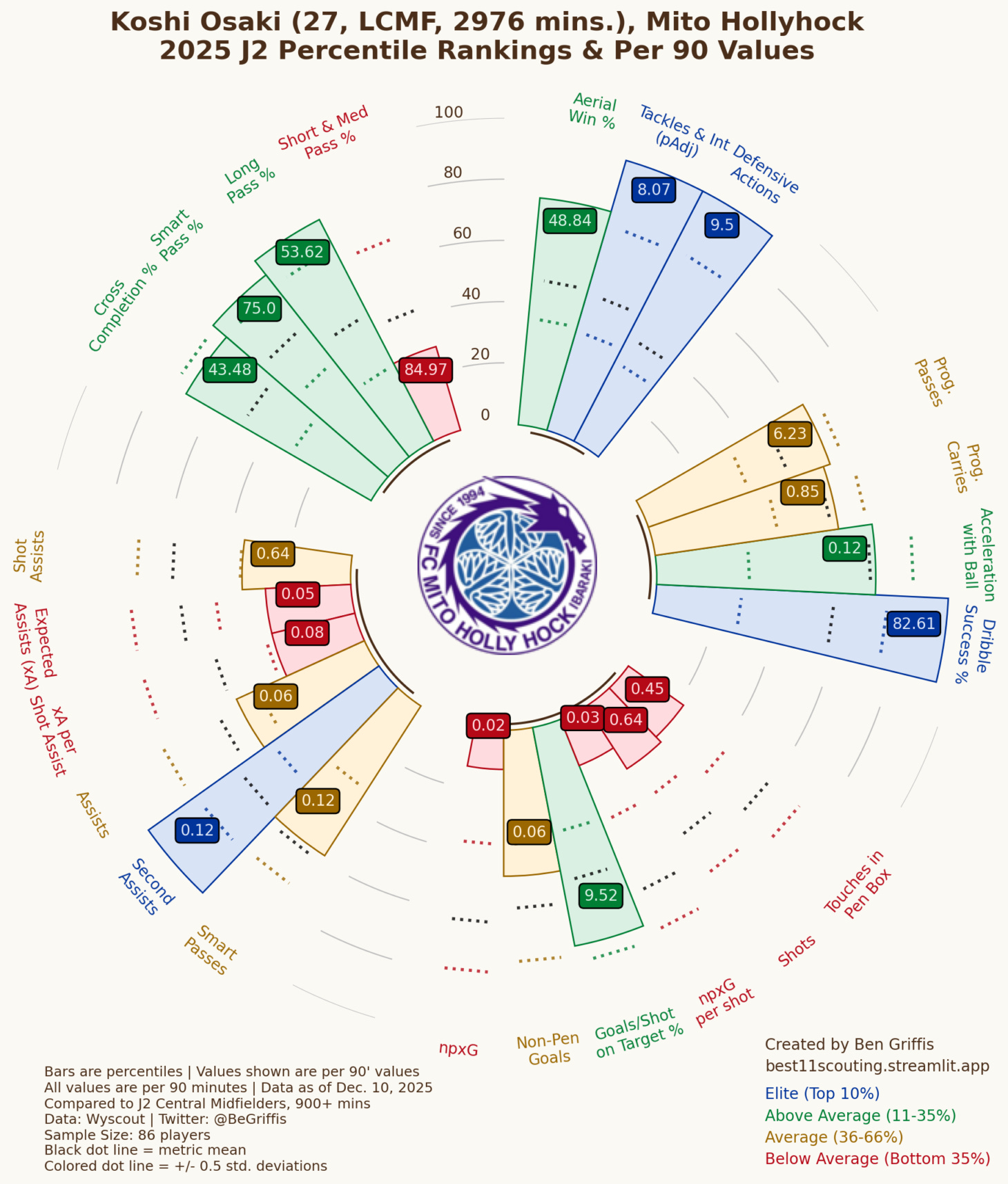
Defensively, Mito were set up in a tight 4-4-2 and as mentioned previously put a lot of work in winning the ball back. Holding it all together from the midfield was Koshi Osaki who also scored the occasional banger from outside the box as well.
The entire Back 4 was fairly set in stone for the season with Travis Takahashi and Kenta Itakura as the Center Back partnership flanked by Sho Omori and Takahiro Iida. A special mention should also go to Konosuke Nishikawa who had a very good season in goal after arriving from Oita Trinita.
Travis Takahashi had a big year as he stepped up to J2 following a debut season in the JFL (4th tier) for Tiamo Hirakata in 2024. He is a big guy, very physical and wins a lot of aerials. Takahashi is comfortable enough on the ball but not much of a progressive passer although Mito’s build-up style has a big influence on this aspect.


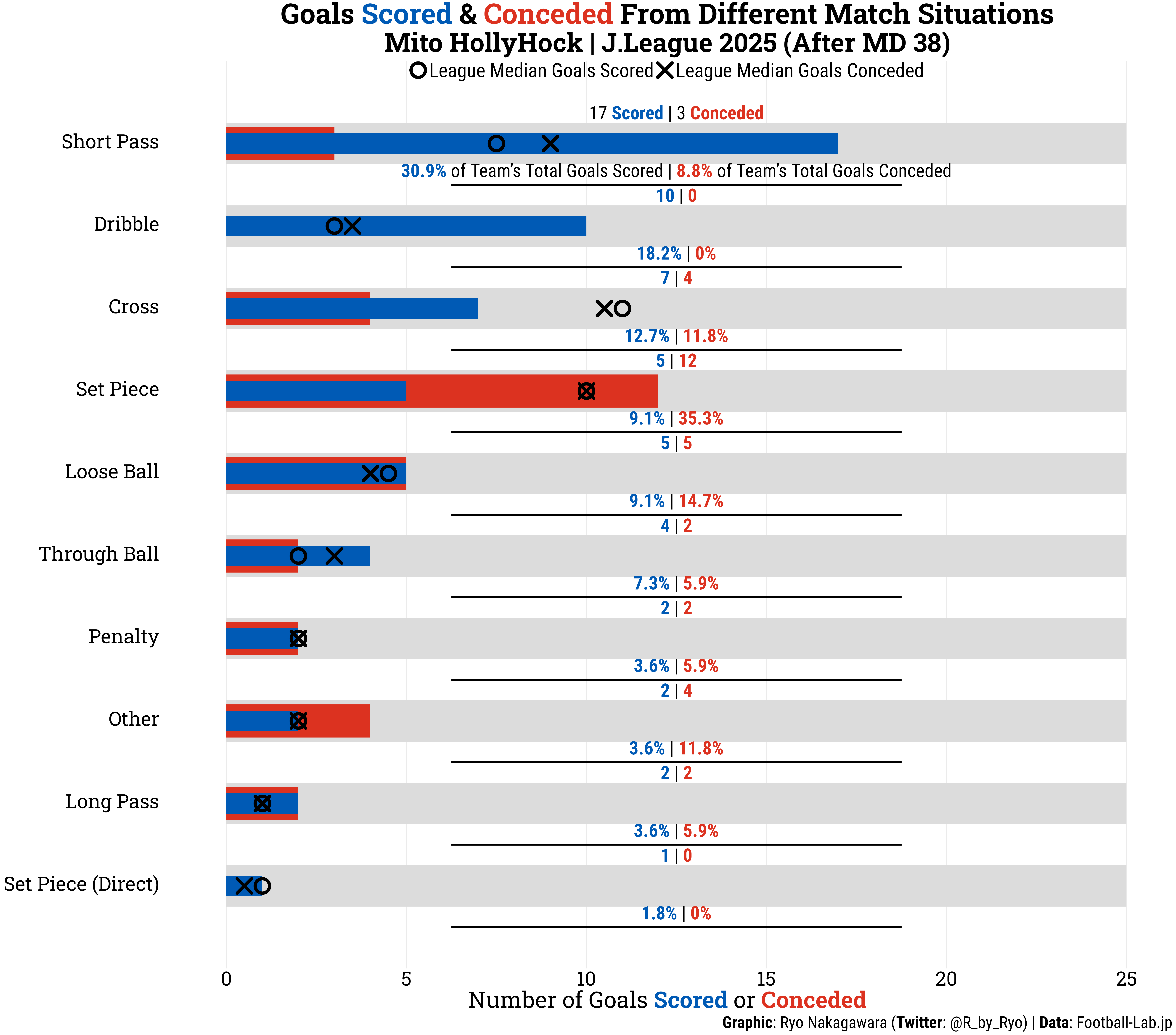
Both Full Backs were very active in getting down the flanks to support the attack with Takahiro Iida getting 5 assists and Sho Omori getting 4. An interesting aspect of Mito was that they didn’t cross much, in fact they crossed into the box the 3rd least per game in J2 this season which may seem odd given the number of assists both Full Backs have. The thing about Mito’s attack was a lot of combination play in the final 3rd to unlock Arata Watanabe or Shunsuke Saito to score. Mito scored considerably more than the league median from “short pass” situations which means sequences of passes shorter than 30m (leaving out set pieces, crosses, and through balls).
Their stats told a story of a decent but not amazing team but I do feel like the aggregate summaries don’t really do a good job of presenting this team. Aside from their goals conceded they were mid-table in most metrics. If you had more detailed data it might be a fun project to look a lot deeper into them.


For most of their existence Mito HollyHock was seen as a mid-lower table side that kept surviving by taking up a niche as a player development club. They would invite loans from J1 clubs or take in players from university and give them a lot of playing time. Mito have even managed to form a partnership with Hannover 96 and Hayate Matsuda has already proven to be a success story in Germany. Mito have spent the past 25 years in J2 and had never finished above 7th. In the past three years their record has been 13th, 17th, and 15th place!
Manager Naoki Mori has a long history at the club having played for Mito for a few seasons before retiring and becoming a coach in 2006. He jumped into manage as an interim early in the 2024 season and really transformed the club. Despite some bumps along the way Mito were able to continue grinding through and win games to keep a hold of their top spot. It’s an incredible achievement!
In an interesting turn of events, Naoki Mori stepped… up into a Director of Football role and Daisuke Kimori will be the manager from 2026 onward. Kimori was another coach that had been at Mito for a very long time and before his brief unsuccessful journey as Albirex Niigata’s manager was most likely supposed to take up the reins at Mito eventually. I imagine there will be vultures flying around Shunsuke Saito among others so all of Mito’s staff across the clubhouse will be working overtime to make sure their first ever J1 season is a successful one.
V-Varen Nagasaki (2nd, 70 Points)
19 Wins // 13 Draws // 6 Losses
Location // Stadium: Nagasaki // Peace Stadium
Manager: Takahiro Shimotaira (to June) // Takuya Takagi
63 Goals (1st); 44 Conceded (9th)
55.75 non-penalty xG (2nd); 39.88 non-penalty xGA (6th)
Top goal scorer: Matheus Jesus (16 goals plus 3 penalties)
Goalkeeper: Masaaki Goto
Takahiro Shimotaira’s team were expected to be runaway league leaders considering their squad and the momentum they showed at the tail end of the 2024 season, despite the heartbreak in the play-offs. V-Varen Nagasaki indeed started the season pretty well with four wins and two draws but slowly the wheels came off as Shimotaira’s formula became stale and a poor seven game win-less streak followed. A 0-3 loss to Mito HollyHock and 3-3 draw to Omiya Ardija in June was the last straw that led to Shimotaira leaving the team. Veteran manager Takuya Takagi was parachuted in and had immediate impact as they went the next 15 games without losing a single game and rocketing Nagasaki back into not just play-off but J2 title contention! Nagasaki lost just once in the entire second half of the season which was an awkward 0-1 defeat to Jubilo Iwata of all teams on Matchday 35… They secured 2nd place and automatic promotion with a spirited away draw against Tokushima Vortis to avoid the play-offs. Mission accomplished!


The most conspicuous aspect of Nagasaki has been their tremendous firepower. The Kyushu side took the most shots, the most shots-on-target, and… you guessed it, scored the most goals although from the 2nd most non-penalty xG!
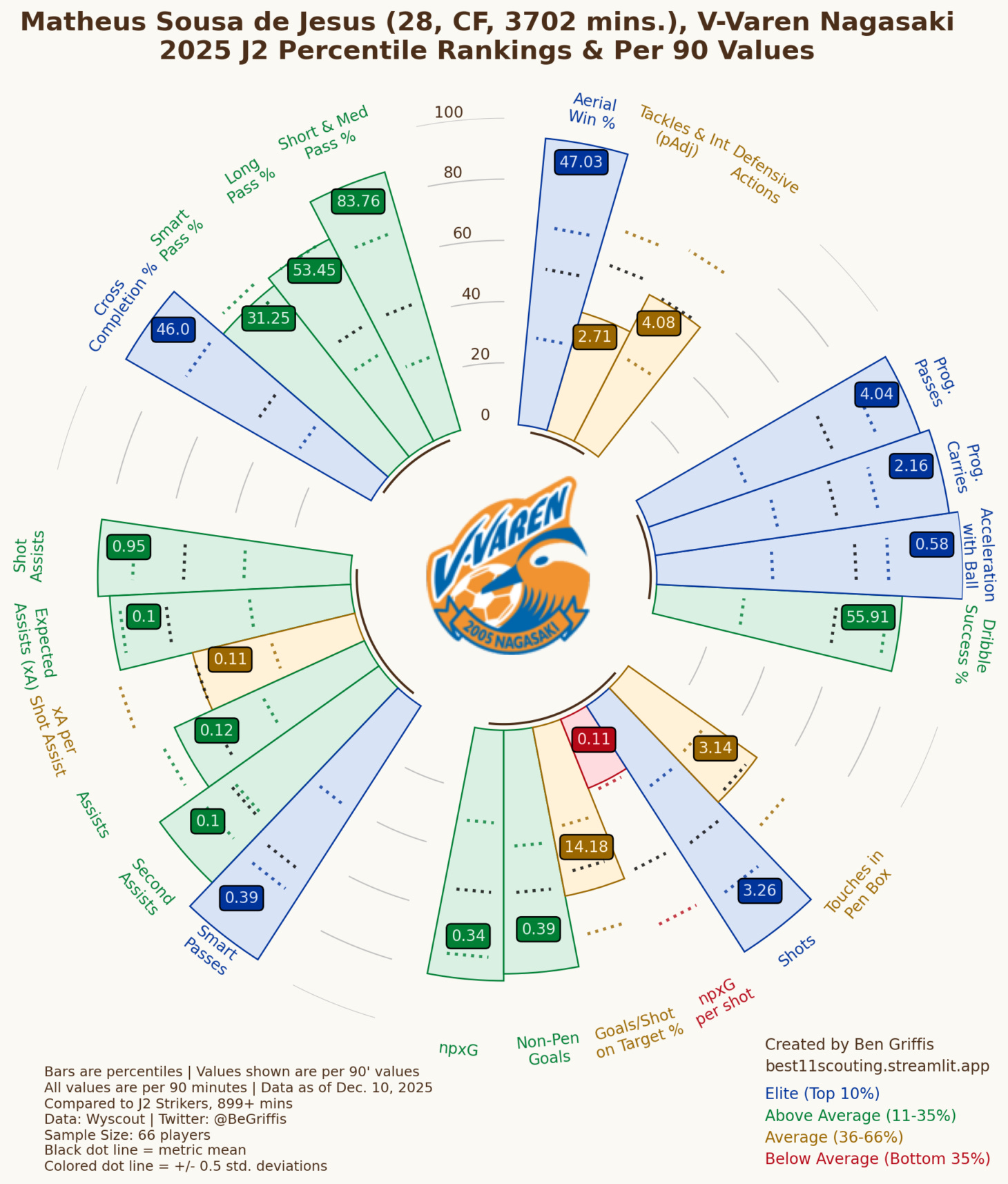
Aside from the numbers, the player that has become the symbol of this Nagasaki side is Matheus Jesus. The big Brazilian was the focal point of any offensive as he took the most shots on not just just his own team but in the entirety of J2! To highlight how central Matheus Jesus was, he was on the end of shots that garnered 16.47 xG which was nearly double of the next best player on the team. After an incredible 2024 season where he scored 18 and assisted 7, in 2025 the Brazilian scored 19 (albeit 3 were penalties) and a further 5 assists. Of course, it’s not just Matheus Jesus’ goal scoring but his ability to progress the ball forward on the dribble and through his passing meant he was the dynamo that pushed Nagasaki forward on every attack. It’s going to be real exciting to see if he can pull off what he’s doing against J1 level defense next year.
With a brand new stadium and significant momentum from their very wealthy backers, V-Varen Nagasaki have been pulling out all the stops to get promoted back to J1 in recent years. As a result the team have invested significantly in lots of quality players. Their game plan has been to really make this quality count by keeping the ball for themselves for the majority of the game and overwhelming the opposition.
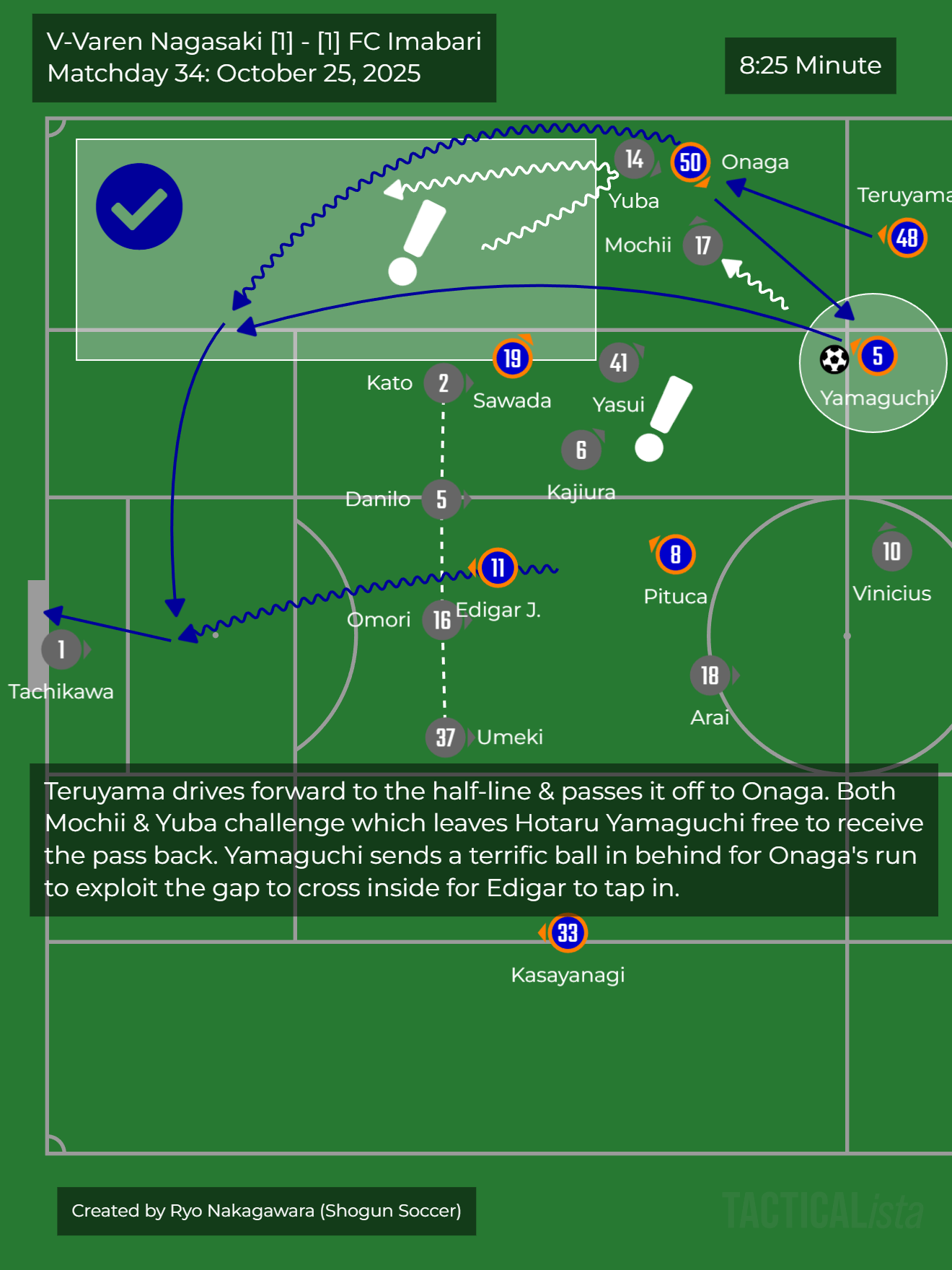
In this regard, their midfield is absolutely stacked with the pairing of Hotaru Yamaguchi and Diego Pituca that wouldn’t look out of place in an upper-half J1 team. Both veterans brought a whole lot of experience and nous to Nagasaki’s ability to control games, pass their way out of opponent pressure, and those moments of absolute quality to impact the game.


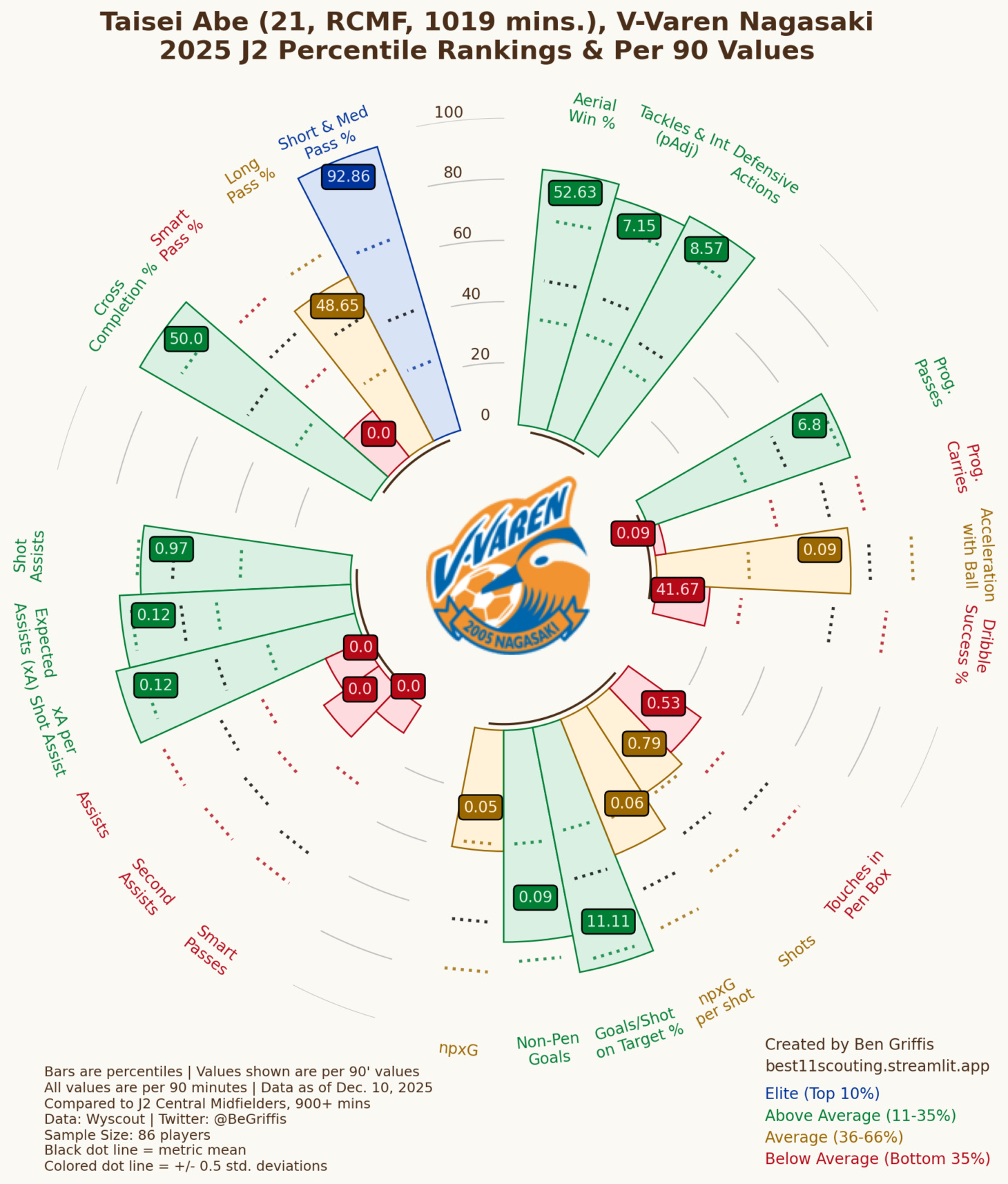
Before Pituca’s arrival, Taisei Abe was one of the few regular youngsters in the side but his good performances led to Luzern picking him up for the Swiss League. I really like Abe as he’s got great technique on his Left foot. A real deep-lying passer that kept the ball moving in the first two thirds of the pitch.
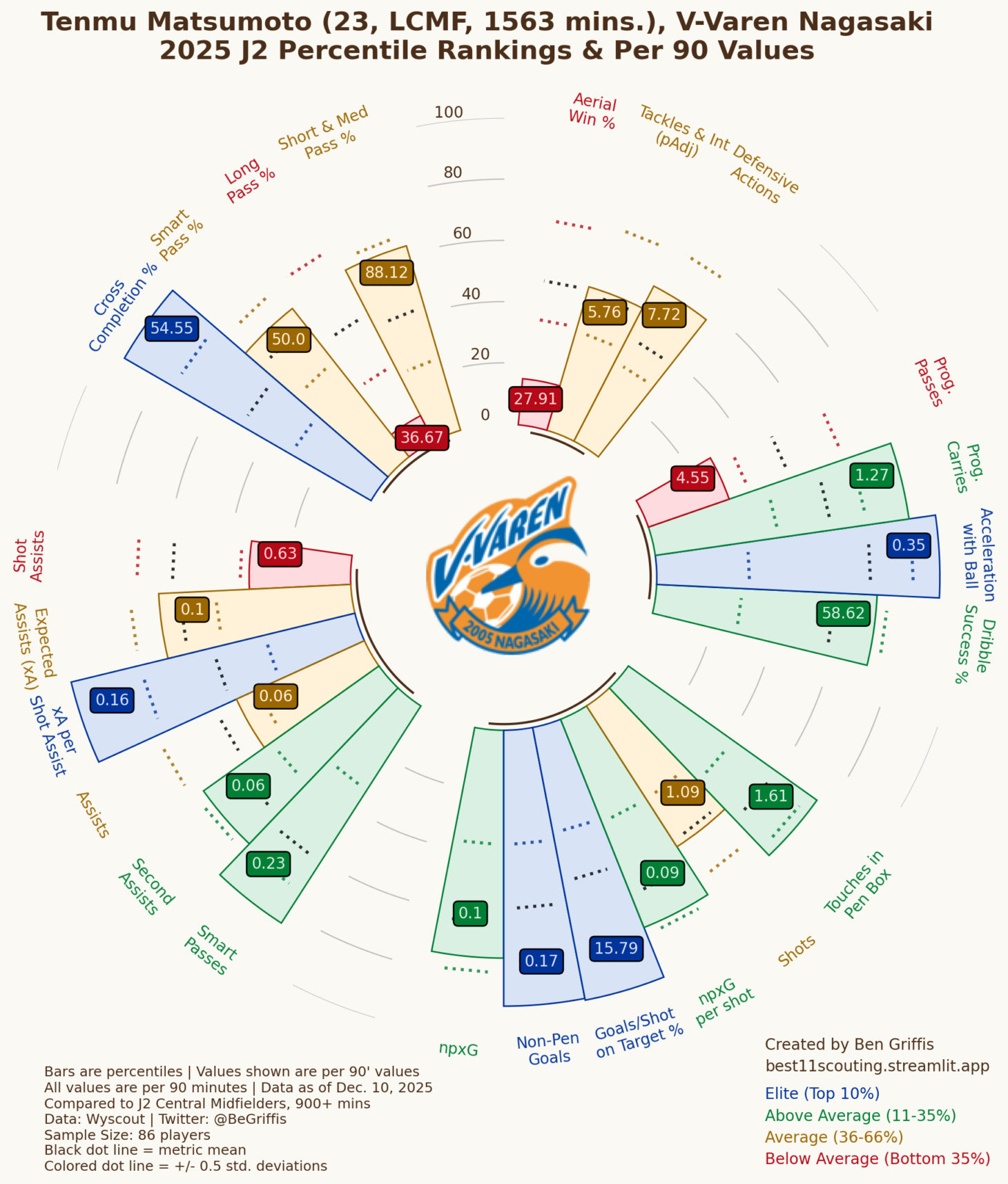
Another young player to look out for is Tenmu Matsumoto, who joined from a university team in January. He lost his starting place after Takagi’s arrival but still made an impact as a substitute. Matsumoto was a very mobile attacking midfielder who combined well with teammates around him when Nagasaki pushed into the final 3rd due to his ability to find open spaces. I’m hoping to see more of him next year to assess him further.
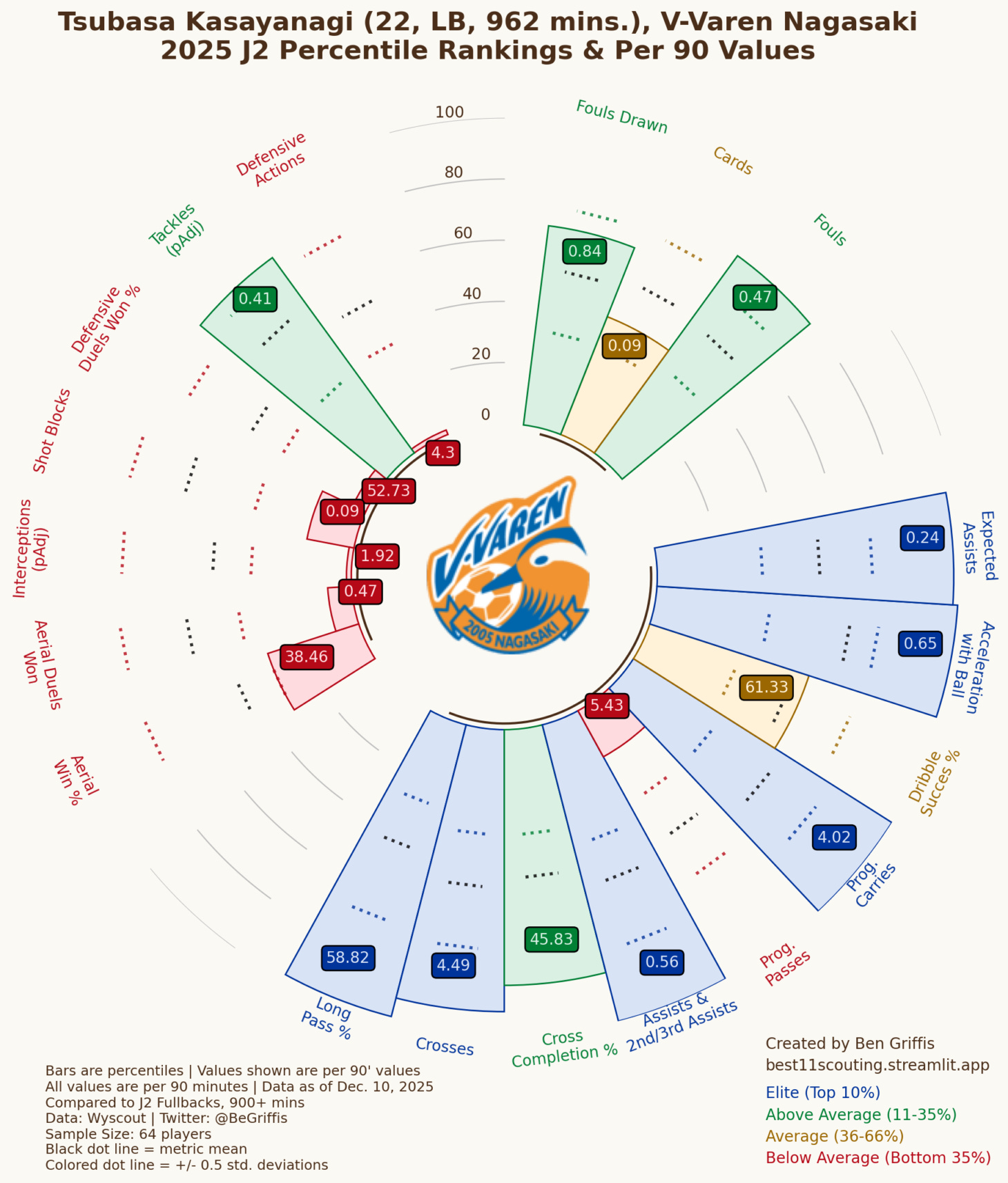
My favorite young player on this team for the past few years has been Tsubasa Kasayanagi. He is a fantastic dribbler that frustratingly had limited game time this year, and at Wing Back that that! Even though his main problem continues to be his final output, Kasayanagi still managed 3 goals and 7 assists, one fewer assist than last season despite more than a 50% drop in minutes played. Somebody break him out of jail (a.k.a. the bench)!
Note: Some of his stats below are inflated as he is on the “Full Back” radar template.
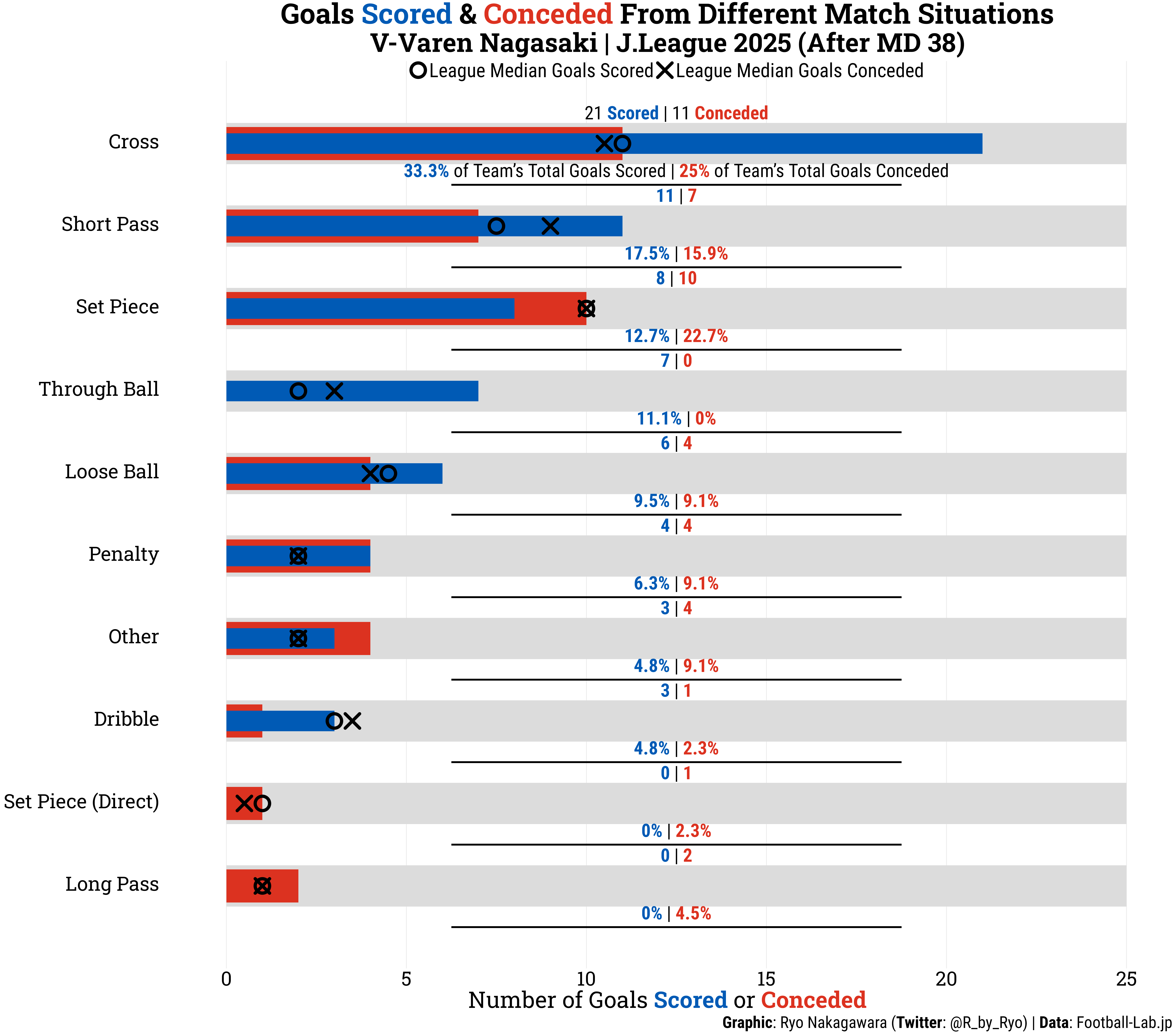
While we’re on the subject of Wing Backs, I’ll also give a lot of props to both Shunya Yoneda and Asahi Masuyama. I feel like Yoneda has been a very underrated Left Back and I find it incredible that he’s never played in J1… well except for a brief time during his debut season in 2018 when Nagasaki were previously in the top flight. Both he and Masuyama contributed a lot with their crossing ability. With all these It should come as no surprise then that Nagasaki scored a third of their goals from crosses!


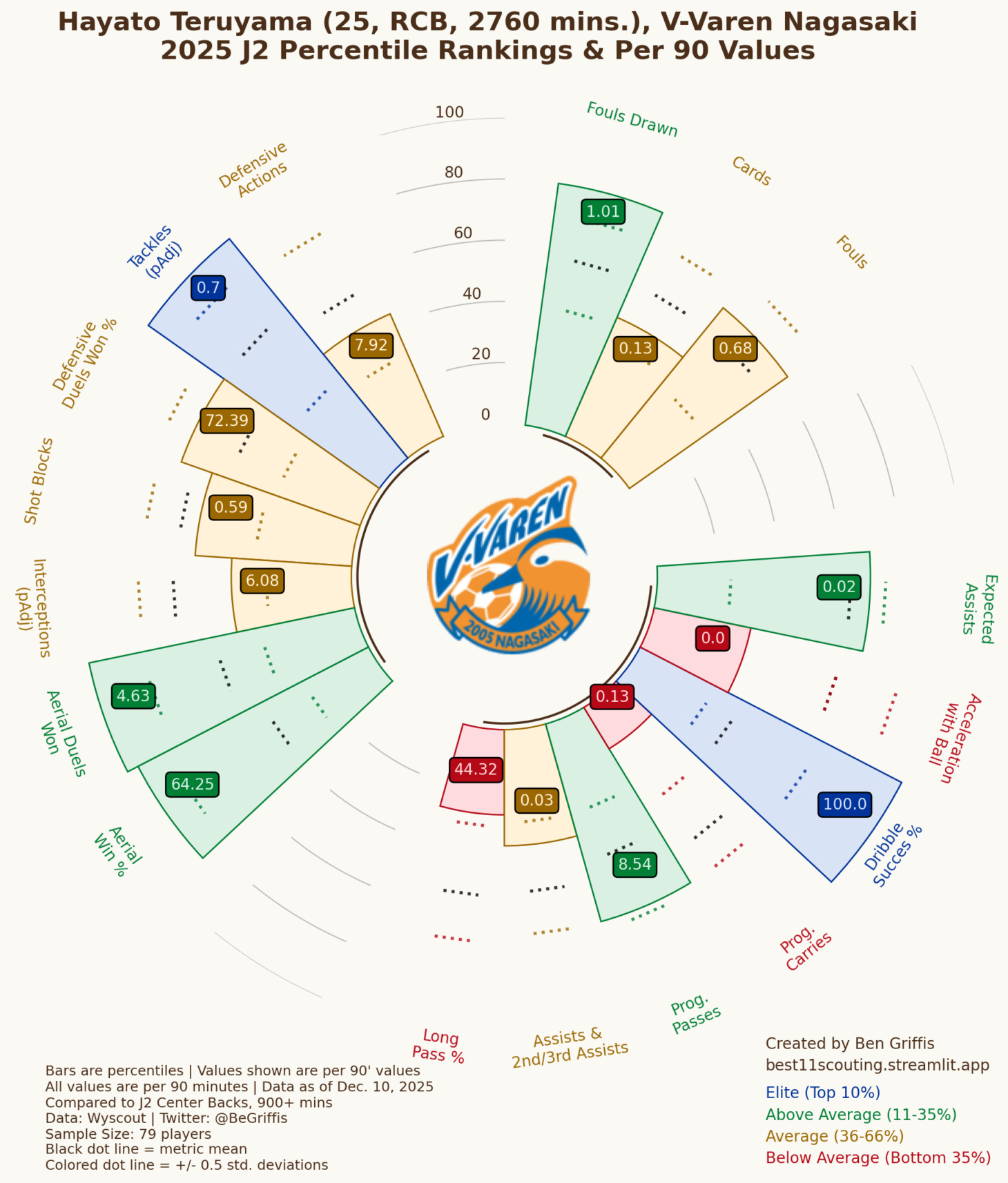
For all the talk of their attack, you might think Nagasaki were weak at the back but that actually wasn’t the case. Sure, they weren’t Tokushima Vortis by any means but they were relatively decent in defense, although it was helped by the fact that Nagasaki simply kept the ball a lot. The opposition can’t score if they don’t have the ball after all! A big part of Nagasaki’s defensive ability, aside from the hard work done by midfielders such as Hotaru Yamaguchi was Hayato Teruyama. Teruyama really stepped up this year after Hayato Tanaka returned to parent club Kashiwa Reysol. He was very good in the air and was useful in the build-up next to veteran presences in the Back 3 like Eduardo and Ikki Arai.
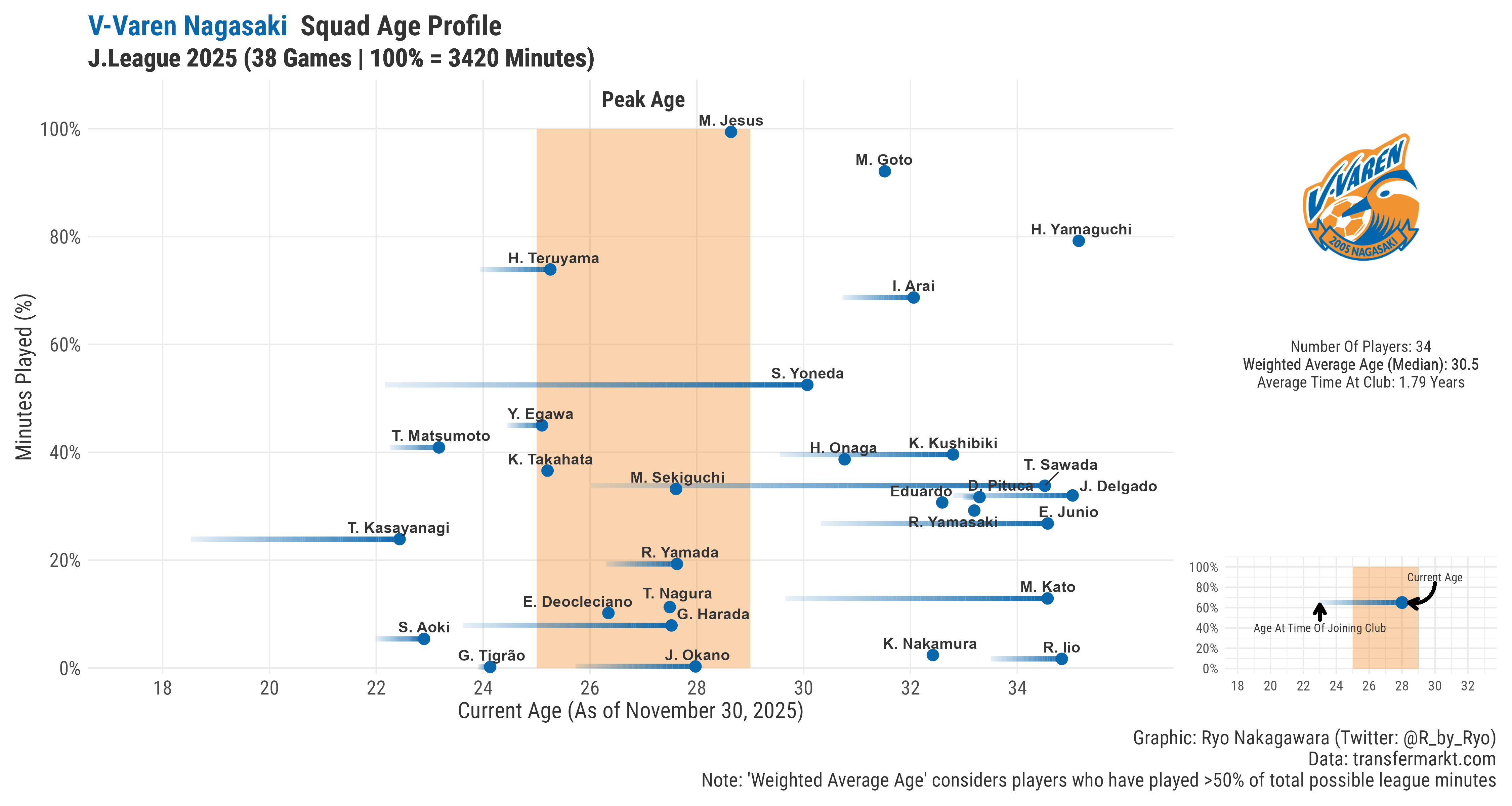
For all the praise about their quality veteran players, it does need to be said that all of these guys are on very high wages and V-Varen Nagasaki have been in “win now” mode for the past 2~3 seasons. As such, they are going to need to freshen up their squad quite soon when you look at the squad age curve across their entire squad and start playing some of their younger players more. There are a number of foreign guys like Marcos Guilherme, Edigar Junio, and Juanma that although have helped the team significantly at various points (including this season), the club will need to take a long hard look at who to keep and who to ultimately let go. While the veterans could dunk on worse J2 players quite easily, it’s going to be much harder against stronger J1 opposition and more sprightly legs so some tweaks in their recruitment strategy will be needed.
JEF United Chiba (3rd, 69 Points)
20 Wins // 9 Draws // 9 Losses
Location // Stadium: Chiba // Fukuda Denshi Arena
Manager: Yoshiyuki Kobayashi
56 Goals (5th); 34 Conceded (tied 2nd)
50.29 non-penalty xG (5th); 44.54 non-penalty xGA (11th)
Top goal scorer: Carlinhos (9 goals plus 1 penalty) & Daichi Ishikawa (8 goals plus 2 penalties)
Goalkeeper: Jose Aurelio Suarez
“Will JEF get promoted... THIS TIME?” is the question everybody asks at the start of every J2 season since their last J1 relegation in 2009. In 2025, manager Yoshiyuki Kobayashi and the team answered the call, JEF United will be back in J1 for the first time in 17 years! This season started again with a whole lot of promise. JEF United won 10 out of the first 11 games of the season to rocket up into 1st place by some distance! However a wretched run of mid-season form resulting in just a single win in the next 11 games leading into July gave JEF fans that sinking feeling again. The team recovered to stay in play-off contention but didn’t quite recapture consistent form until going undefeated in the last six games of the season, including a super important last-second victory against Mito HollyHock on Matchday 33. JEF destroyed FC Imabari 5-0 on the last matchday to head into the play-offs as the 3rd placed team. Their home-field advantage as the 3rd placed team was a major force in their promotion push.
First up in the semi-finals was a resurgent Red Bull Omiya Ardija team who raced to a 3-0 lead in the 48th minute. However, in a 16 minute window from the 71st minute, JEF United came roaring back in one of the best J.League games in recent memory! Then in the final, JEF held their nerve despite lots of pressure from Tokushima Vortis to clinch promotion in front of an absolutely packed Fukuda Denshi Arena!
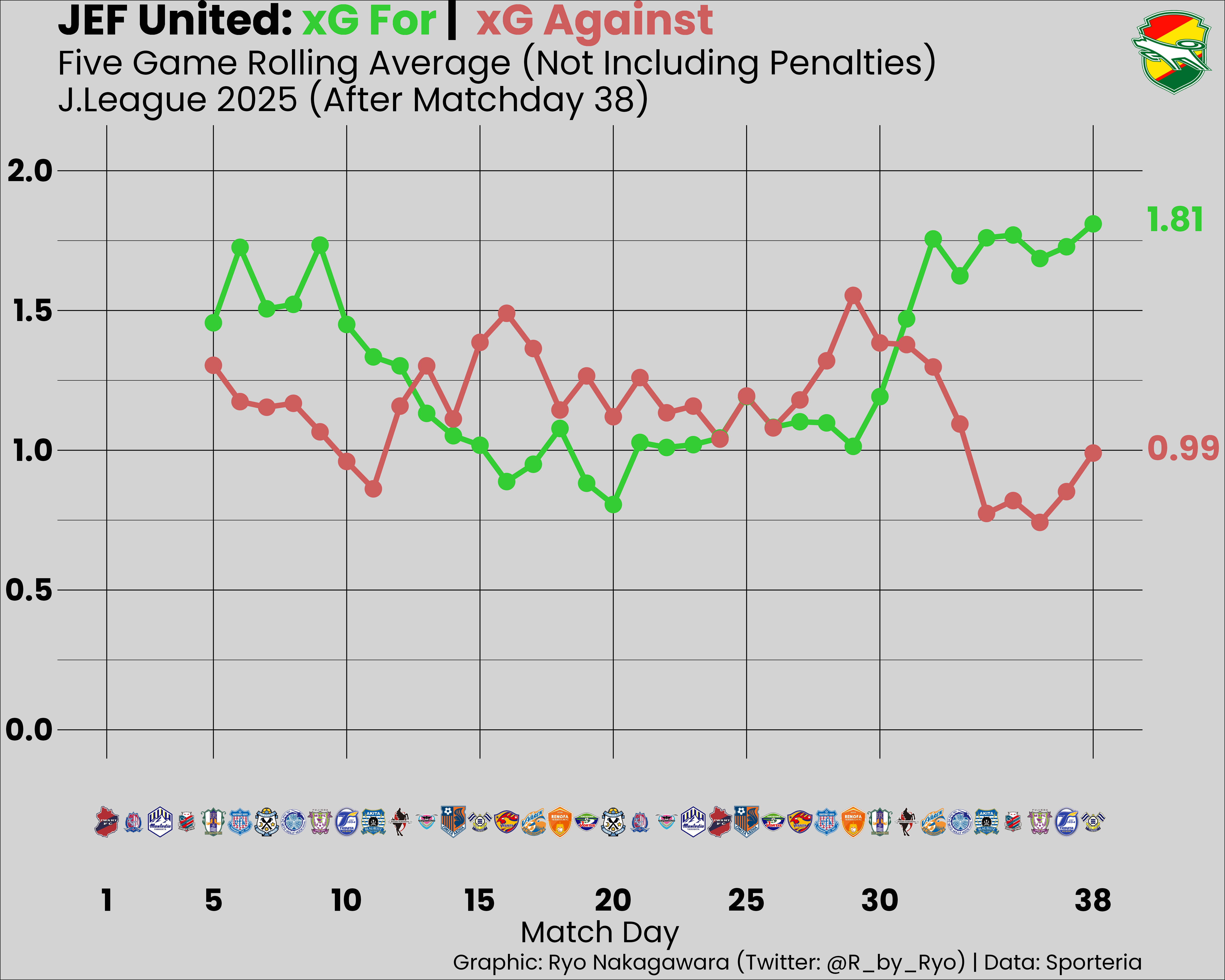
JEF United’s defensive numbers paint a curious picture. Their total non-penalty xGA was 11th in the league, yet they only managed to concede the 4th least amount of goals! I think a lot of this was down to the great saves by goalkeeper Jose Aurelio Suarez who transferred from Tokushima Vortis in the winter.
Of course, a fairly consistent Back 4 of Masaru Hidaka, Daisuke Suzuki, Koji Toriumi, and Issei Takahashi did a good job too. JEF allowed the 4th most shots on their goal but the actual average quality of these shots were quite low! This provides some evidence that the defense were doing a good job forcing teams into making bad shots. The quality of JEF’s defending was also seen by the fact that they kept focus throughout the game and were especially good at not conceding in the 2nd half of games.


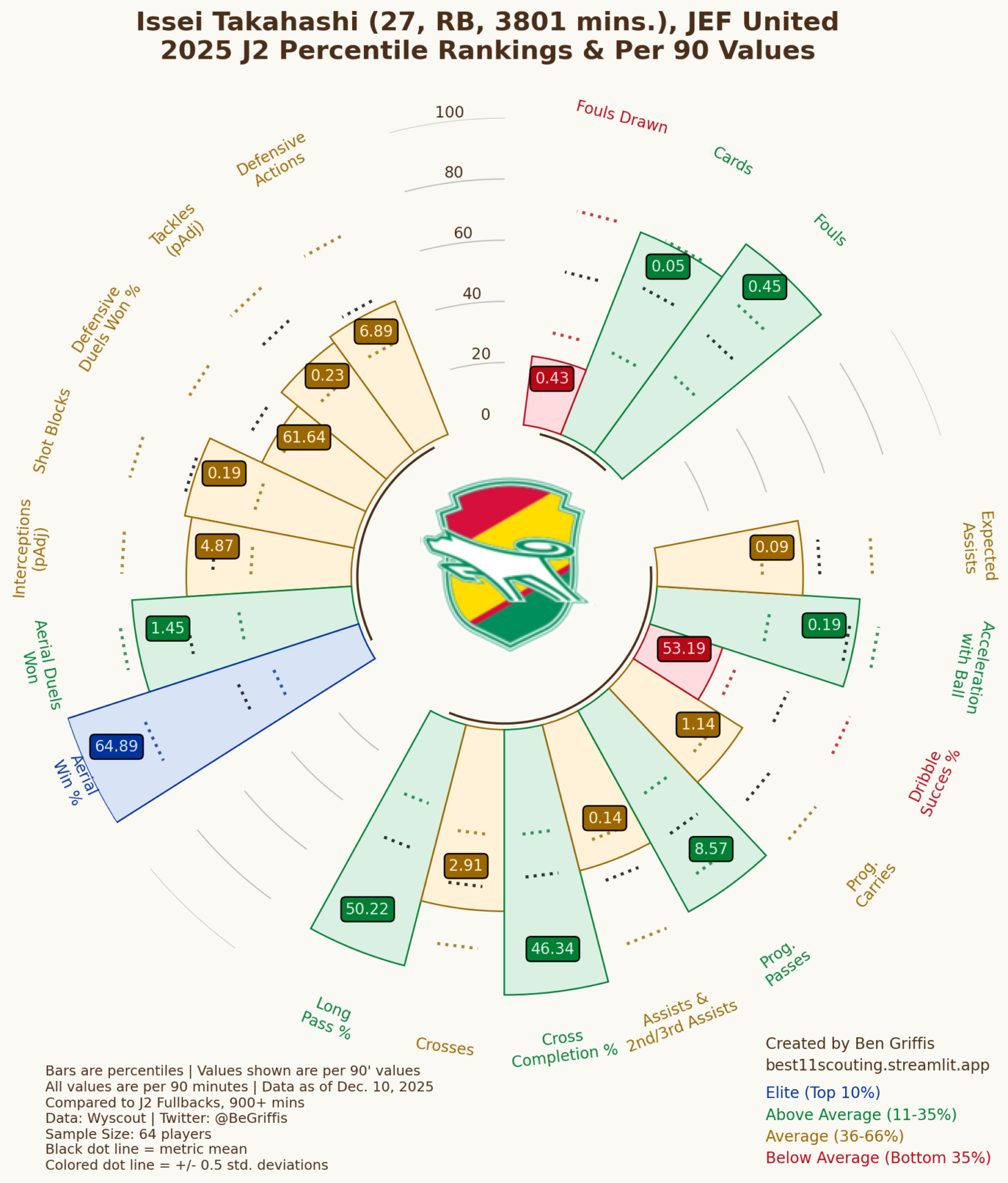
In terms of defenders, I think Issei Takahashi stood out not just for his defending but his on-the-ball qualities too. He played in all but one game and played the most minutes out of anybody in the team, including the goalkeepers. In attack he was a constant outlet on the Right and his passing and crossing was a source of danger despite only finishing the season with 2 assists.
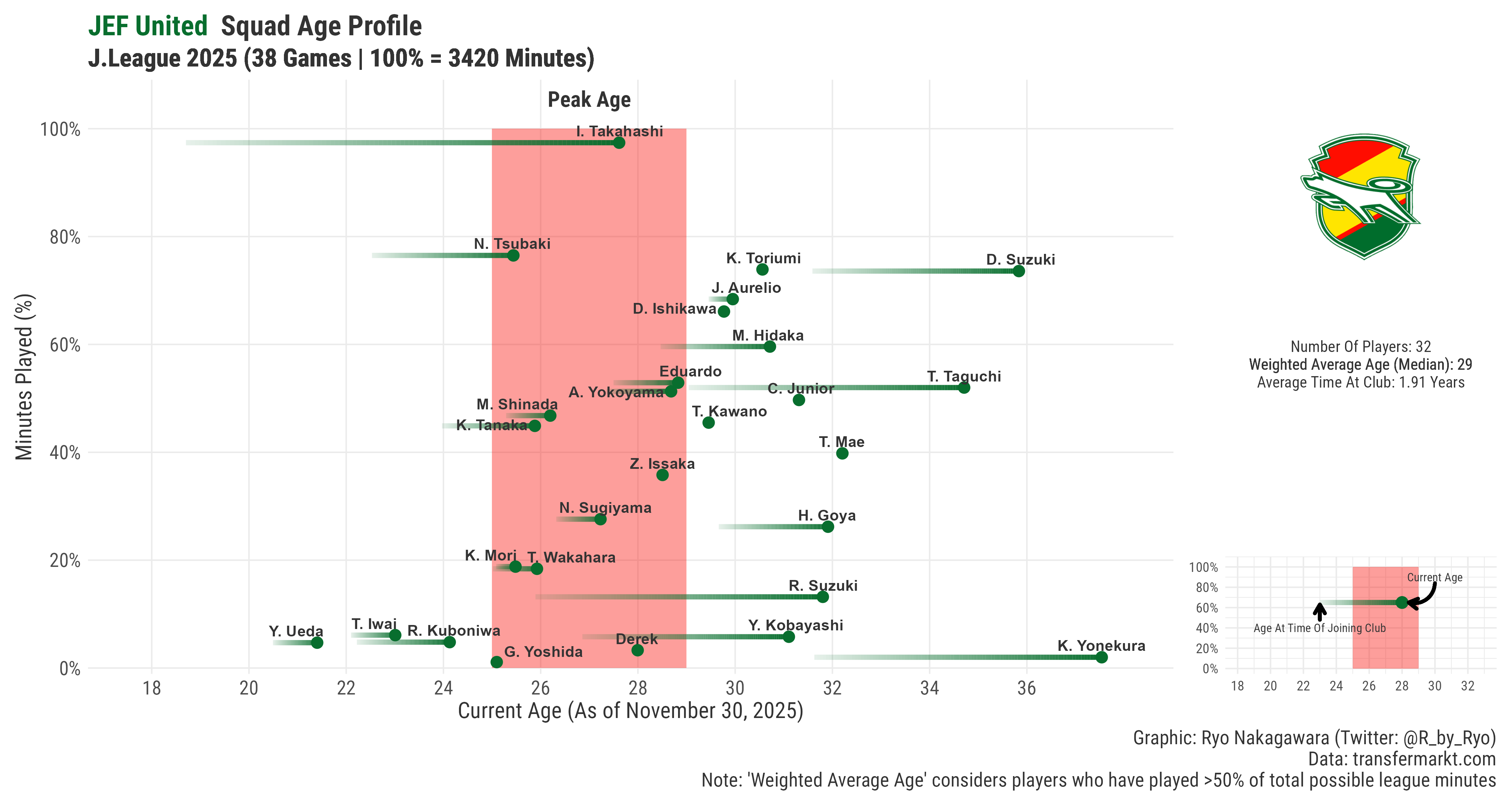
Despite his 34 years of age, Taishi Taguchi played the most minutes after Takahashi. Since his arrival in Chiba five years ago, the veteran has become a real leader for the team and had an impact from set-pieces with 5 assists. I’ve been a Naoki Tsubaki fan for a while and he was finally able to find a consistent run as a regular in the starting XI without injuries this year. His speed and dribbling down the Left to send crosses into the box was a major aspect of JEF’s attack. Tsubaki contributed with 4 goals and 5 assists. Unfortunately on the other wing, Kazuki Tanaka suffered a season-ending injury back in July. I really liked him in the 2024 season so I hope he comes back to full fitness soon.
If you noticed a common theme throughout this section so far, you wouldn’t be surprised to know that JEF scored nearly 50% of their goals from crosses and set-pieces combined!


Despite winning promotion back to J1 with Shimizu S-Pulse in 2024, Carlinhos curiously came to JEF United. The move was an inspired one as the Brazilian made a big impact with 10 goals and 1 assist. Daichi Ishikawa matched his previous season’s record with Roasso Kumamoto with another 10 goals and 3 assist for JEF United. His presence up top meant the team didn’t miss Kaito Mori suffering a long term injury upon arrival.


A theme throughout JEF United’s promotion story this season has been their good recruitment strategy such as being able to adequately replace Hiiro Komori and moving fast to plug Tanaka’s absence with Zain Issaka, overall I’m quite impressed. For those aware of my usual complaints about J.League teams’ transfer strategies, you’ll know that this is high praise! It wasn’t just headline stealing transfers like Carlinhos or Jose Aurelio Suarez but other moves like the return of Koji Toriumi and filling out the squad with decent players like Takashi Kawano and Takayuki Mae were also very important. It does worry me that Takehito Suzuki, the GM, is moving to Yokohama F. Marinos though.
JEF United are finally back to where they belong after a long absence. While celebrations are in order, there still needs to be a lot of work done over the next six months so that they aren’t thrown straight back down into J2 in 2026/2027. JEF will have time over the 100 Year Vision League to test the waters against the strong Kanto area teams to identify what exactly needs improvement to stay in J1 for the long haul.
Tokushima Vortis (4th, 65 Points)
18 Wins // 11 Draws // 9 Losses
Location // Stadium: Tokushima // Pocari Sweat Stadium
Manager: Kosaku Masuda
45 Goals (12th); 24 Conceded (1st)
41.83 non-penalty xG (12th); 33.56 non-penalty xGA (1st)
Top goal scorer: Lucas Barcellos (13 goals plus 1 penalty)
Goalkeeper: Hayate Tanaka
Tokushima Vortis made a name for themselves this season as being extremely difficult to beat, let alone score a goal against. Just a paltry 24 (twenty-four!!) goals conceded this season which is quite incredible. They only lost by more than a single goal once this season, a 0-2 defeat against Fujieda MYFC while also keeping the opponent from scoring in 19 games, that’s half of all their league games!
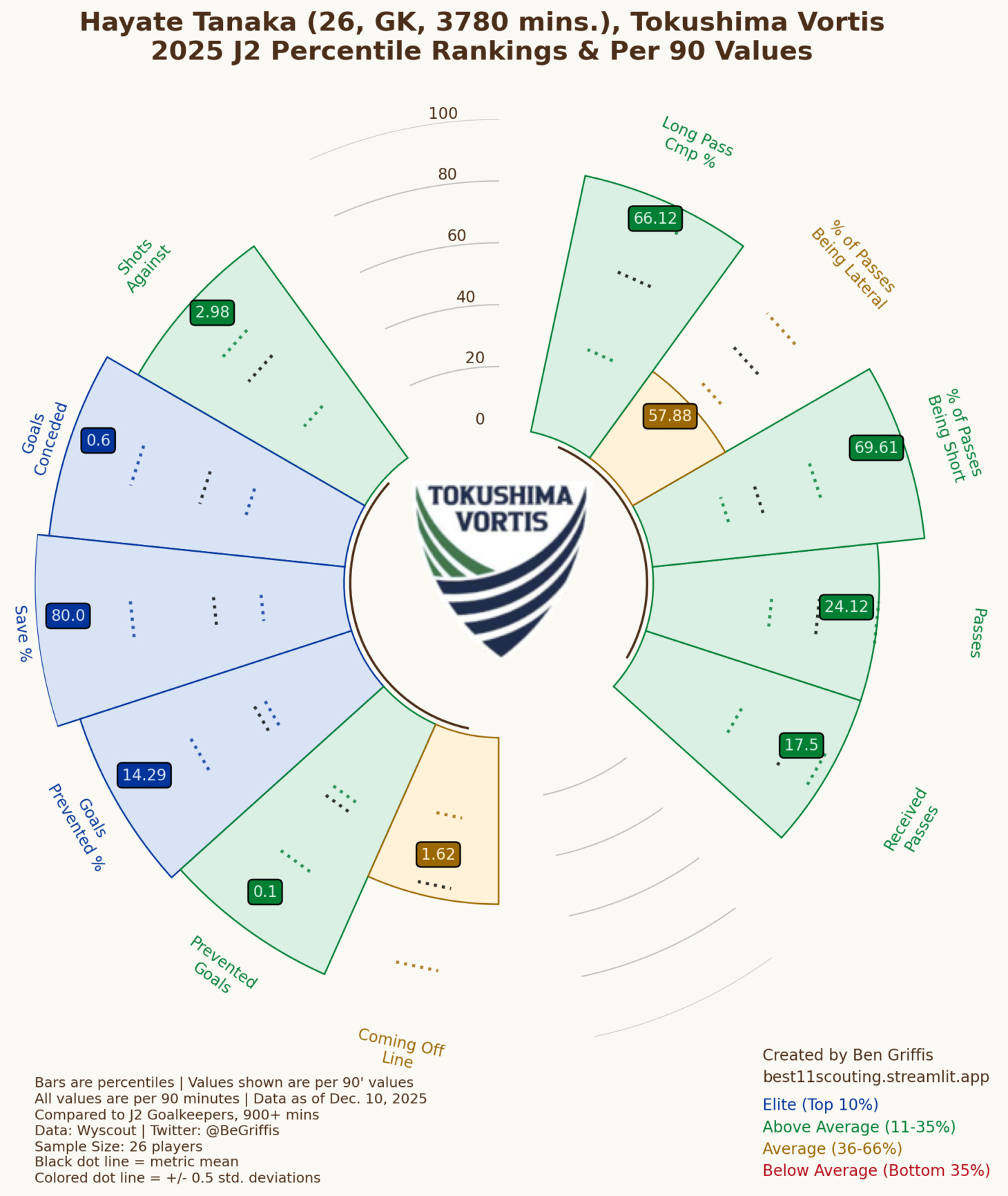
The Back 3 of Hayato Aoki, Kohei Yamakoshi, and Nao Yamada proved solid throughout but to me the stand out performer was Hayate Tanaka in goal. Even though it’s easy to say that he was protected extremely well by his teammates in front of him, Tanaka still pulled off quite a lot of very good saves throughout the season. The goalkeeper was also involved in the build-up too with accurate short and long range passing, Tanaka was a fantastic successor to Jose Aurelio Suarez who left for JEF United in pre-season.
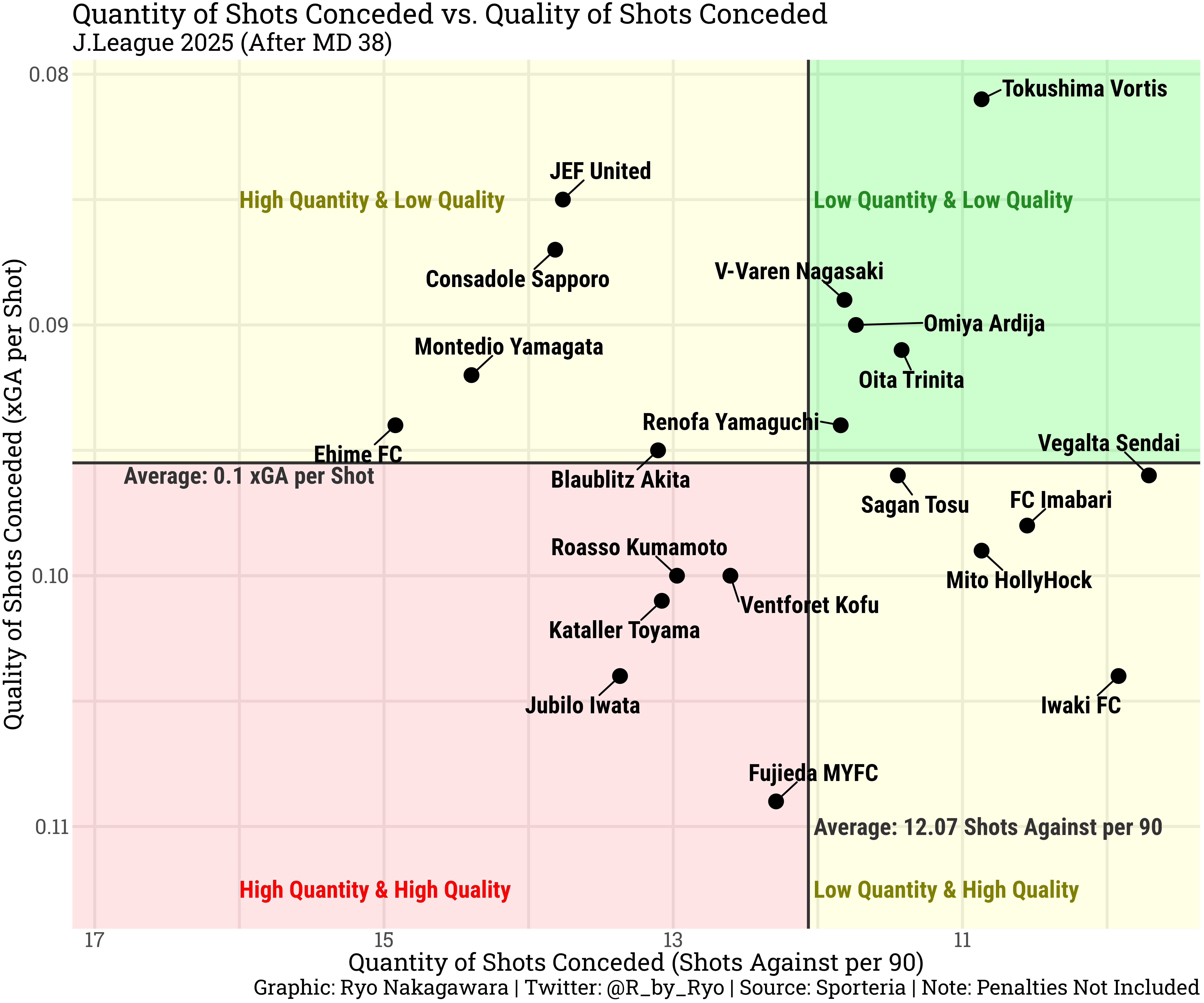
Overall, Vortis had the league best non-penalty xGA, xGA per Shot and only let the opposition take 413 shots (tied 4th least in the league), it’s all extremely impressive!


Of course, this came at the cost of attacking output despite Vortis being an unusual team that liked to keep the ball a lot on top of being very defensive. It was mostly about keeping the ball in their own half of the pitch though with Shunto Kodama especially adept at pulling the strings from the base of midfield.
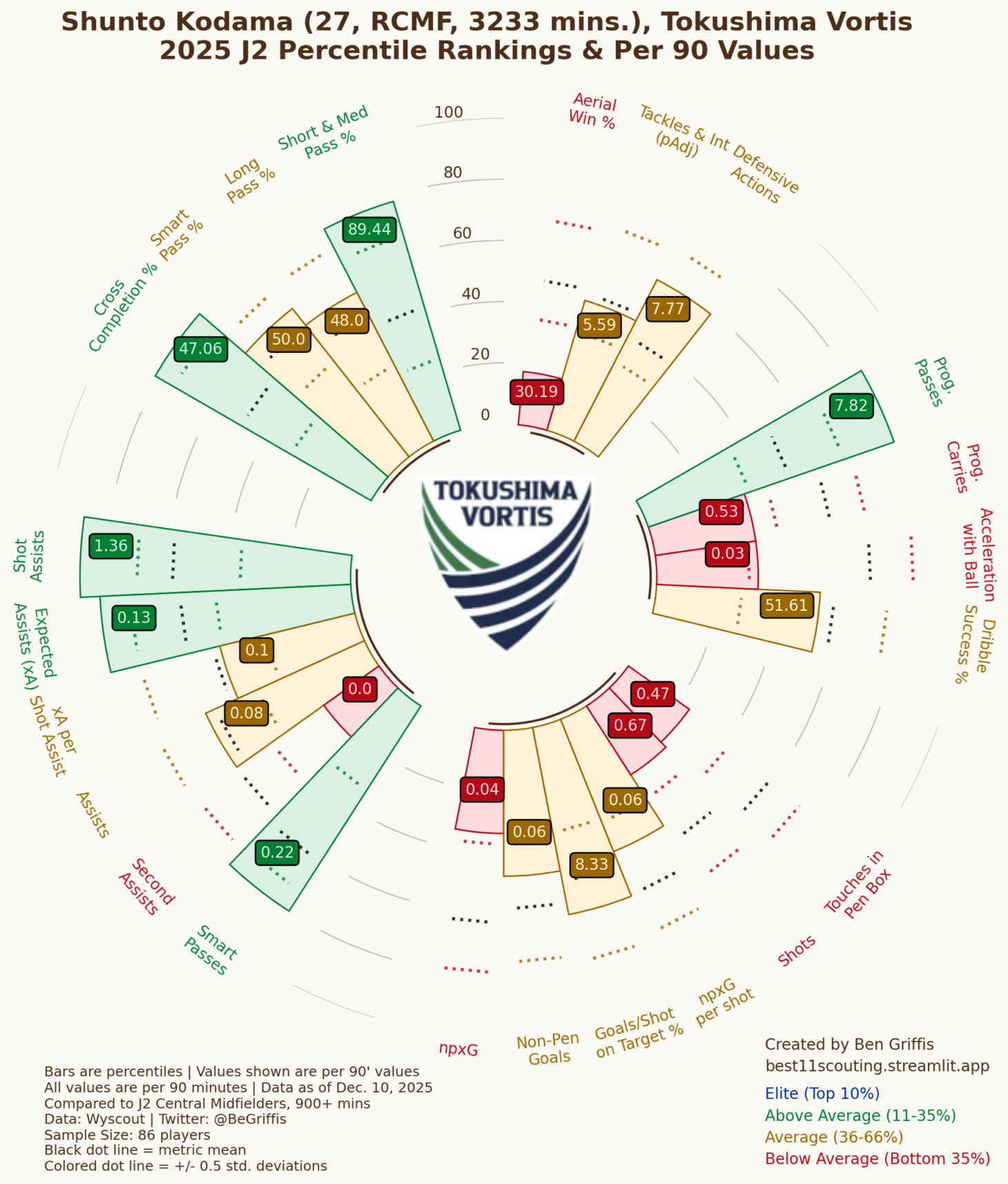
Any and all attacking impetus came from Lucas Barcelos as he finished the season with 14 goals and 5 assists. The Brazilian was the clear focal point of the attack with his dangerous runs forward in transition. Barcelos was a bit of a “shoot on sight” type of striker (his poor xG per shot represents this quite well) but given how little output Vortis were getting elsewhere I think it was somewhat justified. He was ably supported by veteran Daiki Watari (5 goals and 5 assists) and super-sub Anderson (3 goals and 6 assists).


Perhaps not the most exciting football if you’re a neutral but this has been an incredible turnaround by Kosaku Masuda who took over from Tatsuma Yoshida in the early part of the 2024 season when Vortis were in the relegation zone. If Vortis can keep their star defense intact and get Barcelos a bit more support in attack, they could surely have a run at an automatic promotion spot in 2026/2027.
… A day before I released this newsletter, Masuda left Vortis by mutual consent. Unbelievable! The papers are saying there was some office politics going on. What a massive waste by Vortis but a big opportunity for another J.League club to sign Masuda!
Júbilo Iwata (5th, 64 Points)
19 Wins // 7 Draws // 12 Losses
Location // Stadium: Iwata // Yamaha Stadium
Manager: John Hutchinson (to September) // Takayoshi Amma
59 Goals (3rd); 51 Conceded (15th)
41.82 non-penalty xG (12th); 52.6 non-penalty xGA (19th)
Top goal scorer: Matheus Peixoto (8 goals plus 2 penalties)
Goalkeeper: Eiji Kawashima
After relegation from J1, Jubilo Iwata were looking to go straight back up and hired John Hutchinson for the job. The Aussie had managed Marinos on an interim basis during the 2024 season and the Jubilo higher-ups were apparently convinced about his skills. In 2025, the results were fine but the performances were really deteriorating as the season went on. A 3-4 loss to Omiya Ardija in late September was the last straw and Hutchinson was let go. Takayoshi Amma took over and he was able to keep Jubilo in contention with the play-off spots. Once again, much like with Hutchinson, I was never quite convinced with Jubilo’s attacking threat which I felt was really propped up by good finishing more than anything while their defending continued to be poor as it had all season. Somehow on the last matchday of the season, Jubilo won against Sagan Tosu to leapfrog Omiya Ardija and Vegalta Sendai to finish in 5th place for the play-offs!
Of course, the play-offs ended with a drab 0-0 draw against 4th place Tokushima Vortis (the higher placed team only needs to avoid defeat) but Iwata were just two games away from somehow getting promoted. So close, yet so far.
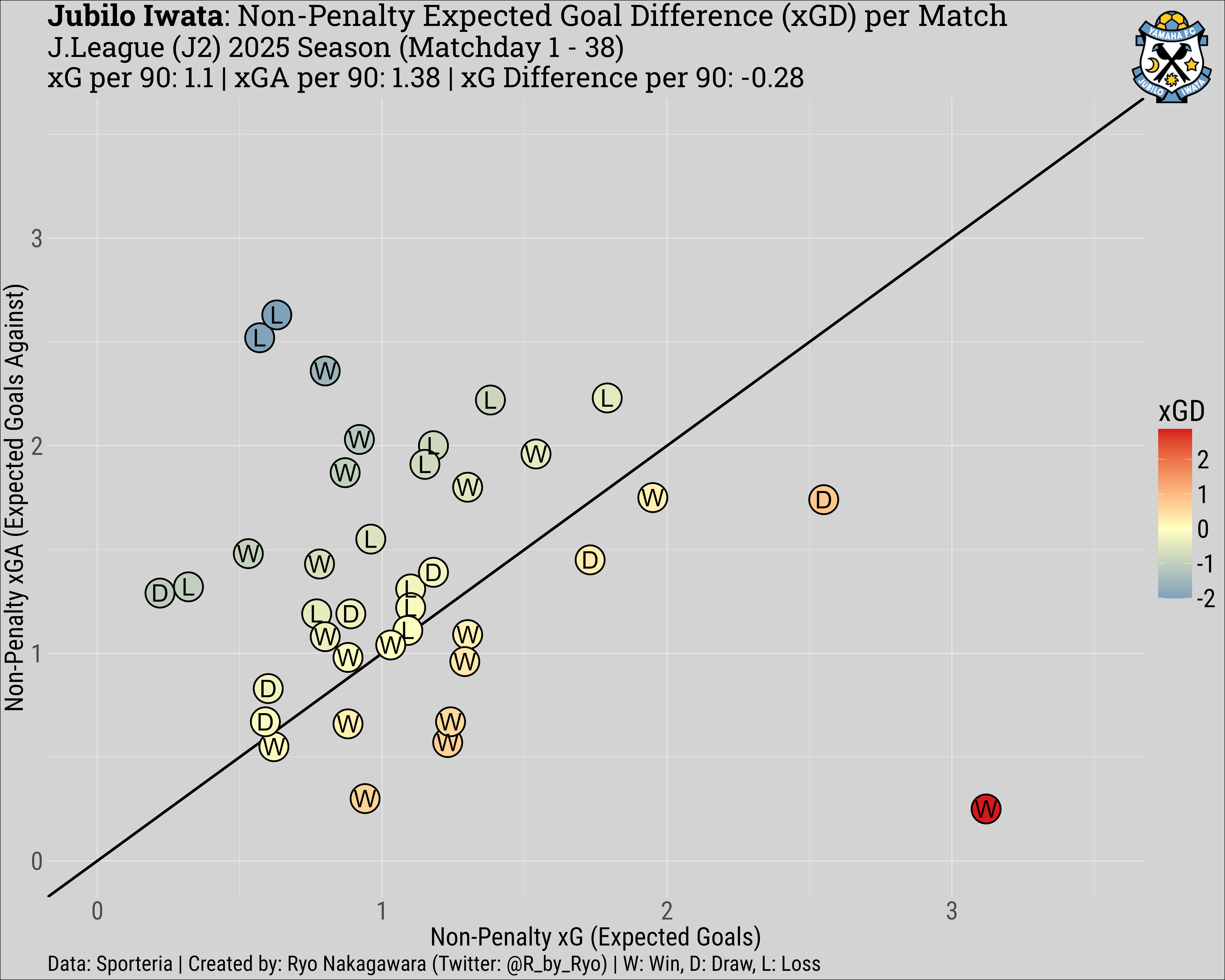
For all their possession which was the highest in the league per match at 56.3%, they seemed to discover new ways to lose the ball in their own half in each game I watched of them. Still, given the amount of possession they had, Jubilo were able to use it to push into the final 3rd quite often, the most per game in the league in fact.
An oddity was how Jubilo only took the 12th most number of shots in the league, yet they had the 5th most shots-on-target which resulted in the 3rd most goals scored… Jubilo not only managed to over-perform on xG but they had a habit of scoring late goals as well!


Matheus Peixoto was the team’s top goal scorer with 10, although he only scored twice in the 2nd half of the season. The Brazilian was also a big source of Jubilo’s xG over-performance as those 10 goals came from 6.99 xG. It does make sense when you consider the usual way Peixoto scores goals are from difficult headed chances from aerial crosses.
The man supplying these crosses, on a Jubilo team that crossed the ball into the box the most in the league, was none other than human-artillery hybrid Jordy Croux. The Belgian left mid-season for Yokohama F. Marinos but still wound up with the 3rd most crosses in J2 at the end of the season! After Croux’s departure the likes of Ken Masui and Ko Matsubara kept the tradition alive up. It should be a no-brainer then that 30% of Jubilo’s goals came from crosses.
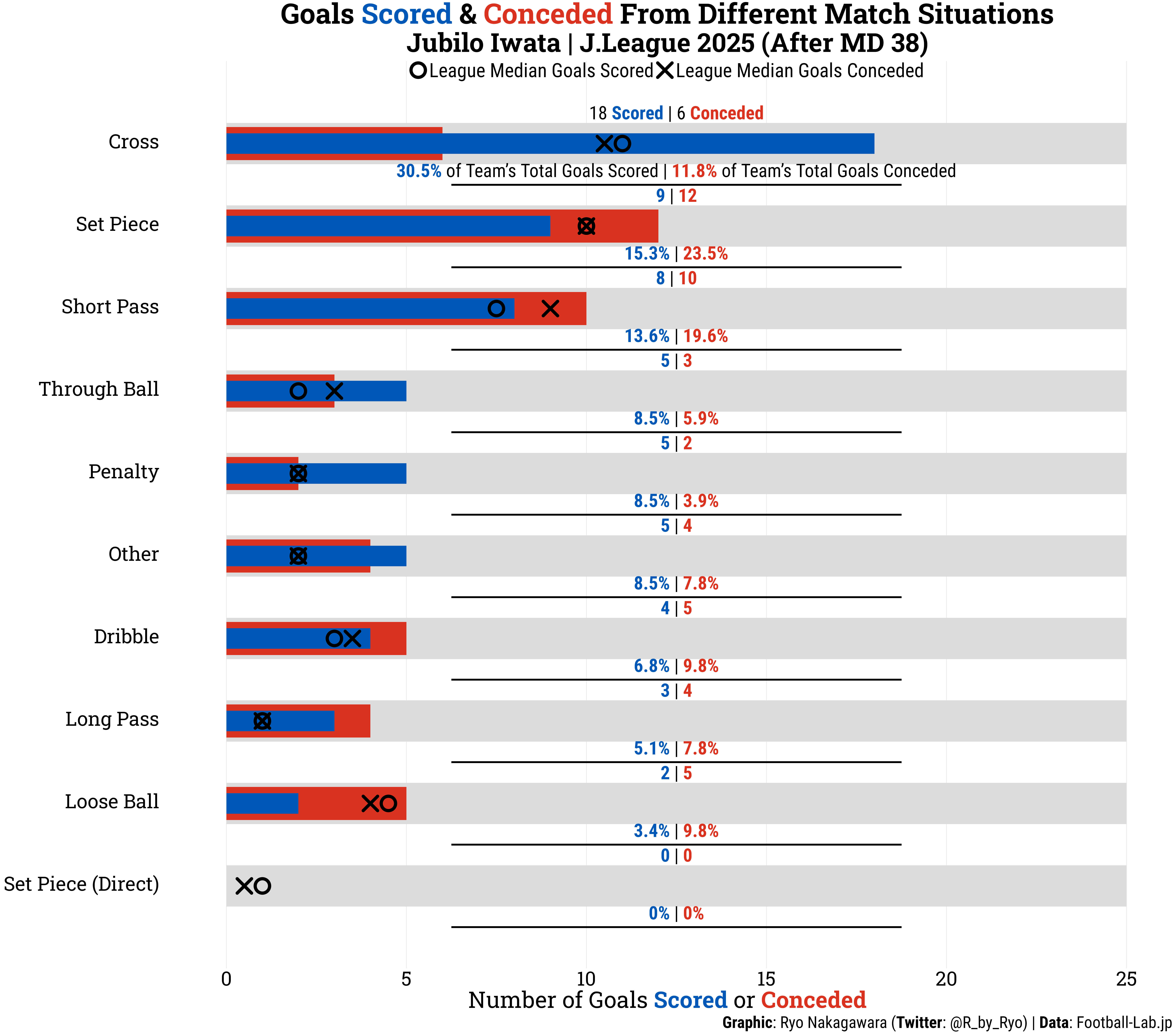
After spending a few years on the bench at Nagoya Grampus, Ken Masui had his break-out year on loan for Jubilo Iwata with 6 goals and 3 assists. He was given a lot of freedom by Hutchinson on the Left to dribble and take people on. It’ll be interesting to see what happens to him and whether he fits into Mischa Petrovic’s plans at Grampus next season as he was forced into an awkward Wing Back role under Hasegawa.
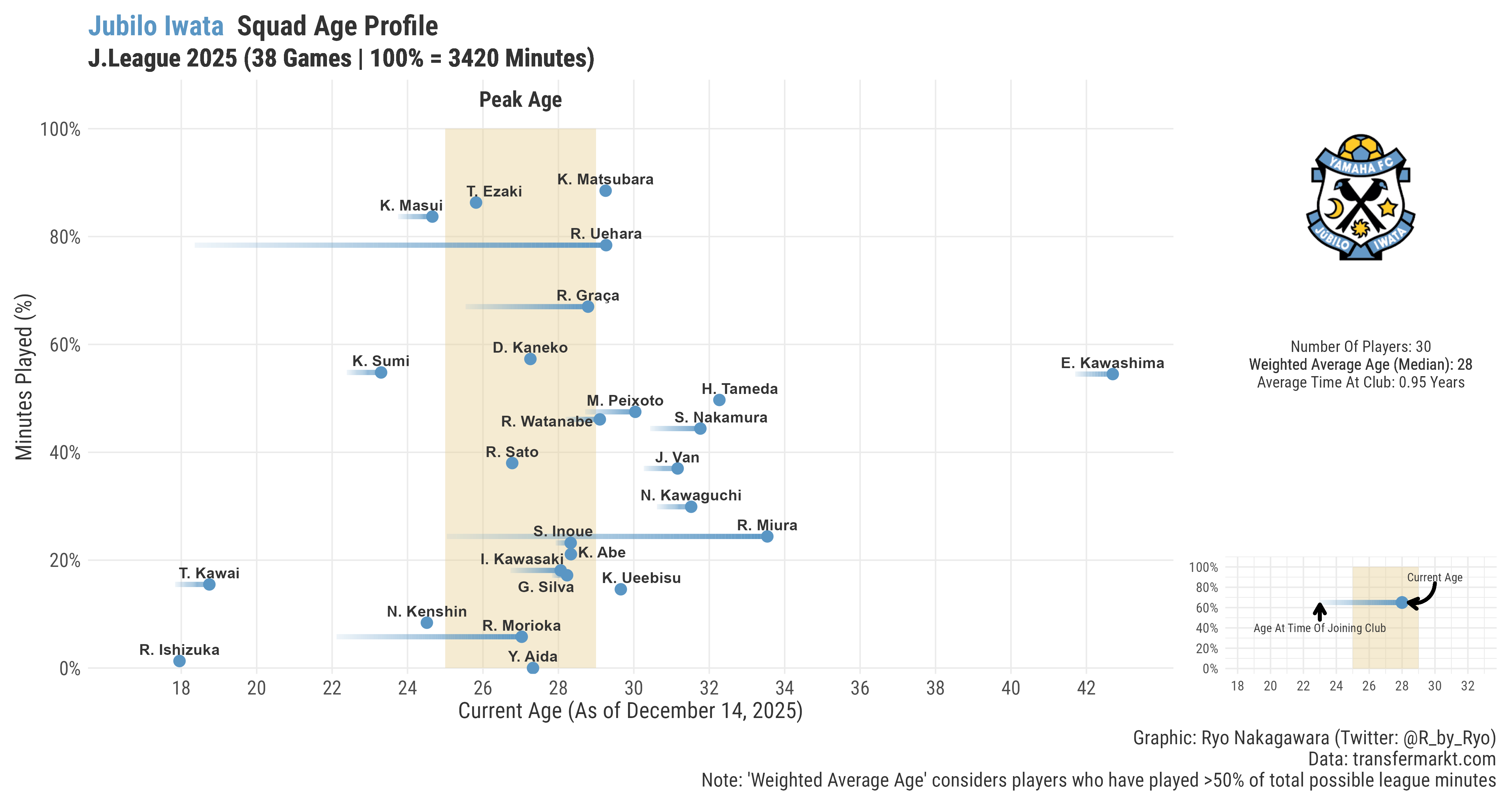
Koshiro Sumi was a player I had a heavy interest in and is the reason why I took some time watching a number of Jubilo games this season. I thought he was quite mobile and good at finding positions between-the-lines to receive. Sumi loves to receive on half-turn & speeds up play from middle 3rd to drive into final 3rd and/or box. He is very fast, direct, and aggressive in these situations. While some of this may be tactical instructions, he does stay up high near the striker rather than drop deep and can make runs behind for lofted/through-balls. It’s from these situations or simply from carrying the ball into the box himself in transitions that Sumi is able to get off a good amount of shots. On the defensive side of things, the 23 year old is not much of a ball winner but dutiful in defensive tasks in the First Line of Press with a good work-rate. In high/mid-block situations he’s very good at cutting pass lanes. My primary concern about Sumi is his rather small size in terms of receiving under pressure from behind vs. bigger/quick opponents who won’t give him space to turn forward. Another curious thing is that he faded out of games often and frequently subbed off in the 55~70 minute mark instead of finishing games.


Another bright young attacker that made some cameo appearances was the teenager Tokumo Kawai. He made lots of late game cameos and managed 2 goals in limited game time. One to keep track of in the future.
Now the big issue for Jubilo all season was their terrible defending! Their pressing was poor and easily created holes between-the-lines that were easily exploited by the opposition. So the defenders were in part exposed by the tactics but quite a few were also just not very good 1v1 defenders in the first place. Ko Matsubara for all his attacking prowess continued to do his best impression of a training cone all season long, it’s very easy to dribble past him. Iwata’s goalkeeper situation is also worrying as both Eiji Kawashima and Ryuki Miura are completely past it. The team really needs to start getting younger goalkeepers in the squad.


So Jubilo Iwata somehow managed to stumble into the play-offs despite being fairly mediocre but ultimately did not gain promotion. It does seem like a bit of a waste of a year considering their squad strength relative to J2. Takayoshi Amma was only hried on an interim basis and if rumors are to be believed it’s likely that he will step back into his youth coaching role and that Ryo Shigaki (the ex-Renofa Yamaguchi manager who joined the Jubilo coaching staff during the season) will become the manager from 2026 onward.
RB Omiya Ardija (6th, 63 Points)
18 Wins // 9 Draws // 11 Losses
Location // Stadium: Omiya // Nack5 Stadium
Manager: Tetsu Nagasawa (to September) // Yuki Miyazawa
60 Goals (2nd); 39 Conceded (5th)
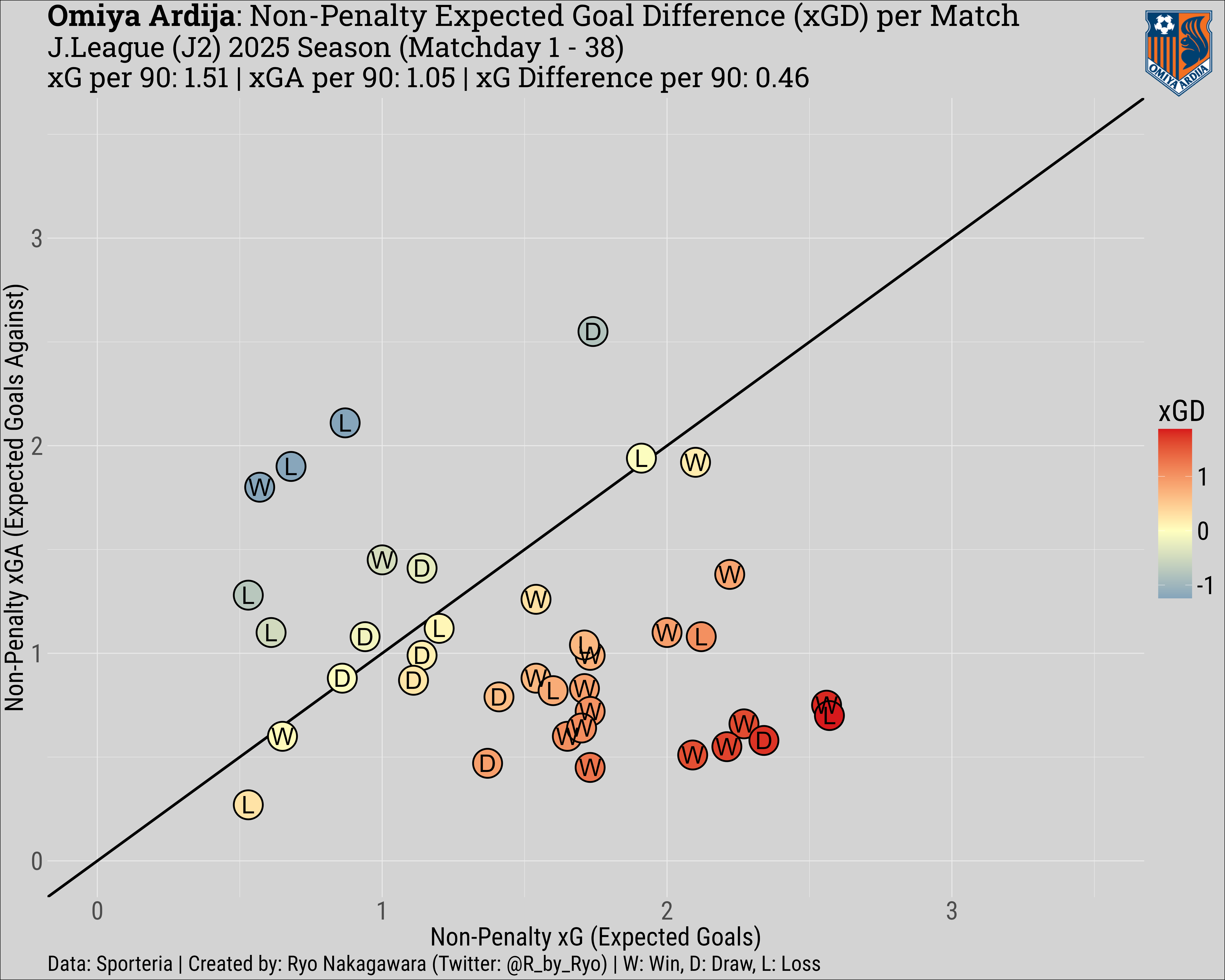
57.38 non-penalty xG (1st); 40.07 non-penalty xGA (7th)
Top goal scorer: Caprini (11 goals)
Goalkeeper: Takashi Kasahara
It was clear from how they walked to the J3 title last season and the arrival of Red Bull in late 2024 that Omiya Ardija were not going to be the typical promoted side this season. They started off the season quite well and were in the driving seat during the first half of the season. However, a wretched run of a seven game win-less streak between June to July dropped Omiya out of title contention. The arrival of new Director of Football Stuart Webber came with it radical changes, although a three game losing streak in September made it easier to justify letting Tetsu Nagasawa go.
In came Yuki Miyazawa who had coached in various positions across the Red Bull organization for quite some years, who rocketed Omiya back into play-off and possibly even automatic promotion contention as they went undefeated in his first 6 games in charge. Unfortunately, they let automatic promotion slip away and ended the regular season poorly with a 1-2 loss to promotion rivals Tokushima Vortis and a 2-3 loss to relegation fighting Renofa Yamaguchi to finish in the last promotion 6th place spot. The play-offs started off at a tough away game to JEF United and they raced to a big lead against the run of play. However, JEF United came back with a vengeance spurred on by a raucous home crowd to flip the score and win 4-3, thus ending Omiya’s promotion hopes.
Omiya’s style changed significantly between managers. Under Nagasawa it was a Back 3 / Back 5 with heavy emphasis on man-marking through tweaking the positioning of the Wing Backs depending on the opposition’s shape and they defended deeper than they do now. Given the composition of the Back 3 on a particular day it meant Izumi was both a Wing Back and a Winger. Under Miyazawa, in true “Red Bull” style the defending was a lot more aggressive and pro-active. Omiya also switched to a 4-4-2 diamond to apply a more ball-oriented pressure on the opponent, a shape that is quite a rare these days. It’s been a while so it’s a bit hazy but I do recall Julian Nagelsmann playing a midfield diamond with RB Leipzig so perhaps Miyazawa was influenced by that.
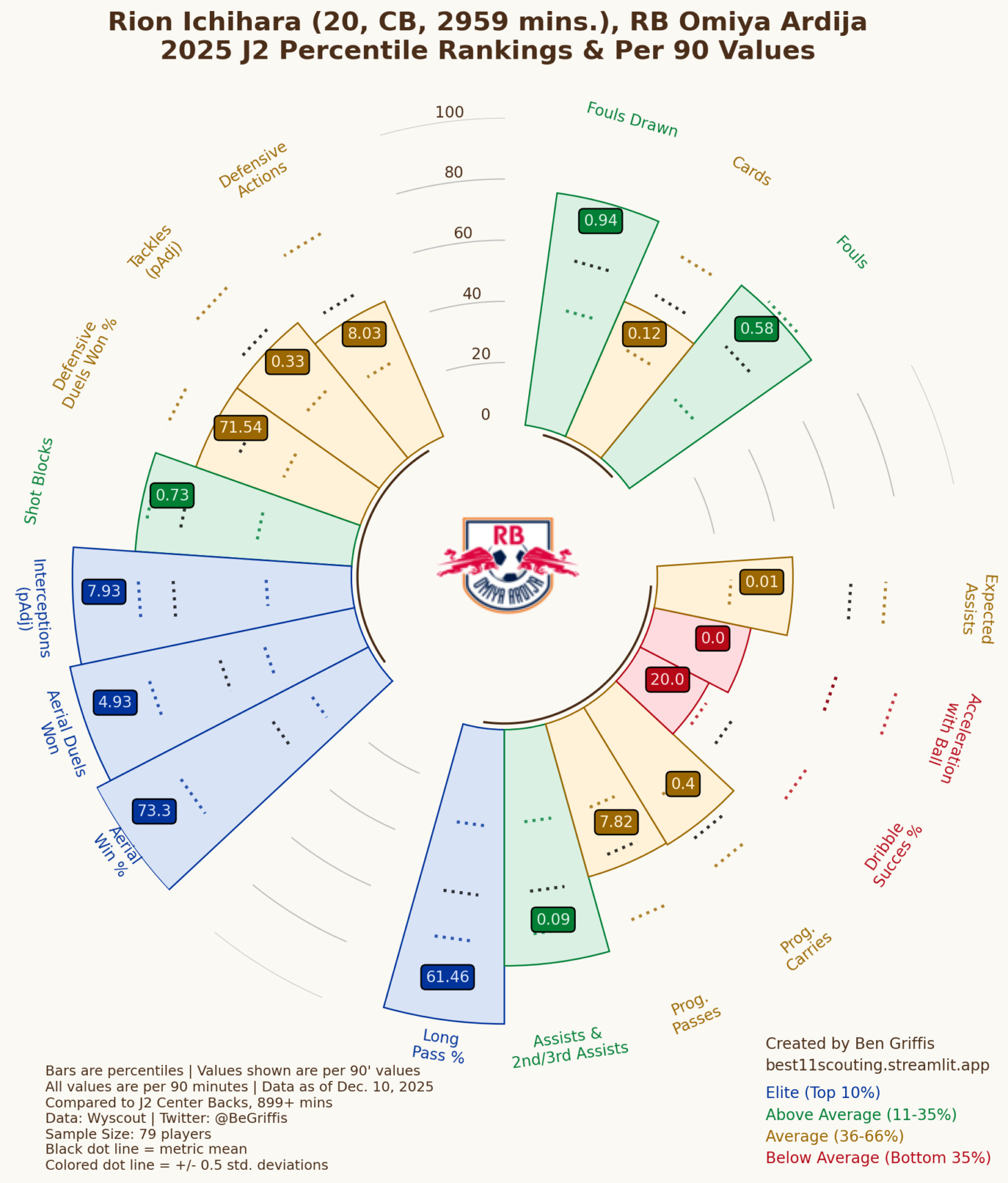
Whether in the Back 3 or Back 4, the leader in defense was Rion Ichihara. He has been making a big name for himself over the past year due to his performances for the Japan U-20 national team with his defensive displays, leadership, and the added bonus of being able to coolly slot home penalties. Ichihara is extremely good in the air and has a very proactive “personality” in defense. Despite his good vertical passing, he wasn’t nearly as involved in ball progression in pure volumes terms probably because responsibility in the build-up was spread out between a lot of players.
I can’t imagine a player of his caliber staying in J2 for another year especially after his sterling performances for the U-20 Japan National Team. Europe beckons and if the rumors start heating up, I’m quite willing to write another feature on him. I wrote the first one last year when I was still starting out with these player reports so I do want another crack at it, a Part Two if you will!

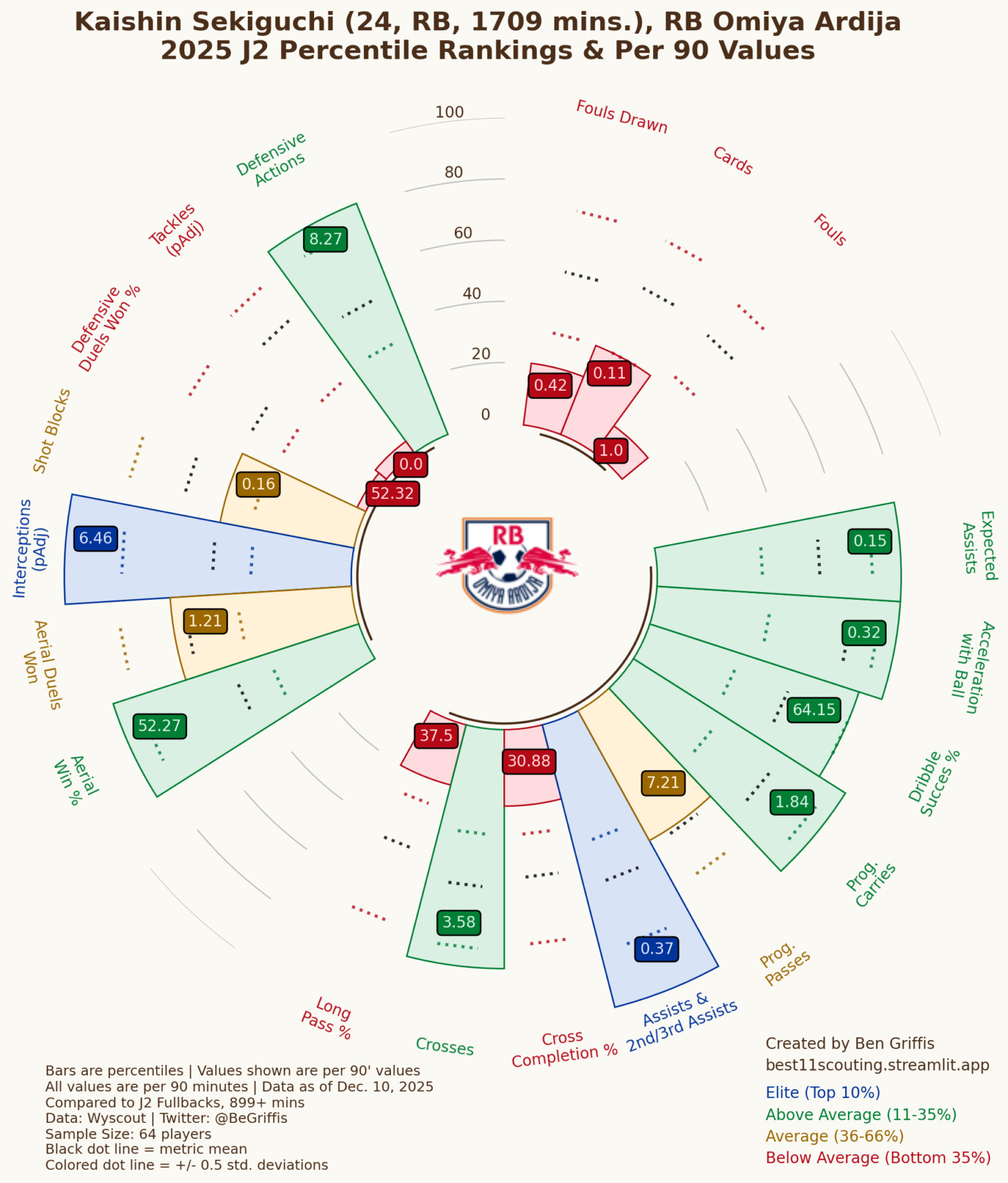
A player not many will recognize in this team that I quite liked was Kaishin Sekiguchi at Right Back. He is a threat from out wide with his dribbling and direct running.
Omiya’s attacks have been slanted toward the left over the past two seasons and that is in huge part due to the presence of Toya Izumi on the Left side as either a Wing Back or later as a midfielder. The ex-Vissel Kobe man dropped down the divisions to get game time and has slowly worked his way back up the footballing pyramid, showing lots of growth and resilience.
In midfield, the usual pairing was Masato Kojima and Arthur Silva. It surprised me when Omiya got relegated back in 2023 that they managed to keep a hold of Kojima. The midfielder has been a huge part of Omiya’s ability to keep the ball with his smart positioning and passing acumen across different ranges. On the defensive side of things, Arthur Silva brought a lot of aggression and tough tackling to support Kojima and other teammates.

The goals in the squad were spread out over many different attacking pieces in the Front 3. Oriola Sunday has slowly grown to become an important part of the attack since he joined in mid-2024 and finished with 6 goals and 2 assists. I saw some promise in Kazushi Fujii in J3 last season but he was relegated to be more of a super-sub and from that role he still managed to score 5 and assist twice. Otherwise it was a fairly veteran presence in attack with Yuta Toyokawa contributing with 7 goals and Kenyu Sugimoto surprising a lot of people with 6 goals and 5 assists. The star in attack was top goal scorer Caprini with 11 goals and 7 assists. I think it helps the Brazilian that he’s now on a much more attacking team than his previous employers, Yokohama FC.
Omiya were very good at stringing together passing combos to create chances. Indeed, they actually scored 16 goals from these situations which was considerable higher than the league median! They had a penchant for late goals too and simply scored a majority of their goals while also being exceptionally tight in defense in the 2nd Half. On either side of the ball, Omiya’s underlying numbers were quite good.


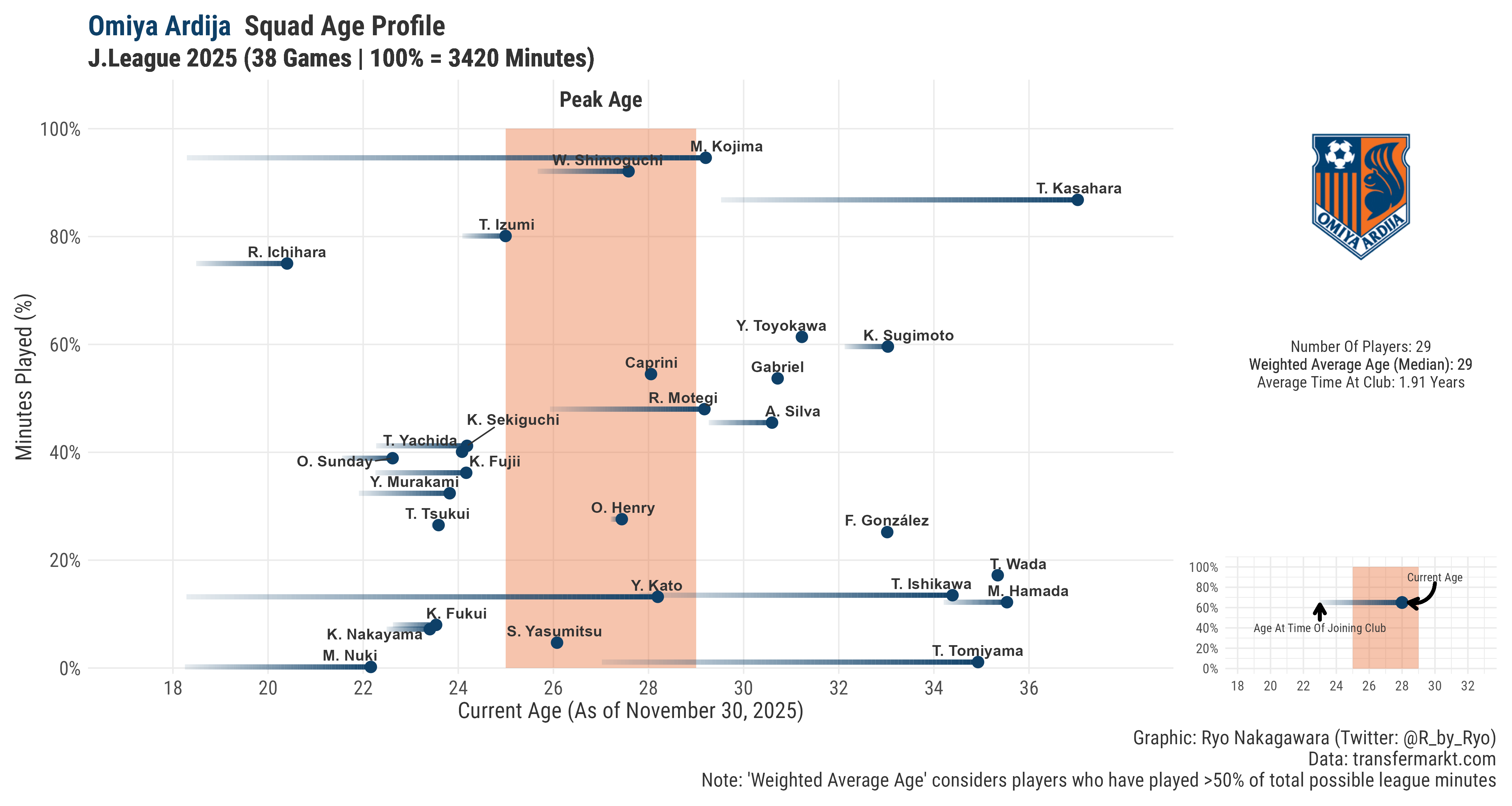
This season progressed with the backdrop of all of the changes that the Red Bull organization made and will continue to make as the new owners of Omiya Ardija. As for the team, they had their ups-and-downs but largely kept pace with the play-offs spot but it was a disappointing finish in the end. I was impressed with how quickly Miyazawa was able to get results while changing the team’s tactics significantly but the last few games of the season including the play-offs showed some problems that need to be worked on. Still, the 100 Year Vision League means they have more time to set the groundwork for their revolution and make a clear push for promotion in 2026/2027. The squad has a lot rotating pieces as it is still in the middle of transitioning into a more leaner and younger “Red Bull” style squad. Changes are coming thick-and-fast, can everybody in and out of the club keep up?
Vegalta Sendai (7th, 62 Points)
16 Wins // 14 Draws // 8 Losses
Location // Stadium: Sendai // Yurtec Stadium
Manager: Yoshiro Moriyama
47 Goals (9th); 36 Conceded (4th)
47.56 non-penalty xG (6th); 35.39 non-penalty xGA (2nd)
Top goal scorer: Yuta Goke (9 goals plus 1 penalty)
Goalkeeper: Akihiro Hayashi
Heartbreak. Disaster. At the final hurdle. Again for Vegalta Sendai. It was Year 2 of Moriyama’s revolution at Vegalta Sendai. After a couple of years of poor performances in J2 after their relegation back in 2021, Sendai changed course to shed a bunch of old players and start afresh. Last year they made it to the play-off final but lost to Fagiano Okayama and this time they lost their last game of the season and were leapfrogged by Jubilo Iwata for a play-off spot!
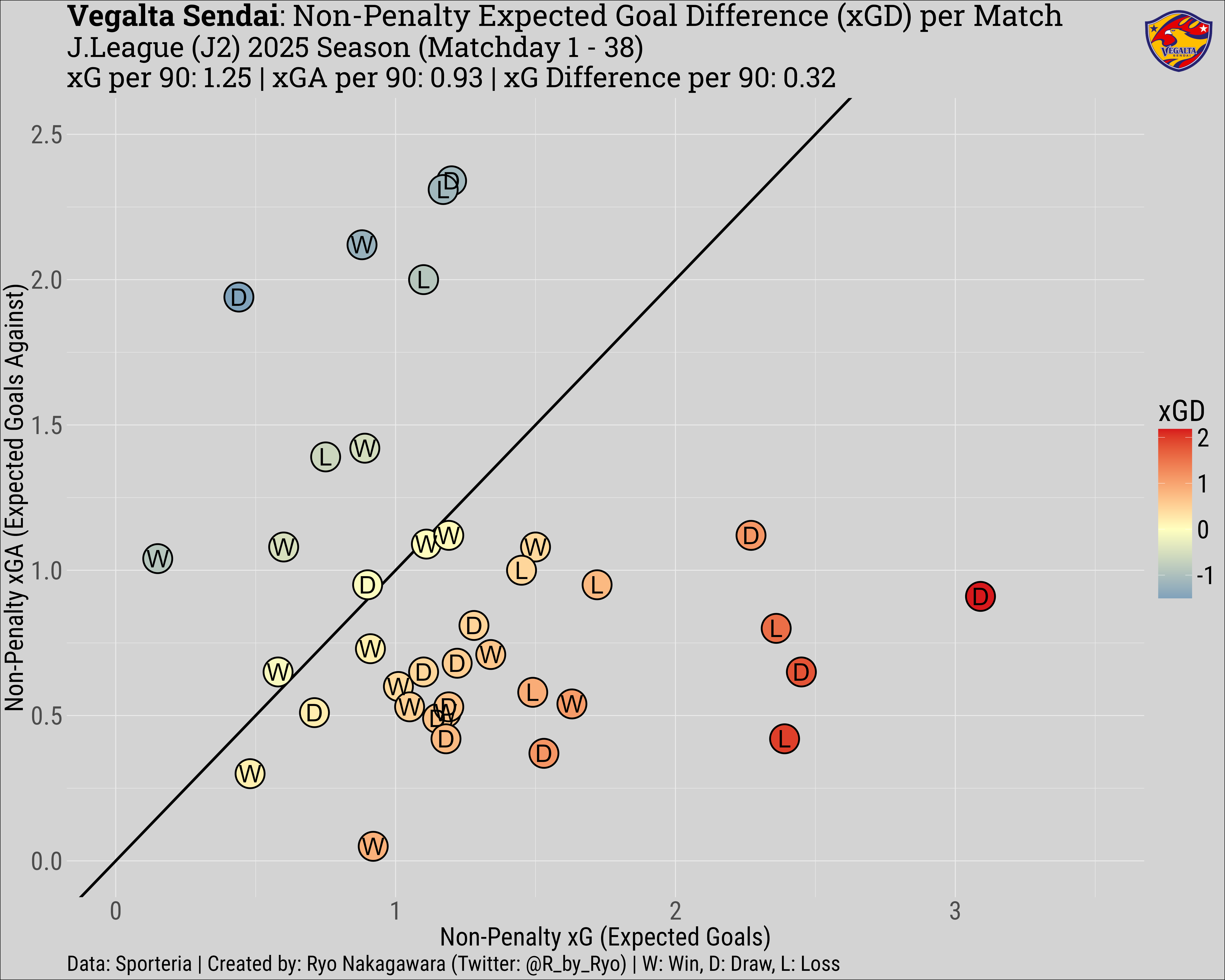
The foundation that Yoshiro Moriyama has built his Sendai team on is their solid defense. This year especially, they were quite excellent having conceded the 2nd least non-penalty xGA and conceding only the 4th least goals in actuality. In particular they were very attentive to set-piece defending compared to other teams as they only conceded four, considerably lower than the league median.


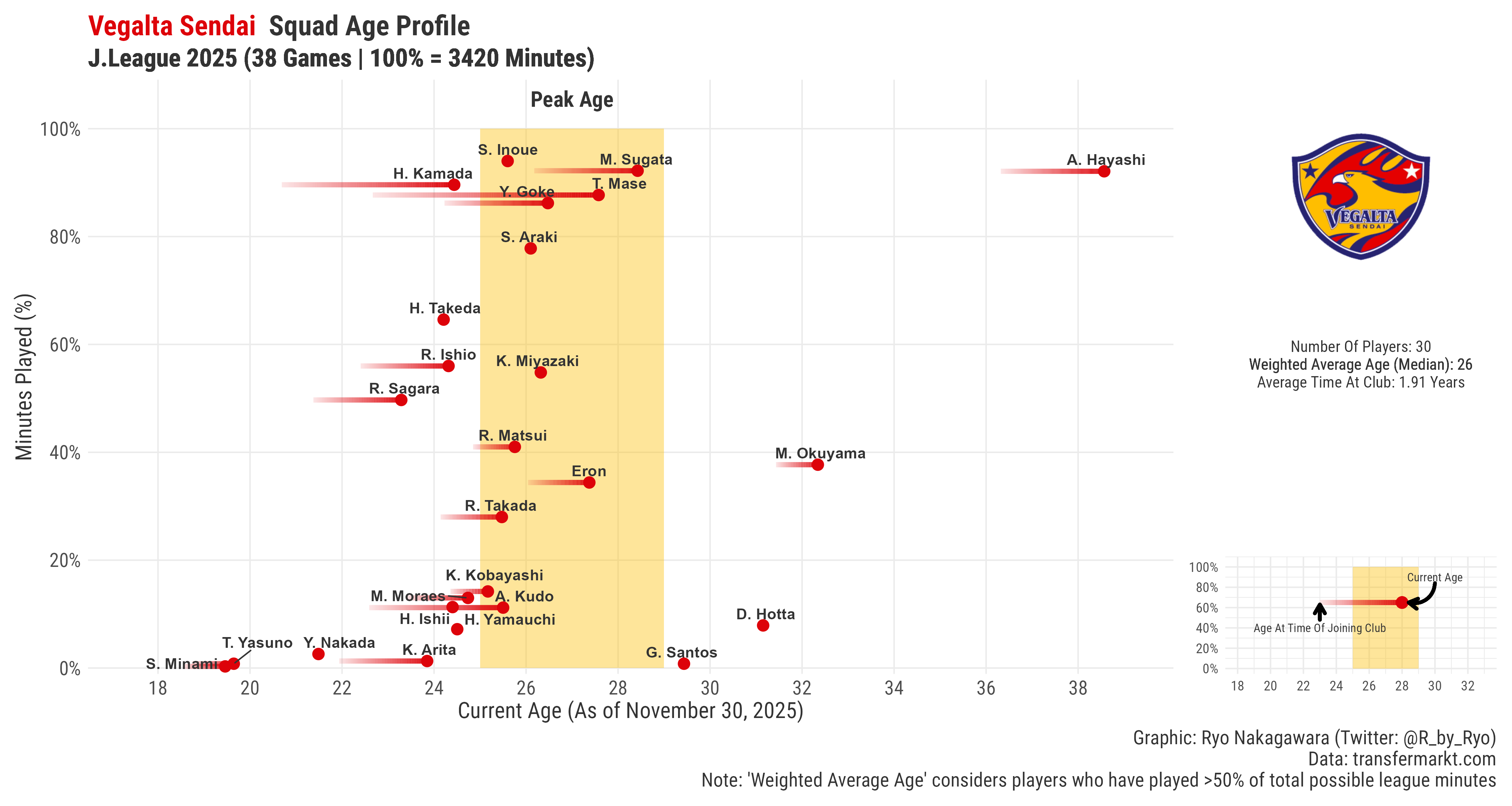
The main Center Back pairing for the season was Shion Inoue and Masahiro Sugata who both provided a mix of decent passing and defensive brawn. From Right Back, Takumi Mase got 6 assists. He honestly looked quite good when he was younger in 2021 & 2022 but injuries in more recent seasons have kept him away from the spot-light and fortunately for Sendai fans, away from the clutches of potential J1 suitors. On the Left side was Rikuto Ishio who was very good ball-progressor through his clever passing. He’s decent in the air especially at 1.81m and just duels in general which makes him even more interesting. With Sendai continuing to flounder in J2, I can see a J1 team trying to buy him as good Left Backs are always in need.
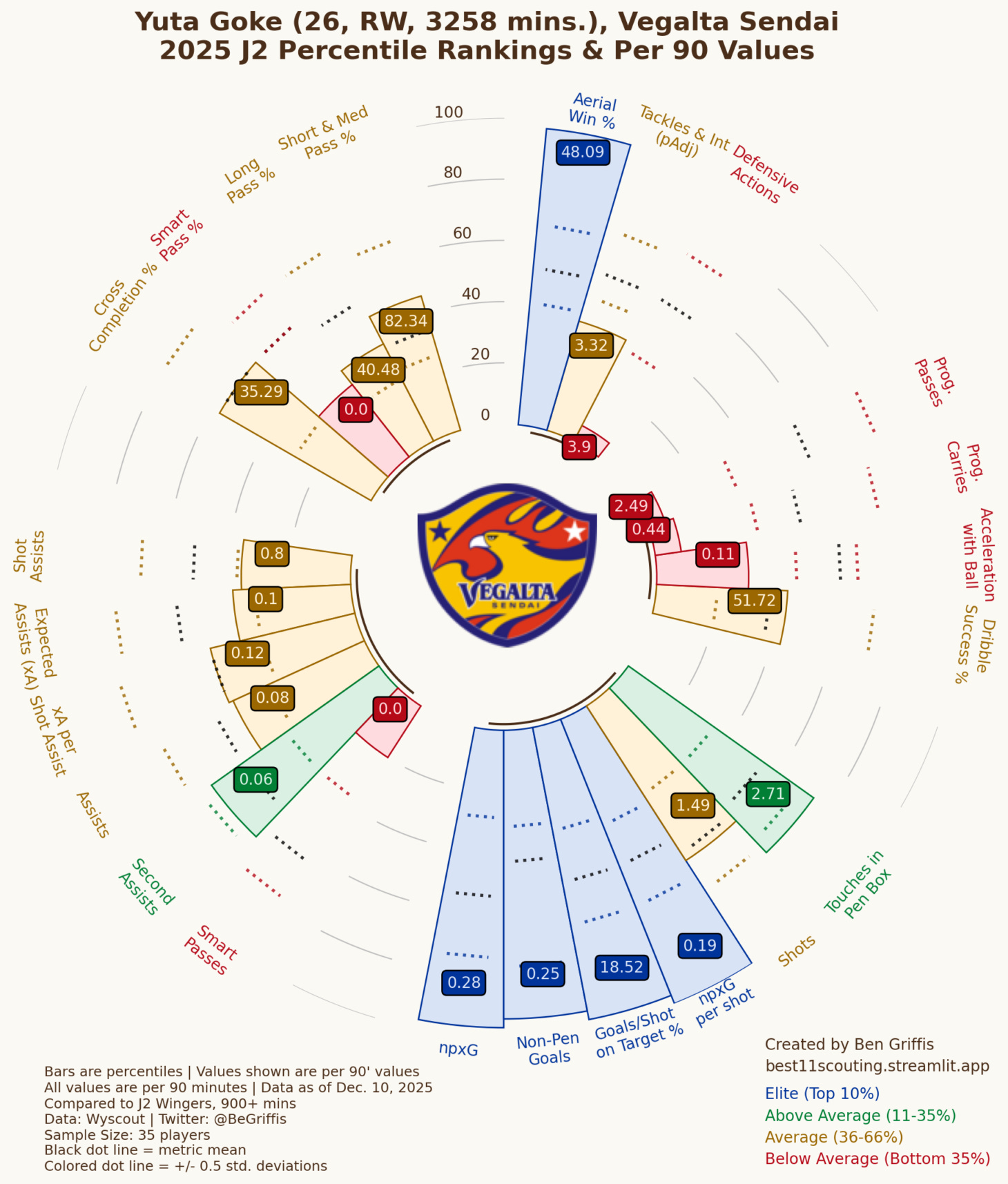
Of course it wasn’t just the individual defenders or the unit itself but a lot of defensive work was done throughout the team. In the midfield double pivot, Hiromu Kamada and one of Renji Matsui or Hidetoshi Takeda have formed a fairly solid pairing. Matsui and Takeda have more specialized skillsets as can be seen in the radars below.


I do think Hiromu Kamada is the most promising out of the midfielders considering his very broad skill-set across the build-up, defense, and attack. Kamada is already 24 though so he should be trying to get a J1 move soon as he can very easily play at that level if he wishes to do so.


It was a fantastic season for Yuta Goke, the ex-Vissel Kobe man who came back home to his childhood club in 2023. He was always very much a “glue” guy that was good at knitting things together but always found it difficult to show his true worth given his mixed skill-set across a variety of positions. Oddly, this season he has shown an extremely valuable ability to pop up with end product at opportune times contributing to a career high 10 goals and 4 assists.
In attack, aside from Yuta Goke, a key player was Ryunosuke Sagara. Although he does have a bad habit of blasting a lot of not-great-quality shots, the fact is that he is one of the few players on the side that can drive forward with the ball and enter the box through his dribbling. If he can start creating for others a little bit more and try to take better quality shots then you’ve got a pretty good player here. Sagara finished the season with 4 goals and 2 assists.
Kokoro Kobayashi was lifted up from recently promoted J3 club Kochi United and scored some important goals despite his limited game time. Perhaps next season he’ll be able to show more of his stuff as he gets acclimatized after a quick ascension from JFL > J3 > J2 in the past year. Koh Miyazaki, I usually say half-jokingly is the Japanese Andy Carroll with his long flowing hair and aerial abilities. He does a bunch of the physical grunt work, a bit of chance creation, and takes an OK amount of shots as well. All-in-all Miyazaki contributed with 8 goals and 2 assists. A perfectly cromulent kind of striker at this level. On the other hand, it’s been a disappointing time for Tsubasa Umeki who looked good at Renofa Yamaguchi and seemed like a “fit” for Sendai’s play style but hasn’t ever cemented a starting spot in the team. A special mention should also go to Shunta Araki, who plays a hardworking role both up top and out wide. His tireless running to create space for himself or others lets his teammates receive in good spaces.


Sendai play some decent football and have the ability to change things up between more combination plays down the wing or just lumping it long or to the strikers making runs behind. A big issue is that they haven’t quite been able to squeeze enough goals out of this squad despite their above-average attacking metrics. Sendai’s overall xG wasn’t bad but unlike other teams they weren’t able to add any finishing/striking quality and luck on top of that. Over a long season that made a big difference. This was why they finished with 14 draws despite only losing 8 times which is tied for the least with league winners Mito!
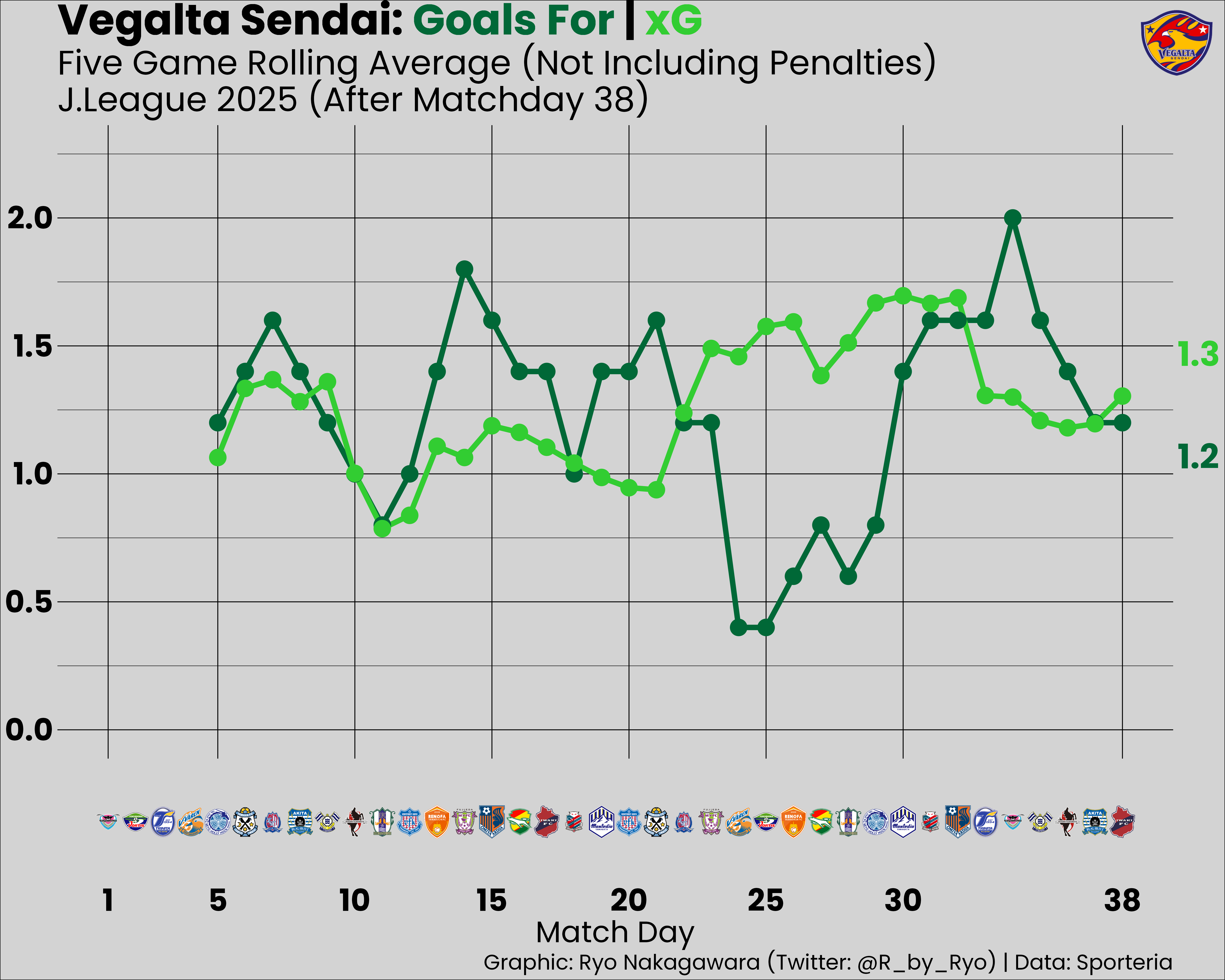
The key indicator for the success/failure of Sendai’s 2025 season hung on whether they got promoted or not and unfortunately, they didn’t even make the play-offs. It is clear though that Moriyama has built a fairly good team and it was confirmed that he’ll be staying on next season. After coming agonizingly close to J1 promotion in the past two seasons, perhaps third time is the charm in 2026/2027?
Sagan Tosu (8th, 58 Points)
16 Wins // 10 Draws // 12 Losses
Location // Stadium: Tosu // Ekimae Real Estate Stadium
Manager: Akio Kogiku
46 Goals (11th); 43 Conceded (6th)
40.86 non-penalty xG (14th); 41.86 non-penalty xGA (9th)
Top goal scorer: Hiroto Yamada (5 goals plus 1 penalty) & Jun Nishikawa (4 goals plus 2 penalties)
Goalkeeper: Ryota Izumori
Sagan Tosu had finished bottom of J1 in 2024 and needed a hard restart. Akio Kogiku (formerly of Cerezo Osaka) took charge of this process and despite a very rough start where Tosu didn’t win the first 4 games of the season, he managed to get them back into play-off contention eventually. However, giving up a 2-0 lead with a man advantage vs. Sendai was the real killer to their hopes and they did not win any of the last five games of the season as a result.
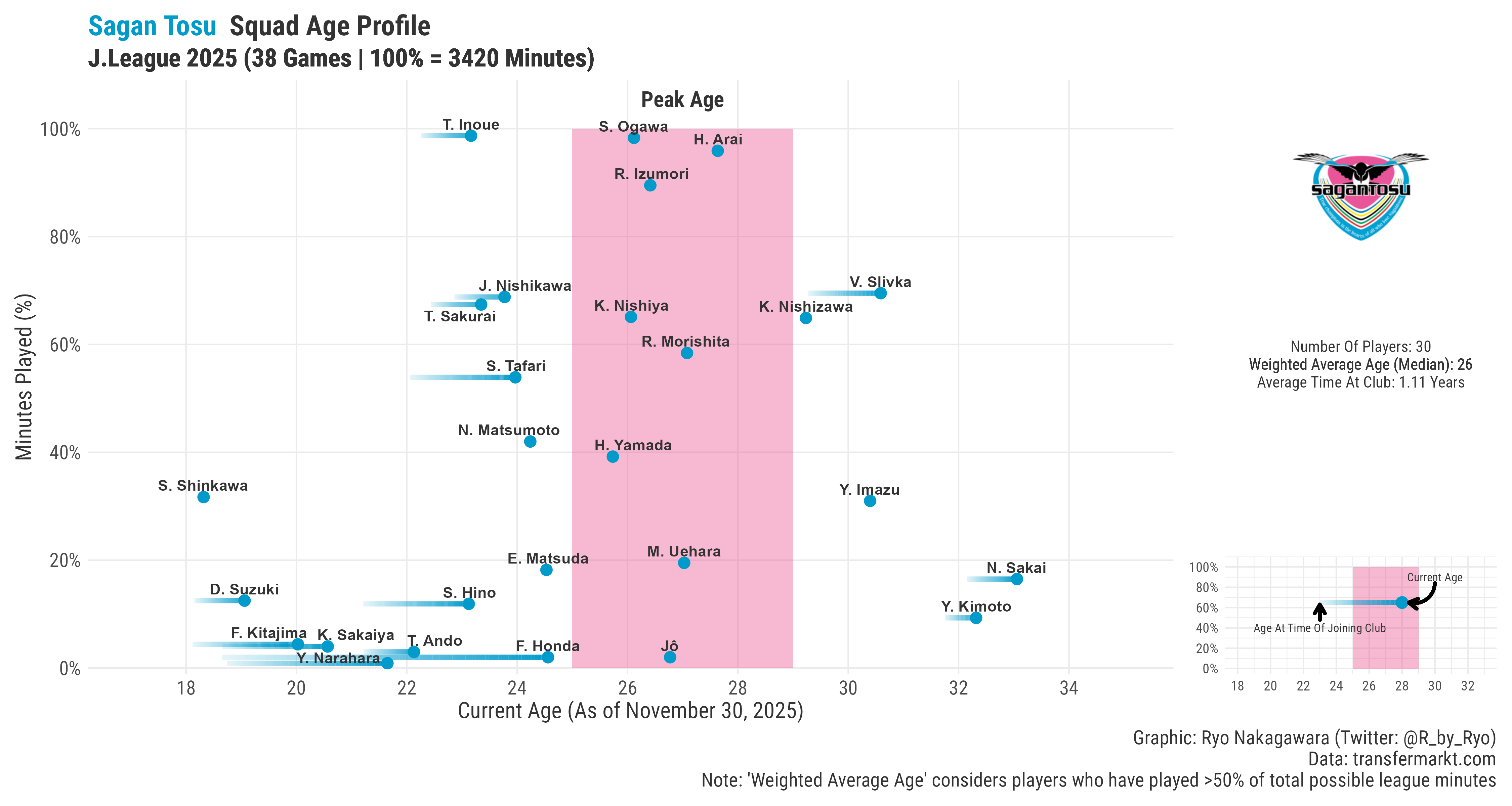
With relegation, there was a heavy amount of turn-over but some key players like Kenta Nishizawa stayed while quite a few ex-Cerezo players like Kimoto, Yamada, Nishikawa joined or re-joined due in no doubt to the influence of Akio Kogiku’s appointment as manager. Jun Nishikawa showed some of the promise he had shown at Cerezo as a youth player. He’s perhaps not quite the superstar that was promised a number of years ago but is a decent enough player at the J2 level.
A feature of Akio Kogiku’s Tosu team was their intricate build-up with the Back 3 and goalkeeper Ryota Izumori heavily involved. A new face to the defense following the departures of J1 regulars Kim Taehyeon and Seiji Kimura was Taisei Inoue, a graduate from Juntendo University. Inoue showed good composure passing and carrying under pressure in the build-up phase for a player in his debut season as a professional footballer.


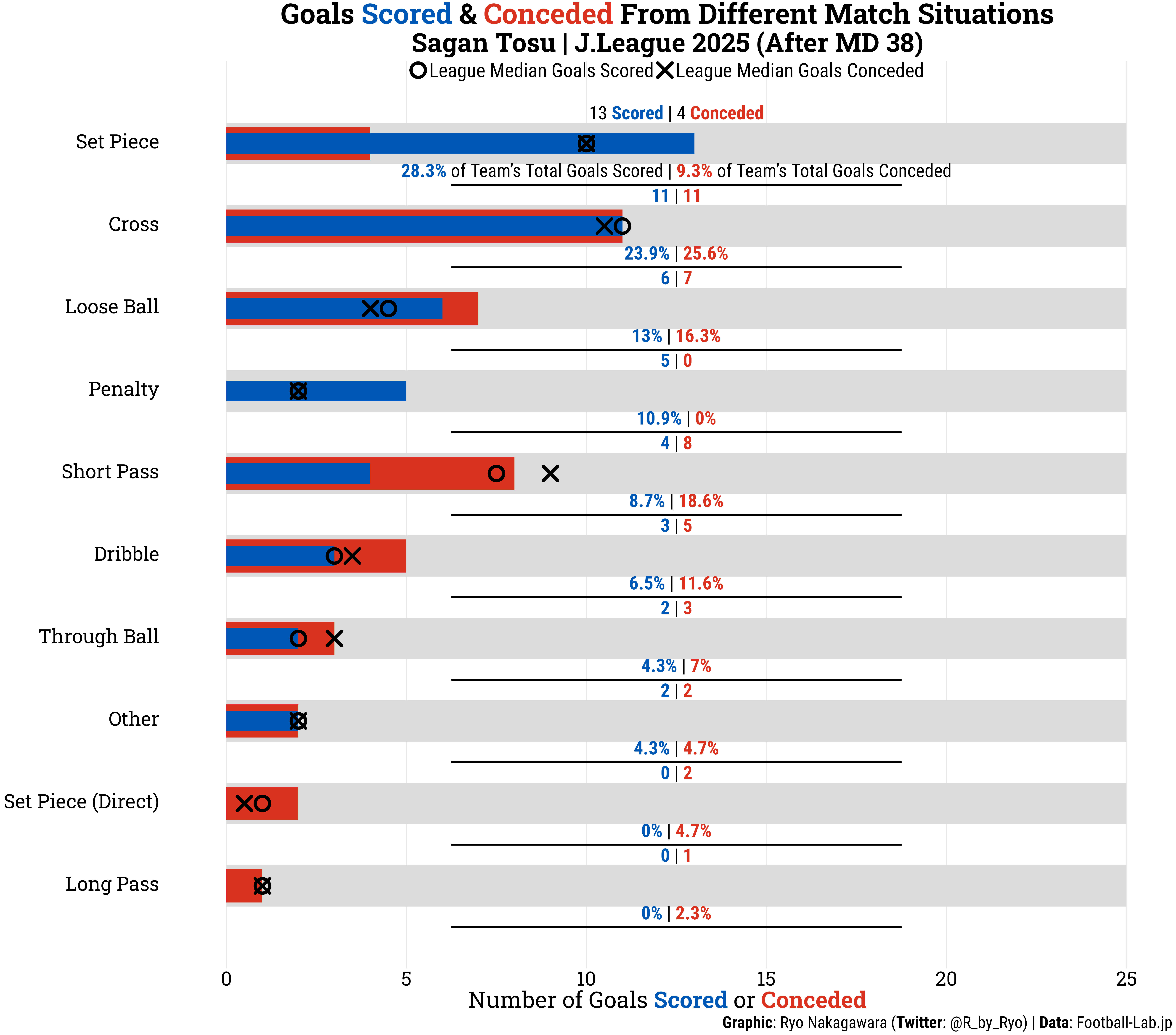
A key outlet following the build-up phase was the width and crossing provided by their Wing Backs. In particular Haruki Arai was a big but problematically one of their few weapons in attack aside from some creative passing from Nishizawa or Nishikawa. Overall, Tosu scored a bunch from set-pieces and crossing. Another thing to note was that Tosu were also extremely good at defending set-pieces having only conceded 4, significantly below the league median.
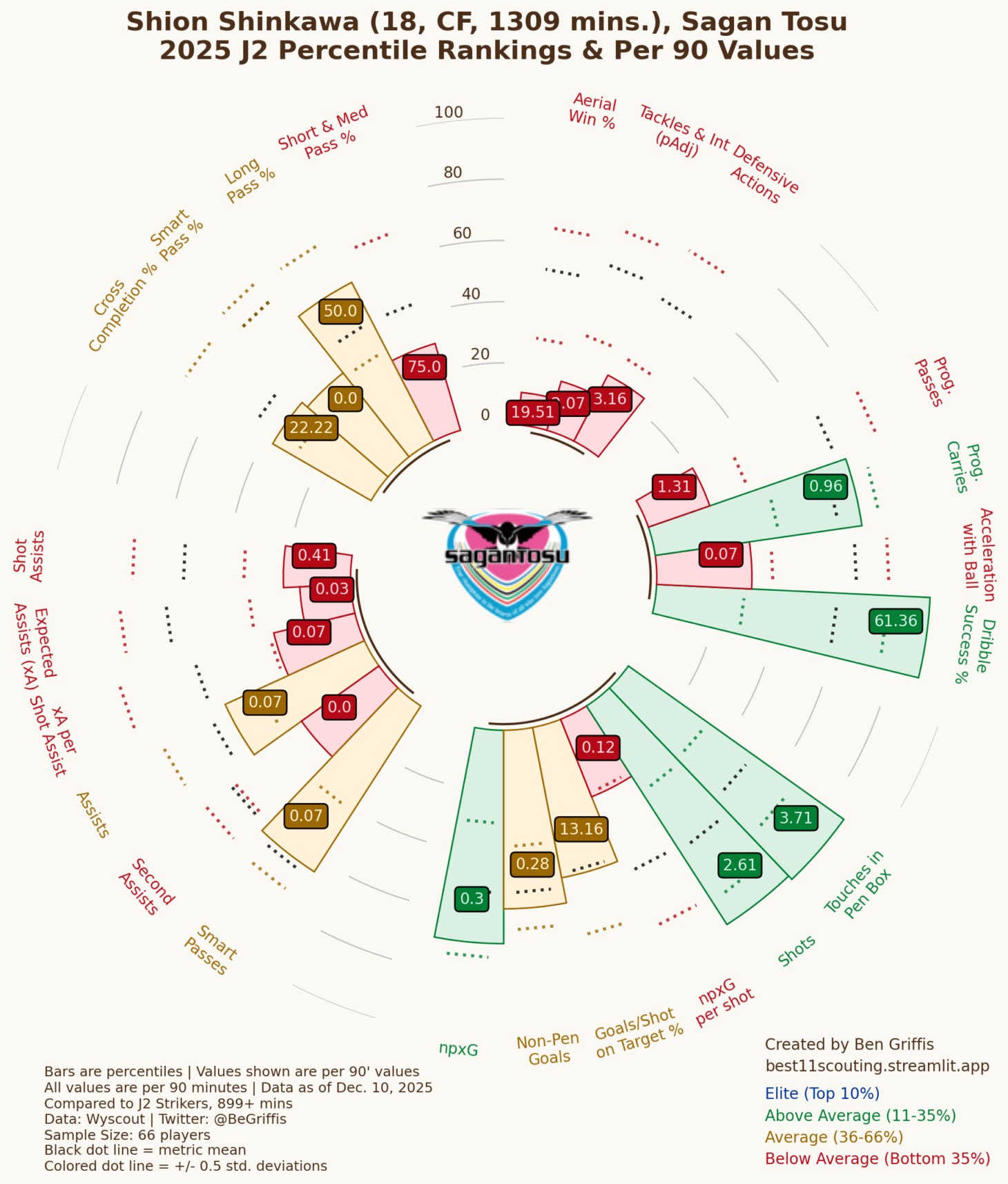
Up top there were two teenagers that really caught my eye, Daichi Suzuki and Shion Shinkawa. I especially like Shinkawa who really impressed me with his 1st touch, how he is able to settle the ball and then immediately get shots off. He usually came on in the 2nd Half and provided an outlet on the counter as he would burst forward with the ball. He’s also a lot tougher than his size suggests when he is dribbling or holding off defenders. While there are still lots of aspects Shinkawa needs to work on, the fact that he’s got a fast trigger and is able to get a lot of shots off despite being a teenager at this level represents his promise.
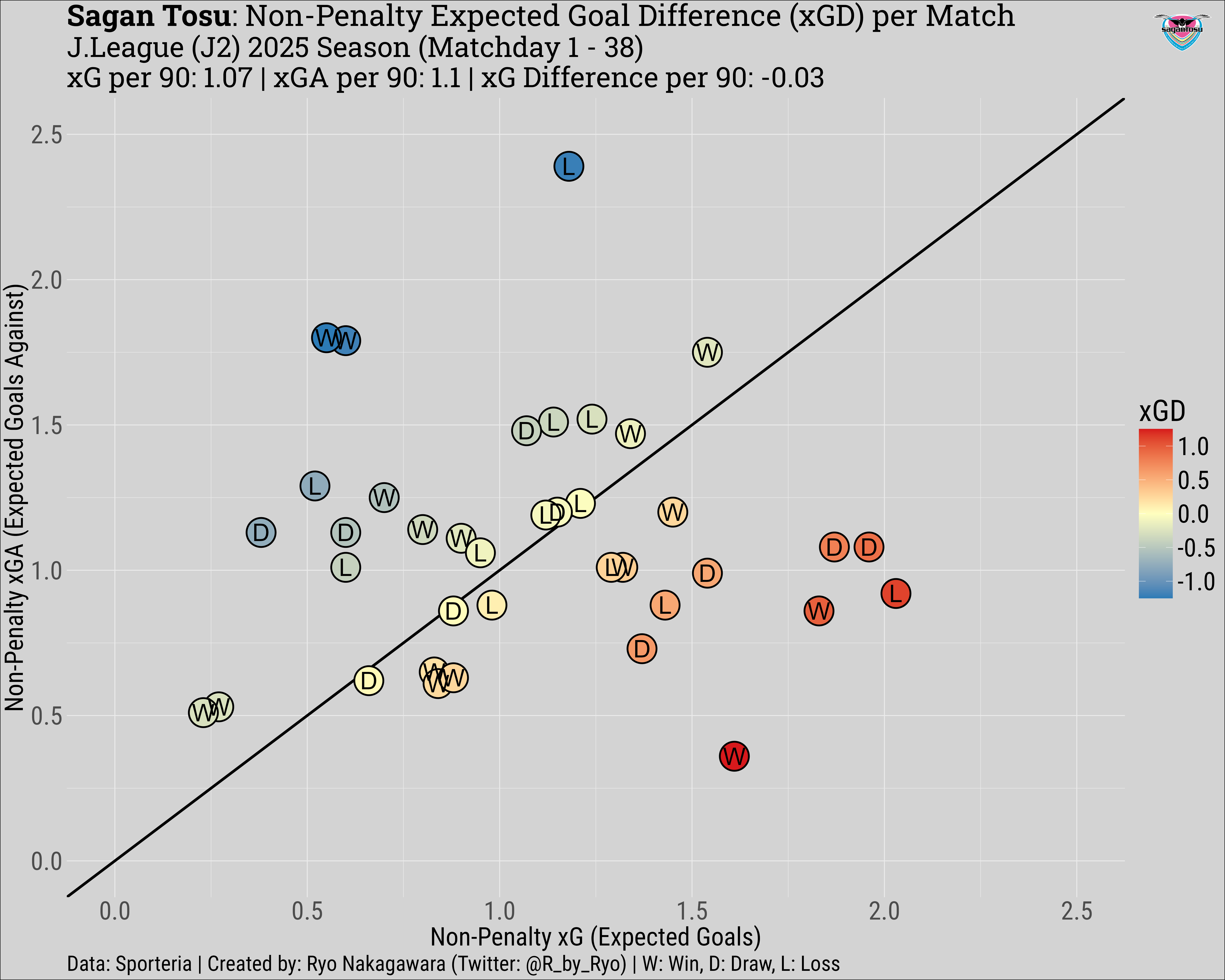
With extremely middling stats in both attack and defense, the underlying numbers showed a team that would be smack-dab in the middle of the table. Despite their possession and decent enough ability to get into the final 3rd (6th most in the league), Tosu noticeably struggled to create chances or score goals. Tosu only entered the box the 13th most times per match to take the 14th most shots, 13th most shots-on-target, all leading to the 10th most goals!


Overall, this squad has quite a lot of decent players across the spectrum of the age range. Akio Kogiku has instilled his playing style on the team after a rough start and there’s a solid base to build on toward achieving promotion for the 2026-2027 season either automatically or through the play-offs.
Iwaki FC (9th, 56 Points)
15 Wins // 11 Draws // 12 Losses
Location // Stadium: Iwaki // Hawaiians Stadium Iwaki
Manager: Yuzo Tamura
55 Goals (6th); 44 Conceded (7th)
50.59 non-penalty xG (4th); 39.1 non-penalty xGA (3rd)
Top goal scorer: Kaina Tanimura (8 goals)
Goalkeeper: Masato Sasaki
Manager Yuzo Tamura has had an interesting career with Iwaki FC. He was the manager who originally brought the club up from the Fukushima Prefectural Football League (the 7th tier!) all the way to J3 but then stepped into a Sporting Director role in 2022. Then when things were going poorly under his sucessor, Tamura came back into the managerial hotseat to help them survive their first ever J2 season!
Now in 2025 he continues to work miracles and develop a bunch of young players with a set-piece and cross heavy play style (highest amount of corners and throw-ins per match in both categories) that has them punching well above their weight. Iwaki are extremely dangerous from set-pieces, having created the most xG within 15 seconds of any set piece situation and also scoring 22 goals from these situations, well above double the league median! They don’t just score from corner kicks and free kicks but through long throw-ins into the box. Ben Griffis has a great thread on how impactful Iwaki FC are from throw-ins on Twitter.


A big part of this long throw-in frenzy is Sena Igarashi whose abilities cause chaos in the box on a consistent basis! He’s a fairly prolific crosser with his feet as well from the Right Wing Back position.


A few other set-piece protagonists include Yuto Yamashita who also has over 150 open-play crosses as well as Naoki Kase.


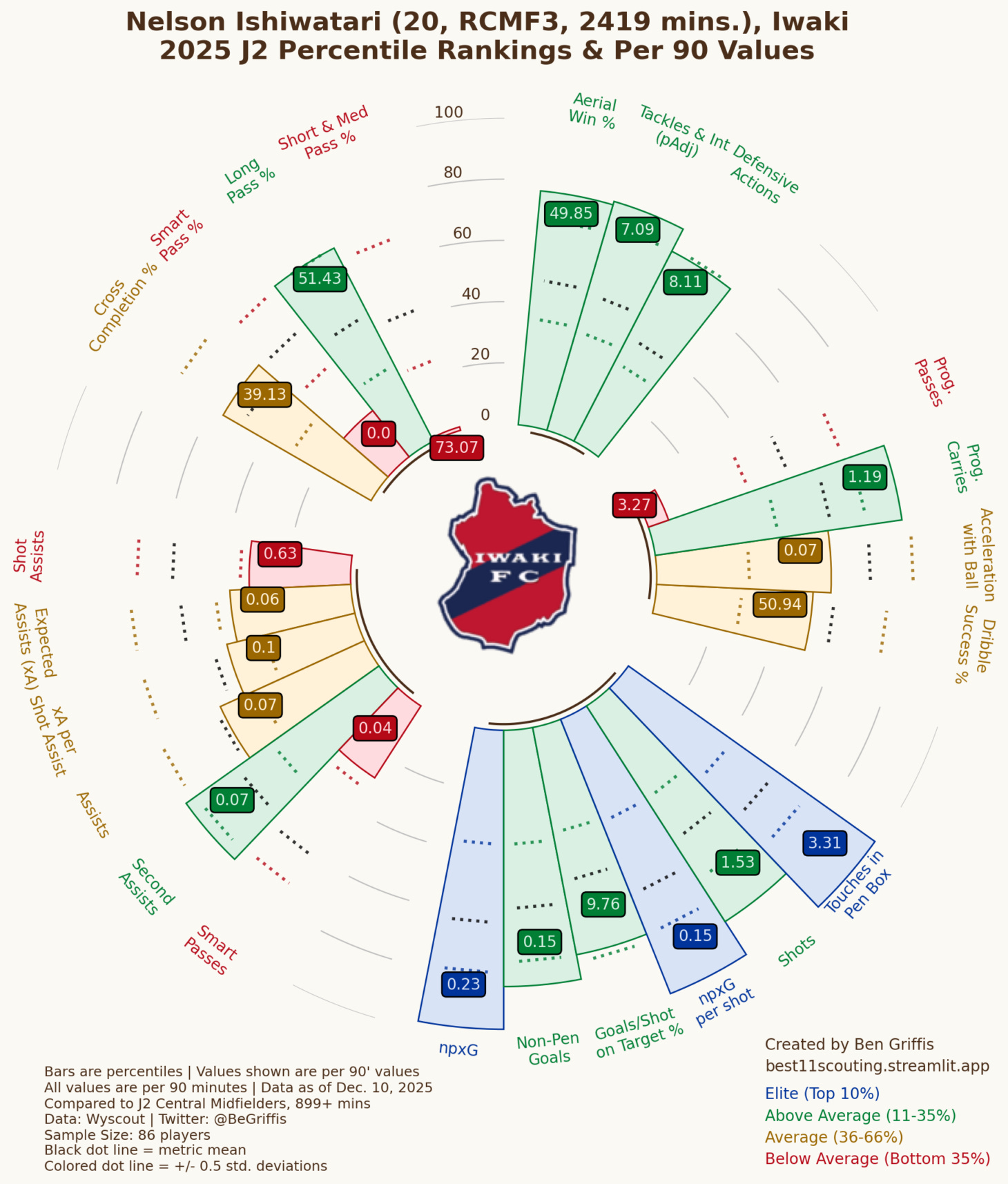
In midfield, Nelson Ishiwatari got a lot of playing time after being sent on loan by Cerezo Osaka. He is very physical for his age and quite mobile, serving as a box-to-box midfielder quite well. Due to his aerial ability and strength he is also quite useful in either box, both attacking or defending crosses and set pieces. Although there may be some team tactical effects, I’m not that impressed with his passing or what he does on the ball in general. I can see him being integrated into Cerezo Osaka next season but it’ll be critical to watch if his physicality can match the higher intensities at the J1 level against stronger and more experienced opponents.
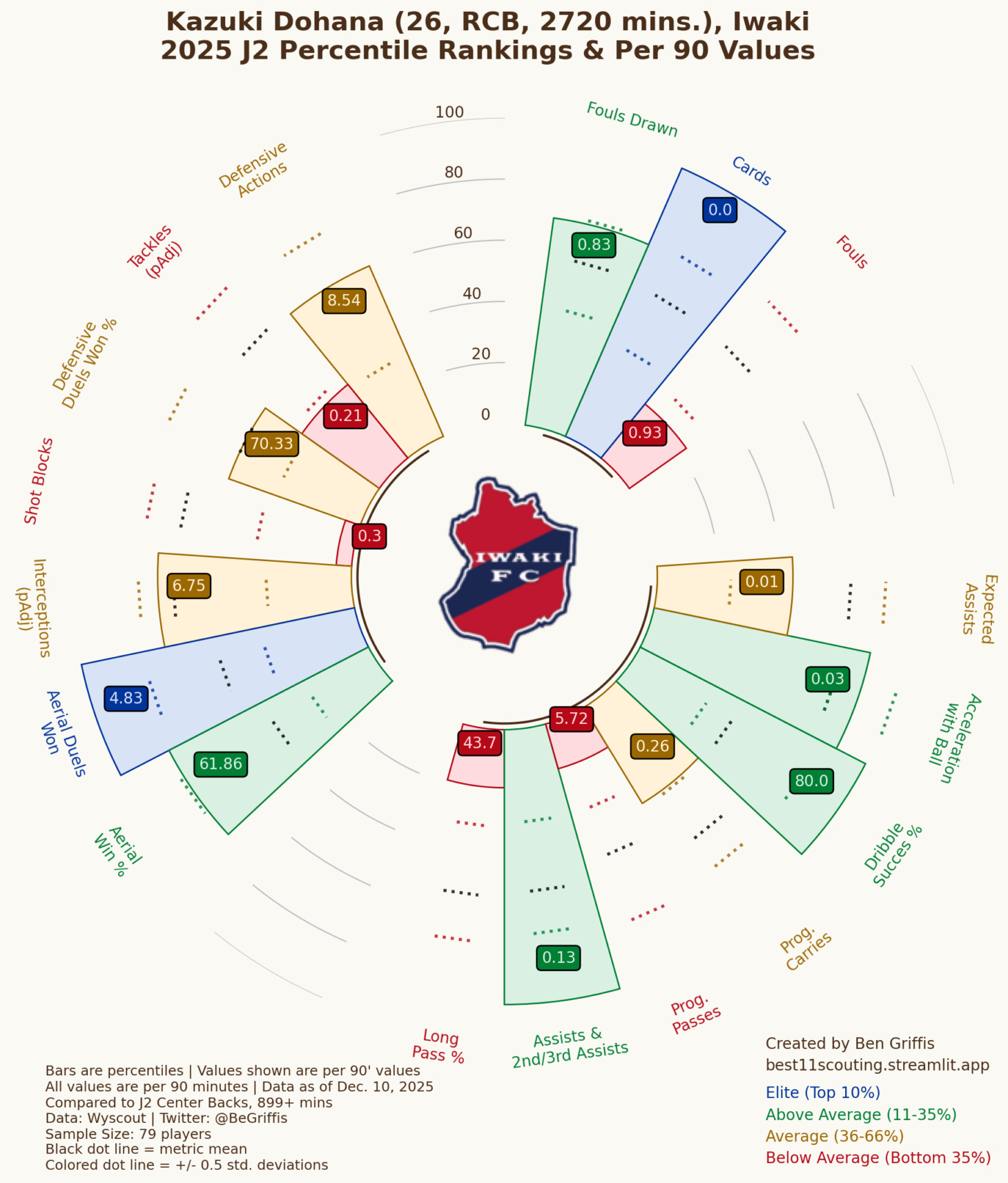
Another player I liked was Kazuki Dohana. He was a decent player for Fukushima United last season and he’s been able to make the step-up to the J2 level to a degree.
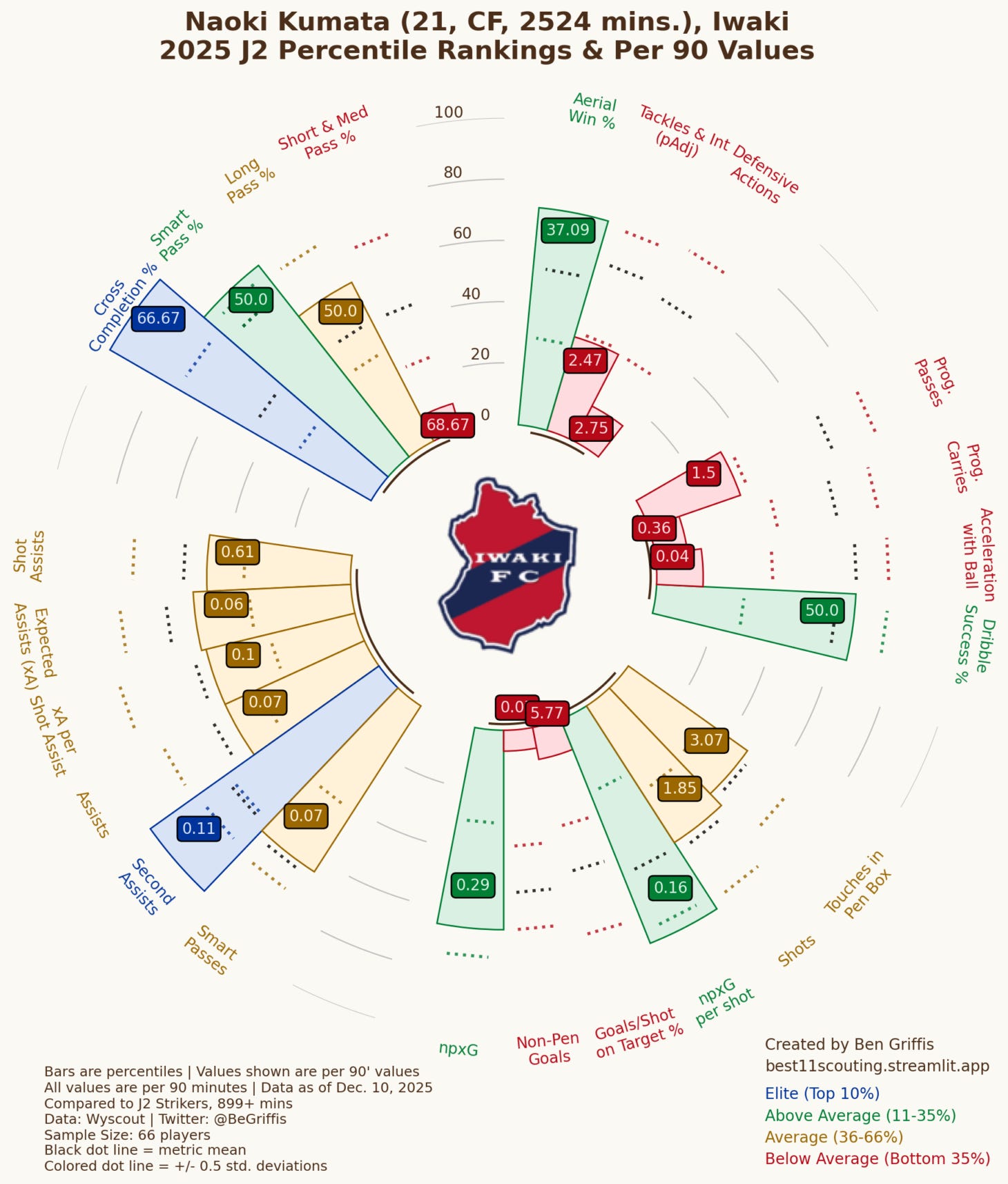
Due to their emphasis on trying to win set pieces, there’s not a whole lot of passing acumen in the team, Iwaki FC are absolutely not intricate and have the 2nd fewest passes per game in J2. Despite entering the final 3rd the 13th most times and entering the opponent box the 15th most in the league, Iwaki FC managed to get the 4th most shots, 8th most shots on target, all for the 6th most goals off of the 4th most non-penalty xG! A big problem though was that Naoki Kumata somehow managed to turn 9.48 xG into just... 3 goals.
Overall, I imagine their attack looks great because they get a lot of decent-to-good quality shots from rebounds and loose balls from the copious amounts of set pieces and long throw-ins they chuck into the box at every given opportunity. Perhaps some of the xG under-performance (by Kumata and others) came from the fact that these chaotic rebounds/loose balls aren’t quite as “clear cut” as they appear to be on paper due to lots of bodies in the way, weird bounces, etc. This is something to keep in mind but I can’t dive further without more detailed data unfortunately!
Even with all this, Iwaki couldn’t quite make themselves consistent contenders for a play-off spot. They started the season in horrendous fashion as they did not win until the 10th game of the season! Iwaki recovered extremely well from that and only lost twice in their last 10 games of the season but it wasn’t enough. They did have a part to play in the play-off picture on the final matchday when they spoilt Vegalta Sendai’s chance with a 1-0 away victory though.
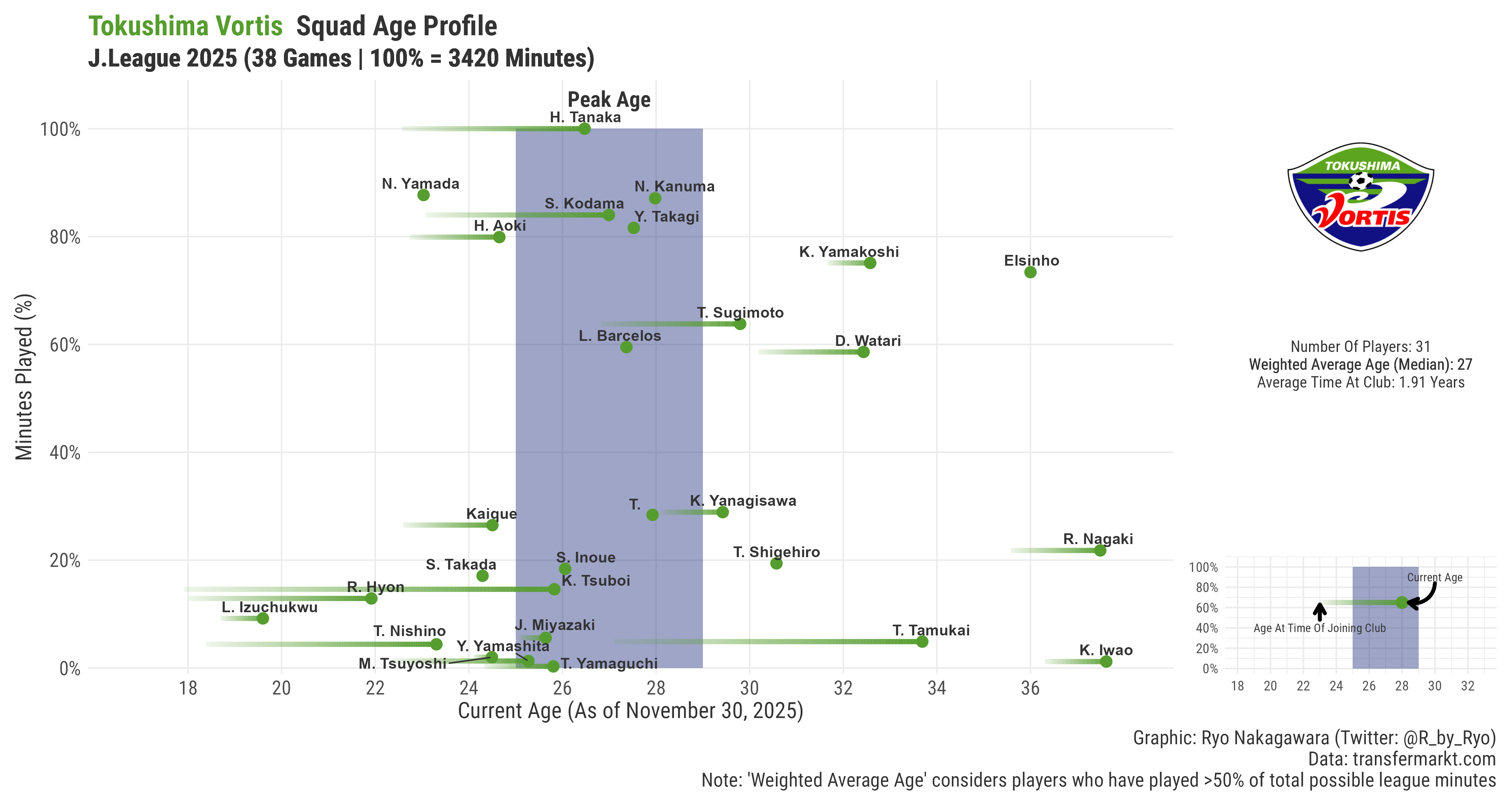
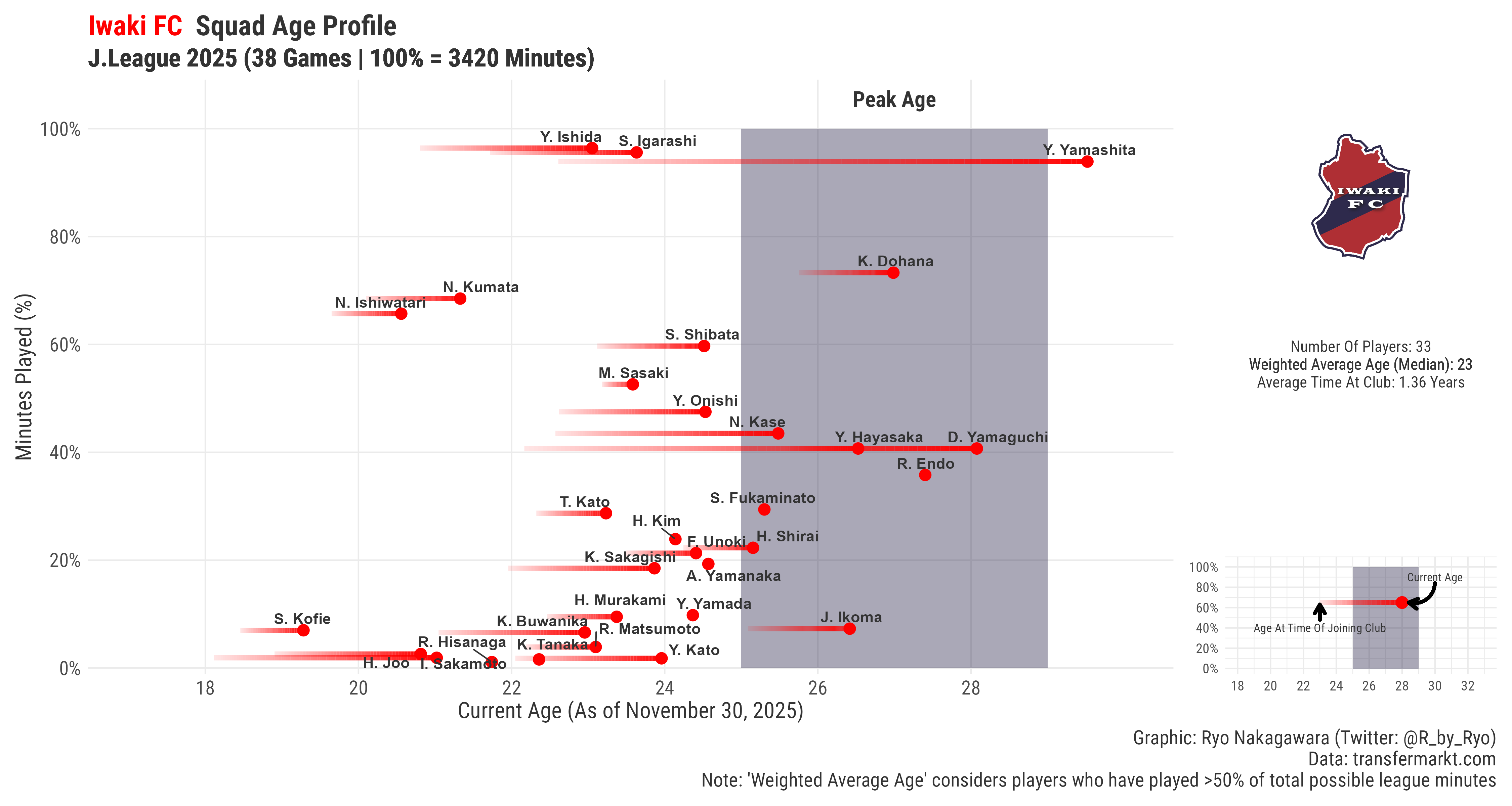
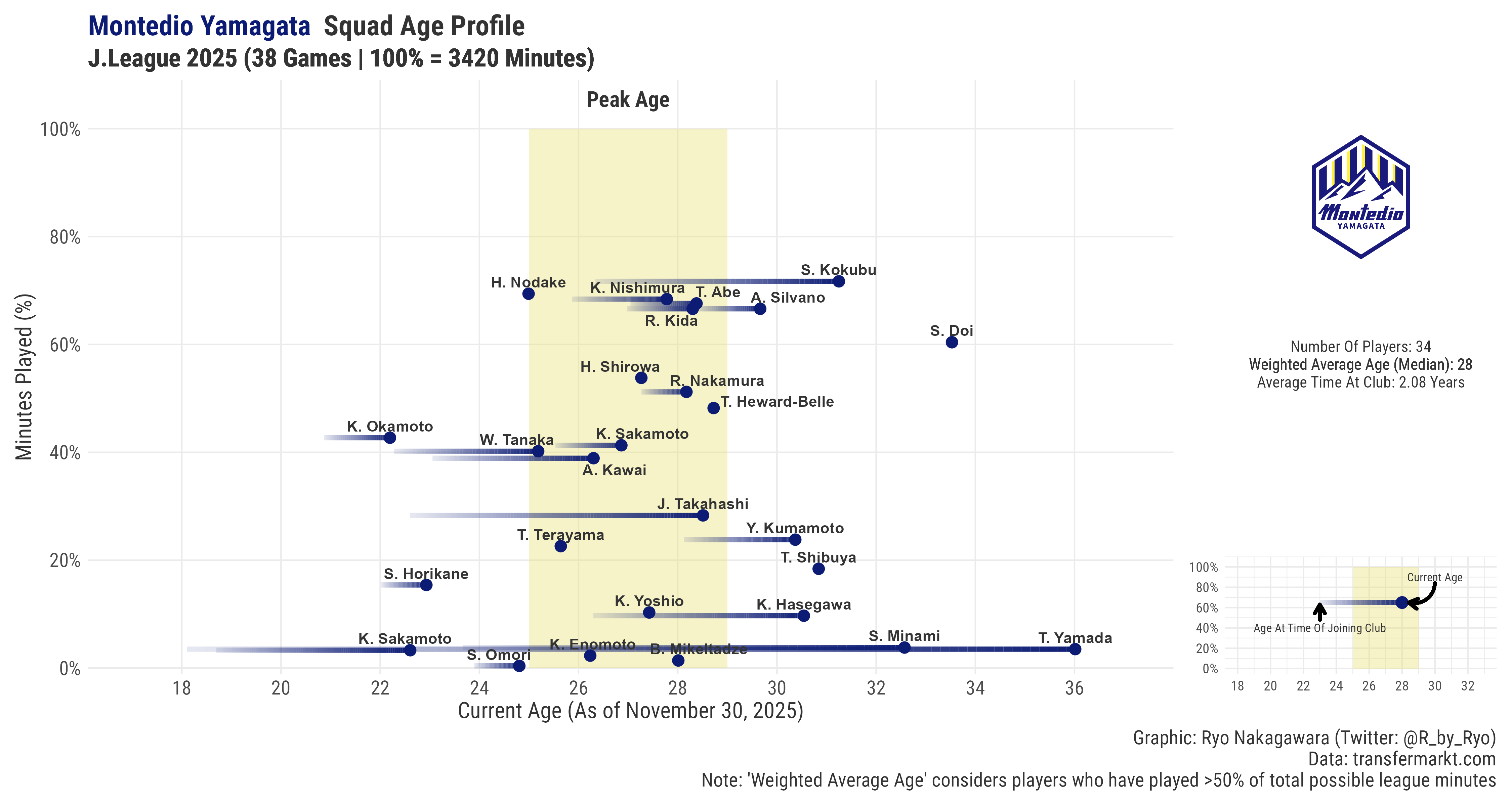
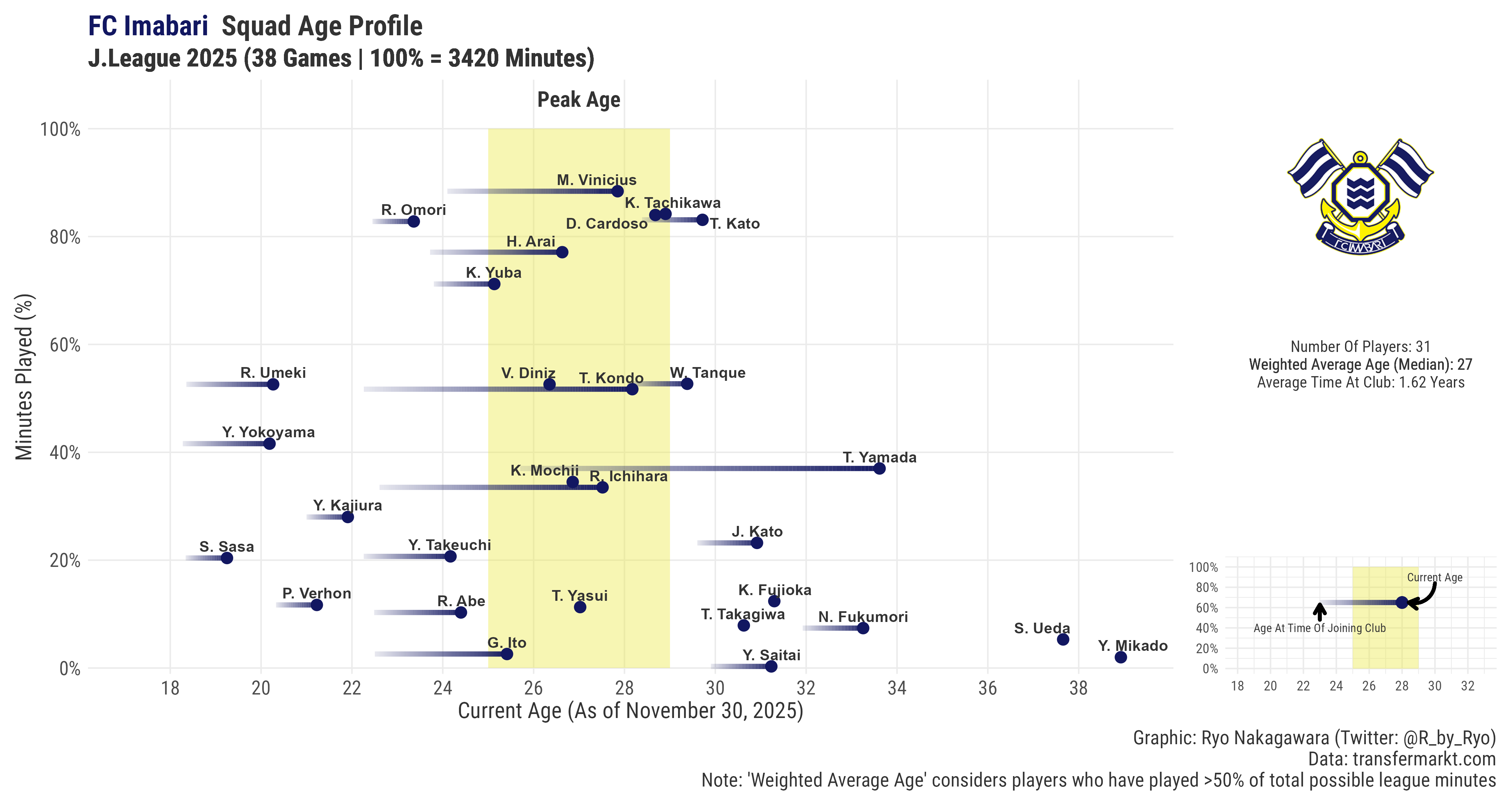
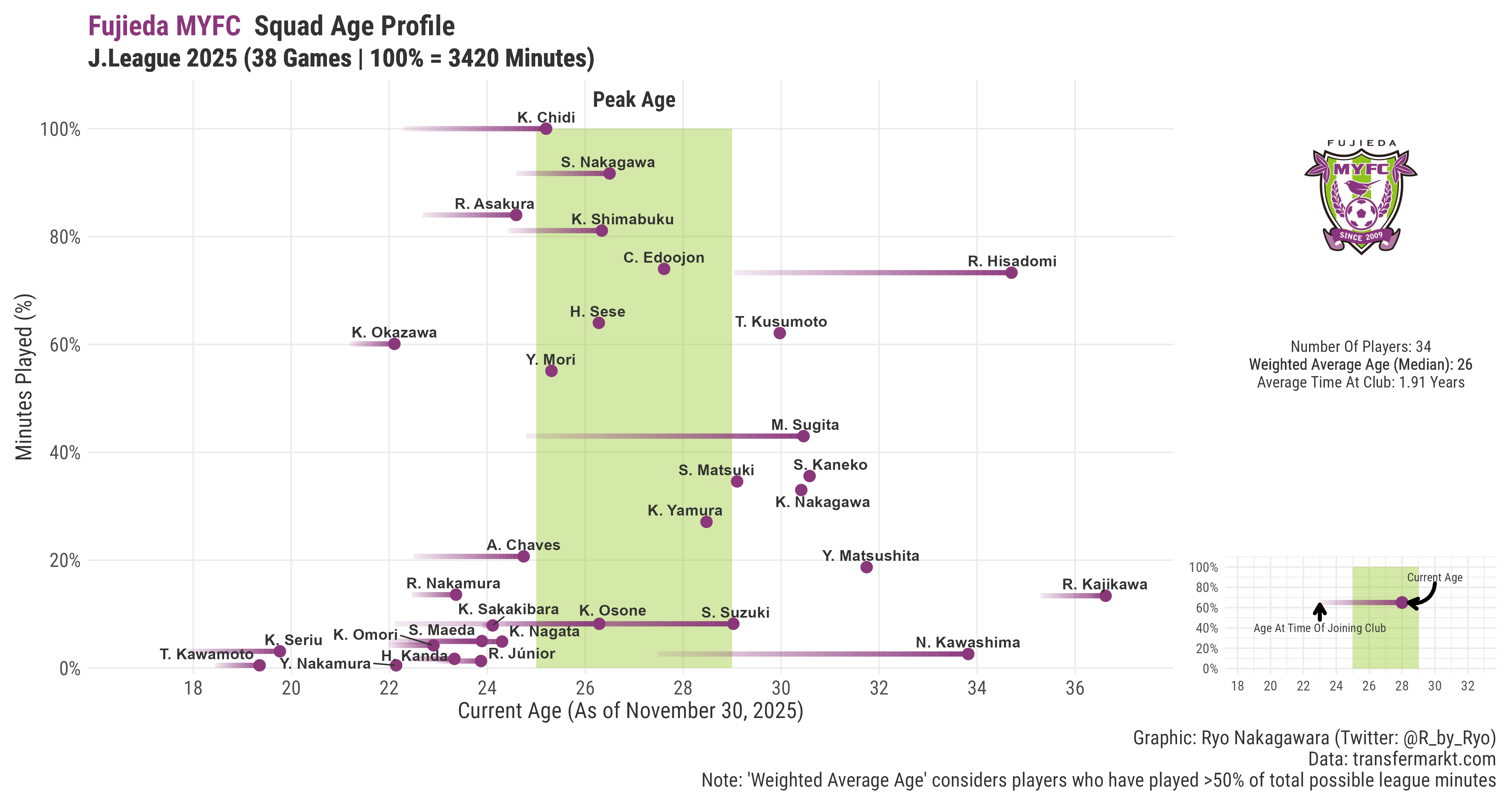
Another defining feature of Iwaki FC has been their extremely young squad, they have consistently been the youngest on average in J2 over the past few years. Notice how Yuto Yamashita is the only player above 29 years old and only one of two who are above 28! Quite a few of these are loanees from J1 clubs looking to give minutes to their youngsters so it’s always interesting to see the incomings every transfer window.
Montedio Yamagata (10th, 53 Points)
15 Wins // 8 Draws // 15 Losses
Location // Stadium: Yamagata // ND Soft Stadium
Manager: Susumu Watanabe (to June) // Akinobu Yokouchi
58 Goals (4th); 54 Conceded (16th)
45.46 non-penalty xG (8th); 50.18 non-penalty xGA (17th)
Top goal scorer: Akira Disaro (11 goals)
Goalkeeper: Tom Heward-Belle
Montedio Yamagata have been investing a lot to get promoted from J2 for a number of years now so all-in-all it was another poor season by their standards... although there was light at the end of the tunnel after a good finish to 2025. The Susumu Watanabe era finally came to an end after having won just five games at the halfway point of the season, simply not good enough. A four game losing streak capped by a painful 3-4 derby defeat to regional rivals Vegalta Sendai was the straw that broke the camel’s back. In his place, ex-Jubilo and ex-Japan youth national team coach Akinobu Yokouchi was parachuted in to help. The results (but not necessiarly the performances which I’ll get to later) improved but Yamagata were well and truly far away from a meaningful challenge for the play-off spots.


A big factor in Yamagata staying in mid-table was Akira Disaro, who continues to be a beast in J2. However, along with another player I’ll get to later the team were very reliant on his finishing over-performance this season as Disaro’s 11 goals came from just 5.66 xG. The other player was Kashima Antlers legend Shoma Doi who really came alive in the 2nd half of the season. His 8 goals, 6 of which came after Yokouchi’s arrival, spurred Yamagata to a late revival!
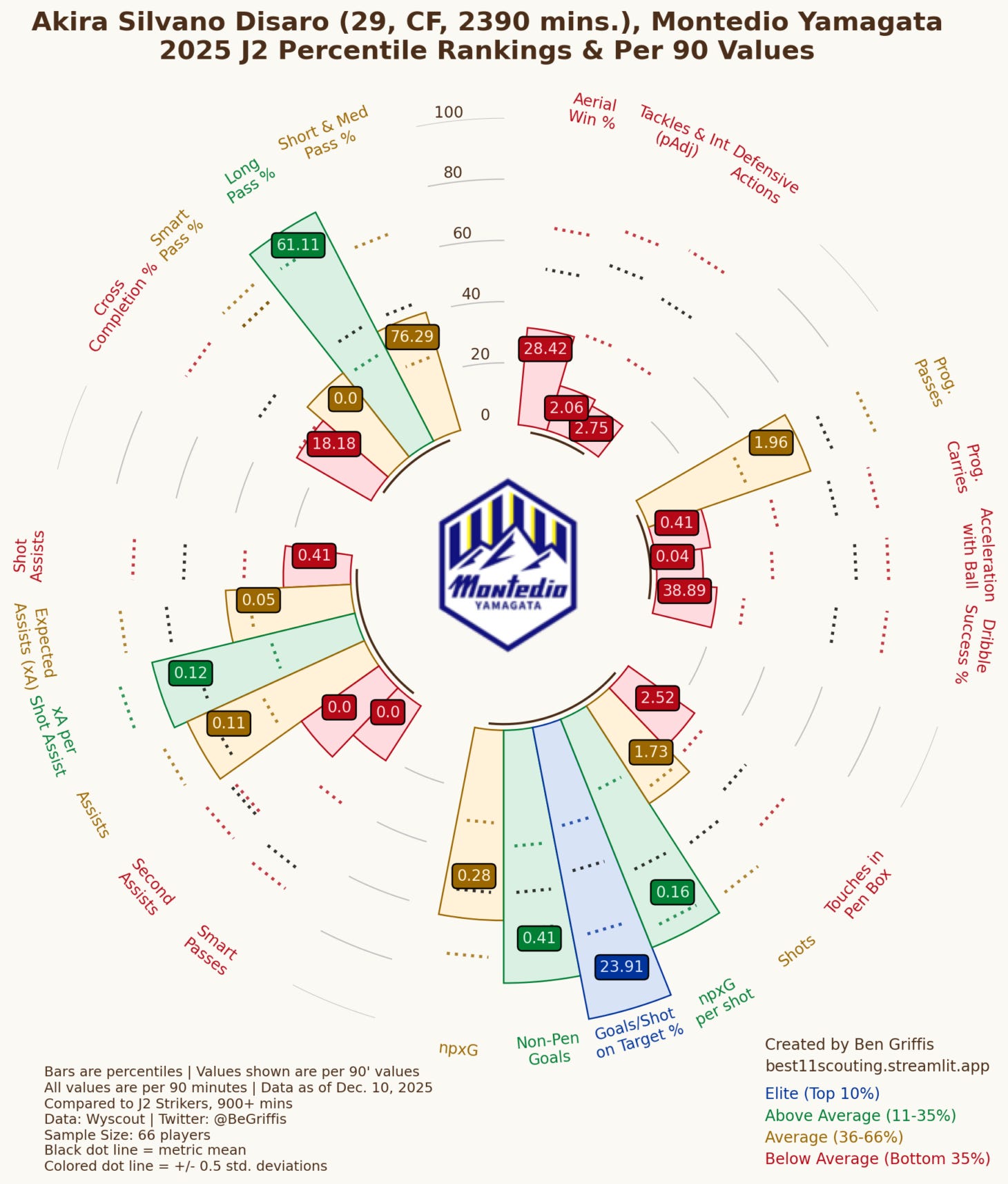
Ryoma Kida continued to be a very good J2 level player with 4 goals and 6 assists this season but at age 28, time is running out for him to get promoted (with his team or just by himself) to the J1 top flight level. The same applied to Leo Takae who is a fantastic passer at this level, he managed to join Yokohama FC in the summer… only to barely play and then promptly get relegated back to J2. An underrated hero of the season was super sub Junya Takahashi who managed to score 7 goals despite only starting in 5 of his 34 appearances, all of which totalled up to just 994 minutes of play!


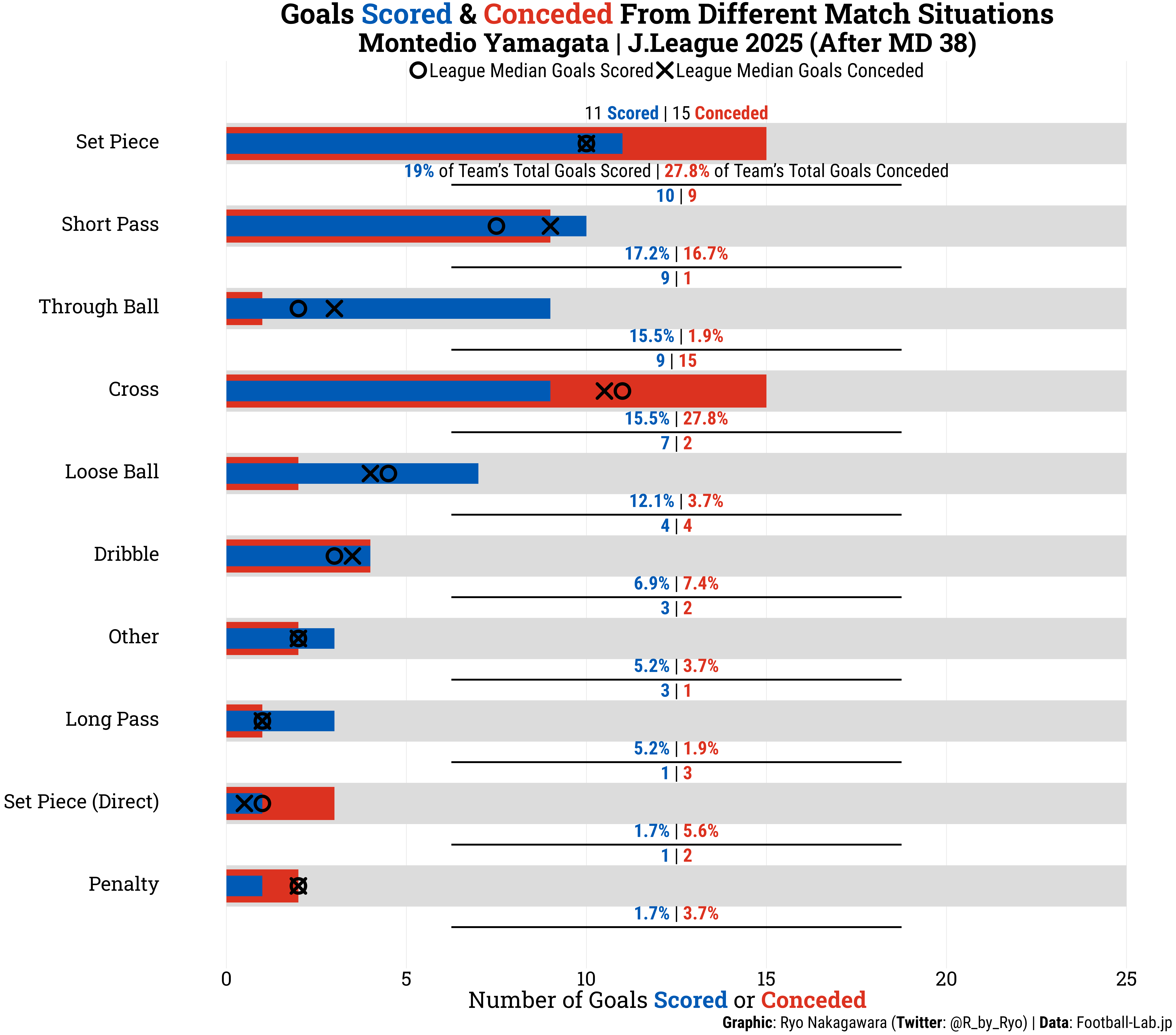
On the other hand, Yamagata’s defense was one of the worst in the league. They conceded the 4th most goals and the 3rd most xGA. In particular, Yamagata were especially vulnerable to crosses and set pieces! They conceded significantly more than the league median from both situations. For all of their good possession work building up from the back, we again see the trade-off at this level where those same defenders aren’t quite the best at actual defending.
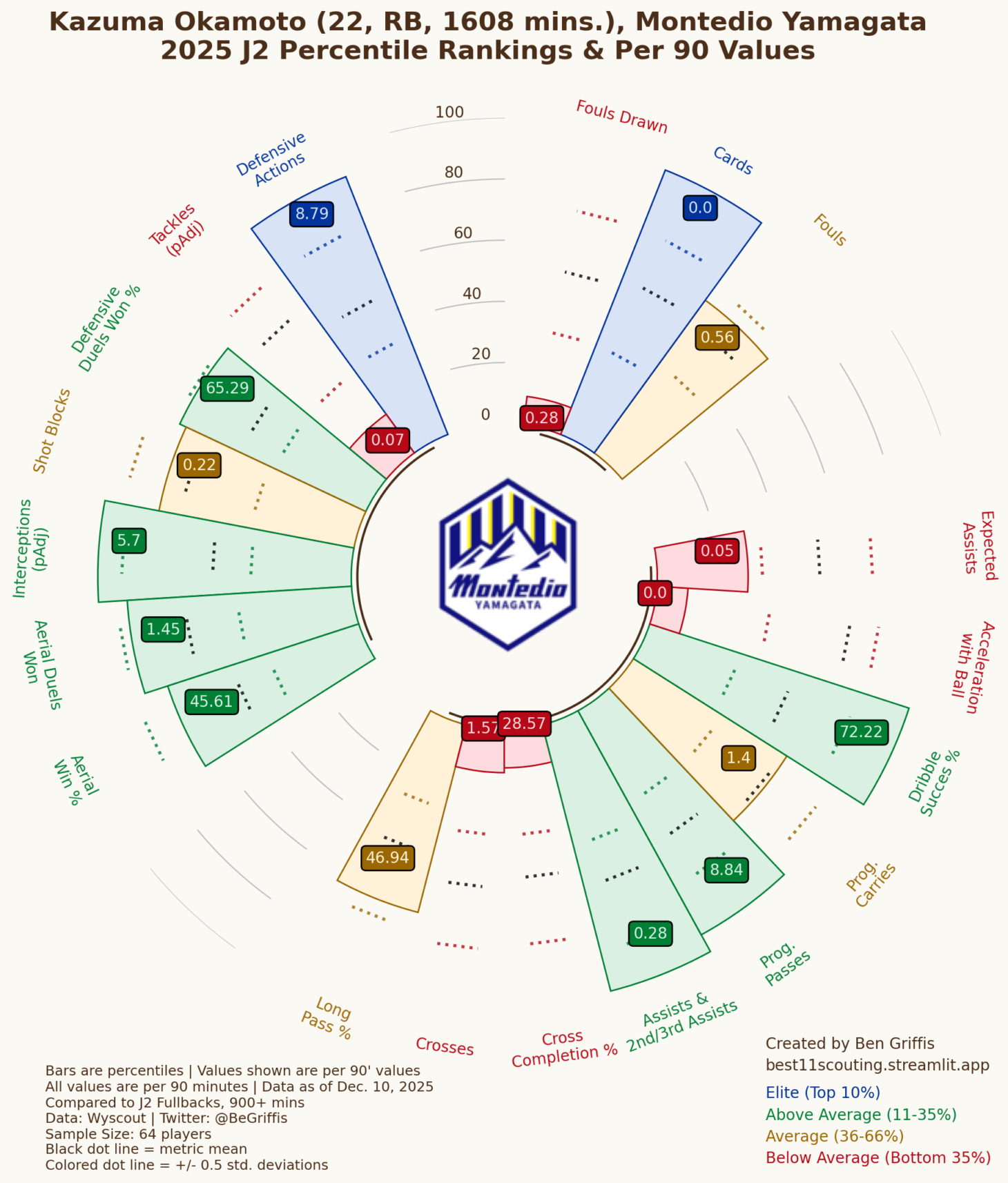
One defender that did stand out to me was Kazuma Okamoto on the Right. He’s not the kind of rampaging physical overlapping Full Back we normally see. Okamoto contributes a lot in the build-up phase as he is very technical and has decent ball progression from deeper areas. Another value add is his ability to combine with others in the final 3rd.
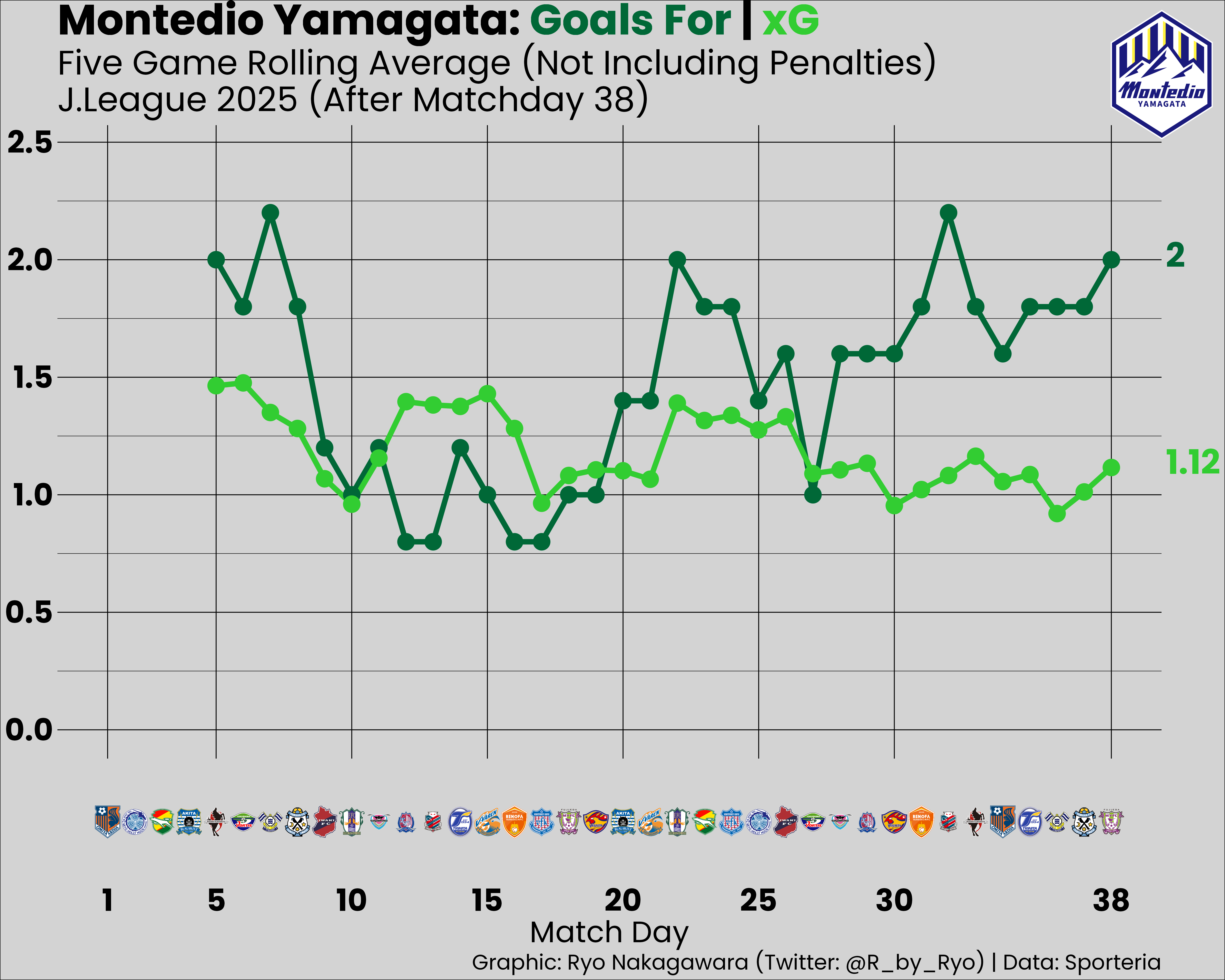
We can split how Yamagata have done between their two managers almost evenly. The one caveat being that one game was taken up by an interim. So looking at the data:
Susumu Watanabe (19 games):
xG: 23, xGA: 26.1, goals: 24, goals against: 27
Akinobu Yokouchi (18 games):
xG: 22.4, xGA: 24.1, goals: 33, goals against: 25
Given the above, what’s clear is that while the underlying performances didn’t change too much from either manager, Yokouchi’s tenure looks a lot better as Yamagata managed to finish their chances extremely clinically! A lot of this xG over-performance seemingly came from Shoma Doi who scored 6 of his 8 goals in the 2nd half of the season, all from just 3.5 xG. At the very least, Yokouchi’s half-season in charge will give fans some hope. However, the club need to keep an even keel and still push for improvements in various aspects if they hope to get themselves back into the promotion race for the 2026-2027 season.
Yamagata have a brand new shiny football-specific stadium coming online in the next five years. They’ve been making a lot of good moves off the pitch to increase revenues and make a push for J1 promotion. However, they kept falling at the final hurdle under successive managers since the 2019 season. With the attractive kind of football they play, a lot of their players have been taken away by bigger teams as well. All of this led to a disappointing league finish this season, the painful price of not achieving promotion quickly enough. However, Yamagata’s huge resurgence in the 2nd half of the season under Yokouchi gives the northerners considerable hope.
FC Imabari (11th, 53 Points)
13 Wins // 14 Draws // 11 Losses
Location // Stadium: Imabari // ASICS Satoyama Stadium
Manager: Keiji Kuraishi
46 Goals (10th); 46 Conceded (11th)
55.66 non-penalty xG (3rd); 39.3 non-penalty xGA (4th)
Top goal scorer: Marcus Vinicius (16 goals plus 1 penalty)
Goalkeeper: Kotaro Tachikawa
A pretty good season for FC Imabari. After promotion from J3 and diving into their first ever J2 season in 2025, many had them struggling in the bottom half but Imabari were in surprise contention for a play-off spot for a large portion of the season! I was very surprised when they separated from Toshihiro Hattori, the manager who got them promoted, for Keiji Kuraishi but it’s honestly turned out quite well them in the end.
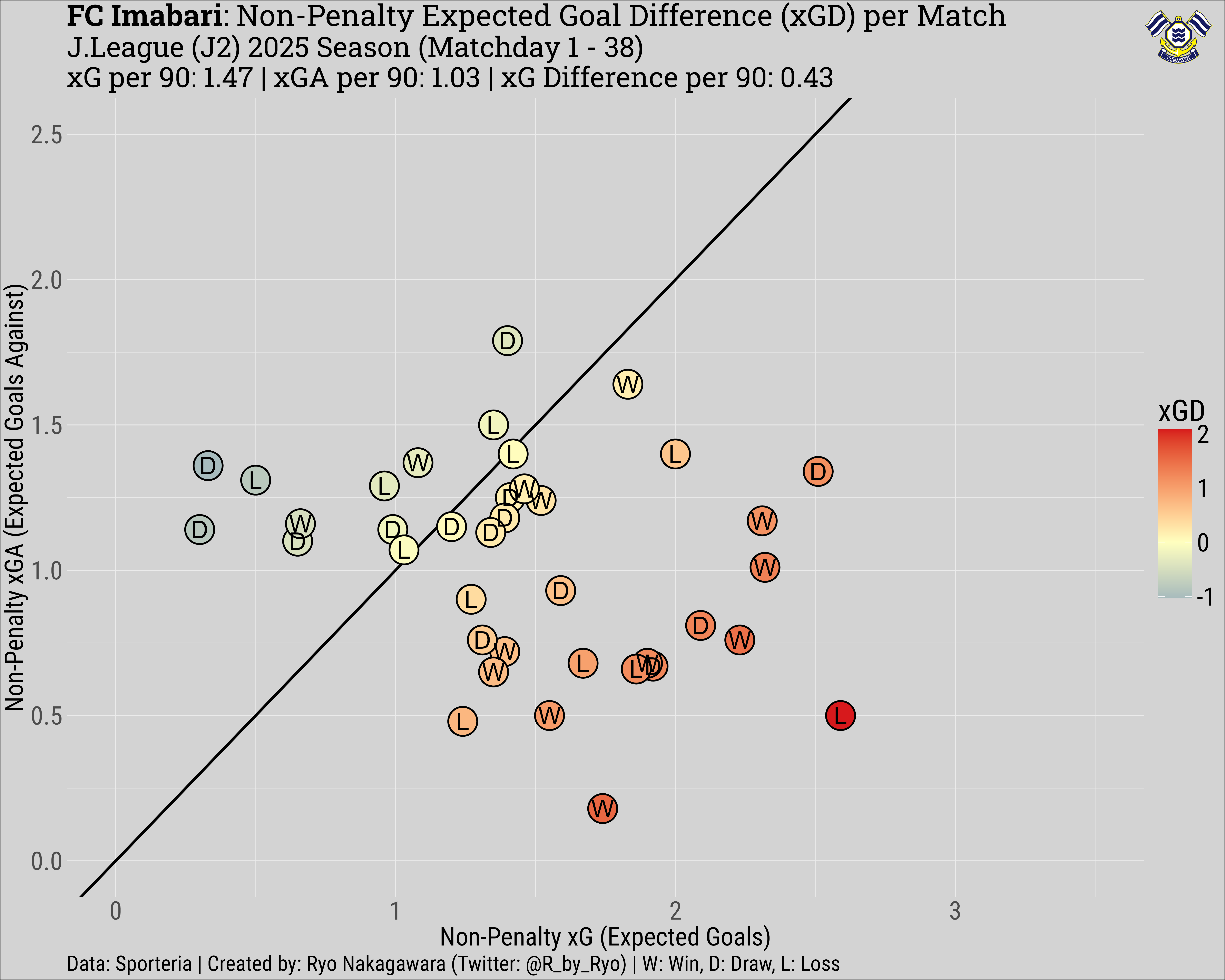
What stood out in their numbers was the incredible discrepancy between their expected numbers and their actual goals. Imabari were quite good in attack, creating lots of chances and consistently too throughout the season but there were periods of games where they just couldn’t score! They were 1st or 2nd in number of shots taken (depending on which data provider you use) but only 4th in shots on target… all of which lead to only being 9th in total goals scored.


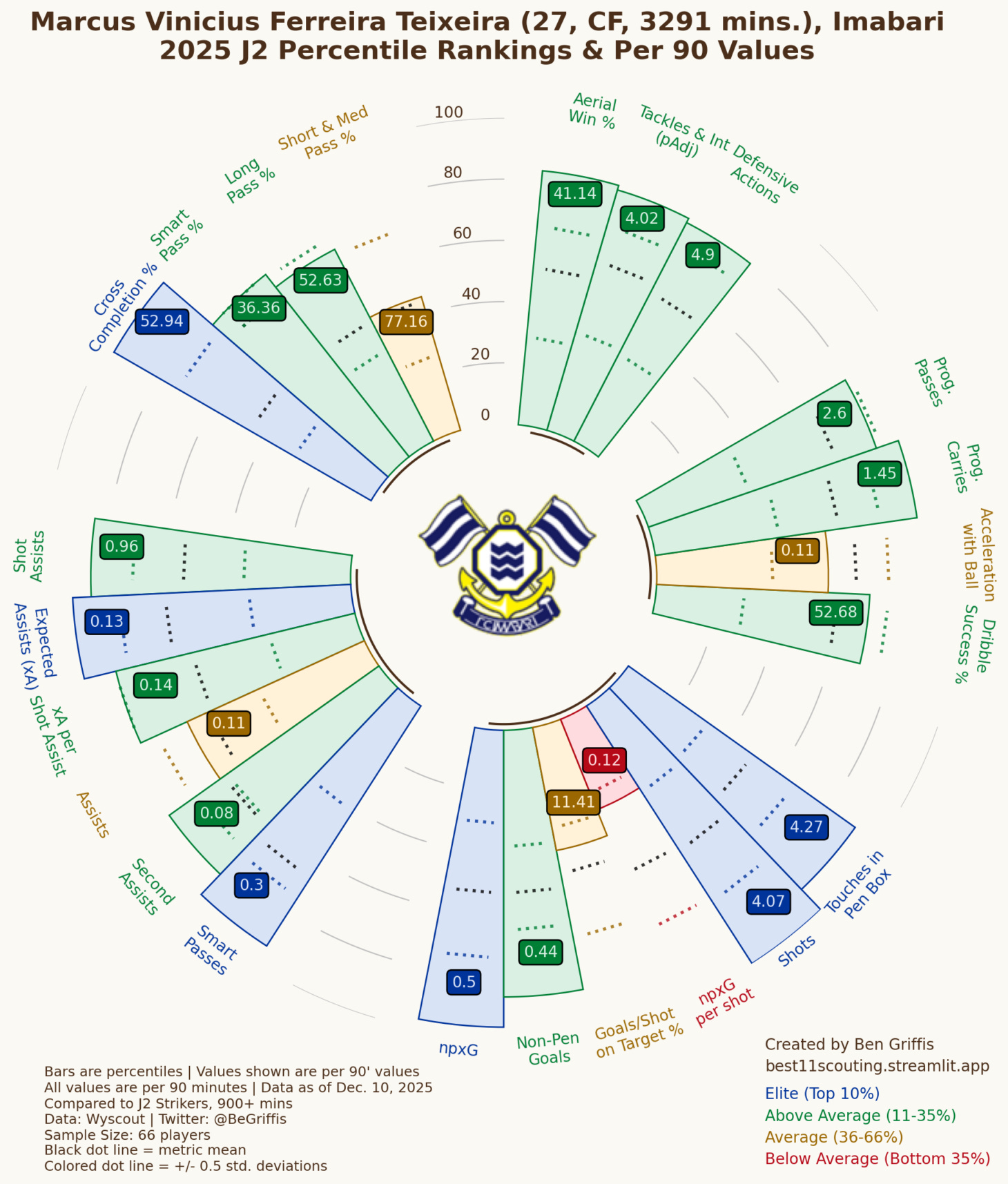
The one player that was absolutely not having trouble scoring on this team was Marcus Vinicius who scored 17 goals from 16.1 xG, nearly three times more than the next best goalscorer on the team! Vinicius has been a talisman for Imabari over the past few years so it’s a bit scary now that there are a lot of J1 teams after his signature in the off-season. Alongside his shooting, Vinicius was very important to Imabari’s playstyle. Not only was he the catalyst in Imabari’s counterattacks charging through defenders with his powerful strides but he could also be a target man in possession to keep the ball and relieve pressure until help arrived.
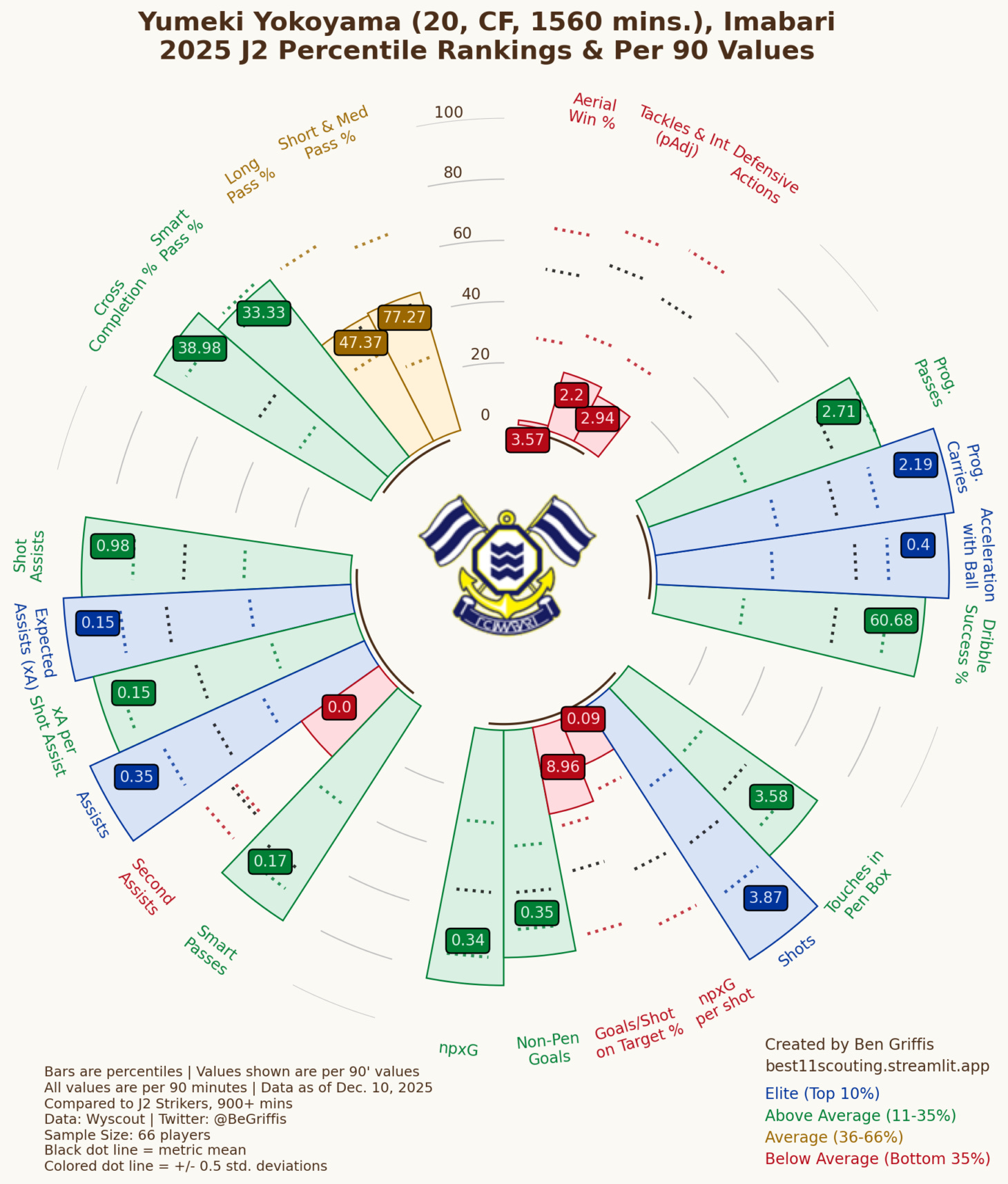
The Brazilian striker was ably supported by a young talent I’m particularly excited about, Yumeki Yokoyama. Yokoyama is an interesting profile, a fearless and agile dribbler that can operate in both wide and more central areas. I do feel like a lot of teams would try to pin him out wide but I’m very adamant that that won’t get the best out of him. Yokoyama excelled in a sort of second-striker role, buzzing around Vinicius to collect loose/2nd balls and combine with the Brazilian on counterattacks. In more sustained possession sequences, Yokoyama would drift wide and take on defenders 1v1 to create chances or take shots himself. I rate him quite highly even though his end-product and decision-making still needs work. He had 6 goals from 4.8 xG and 5 assists. I wonder what will happen to him in the off-season as I’m quite sure he’s good enough to challenge himself in J1 at this point and from there if he can handle the uptick in physicality, Europe shouldn’t be too far off either.
Shogun Soccer Scouting #15: Yumeki Yokoyama

A lot of my summer this year has been dominated by J1 player transfers to Europe but things continue to keep chugging along in the other levels of the Japanese football pyramid as well. So today I’ll be shifting gears to explore a very interesting J2 prospect, FC Imabari’s young attacker:
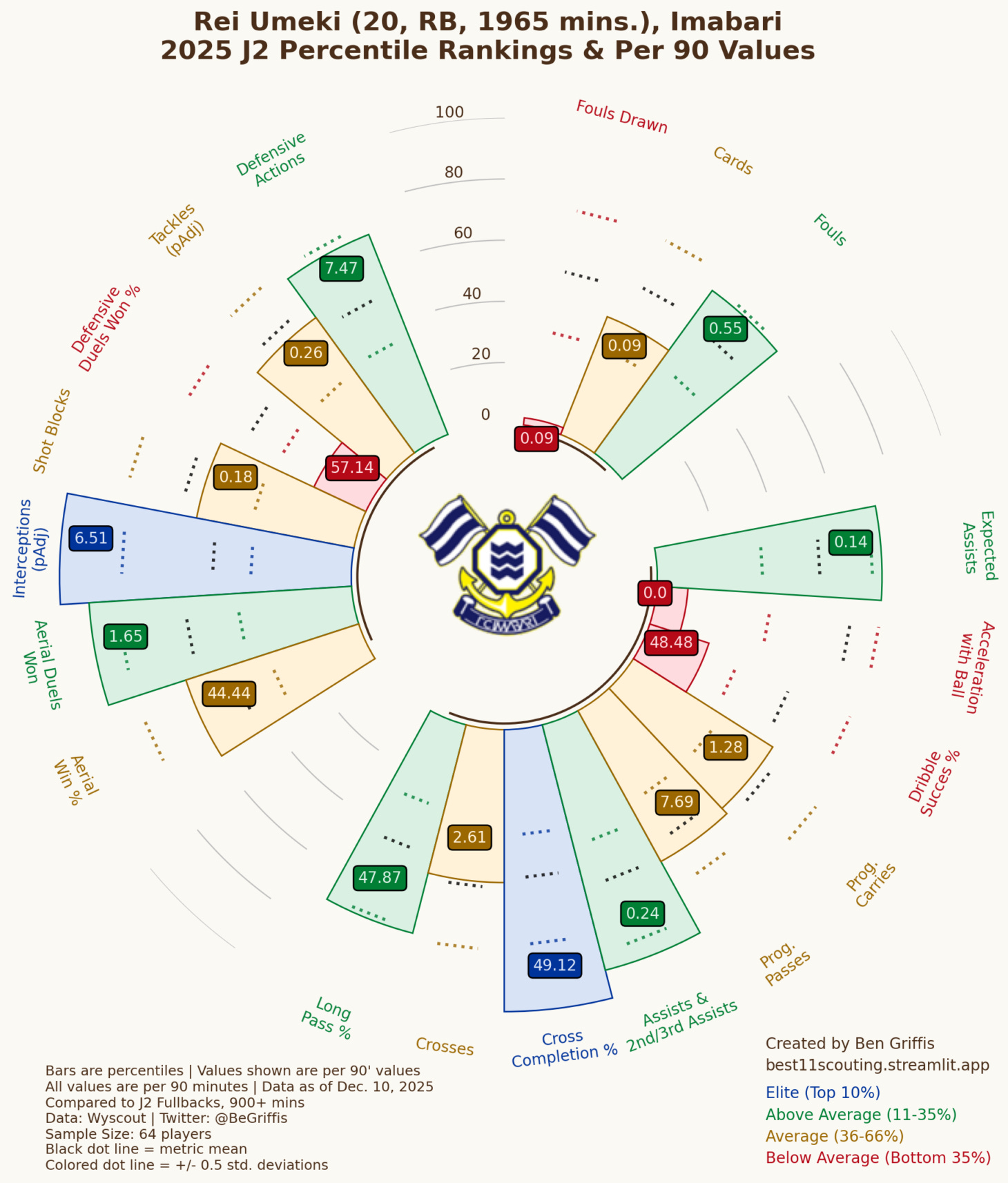
Another young star is Rei Umeki, who has been a regular at the youth national team level. He’s your typical energetic and technical Full/Wing Back that loves to push forward and put crosses into the box. I certainly do have concerns about his defending especially in duels. If he goes to Europe he’ll probably have to play Wing Back so the prospective team can maximize his attacking impact.
Continuing the theme of Wing Backs, another that impressed me was Takatora Kondo down the Left Wing and Kenshin Yuba who played on either side. Both were big threats running or dribbling down the wing. As you might imagine, with all these Wing Backs, FC Imabari created a majority of their goals from crossing situations.


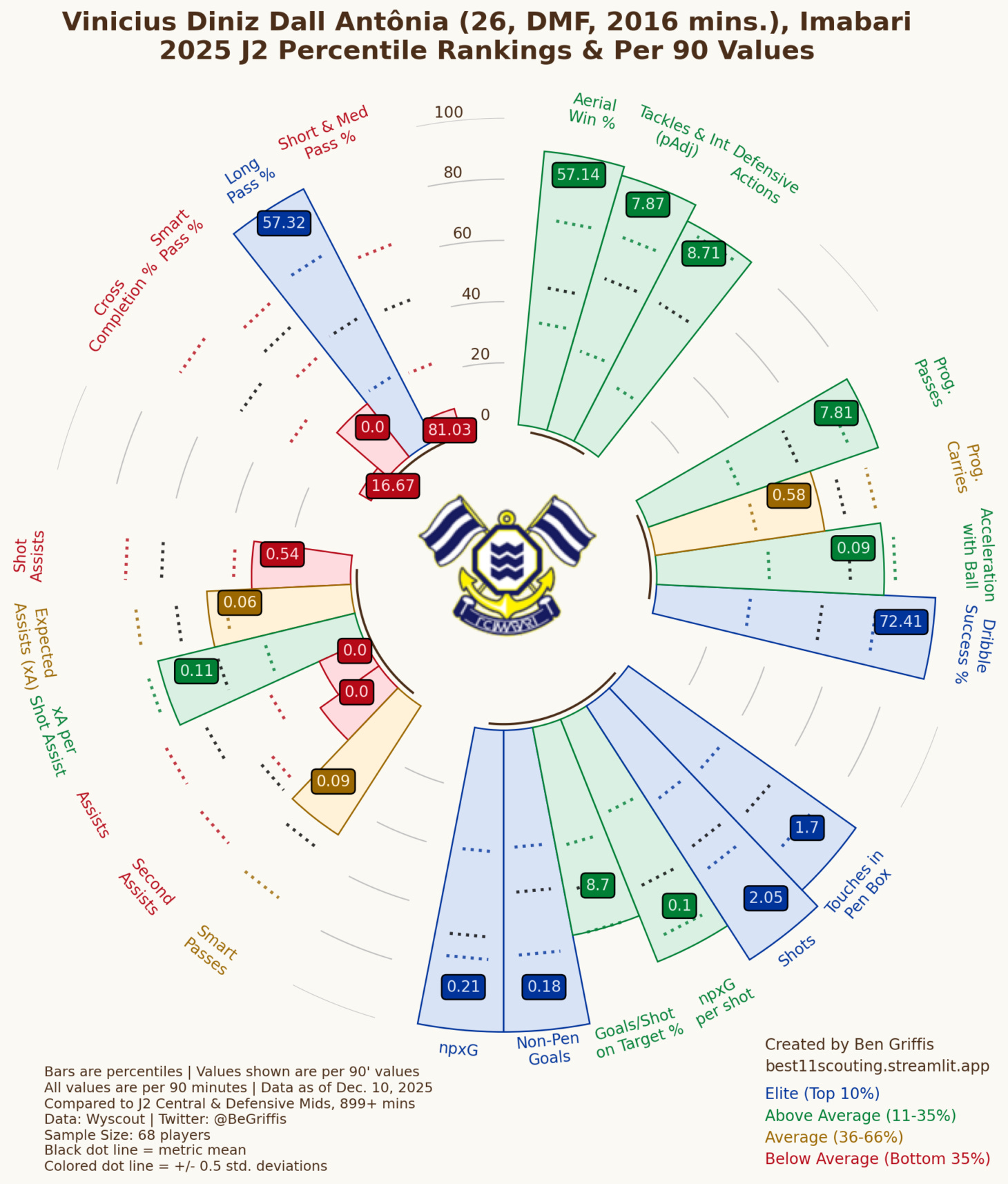
In midfield I was hoping to see a bit more of the teenager Shuta Sasa. Despite appearing in 27 matches he only started 4 and his playing time only totalled a little over 700 minutes. Yuki Kajiura made waves on loan (from FC Tokyo) at Zweigen Kanazawa over the past two seasons and it was hoped that he could be an asset in J2 but unfortunately he suffered a major injury. Even still, he showed his class once he returned and managed to make an impact in 14 games. The absolute rock in midfield was Vinicius Diniz who aside from his tough defending was his 4 goals. It was a surprise to me that he was let go after the season ended.
In defense Rio Omori continues to be quite competent at the J2 level as the FC Tokyo player has spent the past two seasons on loan with Iwaki FC and FC Imabari. Omori was an important part of Imabari’s build-up, being able to carry forward confidently and then being able to punch passes forward from the Back 3. Given FC Tokyo’s aging back-line it might make sense to integrate him into the squad during the 100 Year Vision League but one big concern is his poor duel record in the air and on the ground despite his 186cm stature. Some of this could be explained by how aggressive his assigned role was as part of the Back 3 but it does bear thinking about especially when you consider his disciplinary record too.


Despite some good performances throughout the season, the results didn’t quite follow and Imabari fell away from play-off contention by October. Still, by their standards, finishing in 11th place was a somewhat successful season given this was their first J2 attempt.


If they can keep the pipeline of nurturing young talents and being extremely smart about their Brazilian recruitment like they have done with Vinicius, Diniz, etc. then I do think Imabari can keep punching above their weight to get closer to a play-off spot in the coming seasons.
Hokkaido Consadole Sapporo (12th, 53 Points)
16 Wins // 5 Draws // 17 Losses
Location // Stadium: Sapporo // Sapporo Dome
Manager: Daiki Iwamasa (to August) // Shingo Shibata
50 Goals (8th); 63 Conceded (19th)
43.79 non-penalty xG (9th); 45.65 non-penalty xGA (12th)
Top goal scorer: Tomoki Takamine (10 goals)
Goalkeeper: Shun Takagi // Takanori Sugeno // Kojiro Nakano
Daiki Iwamasa was a terrible choice. If you’ve followed my season reviews for the past few years, you’d know what I thought about Iwamasa’s time as Kashima Antler’s manager... Of course, it wasn’t just Iwamasa’s fault but from the top-down and all over, Sapporo have been completely inept these past few years. The fact that Sapporo are down in J2 and didn’t have the power to go immediately back up can be traced all the way back to the fact that they kept Mischa around too long and the squad was weirdly configured as a result. It was to the extent that it was never going to take a single transfer window or two to fix properly especially not to whatever kind of football Iwamasa would’ve wanted.


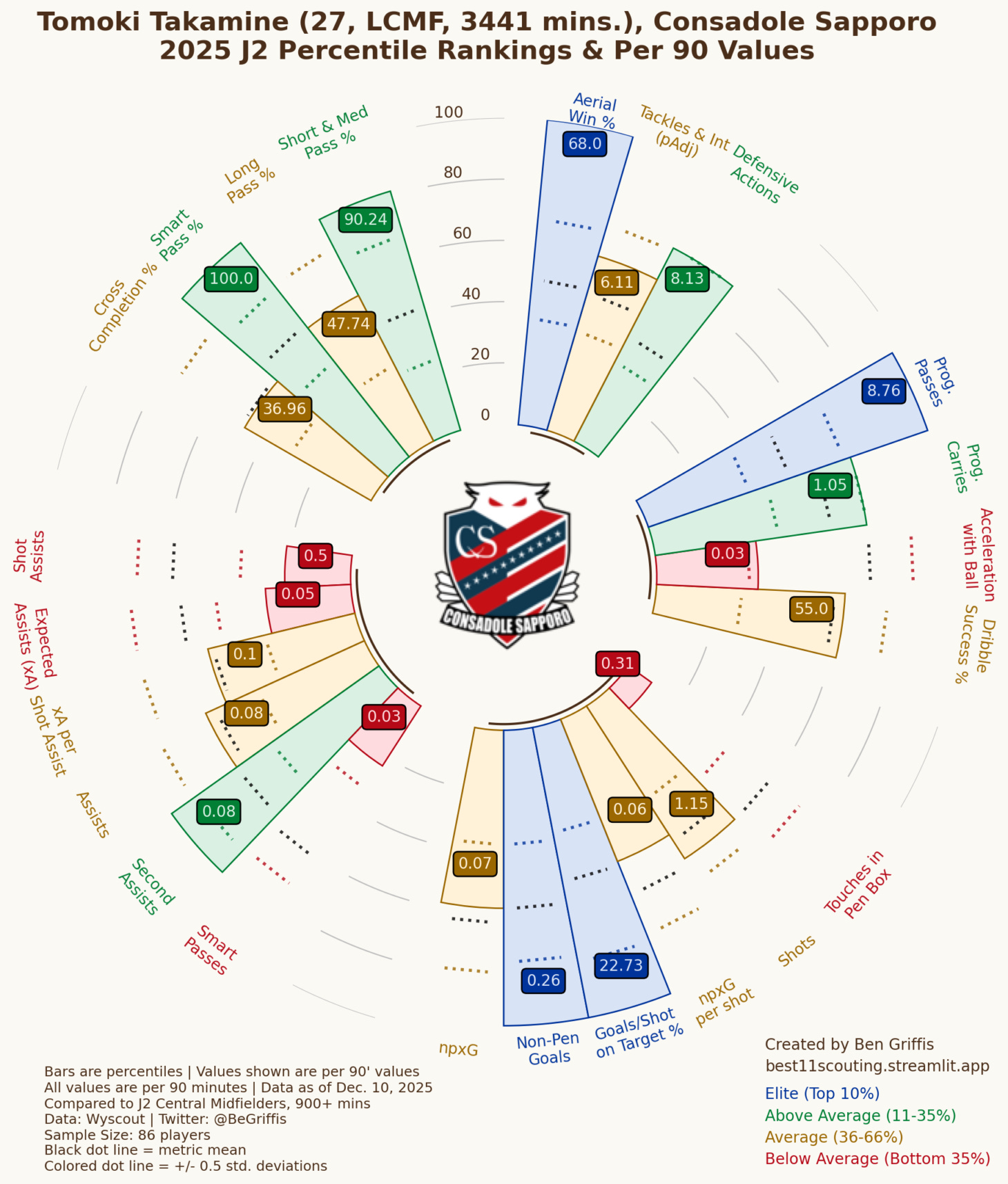
Sapporo would be in the relegation zone if it wasn’t for Tomoki Takamine’s magical goal scoring spree. He somehow somehow ended up as their top goal scorer too. His 10 goals have come from just 3 xG! I just don’t know how Sapporo keep getting away with this kind of stuff (well, except for last year I mean). Like some kind of superhero, Takamine parachuted back in from a brief vacation in Belgium to fire his home-town club to safety!
In other aspects of the attack, Amadou Bakayoko finally came good in the end after a long time where it was uncertain he’d ever do anything. The Sierra Leonan striker finished the season with 7 goals and 1 assist. Unfortunately, Sapporo’s other foreign help continued to disappoint as the Ghanaian pair Kinglord Safo and Francis Cann did not make a single league appearance while Jordi Sanchez barely played. Mario Sergio did manage 4 goals in extremely limited minutes but I don’t think that is still commensurate to the amount the team must be paying for his services... These players are in a long line of Sapporo’s awful recruitment in the past few seasons.
I quite liked Park Min-gyu when he came in to help Sapporo in J1 last year but he barely got playing time under Iwamasa for some reason. The Korean slowly earned his place back under Shibata though. Supachok continues to be a decent player but he is rather injury prone. In terms of the Japanese players, Ryota Aoki and Haruto Shirai chipped in with their fair share of goal contributions but you’d hope talented youngsters like Kosuke Hara aren’t left rotting on the bench again.


Even with the supposed style change under Daiki Iwamasa and then Shingo Shibata, Sapporo’s notoriously porous defense was still extant. Rearing it’s ugly head time and time again. They conceded the 2nd most goals although their non-penalty xGA was a slightly more respectable 12th in the league. Going back-to-back seasons with one of the league’s worst defensive records despite stepping down into J2 is rather embarrassing. I am rather curious as to what exactly it is about their defending that allows teams to consistently score more goals than their xGA presents but you’d need more detailed data (and rewatching all of Sapporo’s goals conceded) for that.


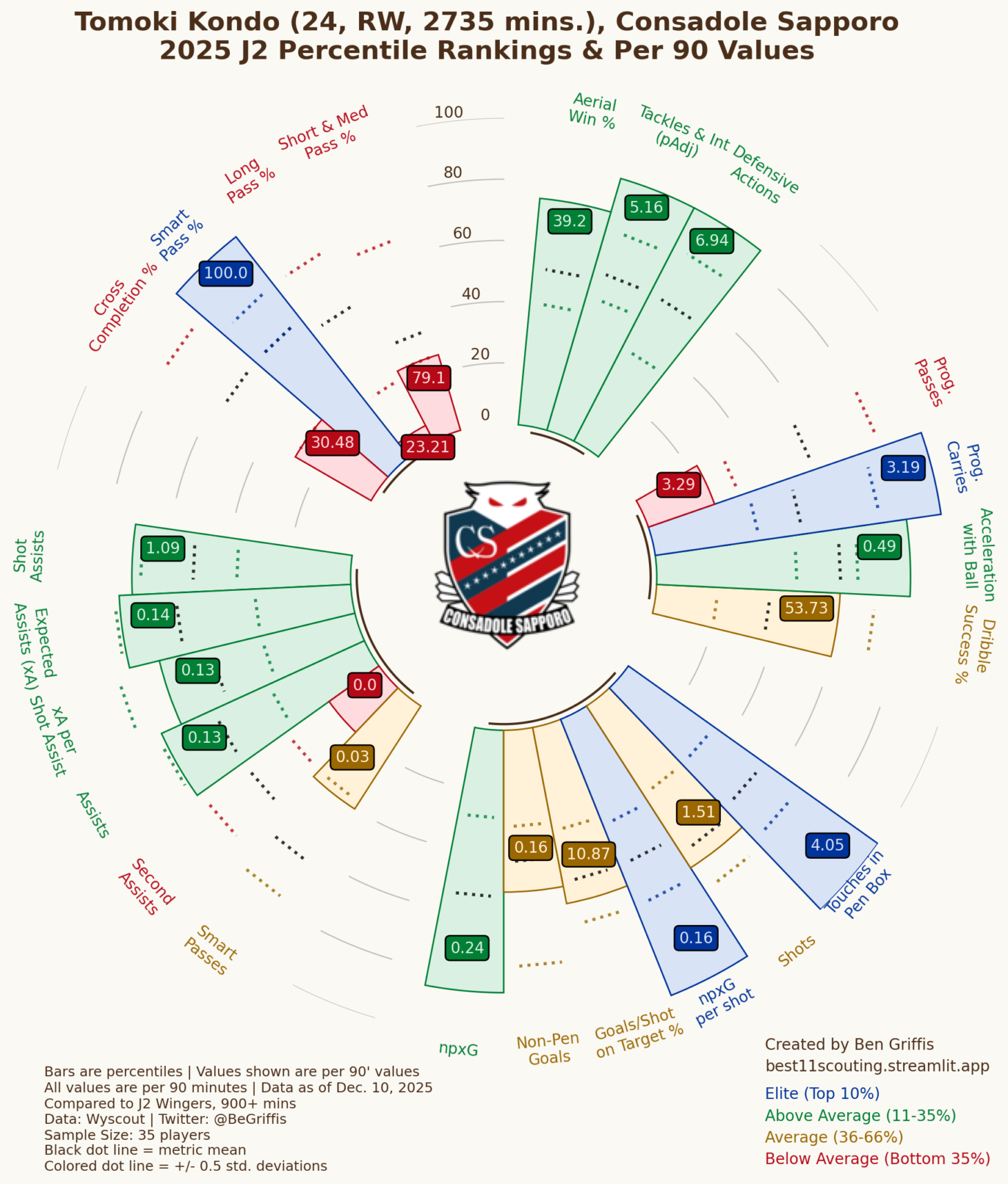
Aside from Takamine’s heroics, Tomoki Kondo was Sapporo’s best player with his crossing and dribbling as has been the case for the past few years. This is also why you might not want to stay with your relegated team thinking that it’ll be easy to go straight back up with them and show the team/fans your loyalty... Kondo definitely had J1 offers in the off-season and he probably should’ve taken it as he’s now wasted a year down in J2 when he really didn’t need to at the age of 24.
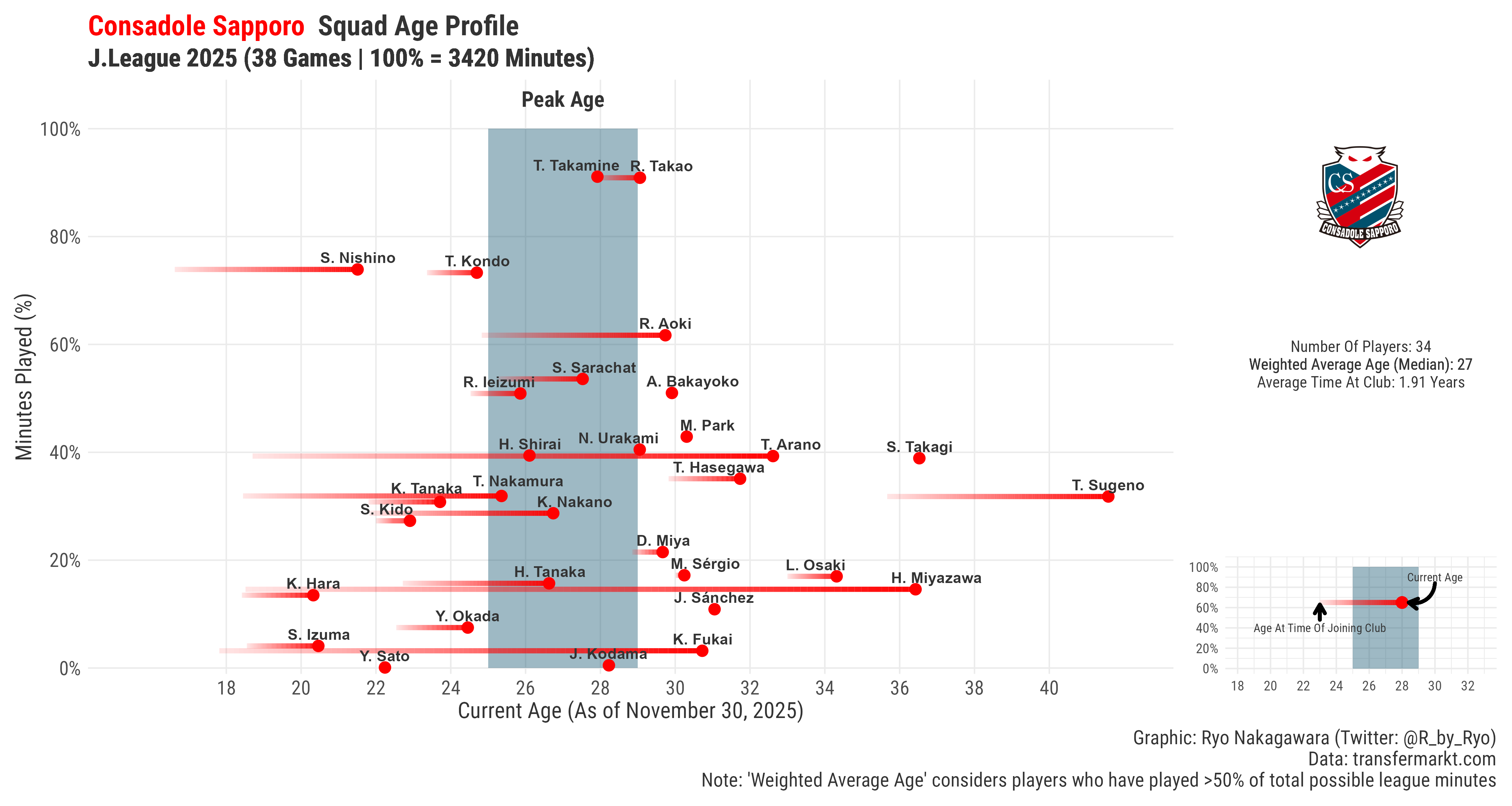
While I’ve been quite harsh on Sapporo over the past several seasons, there’s some decent talent here across a variety of age ranges. However, it’s clear that squad needs further refinement if Sapporo want to get competitive again. Kenta Kawai was officially announced as the new manager last week. He made much more sense as the immediate successor to Mischa Petrovic but I guess they couldn’t get the deal done back then for whatever reason. Kawai is a very interesting coach with his possession game but had the same issues like Mischa in that the defense was rather porous due their playing style (see my criticisms in previous J1 reviews on Sagan Tosu). I’m looking forward to see what Kawai has reflected on in the past year and a half away from a managerial job to update his playing philosophy.
Ventforet Kofu (13th, 44 Points)
11 Wins // 11 Draws // 16 Losses
Location // Stadium: Kofu // JIT Recycle Ink Stadium
Manager: Shinji Otsuka
37 Goals (16th); 45 Conceded (10th)
37.36 non-penalty xG (18th); 47.75 non-penalty xGA (14th)
Top goal scorer: Yoshiki Torikai (9 goals)
Goalkeeper: Kohei Kawata
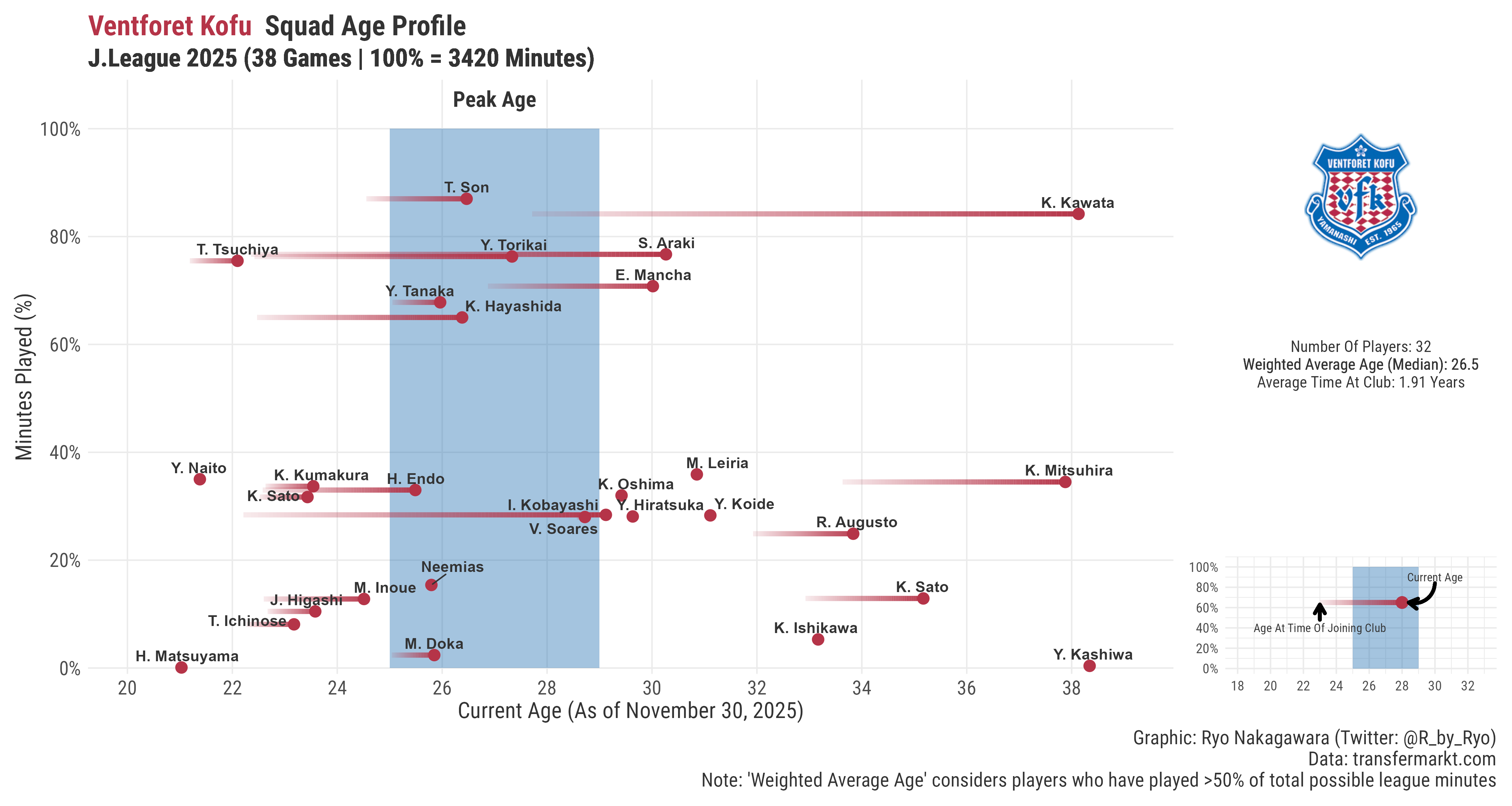
It’s been a pretty disappointing few years for Ventforet Kofu as all the momentum from their Emperor’s Cup triumph and subsequent ACL journey has been well and truly lost! After saving the club from relegation in the 2024 season, Kofu opted for safe and rather boring continuity under Shinji Otsuka. As you might imagine it was a very mediocre team all around… Look at how they are in the bottom-left “red” zone in each of these graphs…


I’ve wanted to watch Kofu this season to keep an eye on Takumi Tsuchiya (another Center Back J2 loanee sent out by Kashiwa Reysol) but given how dreary they were I’ve been putting it on the back-burner all year… Now the season is over, oops! Looking at the data, Reysol have themselves another “modern” defender who is good with the ball at his feet with somewhat OK-ish defending ability in a Back 3.
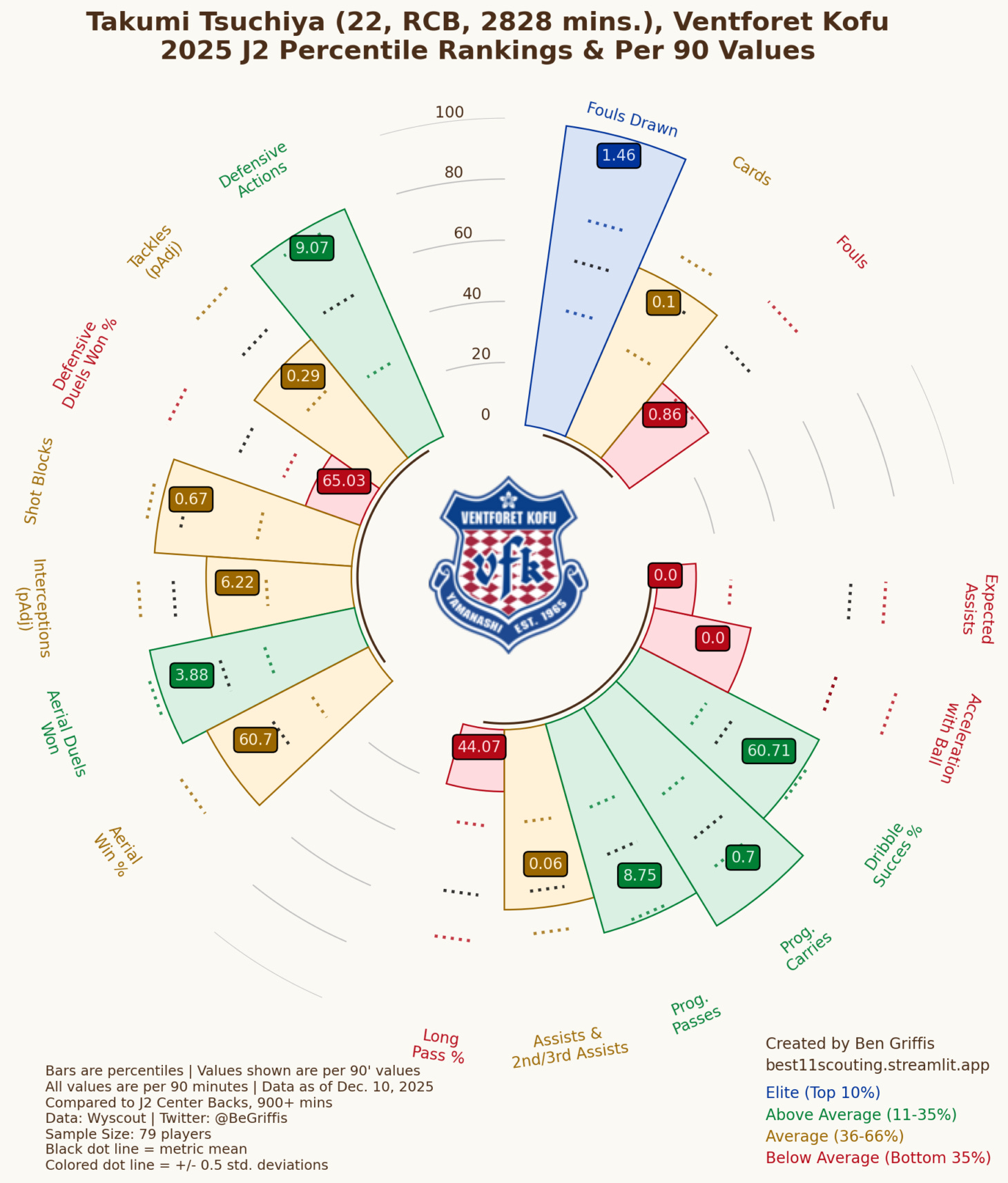
Yoshiki Torikai is one of the few remaining players of those triumphs a few years ago but considering the state of the club I could see him leaving this winter as well. He was the leader and perhaps the only spark in an otherwise dead attack with his dribbling. Another positive was the young 21 year old striker Yamato Naito seems to have some promise with 5 goals and 1 assist in limited game time. While his underlying stats and overall play outside of shooting wasn’t great, it does need reminding that Kofu struggled a fair bit in general. He might be worth monitoring further to see if he improves.


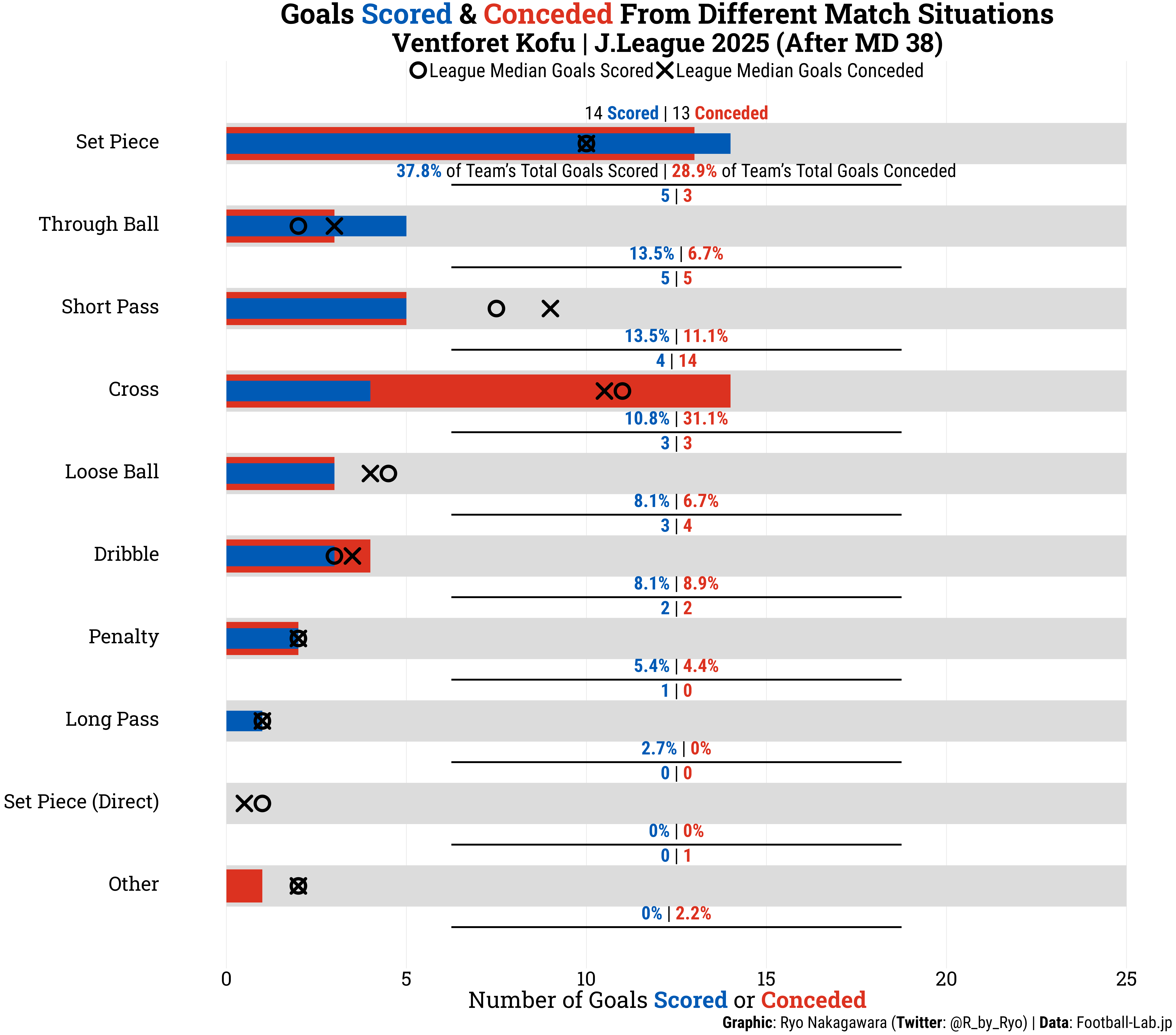
Kofu were another “Set-piece FC” team, nearly 40% of their goals have come from these situations. This makes sense considering all of Kofu’s other attacking metrics which were all in the gutter. 18th in final 3rd entries, dead last in penalty box entries, 17th in shots taken, 19th in shots on target, yet somehow “only” 16th in goals scored.
Ventforet Kofu are safe again but surely they have to actually build something and push themselves back up the table from 2026 onwards. The 100 Year Vision League gives you some time to experiment so here’s hoping for a bit more pizazz instead of the same turgid stuff every week.
Blaublitz Akita (14th, 43 Points)
11 Wins // 10 Draws // 17 Losses
Location // Stadium: Akita // JIT Recycle Ink Stadium
Manager: Ken Yoshida
43 Goals (13th); 59 Conceded (18th)
38.15 non-penalty xG (17th); 47.07 non-penalty xGA (13th)
Top goal scorer: Ren Komatsu (10 goals)
Goalkeeper: Genki Yamada
Well, Blaublitz Akita just about kept themselves up again. It wasn’t pretty as always but a decent second half of the season, especially by their usual standards, had them somewhat comfortably away from the relegation zone since matchday 22. This is despite only winning twice in the last 10 games of the season! What Akita did do well was grind out a lot of 0:0 draws despite very poor underlying metrics in this timeframe compared to the beginning of the season when they were losing quite a lot.


A problem Akita had was a bad habit of conceding goals in the last 10 minutes of games, especially when Akita seemed to have run out of gas to reply in the same time period.
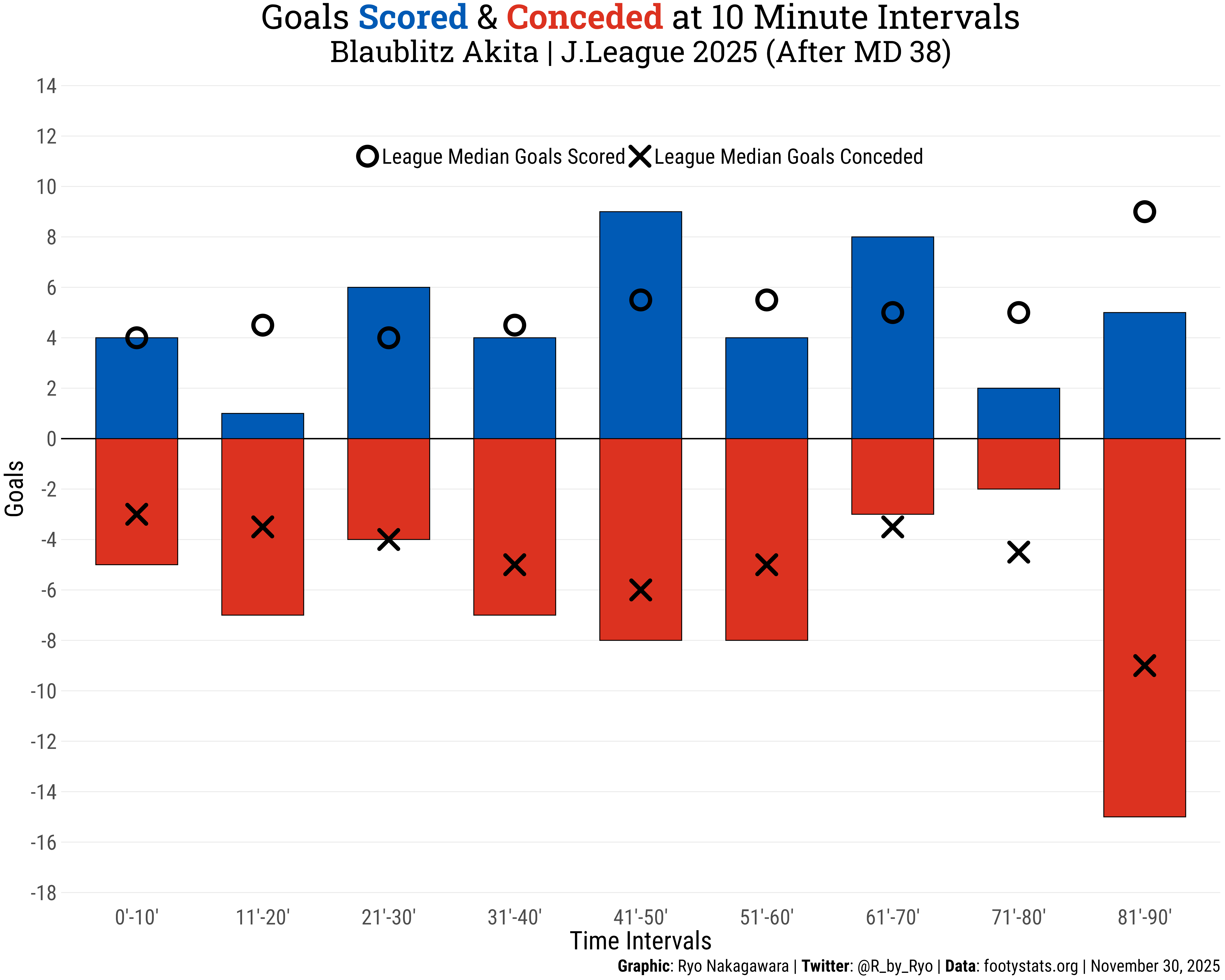
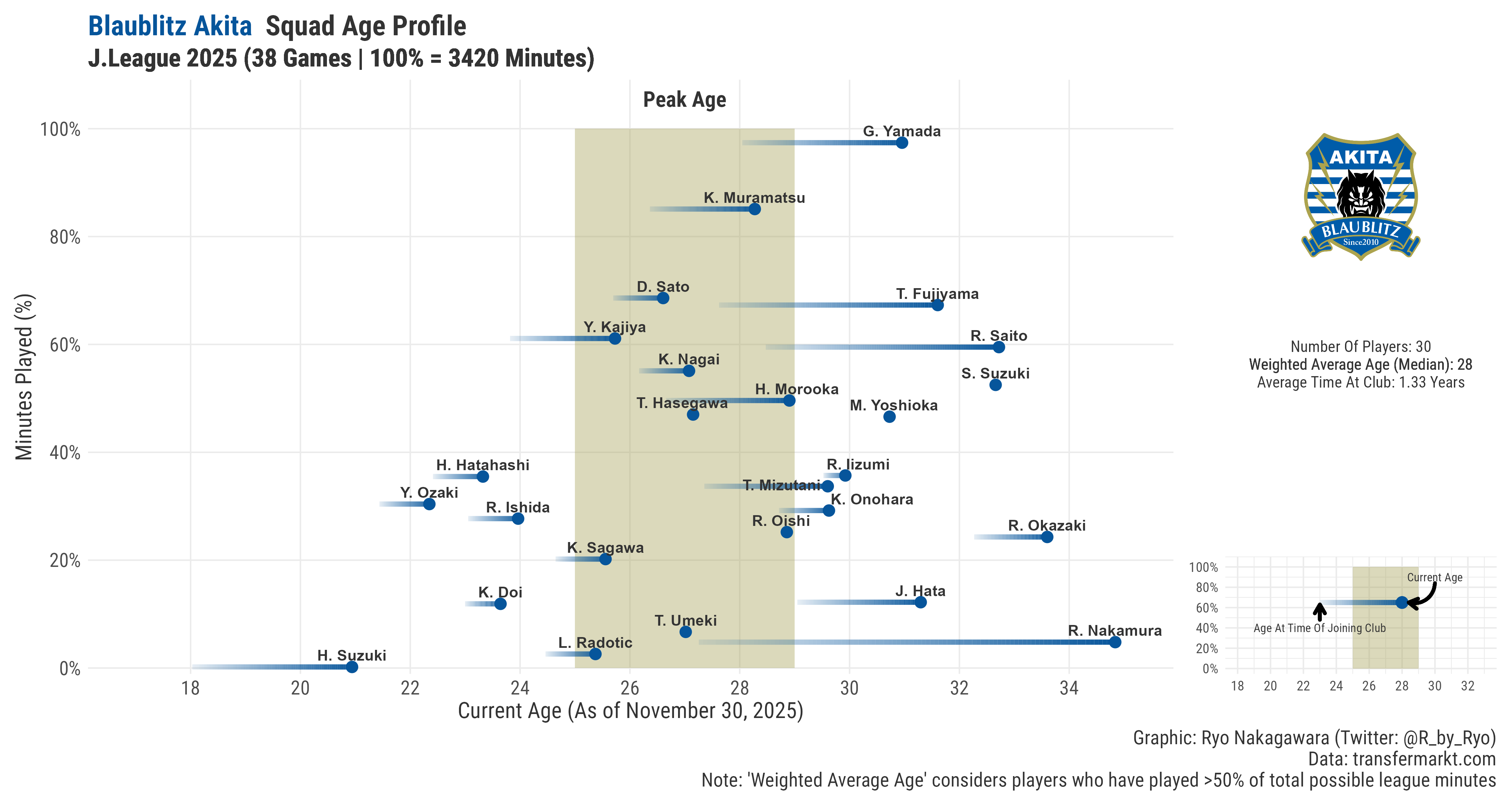
The decent 2nd half of the season, at least results-wise, was a surprise considering the loss of top goal scorer (10 goals) Ren Komatsu to Vissel Kobe in the summer. Thankfully, Yukihito Kajiya managed to take up some of the aerial and physical aspects required for Akita’s playstyle and ended the season with 4 goals and 4 assists.


Throughout the season, Akita were saved by their set-piece prowess as they scored nearly half (46.5%) of their 43 goals from these situations. A big part of this was the delivery from Daiki Sato, who with the departure of Komatsu, became their talismanic player from the Left Wing. Sato had his career best season with 5 goals and 6 assists.


I’m not sure how much more juice Ken Yoshida can squeeze out of the scraps he’s given. Even if Akita had higher ambitions, they don’t have a large financial backer and are stuck in a fairly remote part of the country. Akita are unfortunately another northern club that will get hit hard by the season change. Unless they get extremely smart and can provide some kind of incentive for players to come, luring young college/academy players with game-time in the mold of Mito HollyHock or Roasso Kumamoto it’s going to be very hard for Akita to survive the coming years. Winter is coming!
Fujieda MYFC (15th, 39 Points)
9 Wins // 12 Draws // 17 Losses
Location // Stadium: Fujieda // Fujieda Soccer Stadium
Manager: Daisuke Sudo
41 Goals (15th); 50 Conceded (14th)
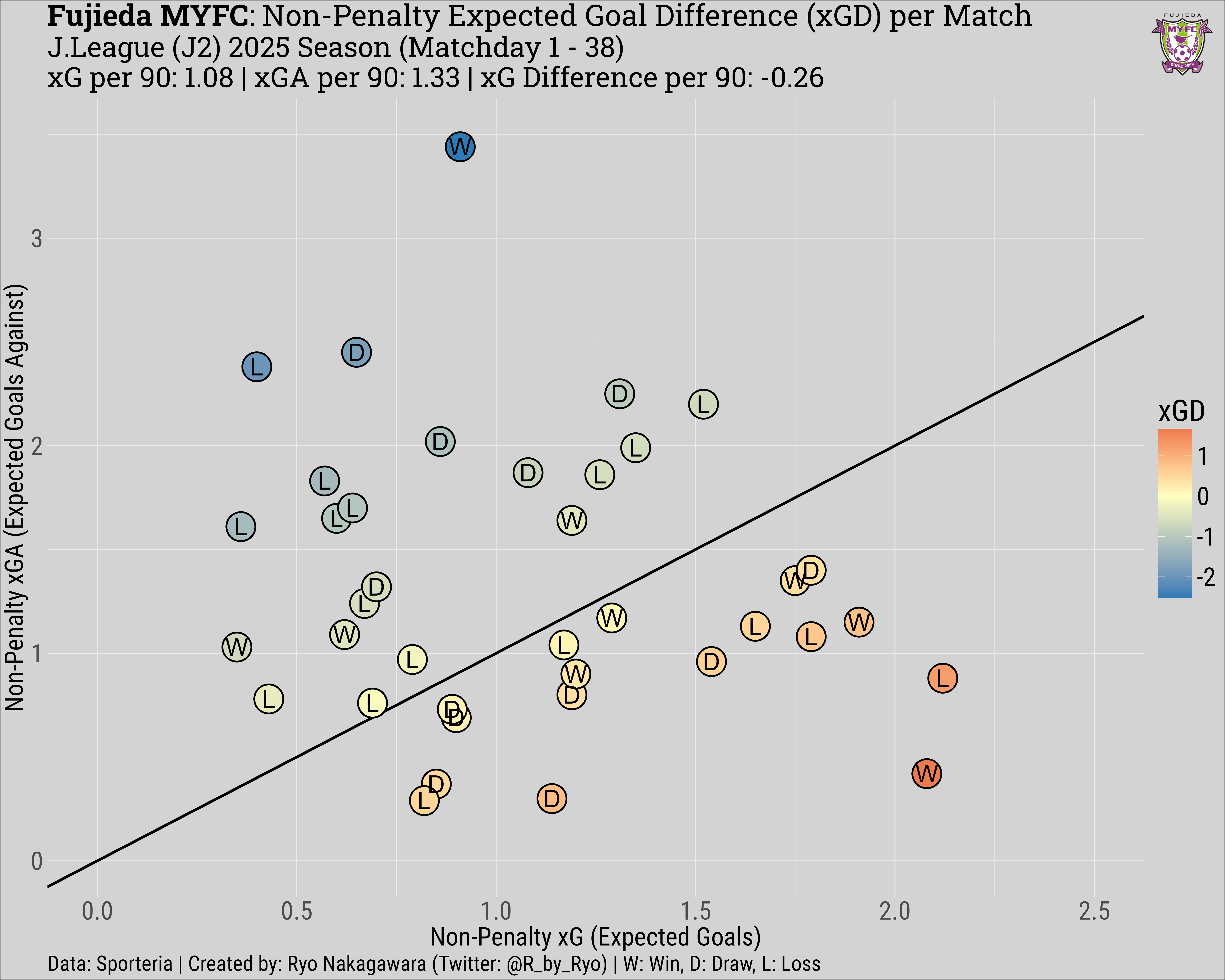
41.03 non-penalty xG (13th); 50.74 non-penalty xGA (18th)
Top goal scorer: Ren Asakura (9 goals)
Goalkeeper: Kai Chide Kitamura
Another season passed and Fujieda MYFC managed to survive as Daisuke Sudo continued to work his magic! The third professional team from Shizuoka have punched above their weight since arriving in the second tier in 2023. The results weren’t always great but Sudo stuck to his guns by having his team keep the ball a lot (especially in their own half) and also sharp pressing and counterattacks with the Front 3.
The star player here was obviously Ren Asakura with 9 goals from 5.5 xG and 3 assists. Although he had a really good finishing streak in front of goal, he simply also was a huge (perhaps only?) part of their attack in terms of being in the right position to receive the ball and then dribbling/carrying the ball to the final 3rd. I think he’s quite talented and a J1 team should come calling for him this winter.


Ken Yamura came back mid-season after disappointing on his return to parent club Albirex Niigata in J1 and helped out a bit with 3 goals and an assist. However, the rest of the team was rather goal-shy. A big culprit was Shunnosuke Matsuki who somehow managed zero goals despite getting on the end of chances worth 3.9 xG.
The Wing Backs did their part both defensively and offensively as both Chie Kawakami (2 goals and 3 assists) and Kazuyoshi Shimabuku (1 goal and 4 assists) bombed up and down their respective sides effectively.
The middle of the park were held down by two players I’ve written about but in the J3 season reviews in the past. Kosei Okazawa followed up a good season at FC Ryukyu down in J3 with another loan from parent club Cerezo Osaka in J2 this year. It remains to be seen if he’ll ever be deemd good enough for the purple-half of Osaka in J1 but perhaps he’ll have a Motohiko Nakajima-esque career. He’s shown he’s a decent enough player at the J2 level at least, does a lot of work with and without the ball. Hiroto Sese caught my eye with Gainare Tottori in J3 a few years ago and now he’s been a steady presence for Fujieda MYFC. Perhaps not quite grown as much as I thought he would though when it comes to the on-ball stuff although that may be more tactical than anything.


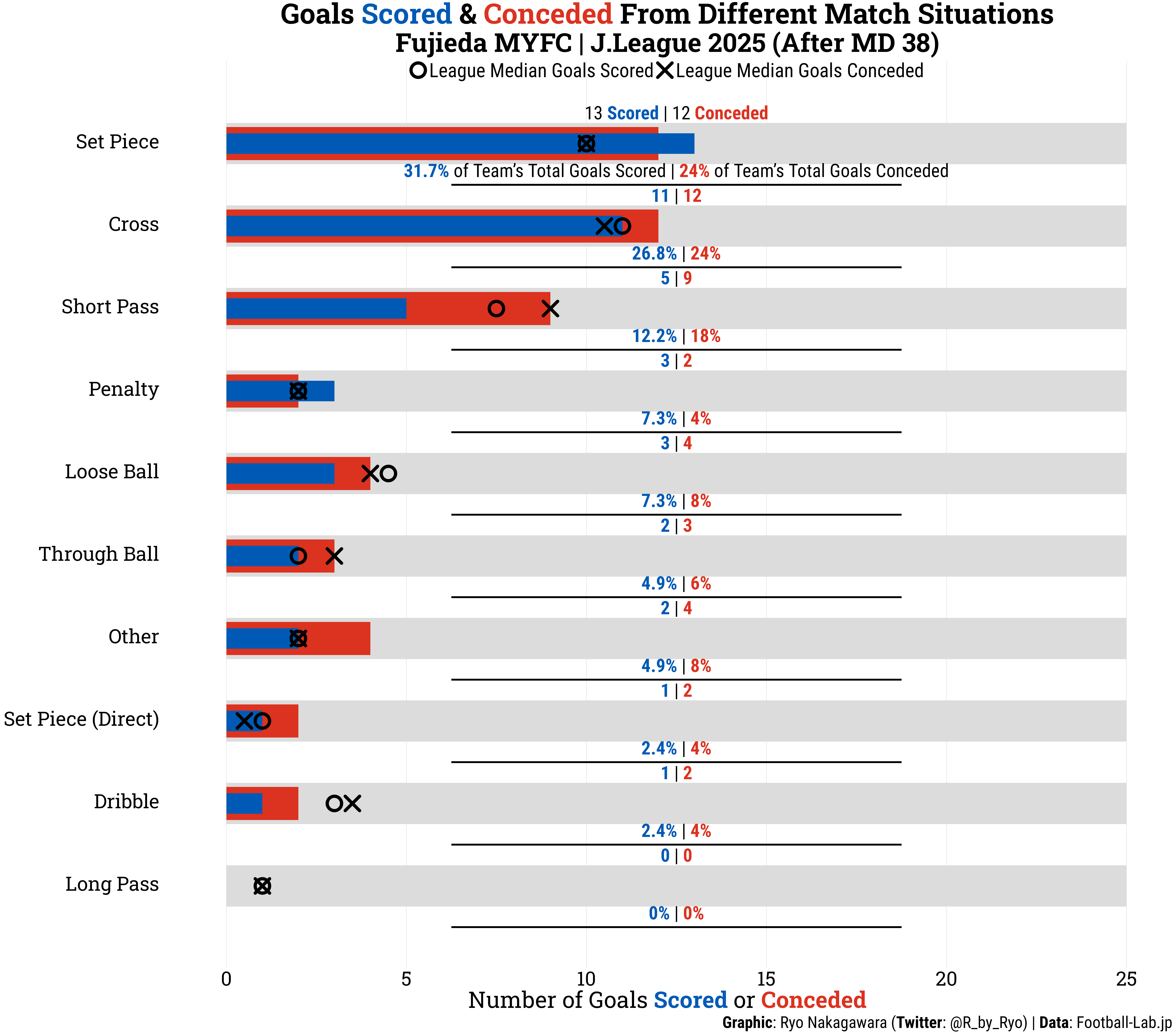
As discussed a good source of chances came from crosses by their Wing Backs but also Fujieda were quite handy on set-pieces with over 30% of their goals coming from these situations.
In goal, Kai Chide Kitamura has developed into a pretty decent goalkeeper at this level despite his 180cm stature probably limiting his potential at higher levels. He’s looked far more stable than in previous years when I was a bit skeptical of him. Kitamura is quite comfortable with his feet and is important to Fujieda’s build-up play.
An issue with this team was that they had a truly awful defense. For all of their skills on the ball, players like So Nakagawa and Ryosuke Hisadomi struggled to prevent danger. Of course, they were perhaps exposed far too often by their teammates as well. This is sort of the trade-off you’re forced to have at this level where the good ball-playing defenders aren’t usually very secure defensively.


There were lots of rumors about Daisuke Sudo being linked to quite a few other clubs which only reinforced his clout across the J.League. After the season ended it was confirmed that Sudo will be moving over to Yokohama FC. Even before thinking about any transfers, it would be a huge task for Fujieda to then find a similarly minded coach who can keep this club afloat in J2… Then big shockwaves reverbated across the J.League world as it was announced that Tomoaki Makino would step up to become Fujieda MYFC’s new manager. After spending the past few years since his retirement to get his coaching badges and manage amateur club Shinagawa CC, this will be the first step into the professional hotseat for the former Japan international.
Oita Trinita (16th, 38 Points)
8 Wins // 14 Draws // 16 Losses
Location // Stadium: Oita // Crasus Dome Oita
Manager: Tomohiro Katanosaka (to August) // Minoru Takenaka
27 Goals (20th); 44 Conceded (8th)
33.73 non-penalty xG (20th); 39.5 non-penalty xGA (5th)
Top goal scorer: Kotari Arima (5 goals)
Goalkeeper: Taro Hamada
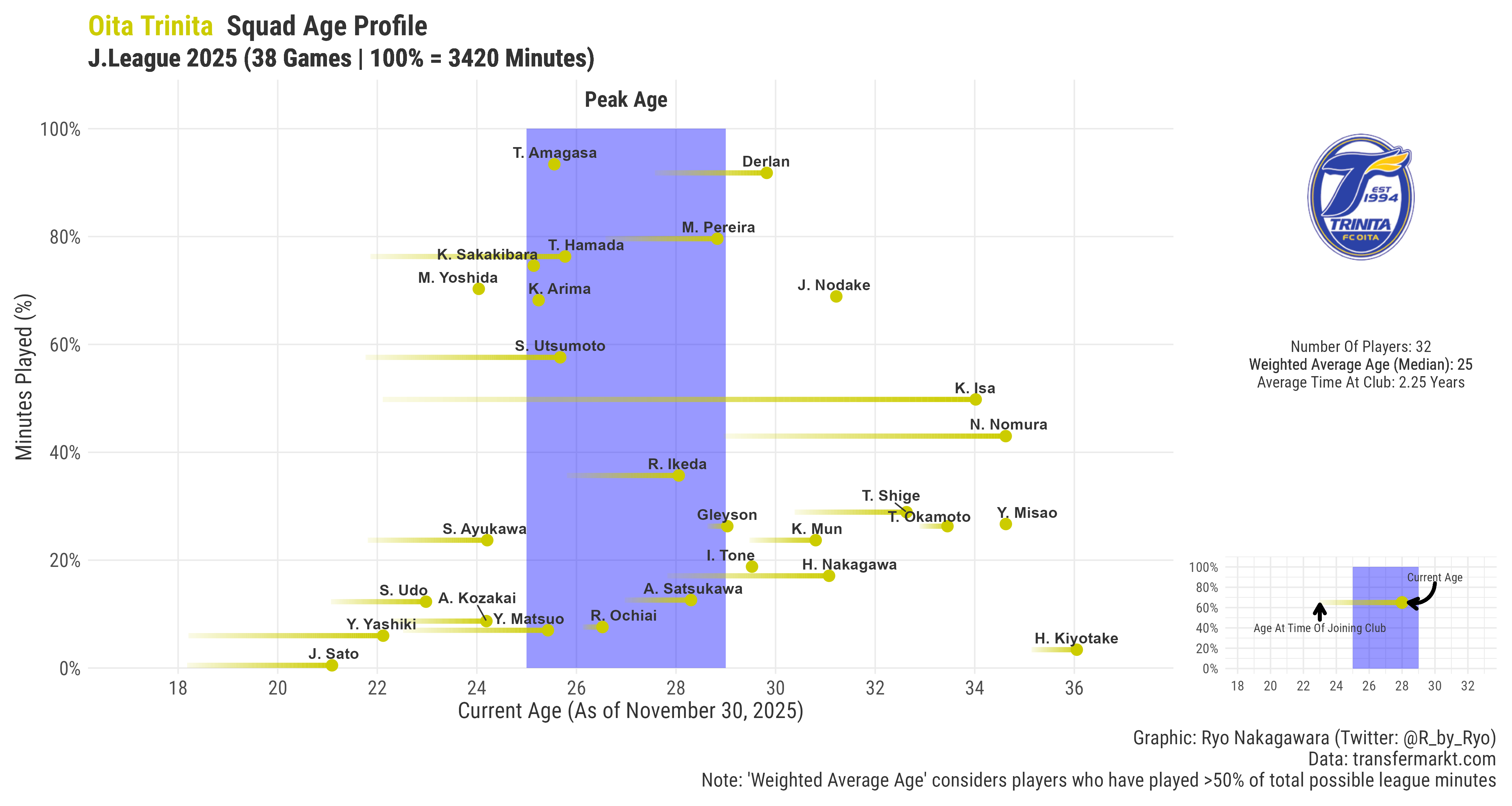
I was very worried about Tomohiro Katanosaka coming back to Oita Trinita as legends returning usually don’t work out. Sure, they just about survived relegation after Katanosaka was let go in August but... where does this leave them?
Oita scored 27 goals, no that’s not the amount of goals halfway through the season, it’s the total for the entirety of the 2025 season! They scored the least amount of goals in the league, seven less than newly promoted Kataller Toyama and eight less than Ehime who finished last. It’s not like they were creating lots of chances but finishing poorly as they also had the league worst xG as well! As you might imagine, Oita had the least shots, least shots on target, the least final 3rd entries, and 2nd worst penalty box entries… Across various five-game windows during the season Oita’s attacking metrics popped above one goal or xG for only a short period of time in the first half of the season!


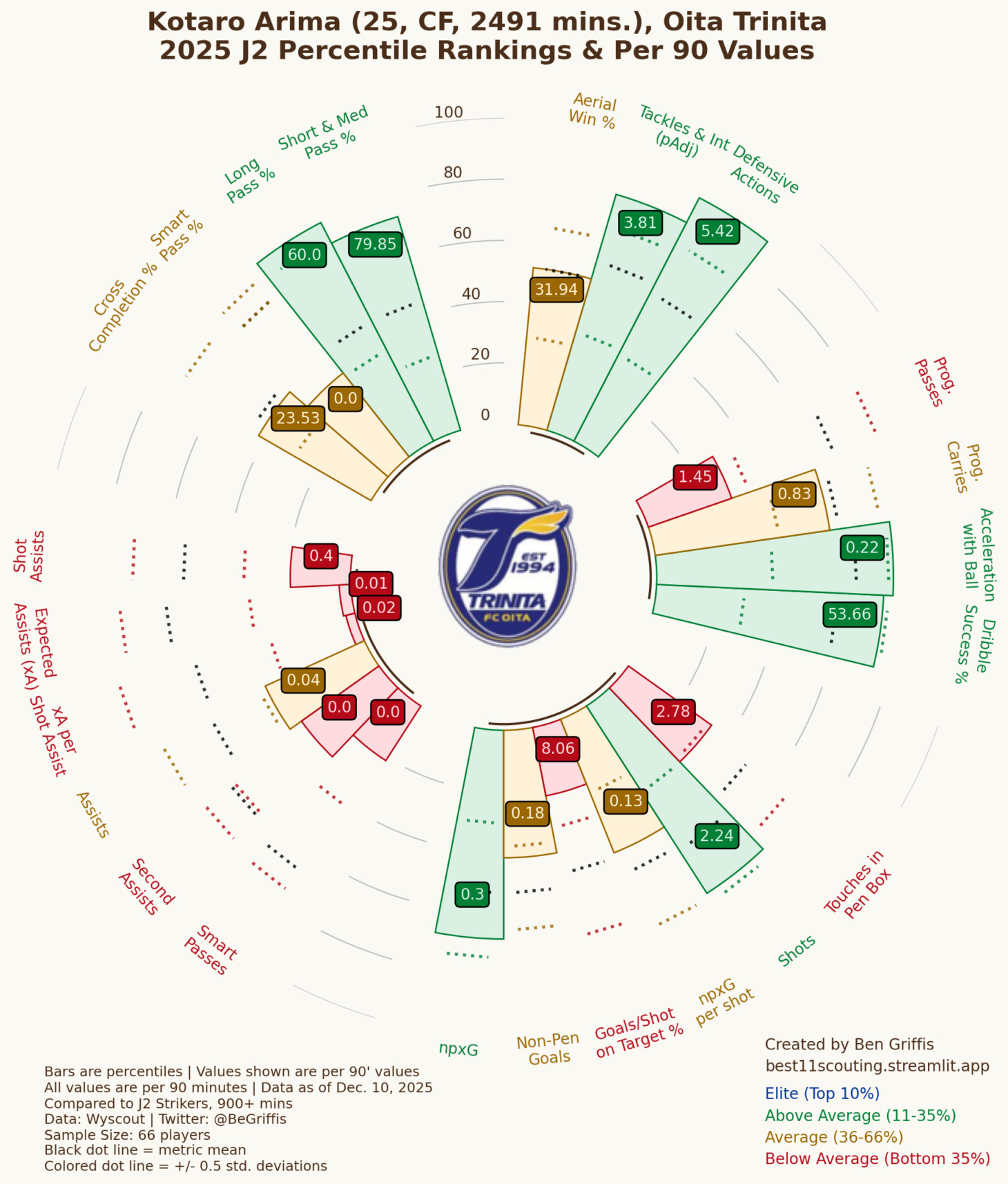
Kotaro Arima was the best of a bad bunch managing to accumulate 6.6 xG that he perhaps could’ve done a bit better with than his 5 goal haul. Gleyson was rather disappointing considering just how much havoc he wrecked with Fagiano Okayama to help them get promoted to J1 last season. Of course, given the complete lack of service for him it was understandable.
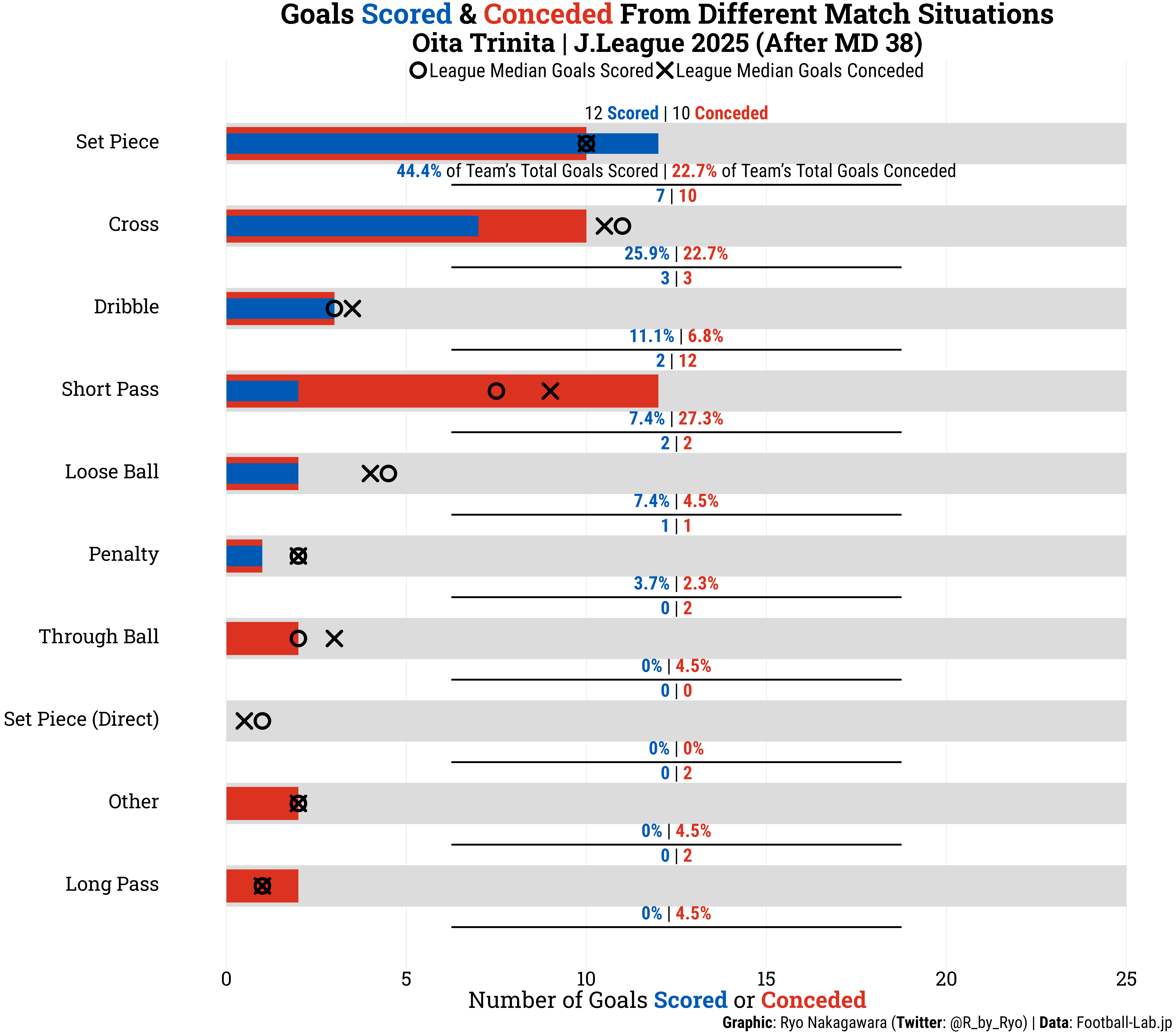
Their attack in open-play was truly dire which was highlighted by the fact that of Oita’s 27 goals, 12 or a whopping 44.4% came from set-pieces!
On the other hand, their defending was somewhat decent coming in 5th in xGA and 9th in goals conceded. There’s a solid base that Katanosaka built that was about grinding opponent teams to a halt but Oita didn’t do much else aside from that, especially with the ball considering they had the 3rd least ball possession in the league.


Taiki Amagasa was frequently the guy starting off attacks with a good first pass. Manato Yoshida, on loan from Yokohama F. Marinos, put in the hard yards as well bombing forward from Wing Back while remaining attentive in the defensive 3rd as well. He’s also decent in the air despite his short (173cm) stature.


Since their relegation in the 2021 season, Oita have really struggled and slid down the J2 table, doing just about enough to survive in the past 2 seasons. I’ve been pretty critical of them in past J2 reviews with good reason. The team are in for a proper reckoning if they don’t actually start to fix their issues soon... One positive news is that Shuhei Yomoda, who has been the mastermind of Yokohama FC’s multiple promotions (and also subsequent J1 relegations…), will take the reins in 2026 and perhaps get them back to a more upward trajectory.
Kataller Toyama (17th, 37 Points)
9 Wins // 10 Draws // 19 Losses
Location // Stadium: Toyama // Toyama Athletic Stadium
Manager: Michiharu Otagiri (to May) // Ryo Adachi
34 Goals (19th); 49 Conceded (13th)
39.37 non-penalty xG (16th); 50.14 non-penalty xGA (16th)
Top goal scorer: Shosei Usui (5 goals)
Goalkeeper: Tomoki Tagawa
Kataller Toyama were plucky underdogs heading into their maiden J2 season and interestingly they started off the season quite well with three wins in their first 5 games. However, a scary run of poor form where they did not win their next 15 games sunk them into the relegation battle and the sacking of manager Michiharu Otagiri in May. They struggled and fought hard under new manager Ryo Adachi but things were looking bleak. Toyama were eight whole points away from safety at the end of matchday 34 after a 0-1 loss against relegation rivals Renofa Yamaguchi. Miraculously though, they didn’t lose the rest of their games, drawing Ehime, beating Sagan Tosu, beating Kofu with a last minute goal and then…
In the final five minutes of their last game of the season against Blaublitz Akita, Toyama scored two to leapfrog Roasso Kumamoto on goal difference to remain in J2 for another season! Incredible! The safety-clinching goal was scored in the 93rd minute by 18 year old rookie, Ayumu Kameda for his first ever professional goal!
With the euphoria subsiding now, looking back at the season it was rather poor all around. Toyama were 16th in both expected goals metrics and had real difficulties creating any meaningful chances on average. Their attacking metrics only shot up in the last few games of the season when they were desperately throwing the kitchen sink against a number of teams in the bottom half. On top of that they lost their top goal scorer Shosei Usui (5 goals in 2.6 xG) mid-season to Avispa Fukuoka while the rest of the team struggled to replicate his finishing ability.


If you were to force me to choose somebody aside from Usui then, at least by the data, Sho Fuseya from Left Back looked decent enough.

Toyama showed remarkable resilience but the quality issues underlying the results are still apparent. This result gives Toyama some much needed respite and an opportunity to regroup over the 100 Year Vision League. Toyama fans will hope they won’t have to repeat such a heart-pounding experience in 2026/2027.
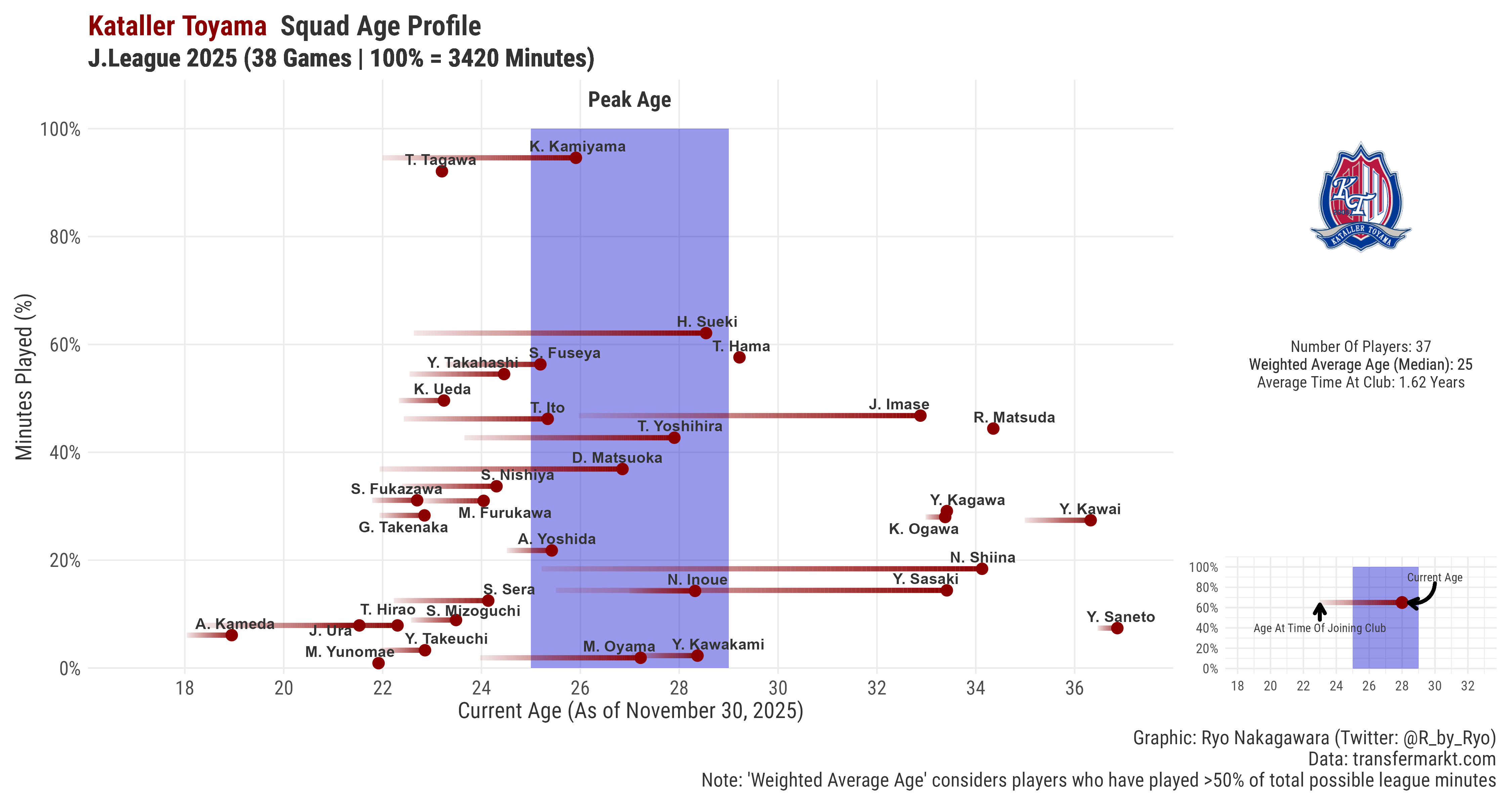
Roasso Kumamoto (18th, 37 Points)
9 Wins // 10 Draws // 19 Losses
Location // Stadium: Kumamoto // Egao Kenko Stadium
Manager: Takeshi Oki
41 Goals (15th); 57 Conceded (17th)
40.07 non-penalty xG (15th); 49.44 non-penalty xGA (15th)
Top goal scorer: Ryo Shiohama (9 goals plus 1 penalty)
Goalkeeper: Yuya Sato // Shibuki Sato (no relation)
A catastrophic final matchday. Things were made worse by the fact that Kumamoto thought they had done enough by securing a draw against Ventforet Kofu. They were keeping the ball in the corner and celebrated at full time… only for news of Toyama’s miraculous come-back deep in extra time flipping the table and sending Kumamoto down to J3. Truth be told, they should’ve secured safety outright long before that but Kumamoto did not win a single one of their last nine games of the season, including losing to fellow relegation strugglers Renofa Yamaguchi, Oita Trinita, and only taking a point from bottom side (with nothing to play for) Ehime FC in the penultimate game of the season. Their underlying metrics (xG, xGA) really tanked in the last stretch of the season…
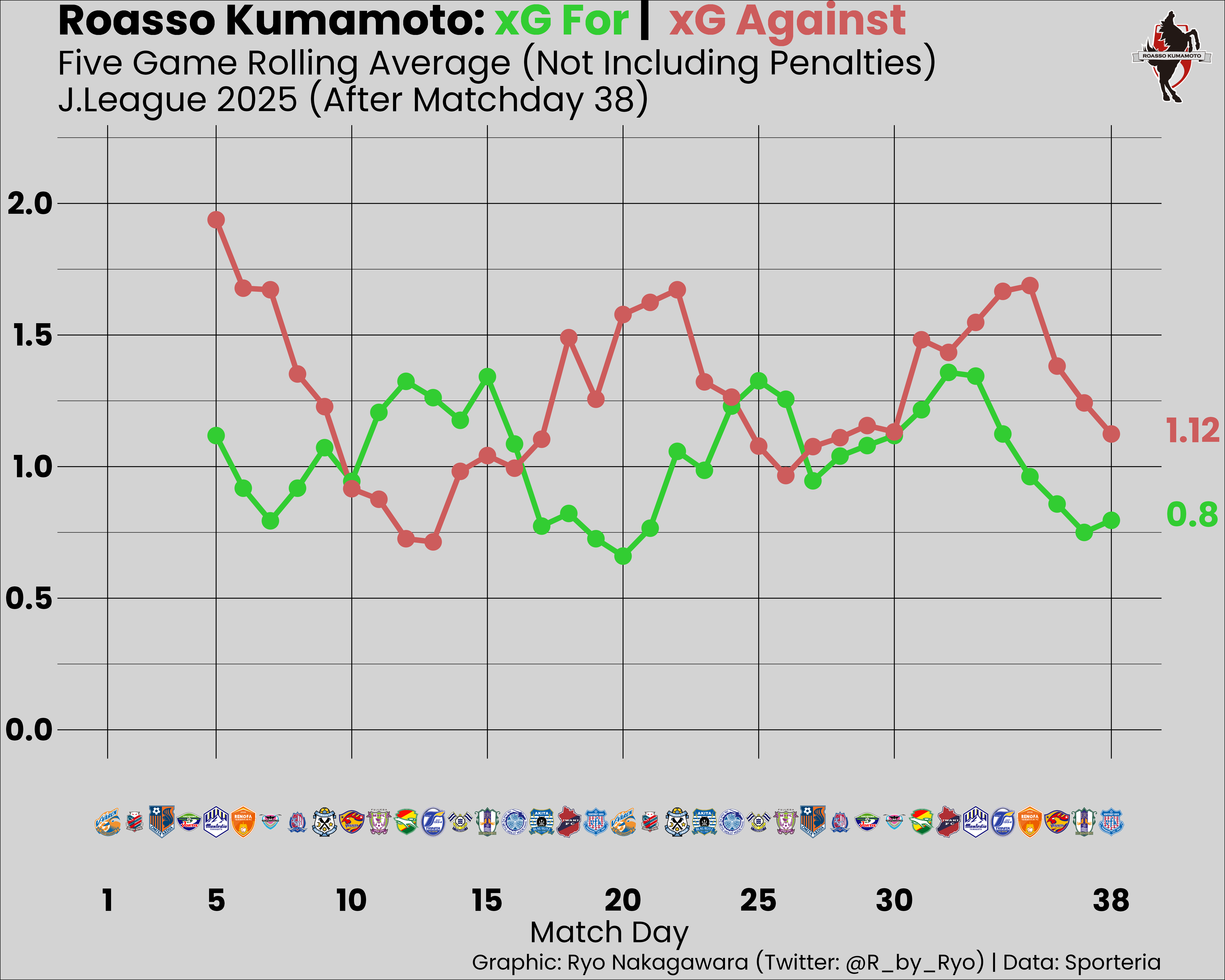
Under Takeshi Oki they have a fairly unique playstyle in a 3-3-1-3 with the midfield looking like a diamond. Kumamoto have been very focused on intricate passing moves as the midfield diamond and attackers all rotate around while the Back 3 are very adventurous in joining the attack as well. While Oki brought them much success punching above their weight there’s been a bit of a stubborness that has led to stagnation. This was coupled with the fact that there was difficulty attracting talent as it was difficult for new players to adjust to their unique play style and also their lack of funds relative to the rest of the league.
Ryo Shiohama stole the show, leading the team with 10 goals and also 3 assists. The winger integrated extremely well following a fantastic J3 season with Fukushima United and it’s likely he won’t be dropping back down to J3 again especially considering he’s 25 years old already.
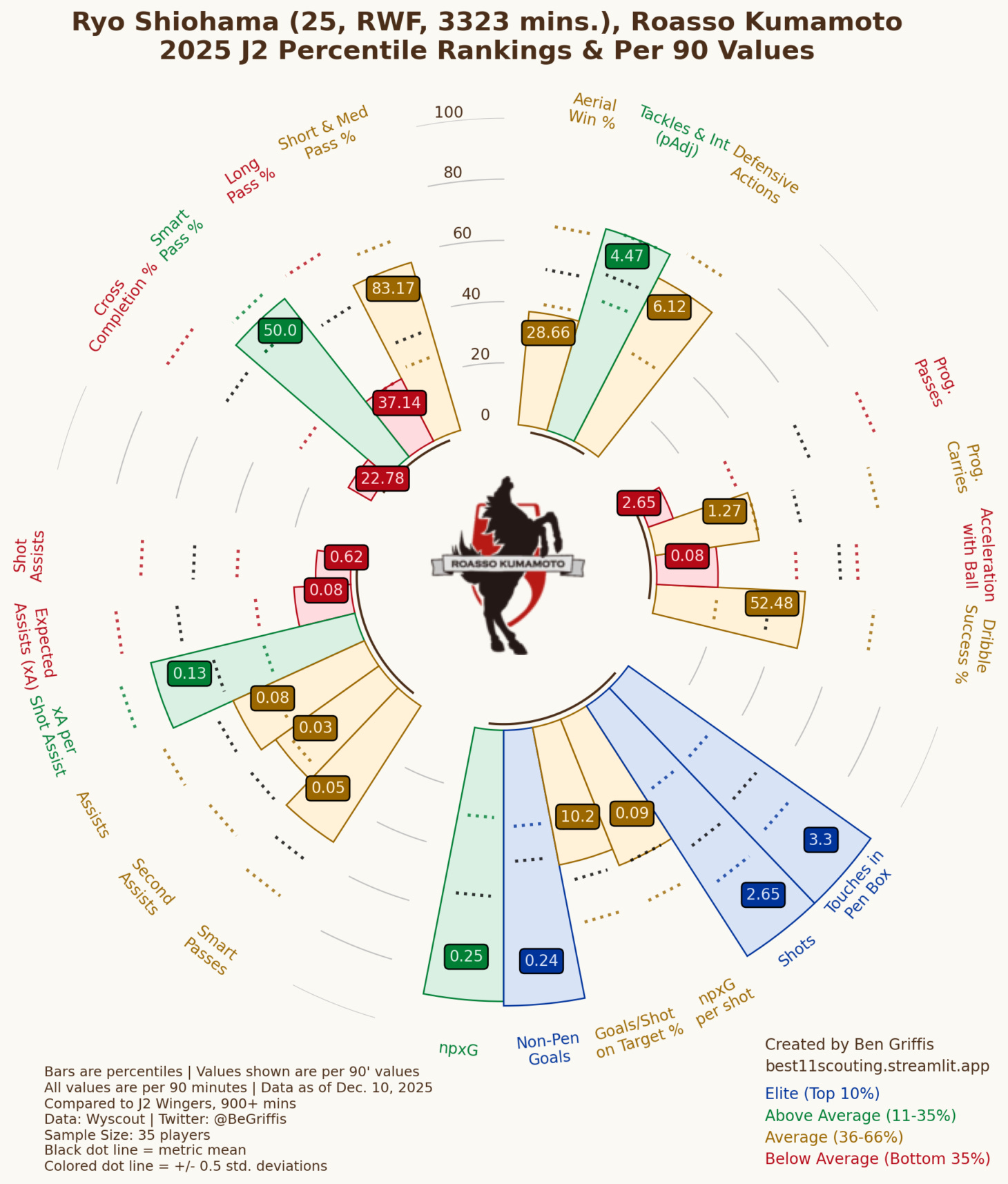
Masato Handai was a university graduate and did not look out of place at the J2 level. While he may not have the physical attributes to wow any potential European suitors, he has good technique and intelligence for receiving the ball in the right places in the way he plays as a very mobile playmaker from a striker position. He finished the season with a team leading 6 assists along with 3 goals.
Keito Kumashiro, on the other hand, was more of an outright #9 Striker type. Kumashiro has been making waves since last season where as an 16 year old he scored 5 goals (even if 3 were penalties). The youngster followed it up this year with a further 8 goals and 2 assists despite battling a major injury sustained in late 2024. He is very likely to get a move to Europe in the upcoming winter transfer window rather than go to a J1 club in my opinion.


Another that caught my eye was Koya Fujii. He’s an interesting attacking midfielder who can perform lots of different tasks along the front-line. He finished 2025 with 5 goals and 2 assists. Shuhei Kamimura is “Mr. Kumamoto” having been born and bred in the prefecture since his U-12 youth days. Despite relegation I can’t imagine him leaving his hometown club especially as he’s 30 years old now and perhaps aiming to be a “One Club Man”. Another very technical player with lovely passes from deep, stitching things together.


In the past I’ve highlighted Ayumu Toyoda in these J2 reviews but unfortunately it wasn’t a great season for him. He’s still only 25 though and perhaps a change in scenery might do him good. A few others like Wataru Iwashita and the North Korean defender Ri Thae Ha might be of interest too.


Kumamoto had poor metrics all around that wouldn’t be a surprise for any relegation candidate. Due to their funky possession style they were able to enter the final 3rd the 5th most on average in the league but getting further was an issue. They were 10th in penalty box entries, 10th in shots taken, 10th in shots on target… all of which led to just 14th in goals scored.
This is a terribly sad end to Kumamoto’s fairy tale under Takeshi Oki which included an J3 2021 champions, J1 promotion play-offs in 2022, Emperor’s Cup semifinal appearance in 2023 but 2025 ends with Kumamoto relegated. It’s difficult to guess what kind of squad Kumamoto will have next season as I think there will be quite a few departures. Despite the bad record, the club is filled with some very technical players that would be of interest to other J2 and perhaps a few J1 clubs. To end on a slightly positive note, the club did announce that Tomohiro Katanosaka is taking charge of the club next season. Given his success in taking up Oita Trinita from J3 to J1 along with a somewhat similar footballing philosophy this appointment does make sense and provides some hope for the future.
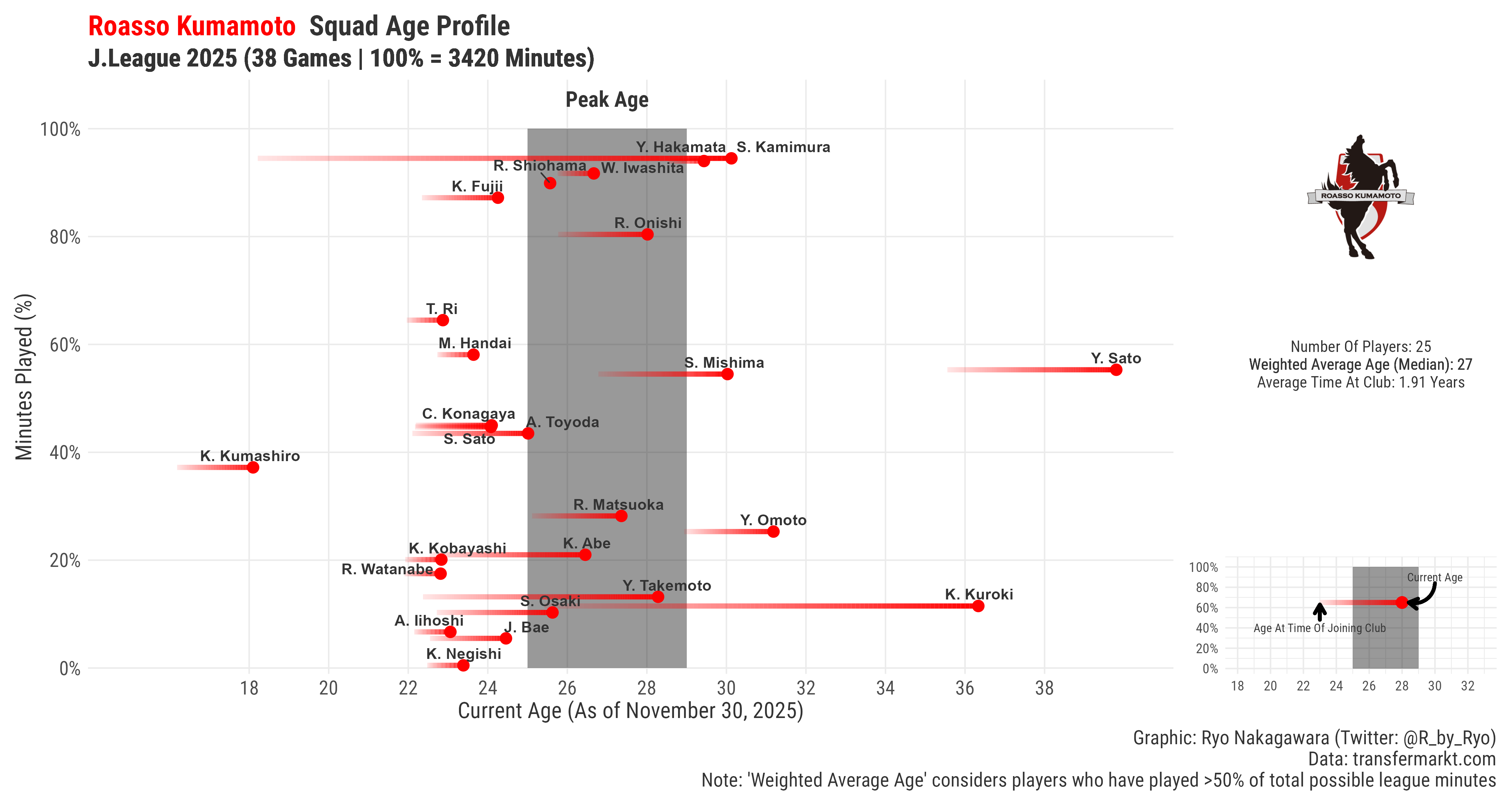
Renofa Yamaguchi FC (19th, 36 Points)
7 Wins // 15 Draws // 16 Losses
Location // Stadium: Yamaguchi // Ishin Me-Life STadium
Manager: Ryo Shigaki (to June) // Genki Nakayama
36 Goals (17th); 47 Conceded (12th)
45.73 non-penalty xG (7th); 42.31 non-penalty xGA (10th)
Top goal scorer: Ota Yamamoto (10 goals)
Goalkeeper: Nick Marsman
Renofa Yamaguchi’s squad was ransacked after a pretty good first year under the guidance of Ryo Shigaki. A lot of things went wrong as simply put, the recruitment to replace the departed players just wasn’t good enough. Yamaguchi had just three wins until Ryo Shigaki was finally let go after a woeful 0-2 defeat to fellow strugglers Ehime FC.
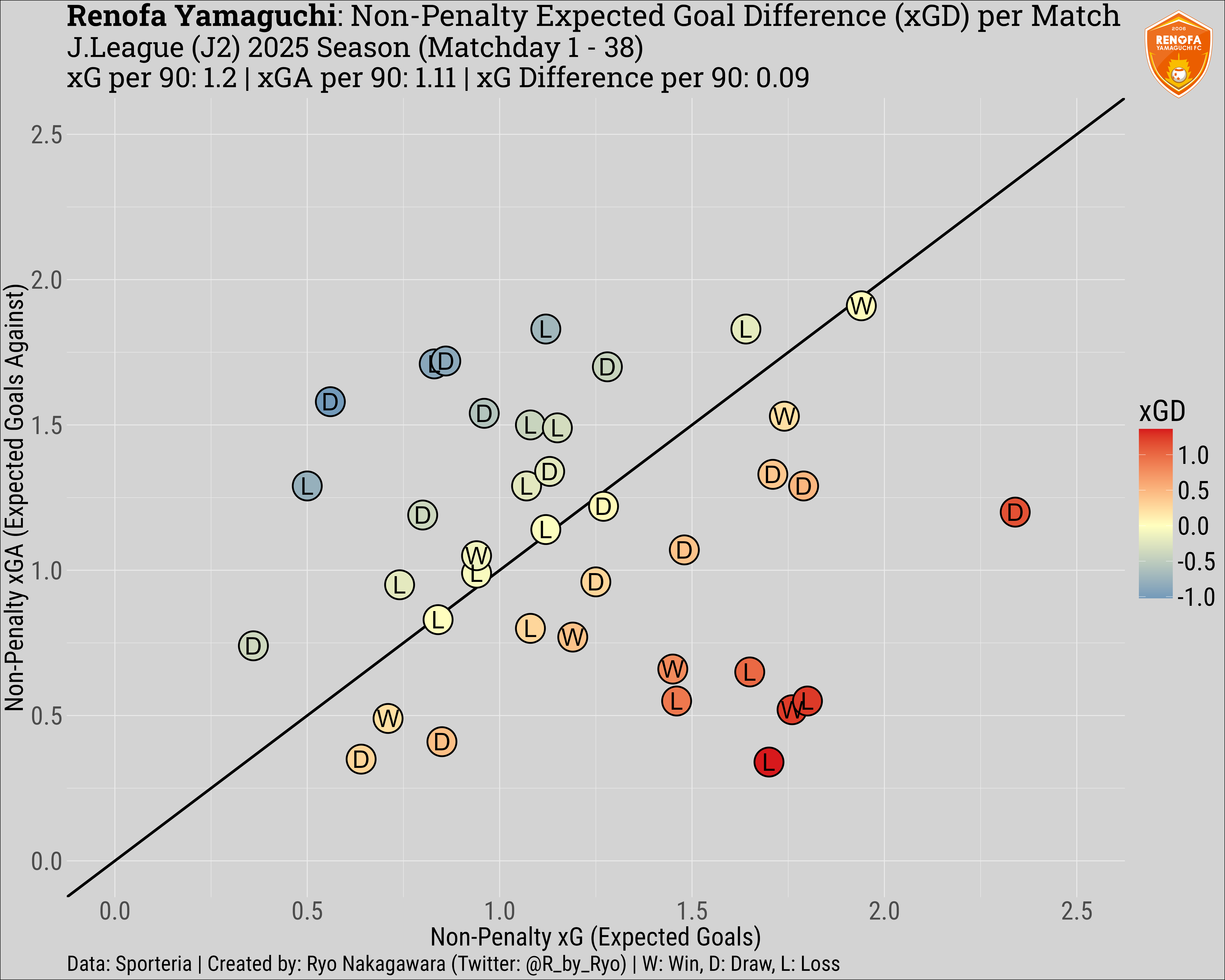
Renofa kept themselves in reach of Roasso Kumamoto and Oita Trinita above them as both continued to flounder and were with a chance through to the last matchday of the season. They managed to win against play-off contenders Omiya Ardija but results elsewhere meant Yamaguchi were relegated. What helped was that they kept most games extremely close, even when they lost it was by never more than two goals. There were lots of 1-2 or 0-1 scorelines where Renofa will kick themselves over not being able to grab an equalizer...
The biggest issue was that they simply could not score goals. With a defense that was around mid-table, Yamaguchi should’ve been fine but it was their finishing that cost them as despite having the 7th best xG in the league, they scored the 4th least amount of goals!
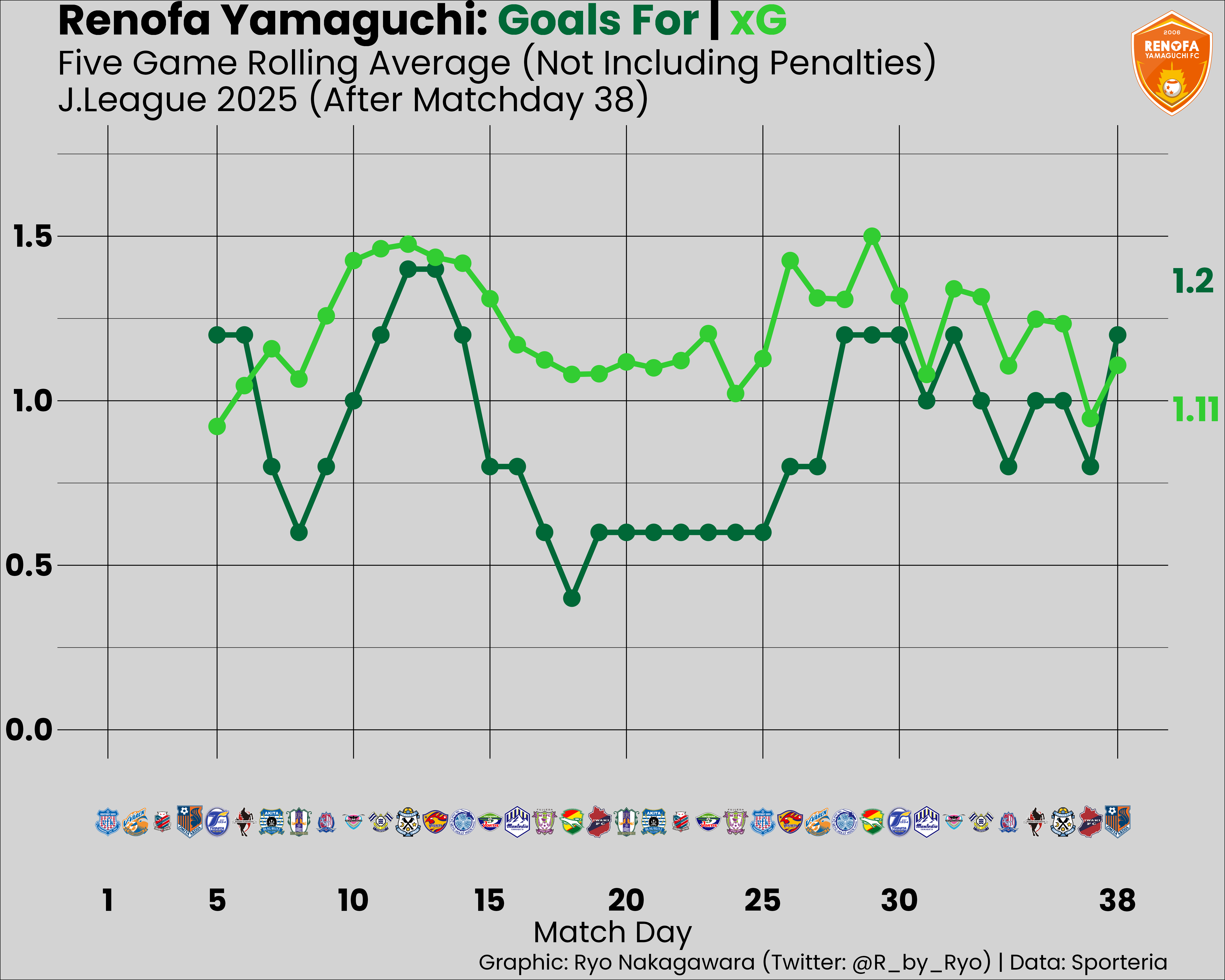
Ota Yamamoto, on loan from Kashiwa Reysol, did manage to score 10 goals from 7.4 xG. In general his ball-carrying and dribbling to push his team forward was as much value as his goal scoring. It’ll be interesting to see what happens to him as Reysol seem fairly stacked in the attacking midfield department. Perhaps a J1 loan instead?
Local hero Kota Kawano, who has spent his entire career with Renofa Yamaguchi dating back to their U-12 team came back from a long injury lay-off in the summer. At 22 years old and quite a decent player, I’m not sure what’s going to happen to him. Although he’s far too good for J3 at this stage in his career, he may also feel obligated to help his boyhood club back up to J2.


After a number of years yo-yo-ing between J3 and J2 , it seemed like the Ryo Shigaki era would bring new heights but now it’s back to the drawing board for the higher-ups at Renofa Yamaguchi once again...
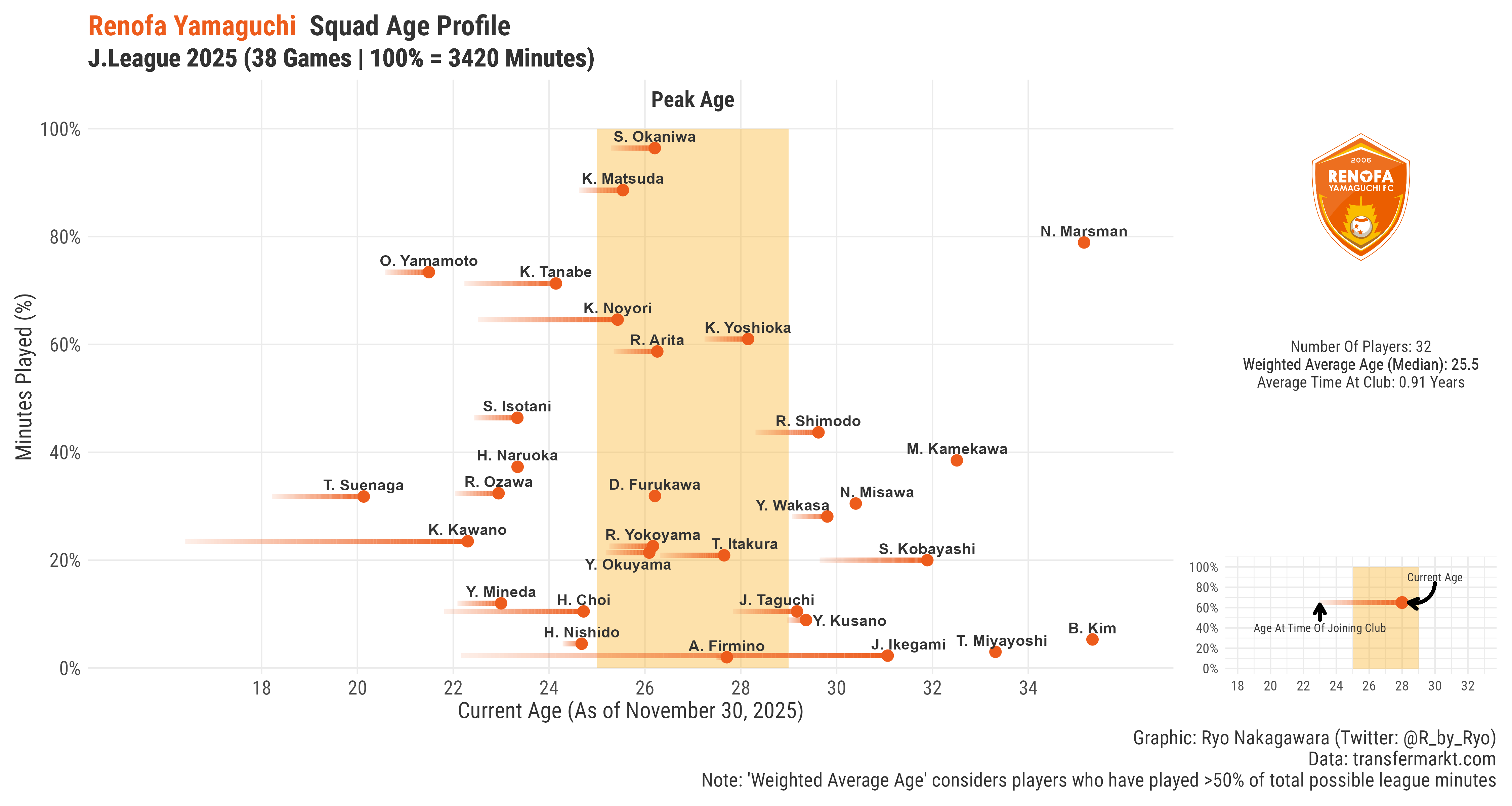
Ehime FC (20th, 22 Points)
3 Wins // 13 Draws // 22 Losses
Location // Stadium: Matsuyama // Ningineer Stadium
Manager: Kiyotaka Ishimaru (to May) // Shinya Aono
35 Goals (18th); 71 Conceded (20th)
33.79 non-penalty xG (19th); 53.44 non-penalty xGA (20th)
Top goal scorer: Ryo Sato (5 goals)
Goalkeeper: Shugo Tsuji
It’s been a theme over the past few seasons that Ehime FC’s terrible defense was a major issue. Yet, they simply never resolved it and this time around Ehime were rightfully relegated. Just three wins all seasons says it all really, it’s less than half of that of the next worse team in the table! The only time they spent outside the relegation zone during the entire season was on Matchday 1 (when they only lost by one goal to… newly promoted Kataller Toyama) and Matchday 3 when they somehow drew 1-1 vs. eventual league winners Mito HollyHock!
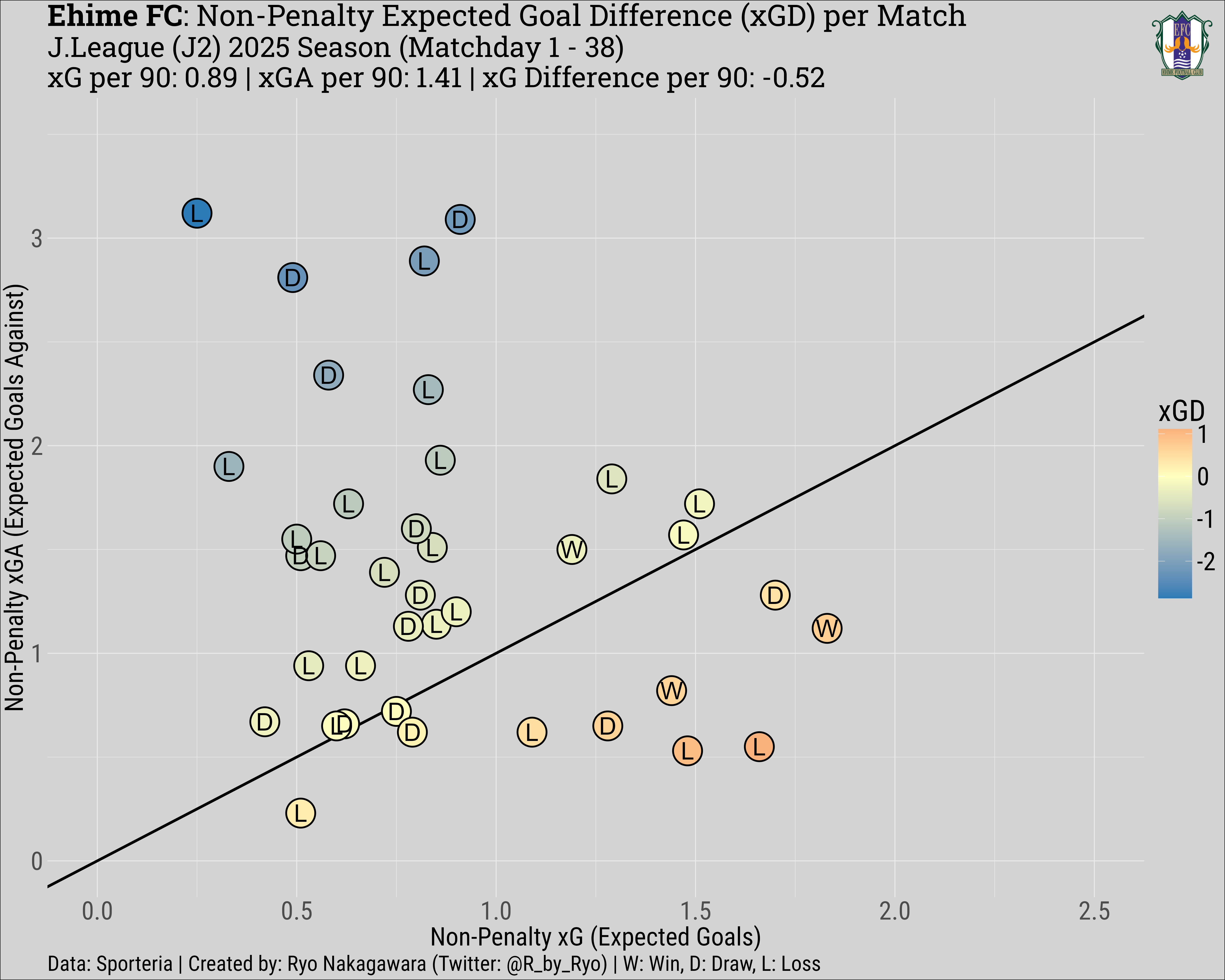
If you remember my 2024 J2 season review, I wrote the same thing that their underlying numbers have always been awful but this time it’s finally sunk them. They were absolutely rock bottom in terms of both goals conceded and xGA.


Players like Yuta Fukazawa and Shunsuke Tanimoto were doing their best though. Fukazawa stood out for his defensive activity (no doubt helped by how long Ehime spent defending of course…). While in-posssession Tanimoto was good at progressing the ball forward with his passing and carrying.


Their attack wasn’t much better considering they scored Ehime scored the 3rd least goals from the 2nd worst non-penalty xG. Things were dire all around. Perhaps the one bright light was Hidemasa Koda with 2 goals and 4 assists but he was only on loan from Nagoya Grampus.


It’s very hard to find any positives about them aside from the fact that Ehime have been very adamant about keeping a fairly young squad (aside from Tokushige), even if more than a few of their actual best players are just loans from J1 clubs. At the very least, they can bounce back in J3 without being weighed down by too many expensive multi-year contracts. This is on top of the fact that they don’t have too many foreign players and those that did barely played significant minutes so it’s much easier to justify letting them go.
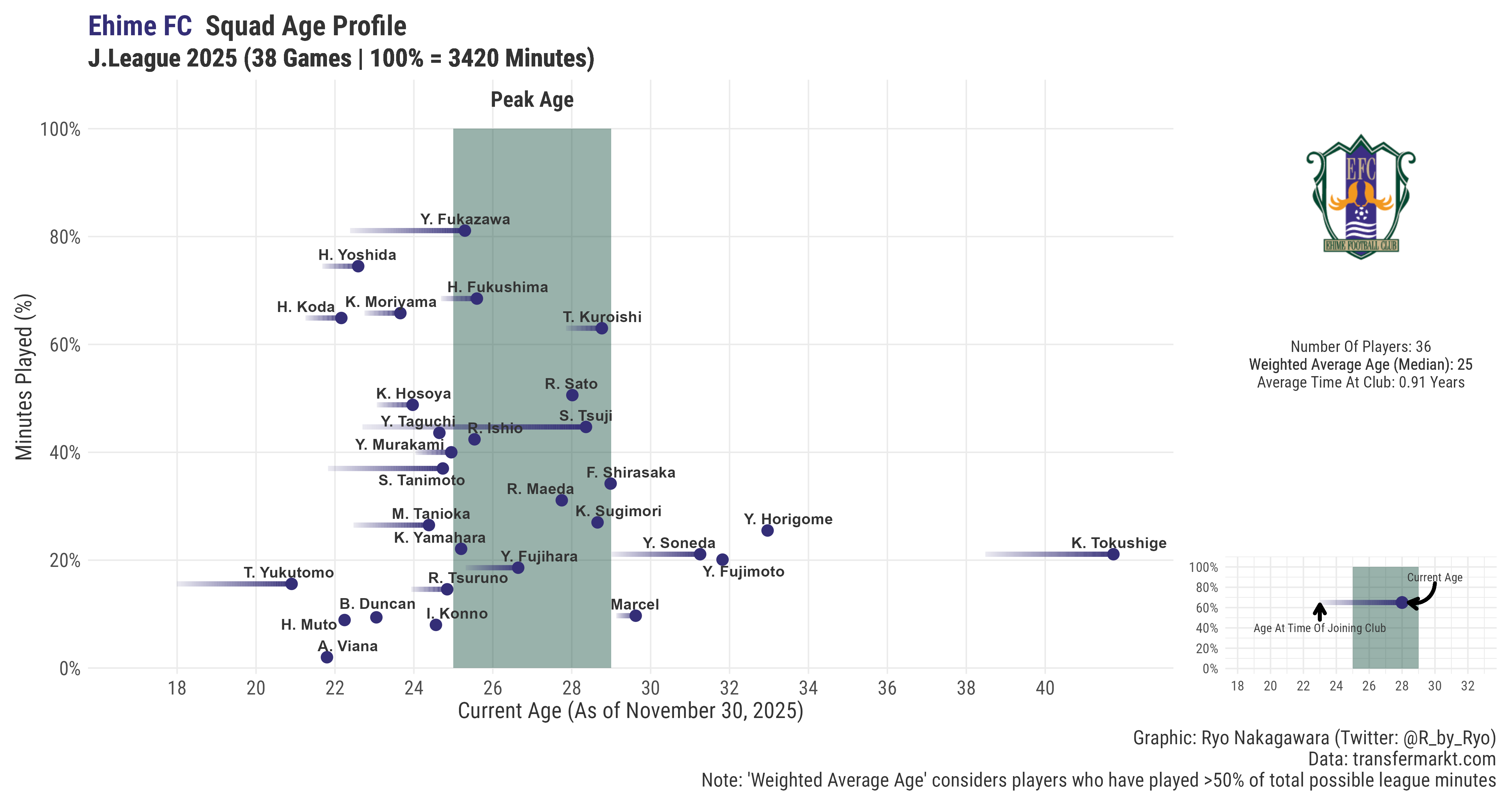
Data Visualizations
Squad Age Profiles
I changed the calculation of a squad’s median age up a bit by simply taking into account only players that have played 50% of more of total possible league minutes. This is so when looking at the ‘average’ age of a team, we’re doing a better job of considering players who are regulars in the team. I am not sure how other people might do it but from playing around with the raw data it looks OK, most teams have around 9~12 players that meet this threshold so I do think I’m capturing the right selection of players in any given team.
Anyway, here’s the list of the U-23 players in the league with the most minutes played so far this season (filtered for those that have played more than 50% of total possible league minutes). You might want to keep an eye on these guys in the short-to-medium term. One of the simplest ways to judge a player’s quality is minutes played. It doesn’t matter how much talent you have or how much potential if, in the end, you don’t actually see minutes on the pitch to show it off!
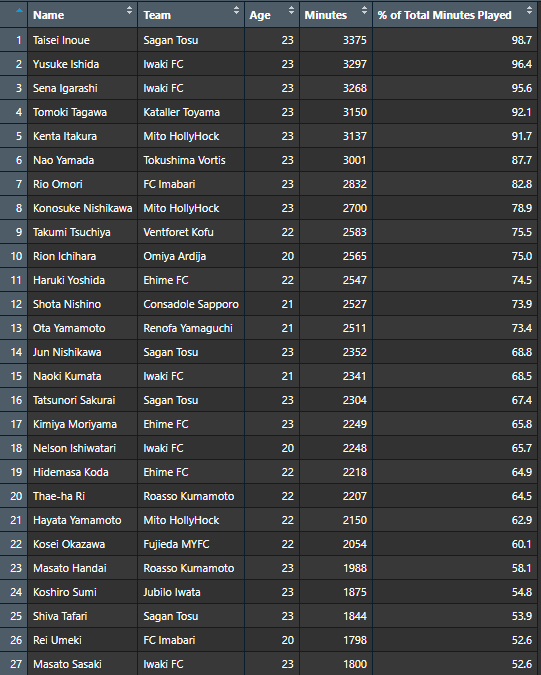
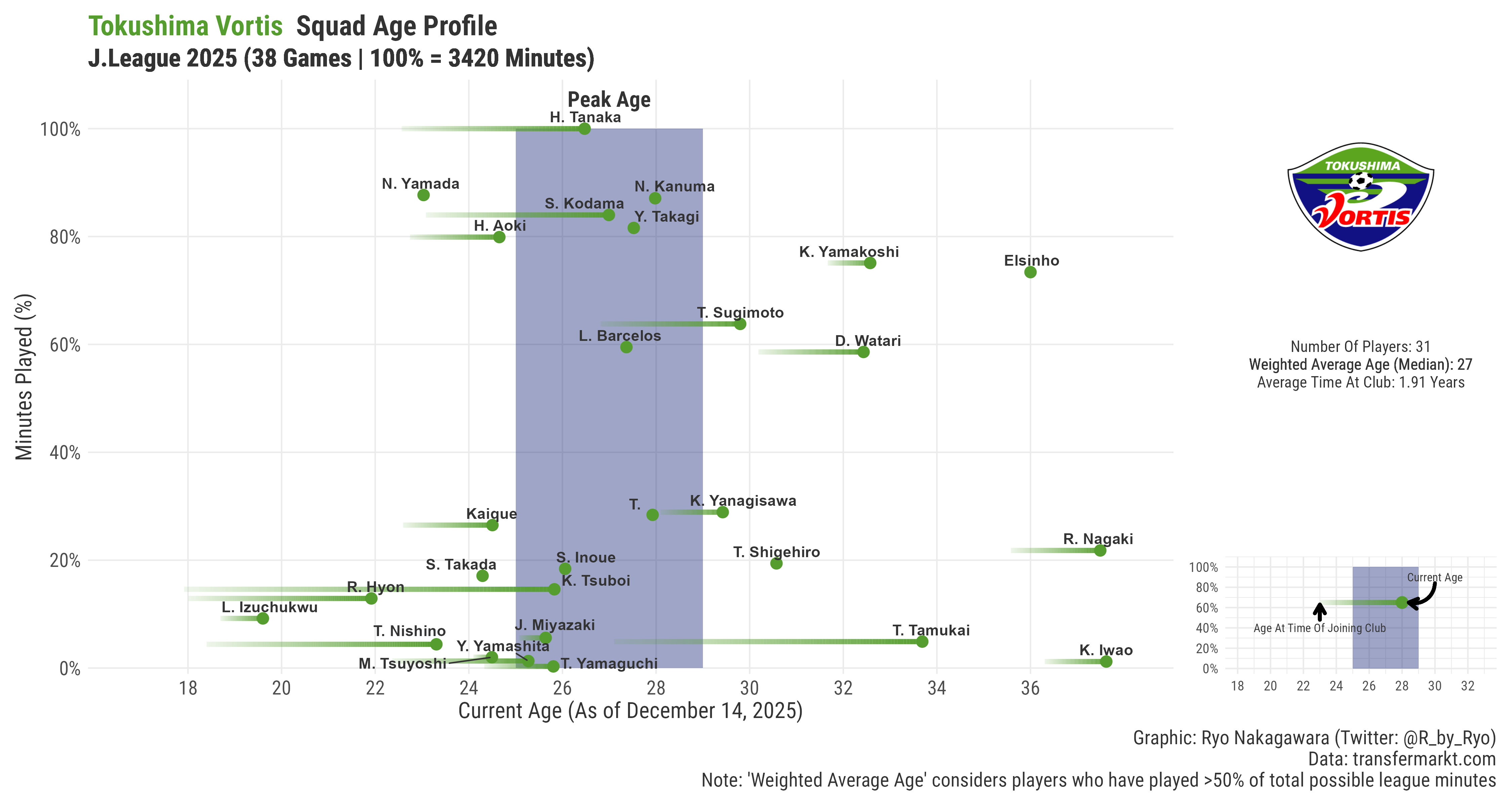
Scoring Situations
Ideally, I would have data that concerns all shots or xG accumulated from different match situations as that would mean a much larger sample of data to power any insights (as goals are only the end result and may not give us information about a team’s actual performance).
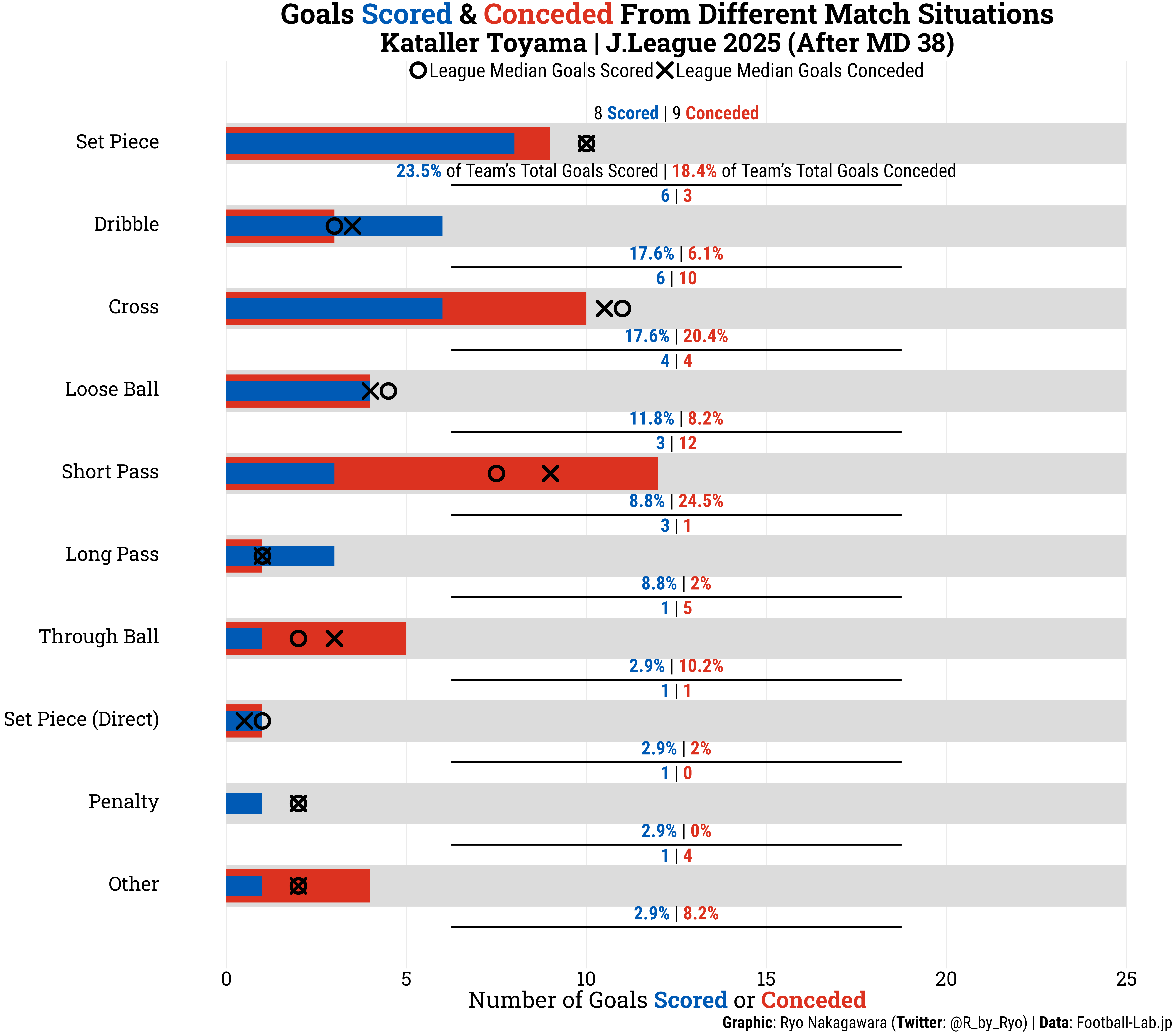
Team Shot Quantity & Team Shot Quality
In the previous few sections we got to know a lot about the goals that J.League teams scored. However, in a sport like soccer/football goals are hard to come by, they might not really accurately represent a team’s actual ability or performance (even if ultimately, it’s the end result that matters). To take things one step further I was able to gather data from Sporteria on shot quantity to dive a bit more into team performances. I’ve reversed the order of some of the stats in these next few plots so that in all cases the top right is best and bottom left is the worst teams when looking at their respective stats.
So, what exactly is expected goals (xG)? Expected goals is a statistic where a model assigns a probability (between 0 and 1) that a shot taken will result in a goal based on a variety of variables and is used for evaluating the quality of chances and predicting players’ and teams’ future performances. A xG model only looks at the variables up to the point that the player touches the ball for a shot. Post-shot xG models covers the information about where in the frame of the goal the shot went (“post” as in all the information after the player touches the ball for the shot) but I won’t cover that here.
For some quick primers on xG check the links below:
The following two sections use xG data from Football-Lab. I’m not privy to all of what goes into their model but the explanation page on their website (in Japanese) tells us about some of the information they used:
Distance from goal?
Angle from goal line?
Aerial duel?
Body part used?
Number of touches? (one touch, more than two touches, set plays, etc.)
Play situation? (Corner kick, direct/indirect free kick, open play, etc.)
So, the usual variables that you might recognize from other xG models are being considered. Combining shot quantity and shot quality numbers gives you a much better idea about a team’s performance on either side of the ball.


xG Difference
xG Difference is pretty much the same thing as Goal Difference except that we use xG and xGA rather than goals and goals against. This lets us see very quickly which teams generally outperformed their opponents in terms of quality of chances created to quality of chances conceded based on a xG model. This time around I also included the team’s results inside the bubble points. So it’s easier to see whether a team that had a positive xGD in a specific match couldn’t manage to win the game or vice-versa. You ideally want to be below the diagonal line and winning (W) these games as well.
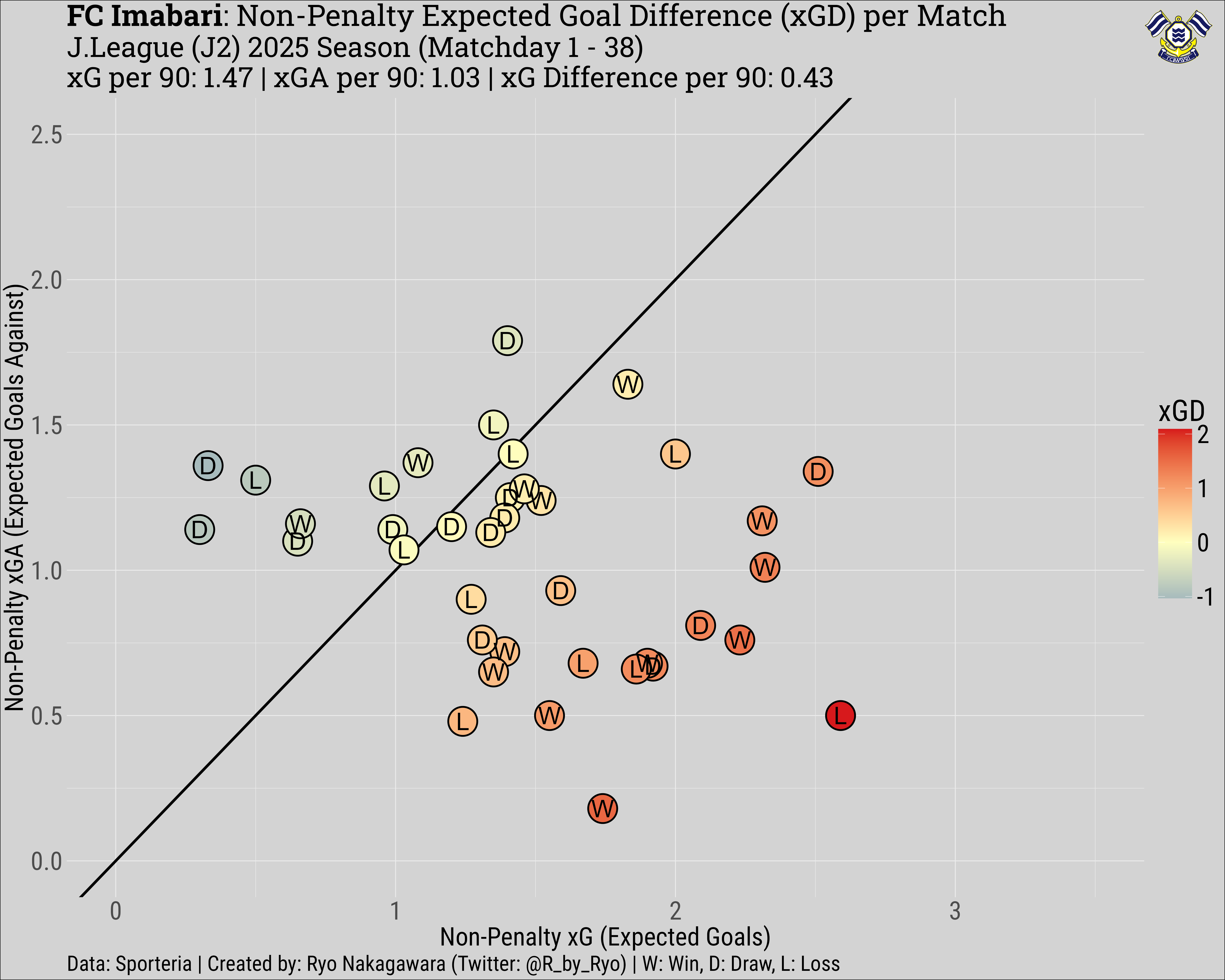
Five Match Rolling Averages
Goals vs. Goals Against
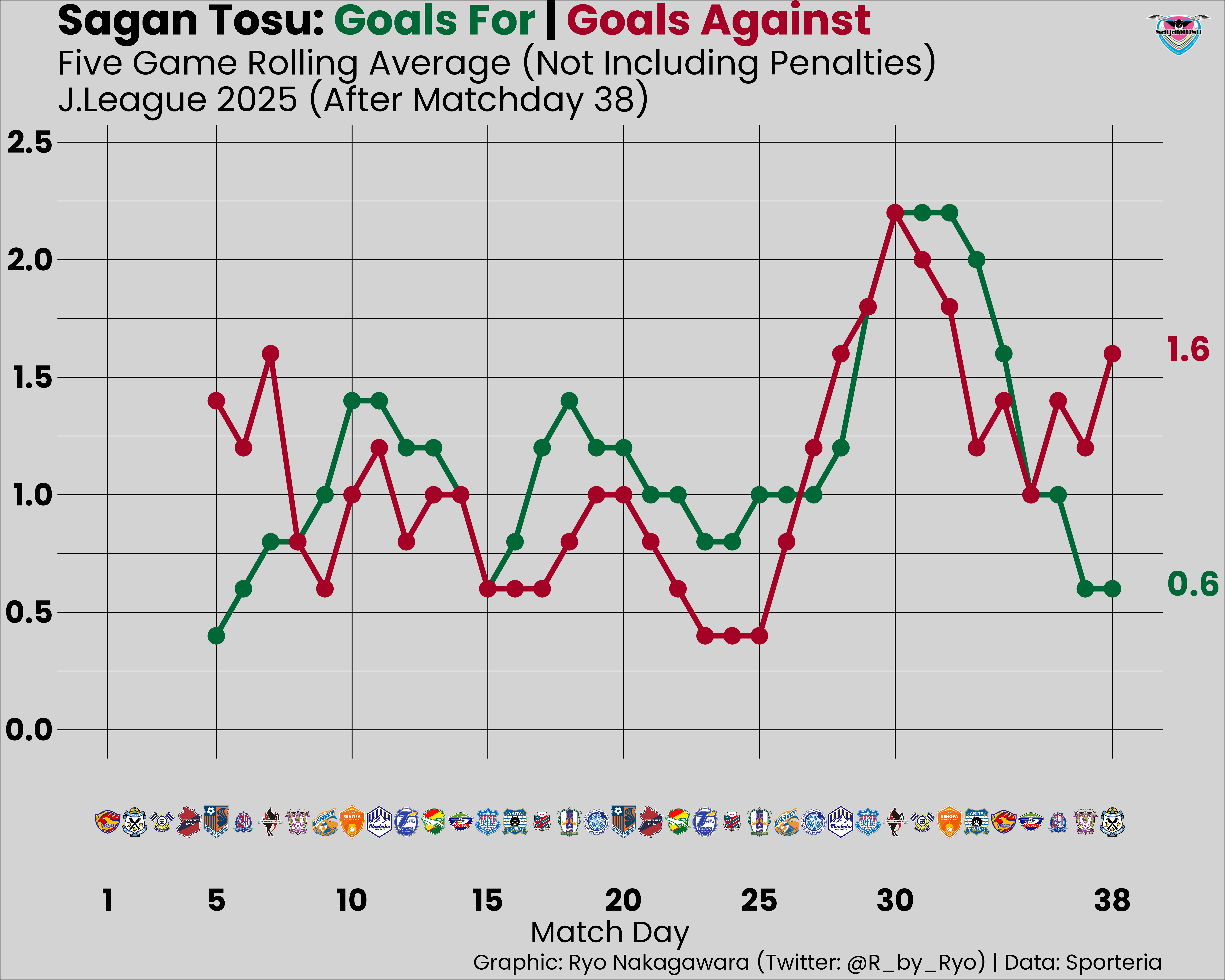
xG vs. xGA
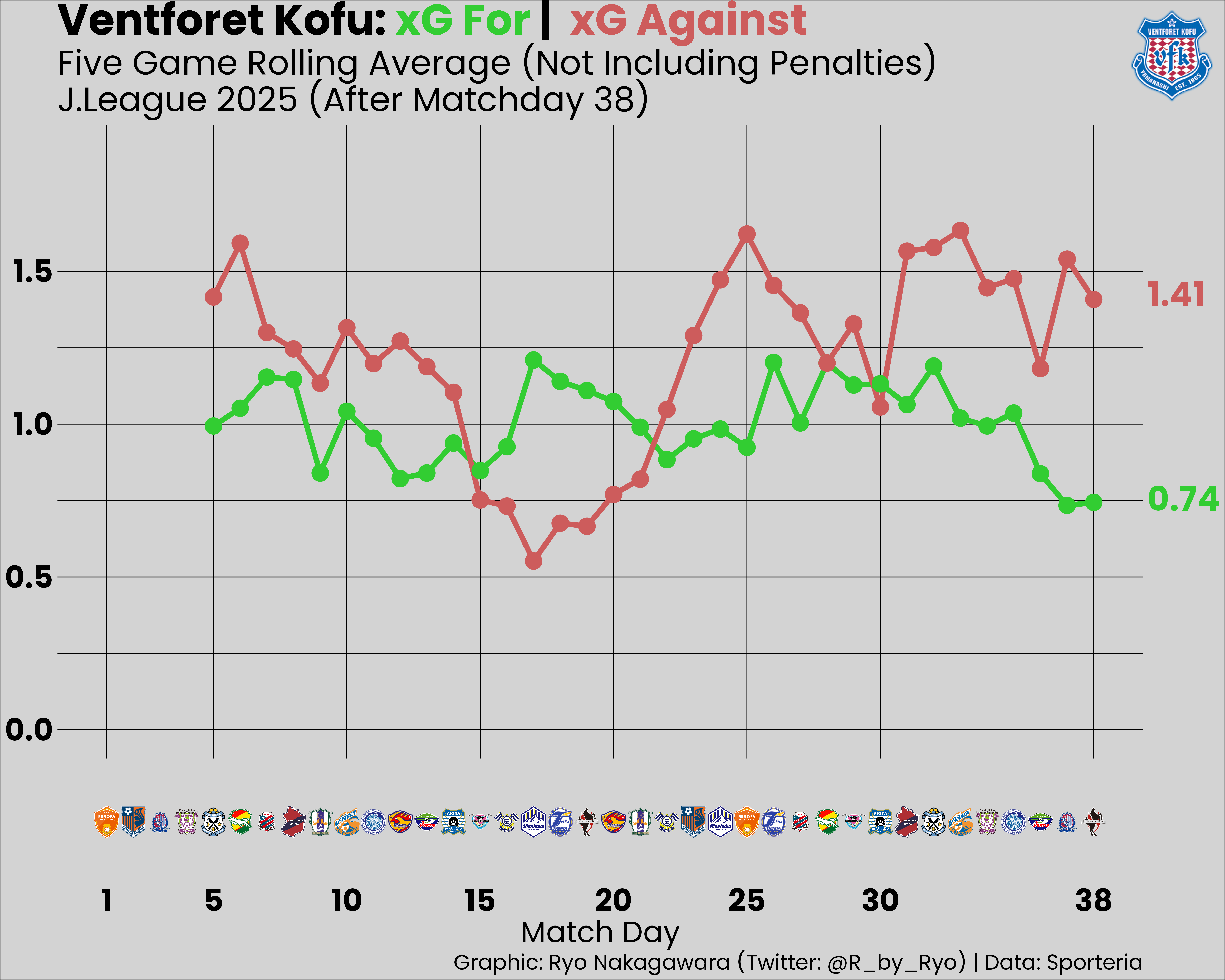
xG vs. Goals
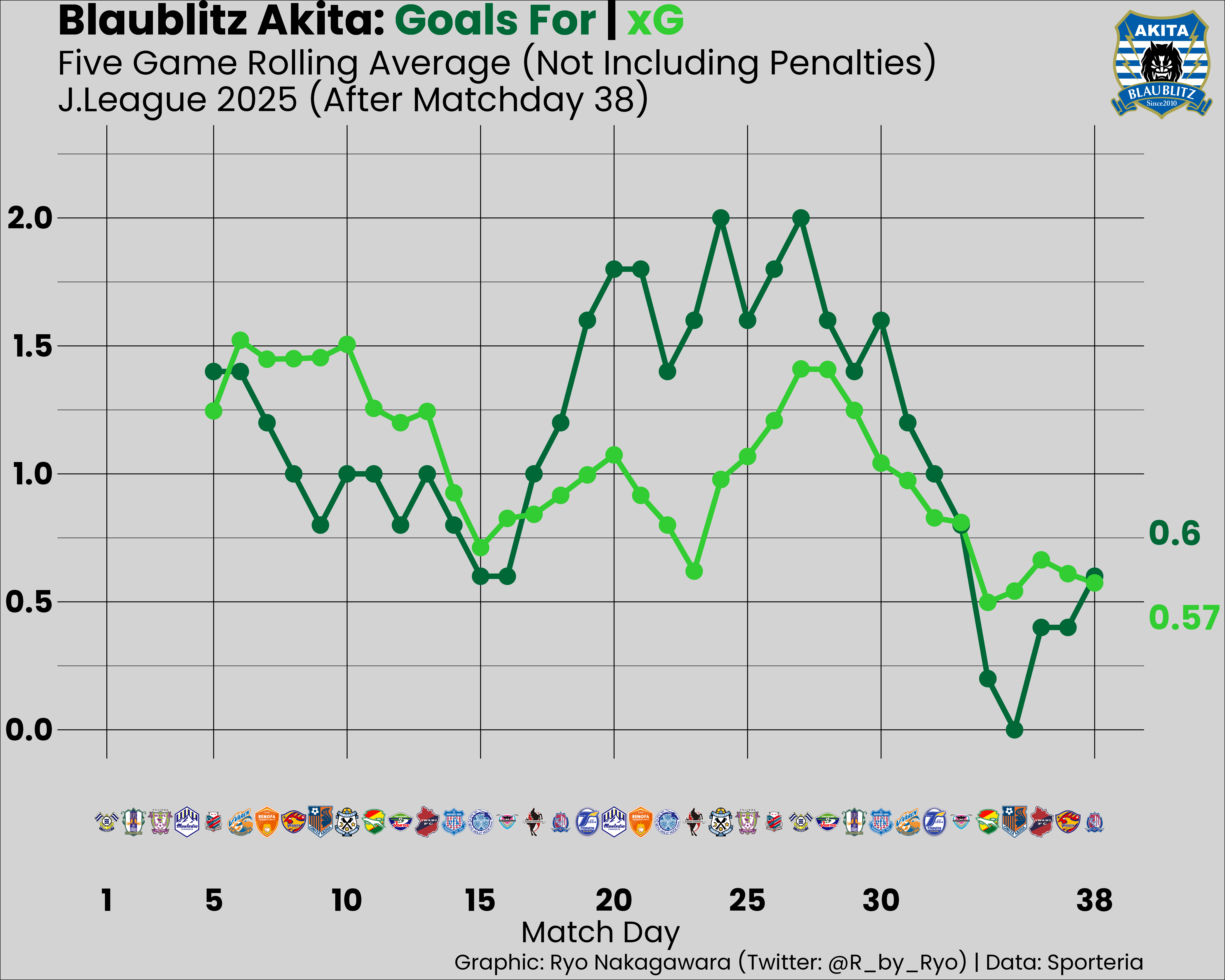
xGA vs. Goals Against
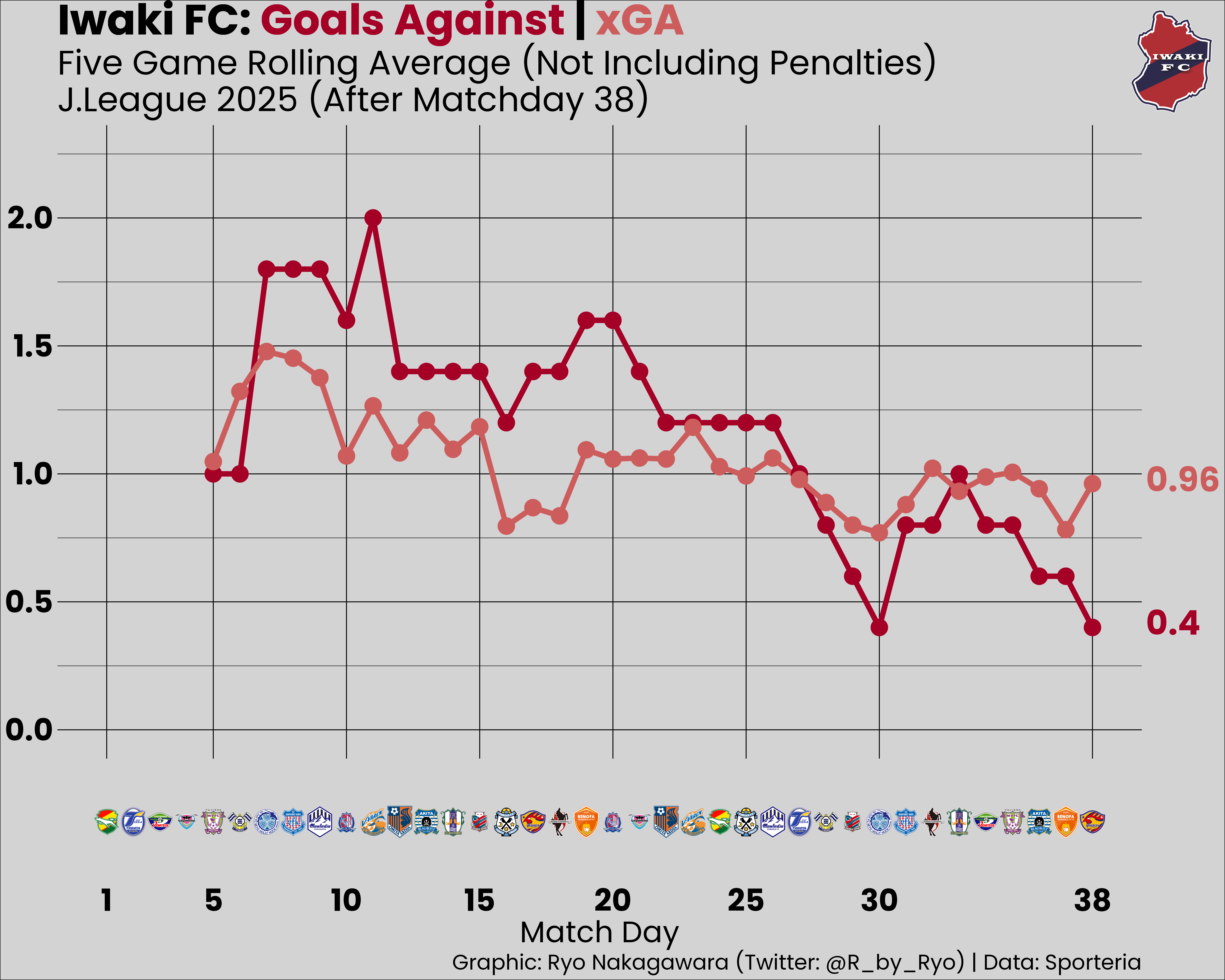
Summary
I’ll be honest, I enjoyed watching J2 far more than I did J1 this season. Yes, I sound like a hipster but it’s true! It’s clear a lot of other people did too as the J2 league hit their highest ever attendance record this season. An average of 8,888 fans per match across 380 games!
With promotion and relegation going down to the last few minutes of the final matchday on top of an absolutely rocking play-offs the 2025 season was one to remember. Mito HollyHock, V-Varen Nagasaki, and JEF United clinch a berth in next year’s 100 Year Vision League and the 2026/2027 season as J1 teams!
There’s still quite a few matches from this season that I want to watch so I may update sections on certain players or perhaps I might even write up a Shogun Soccer Scouting piece on them. There’s tons of talent even down in the Japanese 2nd Divsion, don’t sleep on J2!
Thanks for reading and Happy Holidays!