
2026 World Cup (Group F): Netherlands vs. Japan Review
A hard fought point but could it have been more?

Hello! It’s been an exhausting week or so, fighting little sleep while watching all the World Cup games! So yeah, sorry this one is coming out quite late. If you want more of an audio version of a review, I jumped on to the J-Talk Podcast to talk about the game.
Anyway, let’s get started!
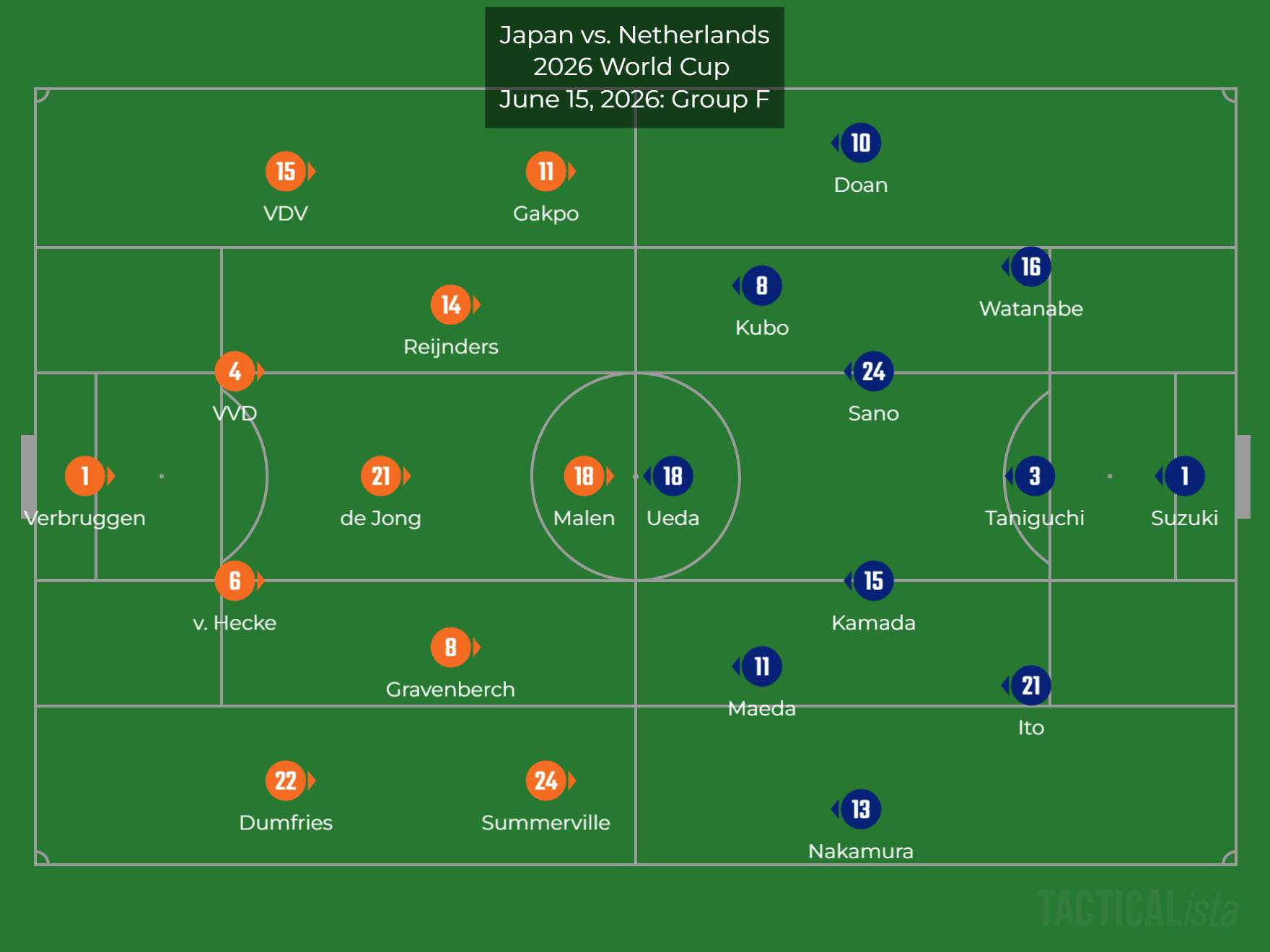
The Netherlands had a lot of the ball but weren’t creating as many chances as one might expect. Initially, Japan tried to shift into a 4-4-2 mid-block out-of-possession with Daizen Maeda pushing up to help Ayase Ueda but as the game wore on the team was largely pinned back into a 5-4-1 low block that we usually see against “big” teams instead.
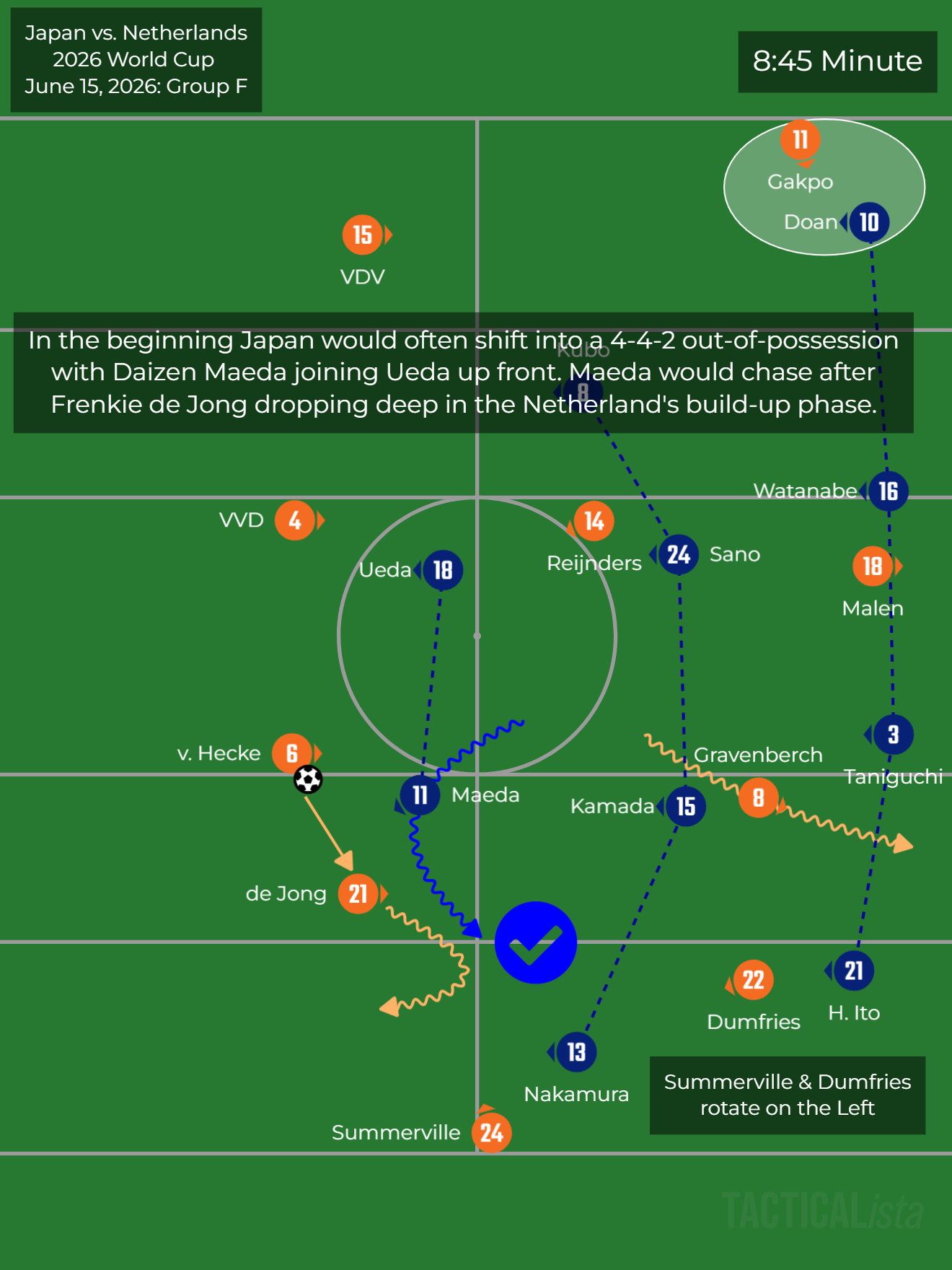
I do think the idea was to hold the Netherlands at bay closer to the halfway line, then hit them on the counter via Maeda’s running and/or Ueda’s hold-up play but I thought Japan struggled to combine and build attacks. I think Japan defended fairly well and limited the Netherlands but the team weren’t actually winning the ball and creating attacking transitions. Nevertheless, I thought Zion Suzuki’s first save against Malen in the opening minutes was a huge morale booster. I thought Zion was one of the best players throughout the match and he could do nothing about either goal conceded.
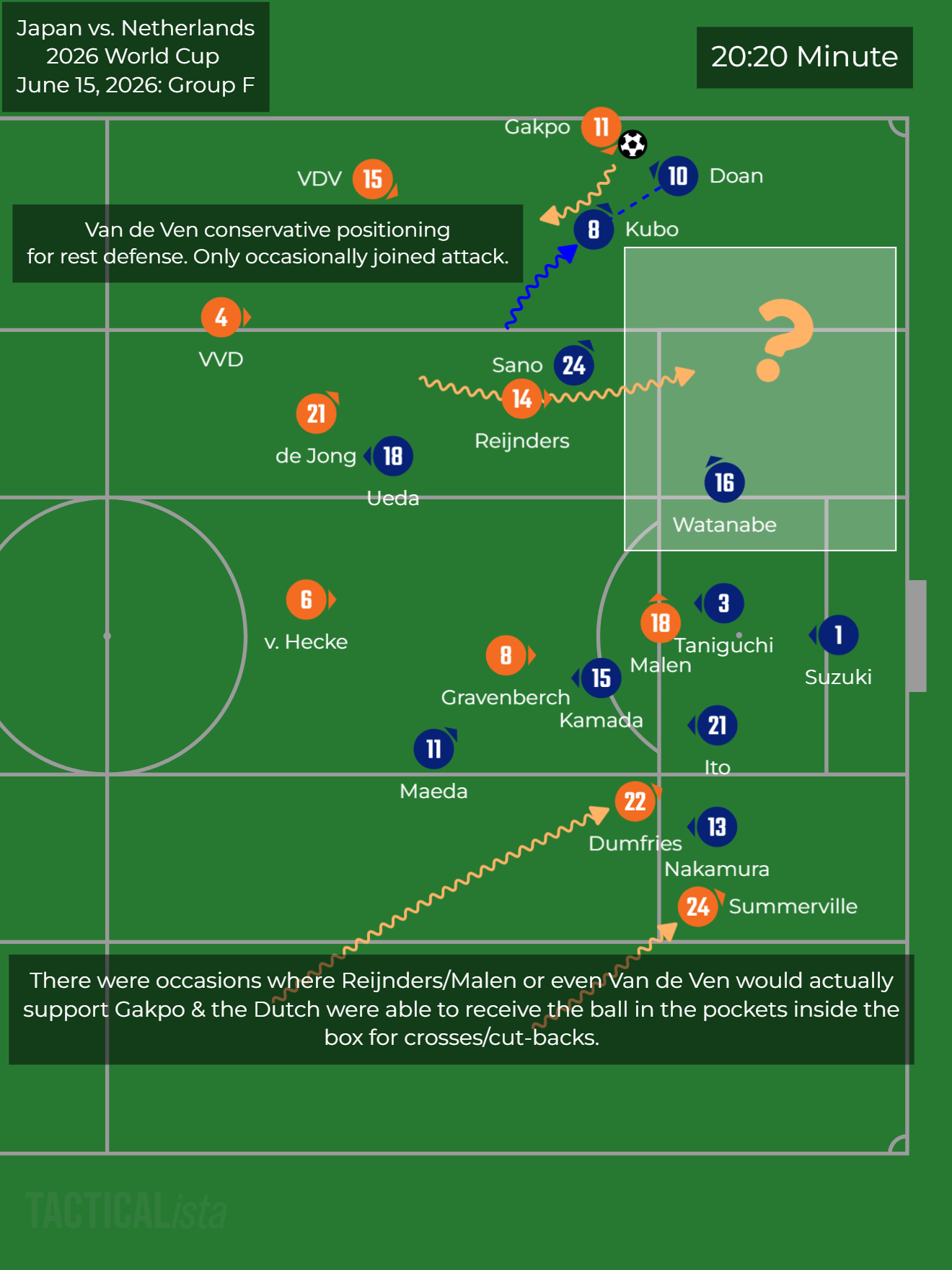
What I also thought was interesting was how it felt like more of a cagey game played between (somewhat) equals rather than a completely one-sided affair (like 2022). I do think the Netherlands (especially Koeman) had worries about committing too many forward in fear of Japan’s counterattacks. This meant that the Dutch couldn’t break Japan down as easily. The few times that Van de Ven supported the otherwise isolated and double-teamed Gakpo was when they were able to drive into Japan’s box to create danger.
Another major reason for the Netherland’s struggles was Frenkie De Jong inability to influence the game. Ayase Ueda put in a big shift to mark him closely, keeping the Dutchman in his cover shadow when the Center Backs had the ball and then marking him closely when Japan were pushed back. de Jong was forced to mostly pass the ball sideways rather than forward.
The Netherland’s attack in a lot of the first half was funneled toward Gakpo who had a clear size mismatch against Ritsu Doan but Takefusa Kubo tracked back to help double-team and force the Liverpool winger backwards quite often. This also meant that Tsuyoshi Watanabe didn’t have to vacate the box to leave space for Malen or other midfielders to run into. The trade-off of this was that it did mean both Doan and Kubo couldn’t provide a lot of attacking threat throughout the game.
Overall, I think Hajime Moriyasu played things very conservative here which is a common criticism of him. However, given it’s the first match of the group stage at the World Cup against a team like the Netherlands I do feel it was somewhat warranted. Even still, like I mentioned earlier I do think Japan could’ve done more to win the ball from their block and attacked more frequently.
Japan didn’t build up with the ball effectively and it was a bit annoying how quickly we shifted to booting it forward and I feel like that was one of the main reasons why the Netherlands had so much territorial dominance. Once the Netherlands took the lead, they did sit back more which allowed Japan on the ball but we need to be able to build-up under pressure more from the start. Anyway, I do think the couple of attacking moments Japan showed some promise in terms of the different ideas the team had.
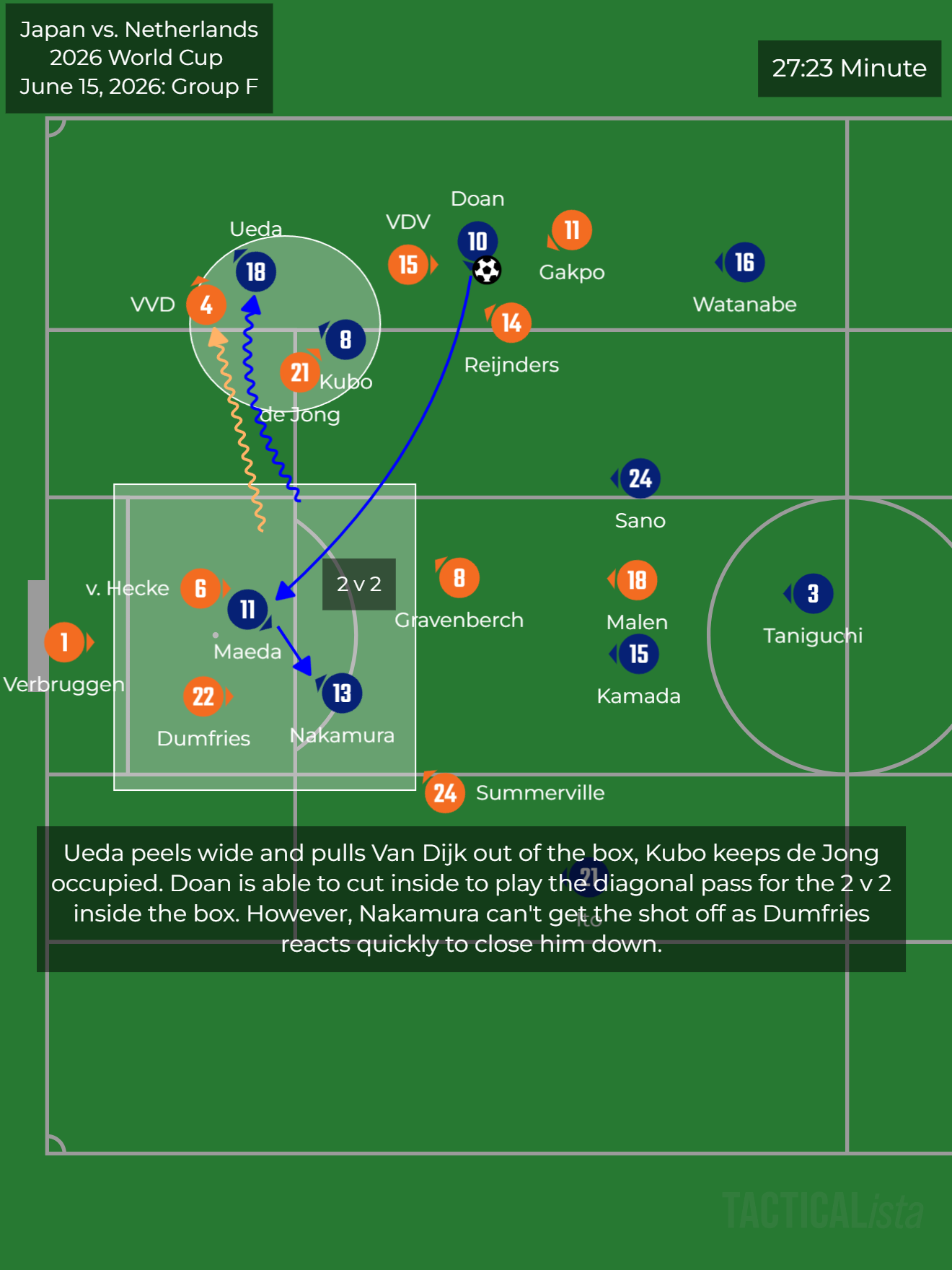
I think starting with a nominal Front Two, or at least Daizen Maeda in more of a striker role provided Japan with numbers in the box even when Ueda would pull defenders away from the middle like in the 27th minute scene shown below.
When the situation called for it the outside Center Backs would push up to support and create triangles with the Wing Back and especially on the Left, Kamada would shift over to combine as well. In the times Japan had possession, one could clearly see how important Daichi Kamada is to how we maintain and spread the ball as he drops into the back-line and then pushes up in support of the wide areas.
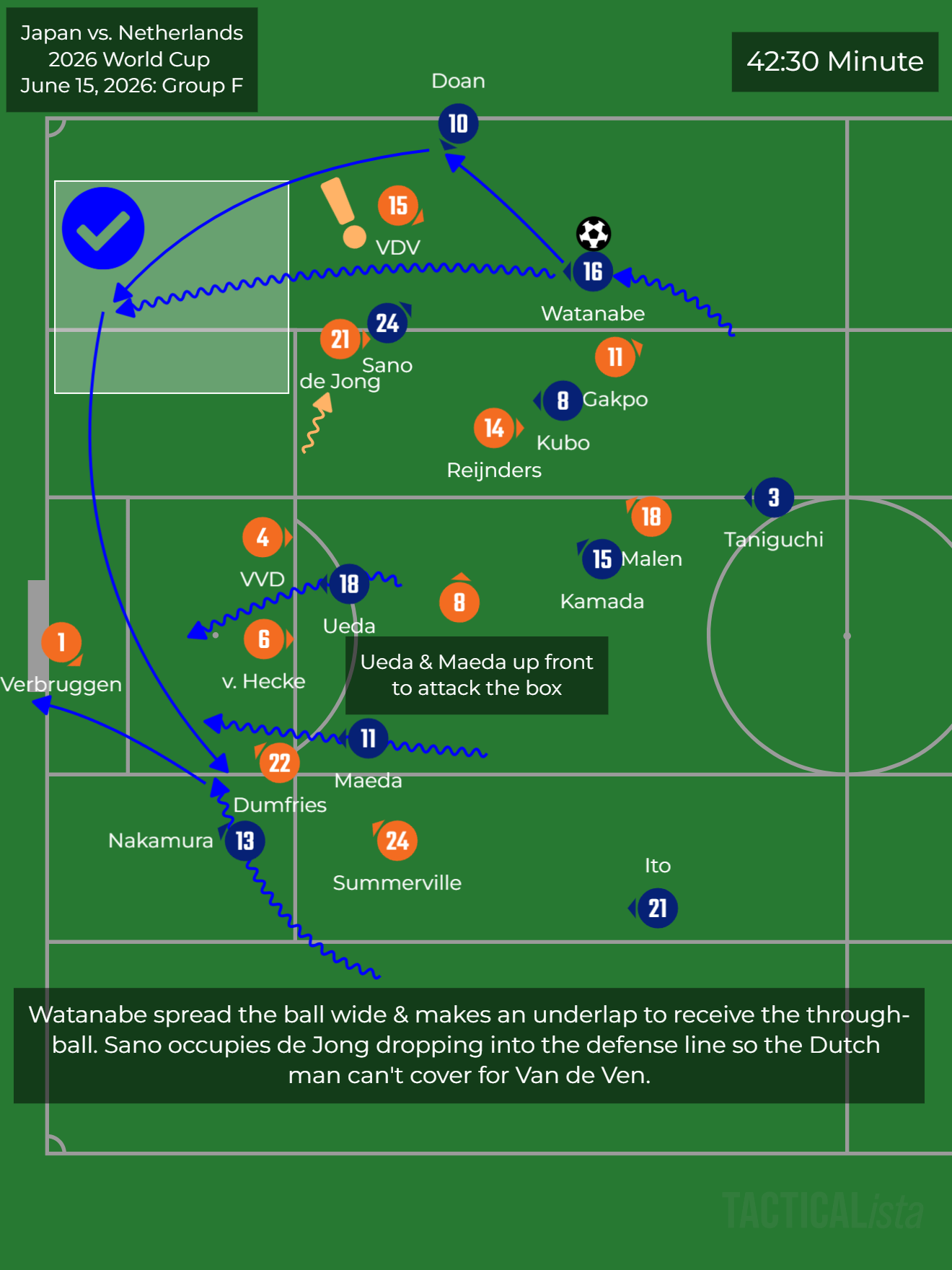
In particular, I quite liked Tsuyoshi Watanabe’s supporting runs like in the 42nd minute. I do feel these risky but potentially rewarding Center Back involvements in attack was something that was missing throughout the AFC World Cup qualifiers (especially against Australia) in 2024~2025 so it was nice to see that here.
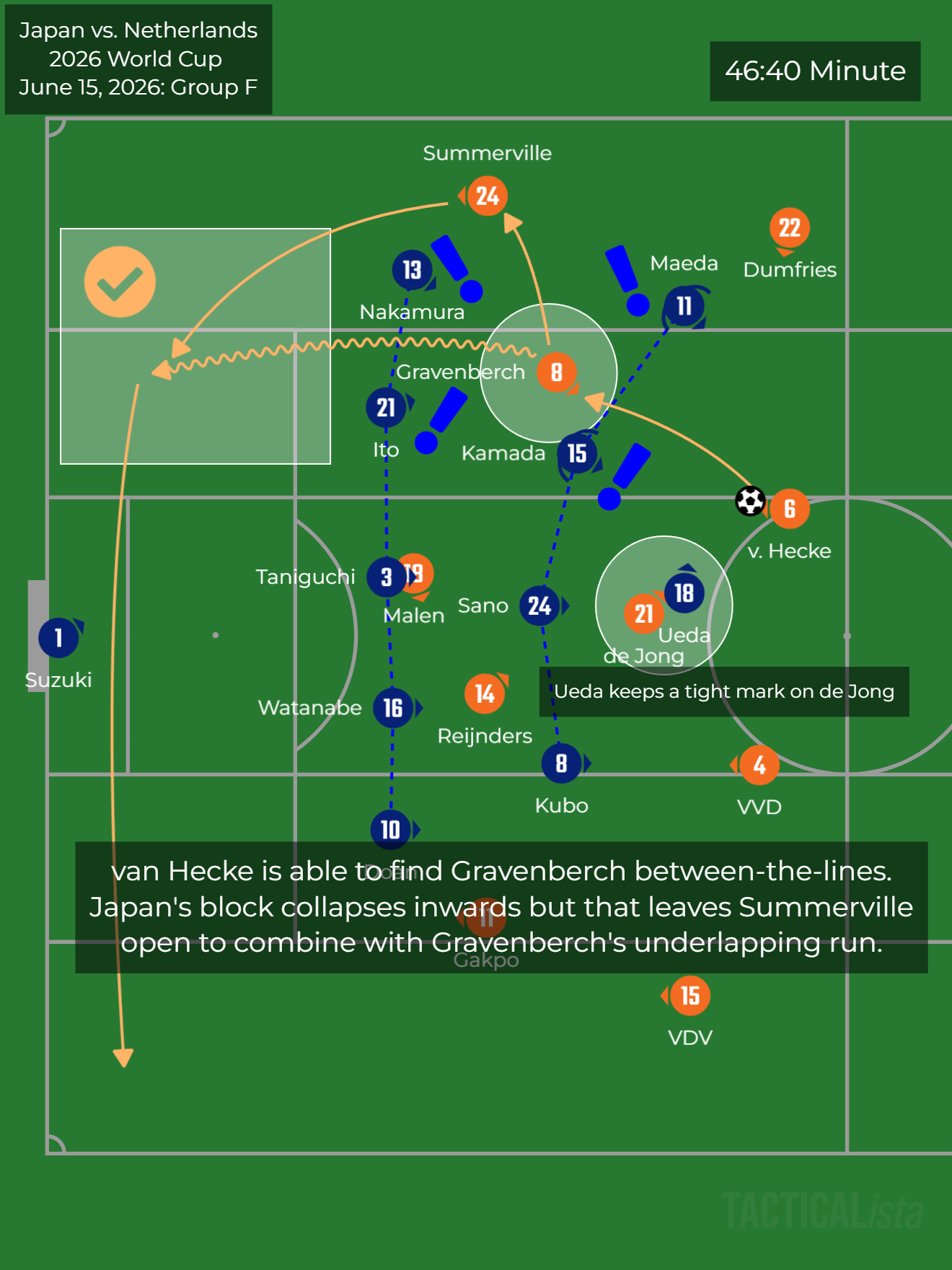
The 2nd Half started poorly for Japan and the Netherlands were really piling on the pressure at this point. A big issue was Jan-Paul van Hecke’s passing being able to find Gravenberch between-the-lines in the right half-space areas. This forced Japan’s block to collapse inwards which in turn gave Summerville more room to operate in and threaten more.
Eventually the pressure took a toll as the Netherlands scored first. Japan’s players were positioned a bit differently due to defending a corner kick so when the ball came back to Gravenberch on the Right wing, Keito Nakamura was too far away to close him down quickly enough. The resultant cross was headed in by Virgil van Dijk. I did think it was rather frustrating to concede in this way given just how perfectly placed that header was into the far corner from a very low xG chance. It reminded me of Perisic’s goal against Japan in the 2022 World Cup. Still, these are the extremely fine margins that make a difference at the World Cup level.
Fortunately, conceding woke Japan up and Keito Nakamura made some amends by scoring 7 minutes later in the 57th minute. The goal was one of Nakamura’s specialties and it reminded me of the goal he scored against Bolivia in a 2025 friendly game. He’s extremely good at cutting in, forcing the defender to step and open his legs, just enough for Nakamura to then thread it in between into the near corner of the goal.
The Netherlands scored again though another 7 minutes later in the 64th minute. It started from the same sequence I described earlier with van Hecke passing into Gravenberch. This caused the block to collapse inwards and Gravenberch did extremely well to dribble and then get the ball wide to Summerville. Dumfries then made an overlapping run to pull Maeda away which gave Summerville the space needed to cut in and shoot into the far corner, leaving Zion with no chance.
It was here that I thought Moriyasu did a really good job. His substitutions of Junya Ito, and then Yukinari Sugawara and Takehiro Tomiyasu were particularly inspired and gave Japan a lot of momentum. Takehiro Tomiyasu’s introduction allowed Sugawara and Junya Ito more freedom to attack as his quality as a defender meant he could cover for the two of them and be able to handle Gakpo or other Dutch attackers by himself. This was a big contrast to the first half when Kubo and Doan needed to double up.
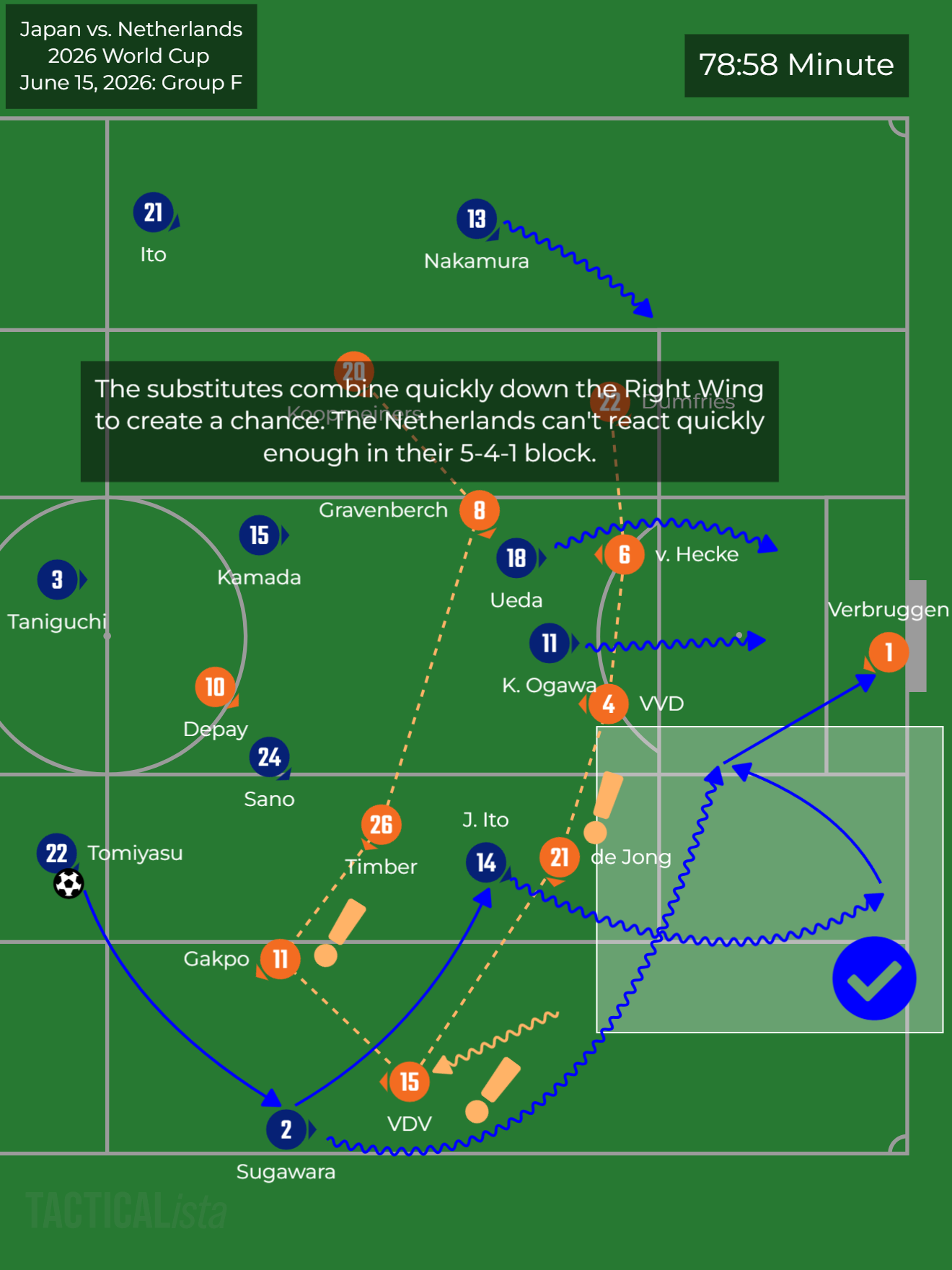
This was all a stark contrast to Ronald Koeman’s substitutions. The Dutch manager took off Malen, Summerville, and later Gakpo which had the effect of reducing the Netherland’s pace up front. Then the 81st minute introduction of Ake further invited Japan to dominate the proceedings as the Netherlands elected to retreat to hold on for the victory instead of trying to keep the ball as they had successfully been able to do throughout most of the game.
Japan’s equalizing goal came, surprisingly for neutrals, from a set-piece. Daichi Kamada set-up a block on van Dijk which did just about enough to delay the Dutch defender and give Koki Ogawa a free header. Funnily enough, Kamada happened to deflect the shot into the net.
Source: 大矢峻 Oya Takashi (@atmark_0922)
People might be perplexed but it’s a fact that Japan have done decent from set pieces in recent years (scored in the 2018 and 2022 World Cups from these situations too). Obviously Japan can’t do the “meat-wall” tactics popular recently but there are far more taller players in attack/defense compared to the past and more importantly, Japanese teams and coaches have been very good at designing a large repertoire of routines involving runs and blocks over the years.
Overall, Keito Nakamura was the star for Japan as he provided a lot of dangerous moments throughout the match. The Back 3 (aside from one moment from each of Taniguchi and Watanabe) along with Zion Suzuki were excellent. Ultimately, I did feel that we could have pushed for more even if it might have meant getting zero points. It does seem as though we’re playing like a “big team” in the sense that we were not going all out 150% from the very first game especially given that the Netherlands were similarly treating Japan with a lot of caution. A lot of credit should go to Hajime Moriyasu for his selections and then his substitutions, even if he would’ve preferred the team to have been able to keep a higher block in the middle-3rd instead. The team showed a lot of mental resilience to come back twice when previous generations would have capitulated.
The big concern going forward is Takefusa Kubo’s injury. It does seem very likely he’ll miss the Tunisia game which is a shame because his creativity and 1v1 dribbling ability is exactly the kind of skills needed to break down a low block. The Tunisia game is extremely hard to read. I had watched AFCON, only for Trabelsi to get fired. Then I watched their March, June friendlies, and then the Sweden game… only for Lamouchi to get fired. Now Tunisia have hired an old nemesis, Herve Renard who has ample experience battling Japan from his previous stints as Saudi Arabia’s manager. Watching the Sweden-Tunisia game I wasn’t all that impressed aside from Hannibal Mejbri (lovely passing range!). The 1st Half was a somewhat okay from them but things were made very easy for Sweden by just the comical nature of Tunisia’s mistakes especially the 2nd Half. I imagine Renard puts Aymen Dahmen back in goal among other changes and more importantly, resetting them mentally (he’s a very good motivator).
The important thing from this game was that Japan didn’t lose and getting a point against the Netherlands was a considerable feat. However, the onus is now on Japan to get the three points vital for qualifying to the knock-outs this weekend. Let’s get the (initial) job done.
Thanks for reading!


Great report, mate. As always!!!!
Great Report! Don't sleep on Japan... very strong contender to go far.