
The Japan National Team heading into the FIFA World Cup! (Post-March 2026 Window)
What did we learn from the Scotland & England friendlies?

I’ve kept most of my thoughts about the Japan National Team on Twitter/BlueSky via various threads and individual tweets but as we near the World Cup I thought I’d start writing down more cohesive, medium-long form thoughts!
Here are previous threads from some key games over the past few years:
Mexico vs. Japan (International Friendly, September 6, 2025)
AFC World Cup Qualifier, Saudi Arabia vs. Japan (October 10, 2024)
A lot of the issues and concerns I wrote about in those threads above still exist today unfortunately but anyway…
Here were the players called up for the March friendlies:
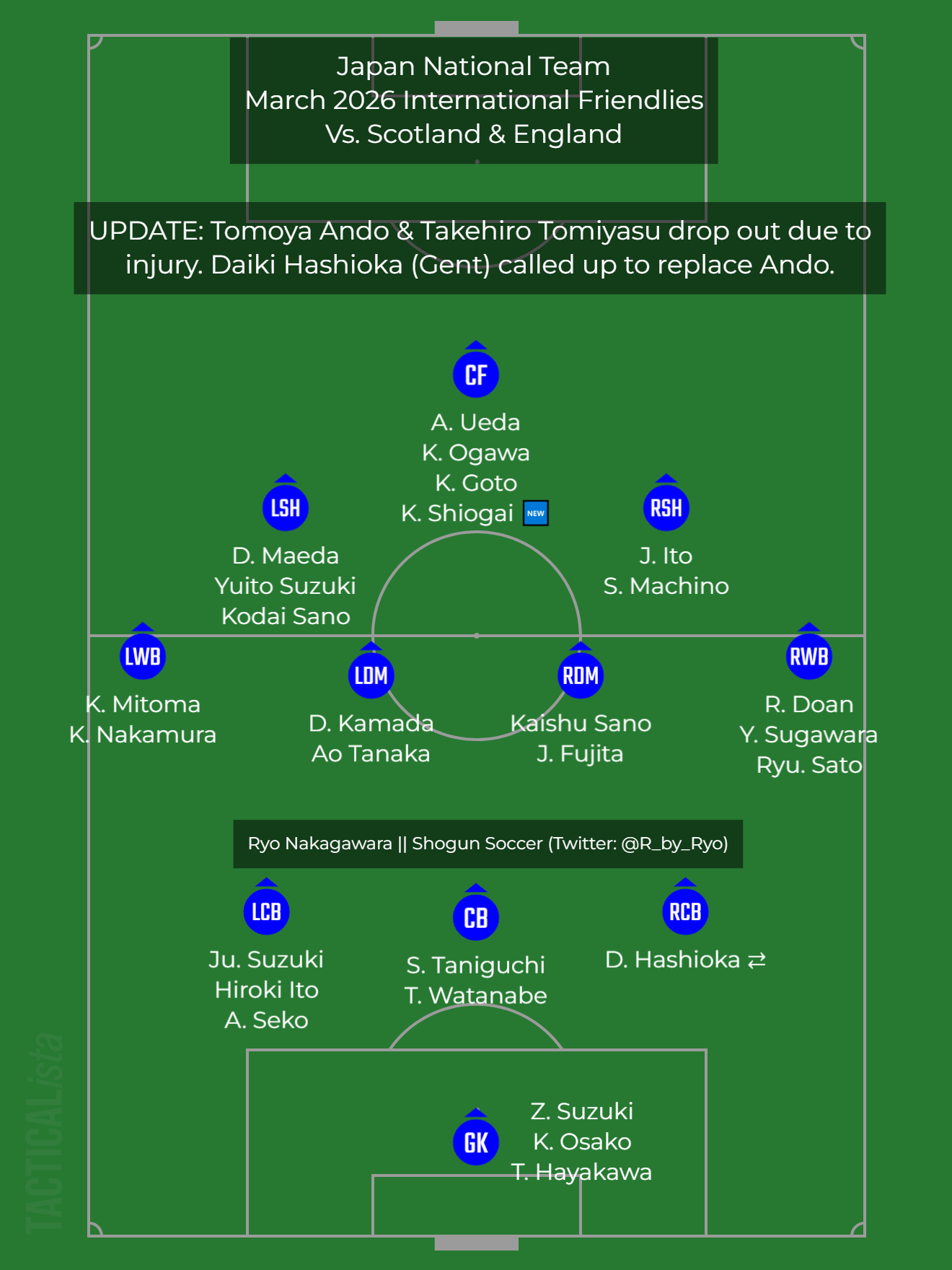
Despite Takehiro Tomiyasu appearing and playing very well in the past few weeks, he went off injured against Feyenoord and ultimately had to drop out. Tomoya Ando also was injured in the last game before the break and was directly replaced by Daiki Hashioka (who is trying to revive his career back in Belgium).
Kento Shiogai was given his first call-up. Perhaps somewhat late given his super-sub heroics for NEC Nijmegen were a number of months ago and since January he has been stuck in a relegation dogfight with Wolfsburg. Hiroki Ito managed to return from yet another injury setback to return to the team, one of the few positive injury news over the past year I’ll say…
Ryunosuke Sato was the only J.League outfield player called up but he missed all of the pre-Scotland training sessions. The two other J.League players in the squad were the regular back-up goalkeepers in Keisuke Osako (Sanfrecce Hiroshima) and Tomoki Hayakawa (Kashima Antlers). There has been a case for both Taishi Brandon Nozawa (Royal Antwerp) and Leo Kokubo (STVV) to be called up given both have been very good in the Belgian League this season but Moriyasu ultimately went with the somewhat tried-and-tested options between the sticks. I do think Nozawa and Kokubo, especially the latter if he can get a big move to a Top-5 League in the summer, will be the main challengers to Zion Suzuki in the post 2026 World Cup era.
The rest of the squad was fairly familiar given the number of injuries with the likes of Yuito Suzuki, Kodai Sano also picked to make the case in Takumi Minamino’s absence. The one big surprise was the omission of Hidemasa Morita! Moriyasu mentioned the immense competition for the midfield spots but also left the door open for the Sporting midfielder by praising his experience and his ability to easily slot back into the squad if called back up later.
First I’ll go through the Key Takeaways from this window. This captures the gist of what I think we learned from this window so just read that part if you’re busy. If you want to read a more detailed report on both the Scotland and England games then continue onward to the following sections.
Let’s get started!
Key Takeaways
The Center Back hierarchy is becoming clear
Since the end of the World Cup qualifiers and the continued absence of mainstay Ko Itakura (only appearing in 2/8 friendlies), Japan’s best Back 3 has emerged. From Left-to-Right it is Junnosuke Suzuki, Shogo Taniguchi, and Tsuyoshi Watanabe. This March window did see the return of Hiroki Ito and he played very well which might relegate Suzuki to the bench, more due to the fact that he is a far more versatile option being able to sub in on either side of the Back 3 and at Wing Back as well. In reserve Ayumu Seko (despite my own misgivings about him) has remained fit compared to everybody else while Tomoya Ando has also emerged as a viable back-up candidate.
This does mean around one more Center Back spot remains with either Takehiro Tomiyasu or Ko Itakura being the leading options. Given Tomiyasu’s supreme quality over any other Center Back if fit, it does stand to reason that Moriyasu would be willing to take him on as a defensive super-sub option if he continues to get game-time for Ajax over the next two months (his latest setback was reportedly a very minor issue but does bear scrutiny). Otherwise, Ko Itakura’s persistent injury issues may finally clear up and his seniority and familiarity with the Back 3 setup throughout the World Cup qualifiers may give him the edge. Of course, either one or both of Itakura and Tomiyasu could simply replace Ando and/or Seko as well!
Koki Machida’s recovery at Hoffenheim is going well as he has finally returned to individual training but it’ll take a lot for him to sneak into the squad at this point (even though I’ve been a big fan of him). This is even more so with Hiroki Ito returning to taking up the “left footed, left center back/full back hybrid” role within the squad. Kota Takai has also suffered a very injury-ridden season and his latest set back prevented him from joining up in March and that most likely does it for his chances for a World Cup place, unfortunately.
Kaoru Mitoma in attack instead of Wing Back
I’ve complained in the past about how having some of our best attackers at Wing Back as they end up spending too much energy tracking back and receiving the ball from a deeper position. With Takumi Minamino’s injury it does seem Moriyasu is more willing to push Mitoma forward in the #10 position more. While this does solve one problem, it has a knock-on effect of diluting the Wing Back depth. If in a best available XI Mitoma is going to be used in attack then it means Keito Nakamura would start at Wing Back. Over the past few years Moriyasu has been able to alternate between Nakamura and Mitoma at Wing Back to keep at least one fresh. Now Japan doesn’t have a good substitute to bring on as “fresh legs” that can take players on and provide attacking impetus with 1v1 dribbling ability that’s very important for breaking down low-blocks.
I do imagine that both Junya Ito and Ryunosuke Sato (if the latter is ultimately chosen) could be shifted across to play as Left Wing Back considering the former has played on the Left before while Sato made a name for himself playing either side as a Wing Back last year for Fagiano Okayama. There are some other more defense-first options like playing Junnosuke Suzuki (like in the England game) or Tomoya Ando at Wing Back instead to keep the attackers in reserve but that comes with its own pitfalls. It’s another interesting conundrum as the attack has been doing fairly well even without Takumi Minamino.
Back-up Striker options
One of the big stories surrounding the March window was the question of the back-up to Ayase Ueda. Koki Ogawa had been the front runner throughout the past few years but his lack of league minutes since late January has alarm bells ringing. I still do think he gets picked considering his physical profile can’t be replicated by the other options (aside from Yuki Ohashi but I don’t think he is a realistic option at this point).
All eyes turned to the double call-up of both Keisuke Goto and Kento Shiogai, the latter earning his debut vs. Scotland. Goto played decently well against Scotland but his lack of physicality raises concerns and while he is a viable option given his play-making abilities, I don’t think in terms of profile he’ll take up Ogawa’s spot. Kento Shiogai had a lively, powerful performance and I think he has a potential place as the “super-sub” role when Japan want to go with two strikers up top when chasing a goal. Given Daizen Maeda is more likely to play Wing Back or in one of the #10 spots behind the striker, I could see all four of Ueda, Ogawa, Goto, and Shiogai taken but it might be prudent to drop one of Goto or Shiogai to focus on other positions.
So then, the guy to fall out of favor is most likely Shuto Machino as he doesn’t quite differentiate himself compared to the aforementioned options with a clear specific quality (he’s more of a jack-of-all-trades that flits between striker and one of the #10 spots) and his league form is extremely patchy given his lack of playing time.
What to do about the potential injury returnees?
Takehiro Tomiyasu, Wataru Endo, Takumi Minamino, Koki Machida, Ko Itakura.
The above are the major injury concerns by key players heading into the World Cup. Tomiyasu is here despite only having a minor setback recently because of … well his past history. I don’t have Kota Takai here because he’s not a major figure in the squad (yet…).
Anyway, there is a limit to how many “walking injured” players Japan can/should bring, especially if Moriyasu is serious about going far in the tournament. There is always a higher risk of these players getting re-injured with the strains of tournament football so balancing the need for their quality with the overall depth/health of the squad is going to be a massive decision to make in late May. I would be hesitant about picking all five from here, I might only take two of the five (Tomiyasu and one of Endo or Minamino - whoever is more fit).
As I explained in a previous section I think our current Center Backs have shown enough to be somewhat okay with leaving Machida and Itakura out but Tomiyasu is a special case. The midfield has been rejuvenated with Kaishu Sano and Daichi Kamada as first choice but Joel Fujita not quite showing his club form for the national team might mean Endo can come back in if he proves his fitness (and/or Hidemasa Morita). The attack and the high press look fine even without Minamino but he has been a key figure and Japan’s top goal scorer so it’s hard to leave him out if he proves his fitness by the end of May.
Whatever happens, it’s genuinely a headache for Moriyasu and I do sympathize with him as these choices are going to be super difficult decisions.
I think it’s really important to look at squad building, especially at the international game, as not just about positions and pedigree (where a player plays, etc.) but also about their specific role in the squad. I do think too much of the assessment of the Japan National Team by foreign observers centers on scouring the Wikipedia page for where in Europe a player plays with complete disregard of their role within the team, how their form/function differs from their club team, etc.
Scotland vs. Japan
Japan started with a fairly rotated line-up vs. Scotland. Perhaps the biggest surprise was Zion Suzuki starting. Given how he’s only been back for a few games at Parma, I think Moriyasu wanted to get him back up to speed as soon as possible.
Chances were given to Kodai Sano, Joel Fujita, and Keisuke Goto. Moriyasu in the post-match presser spoke about how he preferred to use young, inexperienced players from kick-off because they would be better mentally and physically ready by taking part in the pre-match warm-up, knowing that they will get at least 45 minutes of playing time, rather than just potentially/possibly coming off the bench in the 2nd Half.
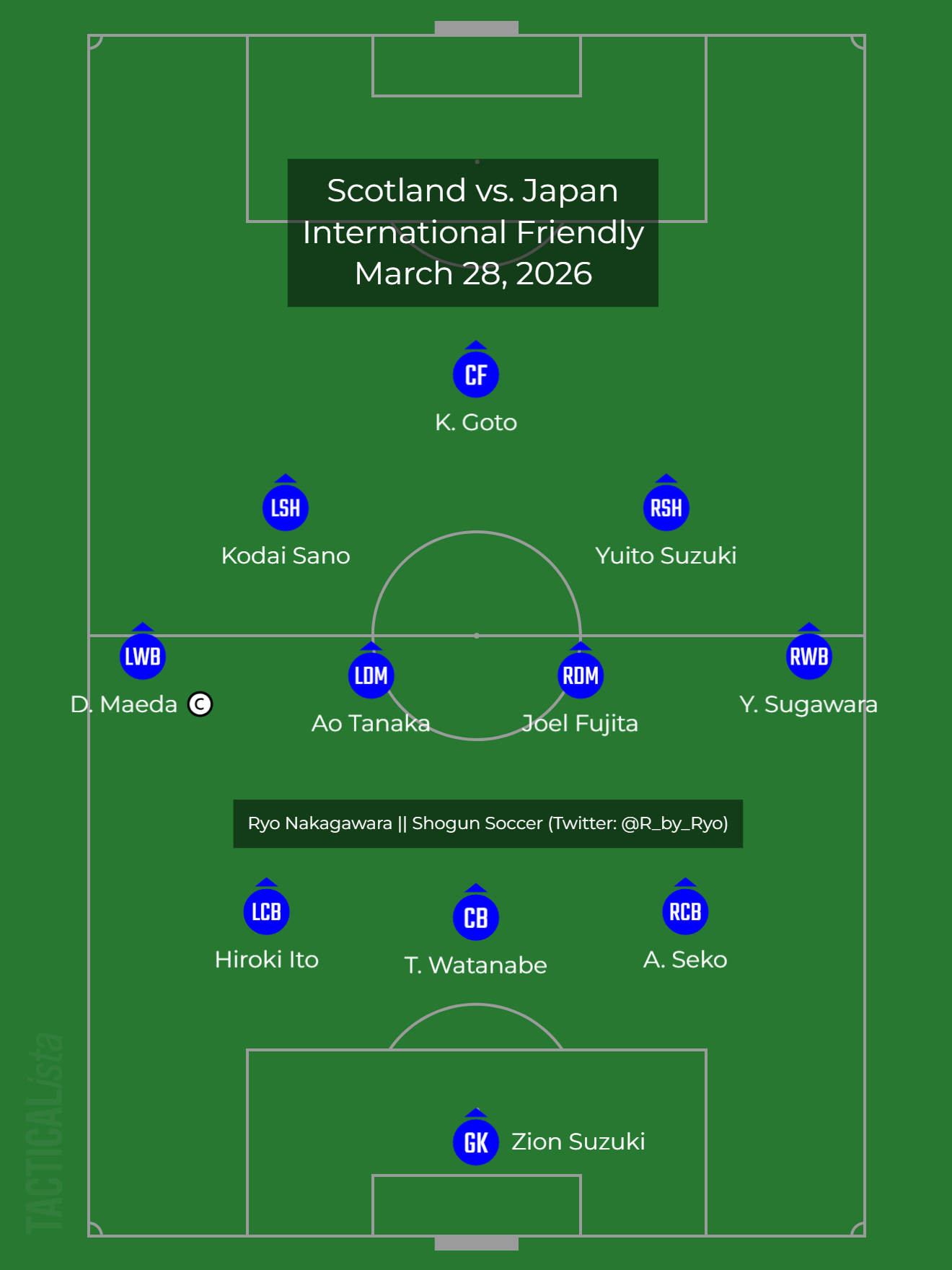
Given the line-up, it was understandable but nonetheless frustrating that Japan looked out of sorts to start the game. Some poor defending by Tsuyoshi Watanabe against Lyndon Dykes set up McGinn to cross for McTominay (sneaking into the box as Sugawara was ball-watching…) for Scotland’s best chance of the match, only thwarted by a great reaction save from Zion Suzuki. However, slowly Japan were able to settle things from around the 15th minute onward.
The game flowed more kindly for Japan as they established themselves with both Ao Tanaka and Joel Fujita dropping deep to support the build-up play and calm things down. While nominally Japan started with a Back 3, the central midfielders’ support meant that it looked more of a Back 4-ish shape in-possession.
Yuito Suzuki looked especially bright down the Right working well with Yukinari Sugawara to create some chances or at least push forward into the final 3rd. The finishing touches were lacking though as Suzuki, Kodai Sano, and Ao Tanaka all missed chances to score.
Compared to the Right side, the attack down the Left was almost non-existent as although Hiroki Ito performed well on his return to the national team, there was a lot of awkwardness with Daizen Maeda and Kodai Sano ahead of him.
Both teams went into Half Time not quite satisfied.
For the 2nd Half, Moriyasu made a trio of changes with Junnosuke Suzuki, Shogo Taniguchi, and Kaoru Mitoma coming on for Hiroki Ito, Tsuyoshi Watanabe, and Kodai Sano respectively. Ito’s substitution was a planned one as Bayern Munich had requested his playing time to be limited for obvious reasons.
The biggest change in the 2nd Half was how the central midfielders stopped dropping into the back-line to support the build-up play, even in the period when Scotland decided to press more intensely. After a nervy start where Scotland were able to push in, Japan gradually figured out their build-up play and once again the tide turned toward the Samurai Blue. With both midfielders staying further forward it did mean Japan were also able to get forward and push Scotland into their own defensive 3rd better.
Kaoru Mitoma provided an immediate spark from the Left #10 position with some sumptuous passes while Junnosuke Suzuki provided his usual ball progression from Left Center Back. The left side unit in general, especially when Keito Nakamura replaced Daizen Maeda at Wing Back was really great in my opinion. It was the perfect blend of ball progression through passing and carrying/dribbling. It does seem like this is the best possible unit on this side of the pitch going forward.
It wasn’t all completely Japan’s way though as some poor defending from both Ayumu Seko and Daiki Hashioka allowed Scotland with a few glimpses of goal.
For the final 15 or so minutes, Moriyasu went with another one of his surprises by springing a very attacking 3-1-4-2 formation. Daichi Kamada came on as the single pivot while Mitoma and Doan turned into box-to-box #8s, and Kento Shiogai came on for his debut up top joining Ayase Ueda.
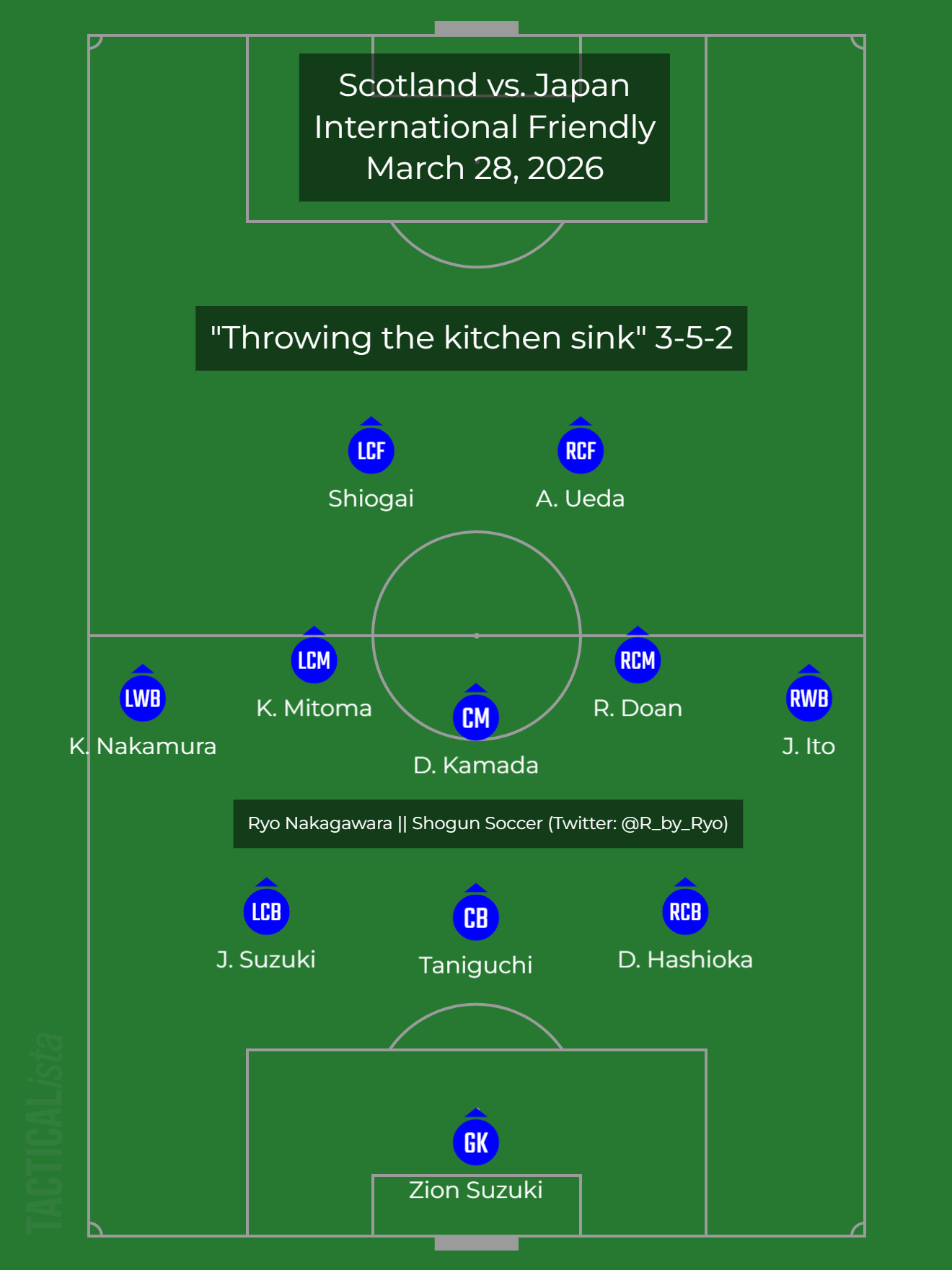
Having both Shiogai and Ueda up top meant that at least one could remain forward if the other dropped deep. Throughout the past few years, a challenge has been that Ueda would drop and hold the ball up but the #10s and the Wing Backs wouldn’t exploit the space left behind so this was a nice alternative to the usual formula.
The goal was an extremely well crafted move with Mitoma and Nakamura exchanging lanes and then Junnosuke Suzuki motoring up-field on the under-lap to cross the ball in. Shiogai managed to shield and somewhat lay the ball off to Junya Ito who bamboozled Scotland’s defender and goalkeeper before slightly scuffing the shot into the net.
Overall, I felt Scotland didn’t really press with much intensity (aside from a spell in the 2nd Half) and they didn’t really go all the way to Zion Suzuki when Japan passed the ball back to him. Junya Ito showed his worth again as a super-sub, adding pace and directness against tiring legs in the 2nd Half.
One final note was that I felt the Scotland home crowd at Hampden Park was very tame. It was quite disappointing as I could very easily hear the player’s voices and also the minority of Japanese fans chanting from the broadcast… It didn’t feel like the high-pressure away game atmosphere that this game was supposed to simulate.
Winners
Yuito Suzuki: He was a big positive especially in the 1st Half as a lot of attacks came through his ability to drive forward with the ball down the Right. With Minamino’s absence and Junya Ito, Ritsu Doan needing to be kept at Wing Back, Suzuki did quite well to be in consideration for the final squad.
Hiroki Ito: Had a good 45 minutes. Still a big concern that the Left Wing attack with Maeda was non-existent (not solely on him) but defended well & kept the ball moving with crisp passing in the build-up.
In between?
Keisuke Goto: When he was able to find that little pocket of space, his lay-offs + flick-ons were good but he’s still poor at handling actual contact from defenders. There was a noticeable difference when Ueda came on and was able to win headers and do hold-up play while under pressure from defenders in the 2nd Half. Defining Goto’s exact role within the striker unit is somewhat difficult in this sense. He is a tall guy but without the physicality, a decent play-maker but not quite the #10 type compared to the other attackers like Yuito Suzuki, Ritsu Doan, Takefusa Kubo, etc.
Daizen Maeda: Worked hard as usual but he’s another player I would rather see playing in attack... I do think he is 100% on the plane given his versatility and the fact that there isn’t anybody with his pressing speed & intensity for the kind of man-to-man high press that Moriyasu is going to spring on opponents at various periods at the World Cup.
Losers
Kodai Sano: Watching him for NEC Nijmegen this season, the role he was given against Scotland stands in contrast to his club team. For the Dutch side, Sano plays much deeper and keeps the ball moving through his technical abilities in passing and carrying. He also does a lot of defensive work as the screen in front of the defense while the players in front of him press high up. Understandably it was then quite hard for him to impress with the rotated line-up around him especially with Daizen Maeda as his Wing Back made the odds stacked up against his favor. Nevertheless there were certain moments where we saw his technical magic, including a chance from outside the box, but ultimately it was a frustrating outing for the younger Sano. Given where Kodai Sano and Joel Fujita play for their respective clubs, it might have been more interesting to see their positions swapped in the starting line-up…
Joel Fujita: Unable to quite show the dynamic performance that has made him one of St. Pauli’s most important players this season. Perhaps it was a bit ironic that he has mostly been playing as one of the attackers rather than in the double pivot in the past few months for the Bundesliga side. I don’t think he was bad vs. Scotland but he isn’t showing enough to be a true starter. With Endo’s injury, I can still see Fujita going to the World Cup but he won’t get a whole lot of minutes at this rate.
Daiki Hashioka: Only called up as a last minute replacement for Tomoya Ando, Hashioka didn’t really impress and was ghosted past by George Hirst for a shot in the 88th minute. Hashioka’s career has been on a big decline after his move to Luton Town fizzled out and he’s only been called up in the past few years because of the massive injury list in the Back 3. If the likes of Tomiyasu, Takai, Ando, Machida were all fit he would be nowhere near the squad. I’d be very worried if Japan bring him along to the World Cup and we have to play him. It’s a shame because he really did look quite good at Sint-Truiden a few years ago.
England vs. Japan
As one might imagine from the Scotland game line-up, Japan went all in with their best available players against England. Unfortunately, with England’s own injury crisis, the hosts didn’t line-up in kind. Even more disappointingly Harry Kane who was tipped to start by Thomas Tuchel in the pre-match presser suffered a minor knock and was left out of the game entirely. The two somewhat surprises for me was Junya Ito starting from kickoff and Hiroki Ito getting the nod again.
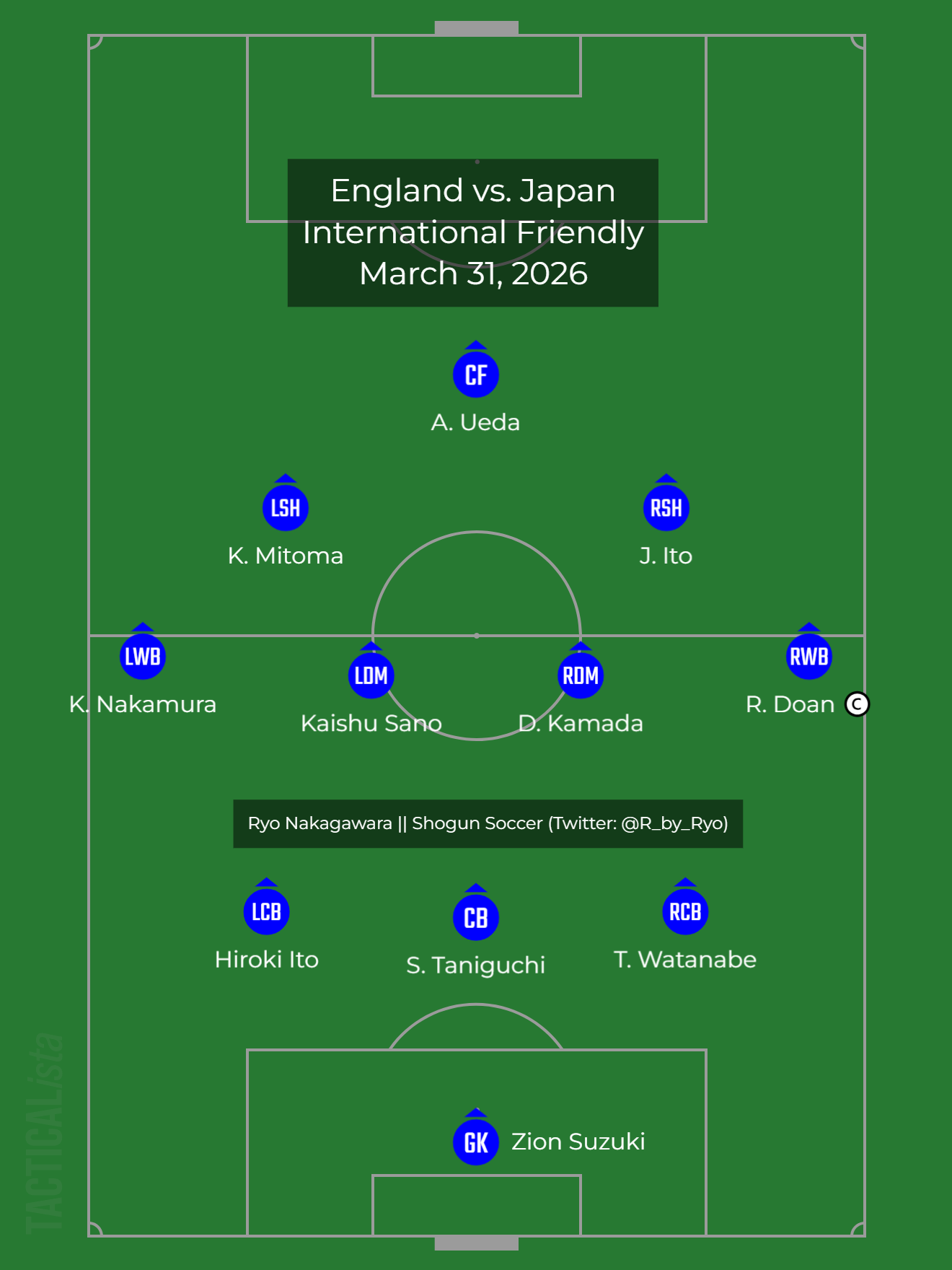
Japan started the game alternating between a high press, then retreating to more of a mid-block 5-2-3 shape. The defense constantly shifted between a Back 4 and Back 5 as one of the Wing Backs would push up then the other defenders would slide across. The Front 3 did a good job of pressing England’s defenders while also alert to Mainoo-Anderson in the double pivot by pressing at certain angles and keeping the two in their cover shadow.
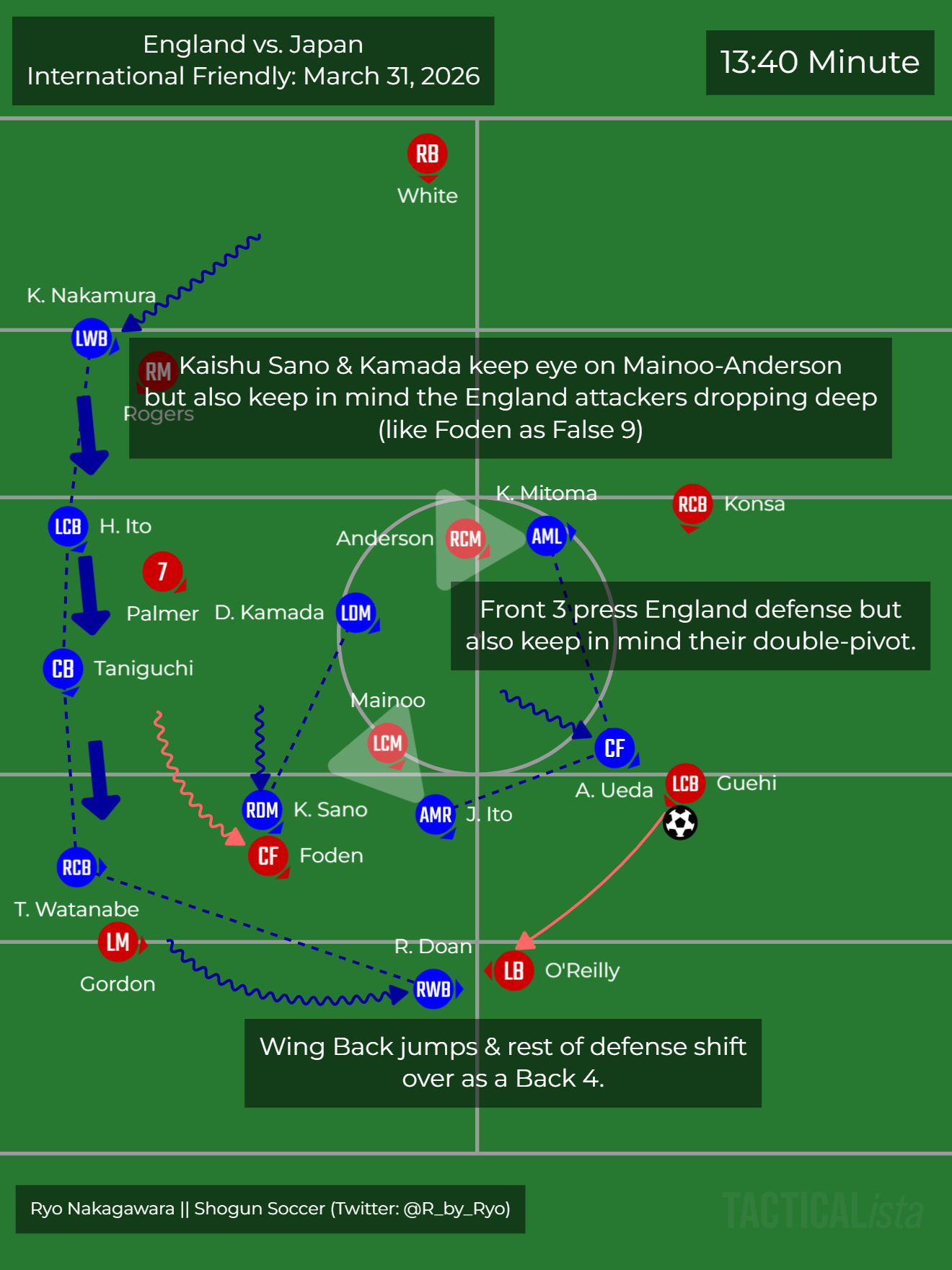
Japan’s goal came from this shape as Mitoma tracked back to tackle Palmer and launched a lightening counterattack. Keito Nakamura’s bursting run forward was found by Mitoma and then the Brighton man received the ball back in the box to score with a composed one touch finish.
Below is a really good video breaking down Mitoma’s role in the goal by @FathalliMo on Twitter (click the link for the original tweet).
As the game wore on both teams had a number of chances with Keito Nakamura coming closest with a curled effort in the 68th minute after another good passing sequence. Zion Suzuki became more active as England started to pile on the pressure.
The last 15~20 minutes, especially when Tuchel put Dan Burn and Harry Maguire on to threaten Japan more with set-pieces allowed Moriyasu to test Japan’s defensive shape & resolve. Junnosuke Suzuki was subbed in as a Wing Back to test a more “defensive” option there. In the end, Japan did enough to keep England out (including Sugawara clearing off the line) to see out the win. This result will do wonders for confidence across the defensive unit knowing that similar threats will exist against the Netherlands and other opponents at the World Cup.
Winners
Daichi Kamada & Kaishu Sano: Together the two were imperious in midfield. Working extremely hard and matching England duel-for-duel. Sano stood out for his interceptions while Kamada covered for defenders in the box a lot and also took charge in possession from the build-up phase. The Moriyasu era has largely been dominated by the twin pillars of Wataru Endo and Hidemasa Morita, it’s clear there’s a new duo leading the midfield now.
Losers
To be honest I don’t think there were many in terms of players that actually got on the pitch. Perhaps Kodai Sano is one considering he was left out of the matchday squad entirely. Also Ryunosuke Sato missed the chance to impress Moriyasu given his sickness and understandable reluctance on Moriyasu’s part to put someone like Sato on when defending the lead against a team like England.
While Shuto Machino did come on he didn’t get to do a whole lot. Of course, given the game state it’s not really his fault. However, compared to the impact that the other strikers (except Koki Ogawa but his role is clear in my opinion) were able to show, I think Machino’s place in the squad is on a knife’s edge…
Conclusion
Ultimately, the March friendlies provided a lot of insight to how Japan are shaping up for the World Cup. The games allowed Moriyasu to try out a super-attacking formation vs. Scotland and then a super-defensive formation vs. England which simulate some potential scenarios that Japan should face in the big event.
Some quick notes on Japan’s Group F opponents:
The Netherlands “on paper” should provide the sternest test for Japan especially as they are the first opponent of the group stage. While their performances haven’t really been great they still have world-class players on world class teams in most positions (along with teammates of the Japanese players at the club level).
Tunisia are a bit of an enigma. They strolled through their World Cup qualifiers without conceding a goal but their group consisted of some pretty poor teams. A poor AFCON showing also meant the dismissal of Sami Trabelsi so watching back those games won’t be too much help to prepare. The new manager is Sabri Lamouchi who managed Ivory Coast in the past and helped defeat Japan in the 2014 World Cup. Their March friendlies showed a squad with an interesting mix of young and old including the first time call-up of Rani Khedira (brother of ex-German international Sami).
Sweden won against Poland in the final UEFA play-off to secure their spot in Group F. Despite their horrendous qualification campaign, Graham Potter’s appointment have turned things around somewhat on top of the fact that they still have quality players (Gyökeres, the return of Isak & Kulusevski, etc.) that can hurt many teams in this tournament.
I might write a more detailed look at Japan’s Group F opponents closer to the World Cup.
Thanks for reading!


The Japan national team heads into the FIFA World Cup 2026 with a reputation as one of Asia’s most disciplined and technically skilled sides. Known as the “Samurai Blue,” Japan combines quick passing, tactical organization, and relentless work ethic, making them a tough opponent for any team. Building on strong performances in recent tournaments, including impressive wins against top European nations, Japan aims to go beyond their previous Round of 16 finishes and challenge deeper into the knockout stages. With a blend of experienced leaders and emerging young talent, the team represents the growing strength of Asian football on the world stage and carries the hopes of millions of passionate supporters https://club-fifaworldcup.com/